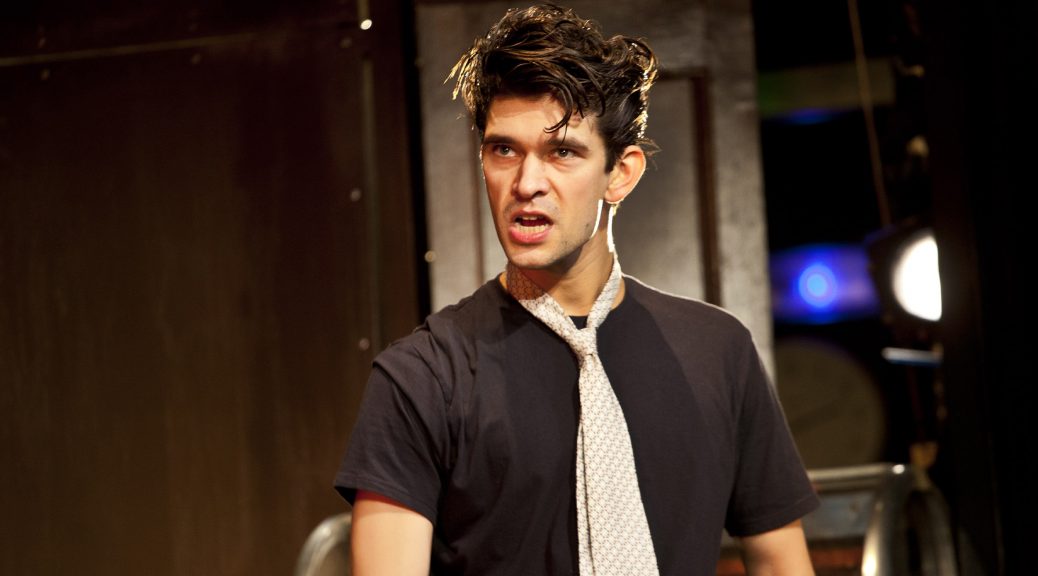
“Ghosts” at the Almeida Theatre

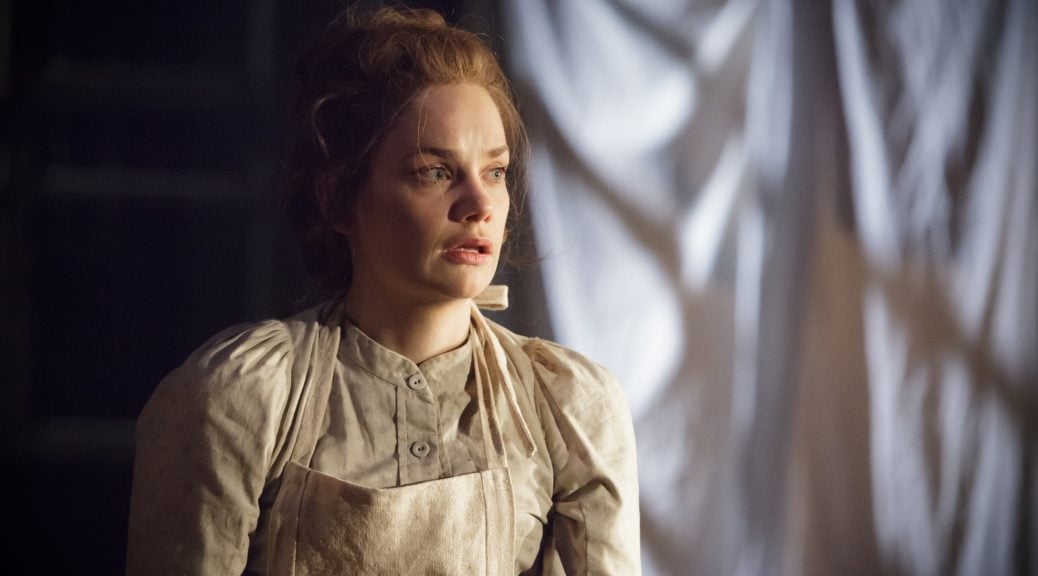
Richard Eyre’s production of Ibsen’s Ghosts has been a long time in the making – he first worked on the script in 2006. It must be gratifying that now it has reached the stage, opening this week at the Almeida Theatre, everything has come together so eloquently. Eyre’s adaptation is superb, his direction impeccable and his cast faultless.

In this 1881 play we encounter one of Ibsen’s many heroines, Helene Alving, a magnificent character whose long-endured marriage has ended and who hopes she is now “learning to be free”. But, while ironically planning an orphanage as a memorial to her syphilitic, drunken husband, she is haunted by her decision to shield his philandering from her son and the community. As Helene, it is difficult to praise Lesley Manville sufficiently.

Helene’s unrequited love for her Pastor, a ridiculously religious figure made credible by the clever casting of the excellent Will Keen, and her desperate love for her sick son Oswald, played with skill by Jack Lowden, makes things grim and grimmer for her. A radical thinker, Helene has us on her side, but the past and society are against her. The Pastor’s restraint and Oswald’s bohemianism, including his incestuous attraction to his half-sister, trap Helene like a pincer. Manville copes with the intensity terrifically, agonisingly building up the pressure.

The play is set in a single room, Helene’s “university of suffering”, created out of ghostly transparent walls by designer Tim Hatley. Sometimes opaque, at others revealing the comings and goings of the servants the Alvings are intimately connected with, it acts as a claustrophobic canvas for some fine work by lighting director Peter Mumford.

Ghosts caused controversy when it was written and Eyre’s adaptation reminds us why. Swift and brutal, you sense Ibsen’s hunger for life and the truth with a ferocious intensity. The heart-rending finale, where Helene faces a moral dilemma about the euthanasia of her son, could easily find you in tears.

Until 23 November 2013

www.almeida.co.uk

Photo by Hugo Glendinning

Written 4 October 2013 for The London Magazine

“The Last Yankee” at The Print Room

The Print Room has produced another quality show with a revival of Arthur Miller’s The Last Yankee. Casting the spotlight on a pair of husbands visiting their wives in a mental hospital, this short play combines the stories of two very different marriages with a social commentary on the American dream. The production, combining the young talent of director Cathal Cleary and an experienced cast, delivers a great deal in just over an hour.

The performances are ones to relish. Paul Hickey has the strongest part as the carpenter descendant of a founding father, generating sympathy for a proud working man whose efforts to make ends meet frustrate his wife Patricia (captivatingly played by Matilda Ziegler). Their fellow New Englanders are self-made Frick and reclusive Karen, who seem to have it all. Andy De La Tour and Kika Markham make a fantastic team in these roles, forming the play’s emotional backbone as an elderly couple facing frightening problems.

Miller’s idea that money and status have become too damagingly connected is forcefully written and respectfully presented. Arguably, too much has happened in America in the 20 years since the play was penned for these concerns to overly interest an audience in Notting Hill in 2013. But even when Miller’s allegory pushes against credibility (in particular the suggestion that Patricia is punishing her husband by having a break down), human drama is to the fore. The performances focus attention on the pain of mental illness and there are heart-rending moments that make it easy to recommend this show.

Until 5 October 2013

www.the-print-room.org

Photos by Ellie Kurttz

Written 16 September 2013 for The London Magazine

“Hysteria” at Hampstead Theatre

Hampstead Theatre’s new production of Terry Johnson’s Hysteria is a significant revival, not least because the writer himself directs it. One of the most successful plays to mine the rich seam of psychoanalysis, it imagines Freud on the couch. Like the man himself, it explores trauma and humour in inspired fashion. This is a work of big ideas that boggles the mind and attempts to explain deep truths.

The action is set down the road from the theatre in Maresfield Gardens, during Freud’s exile in London just before the Second World War. The father of the unconscious approaches his death with plenty of humour. Antony Sher is magnificent in the lead; Freud joins Stanley Spencer and Primo Levi as famous figures Sher has embodied so well. Elements of farce abound as he hides a naked woman in his closet from his Doctor (David Horovitch – excellent) and a visitor paying homage, none other than Salvador Dali.

The scenes of farce are a delight. Adrian Schiller’s “doolally” Dali is superb and his accent a triumph. But the play soon develops into a tense exploration of Freud’s methods and the foundation of his movement. In an emotional performance as the unwanted guest in his bathroom, Lydia Wilson highlights one of Freud’s failures, a case study he presumptuously reported as a success, and a change in his theories that she questions. Her interrogation of him reveals his doubts and the trauma in his own life.

Johnson’s play is full of clever touches and is a close study of his subject. It can’t have hurt the farce that Freud’s study was full of erotic sculptures but picking out the Surrealist painter’s visit is inspired. The final tableau, depicting Freud’s dream, realised by Lez Brotherson’s superbly ambitious set, rises to the challenge of a problem Johnson highlights – that depicting the unconscious diminishes it – but can still create fine theatre.

Until 12 October 2013

www.hampsteadtheatre.com

Photo by Alaistair Muir

Written 13 September 2013 for The London Magazine

“Afraid of the Dark” at the Charing Cross Theatre

The latest attempt to scare London theatregoers out of their seats is Afraid of the Dark, which opened last night at the Charing Cross Theatre. I chickened out of Ghost Stories but always recommend The Woman in Black, so consider myself open-minded about scary shows. Afraid of the Dark didn’t make me jump much – you wouldn’t bother daring someone to see it – but it’s perfectly diverting.

Intriguingly penned by Anonymous, the play’s various scenes of suspense circle around an old Vaudevillian magician who delights in scaring the wits out of a B-movie producer and his minions. Julian Forsyth takes on the role of ‘Master of Terror’, Dr Henry Charlier, with nice prestidigitation. And those he terrorises at the film studios (by giving them an envelope predicting their darkest fears) ham it up in appropriate fashion. Rebecca Blackstone’s screams are great and Mark Rice-Oxley tries hard to shed some light on his character’s motivation. None of the actors has that much to work with – characterisation isn’t the point after all – and nor is the plot trying to thread them together up to much. But there’s a good sense of humour here and some neat touches.

What impresses is the show’s production team. Effective light and sound, along with illusions from Darren Lang, reveal this to be a magic show that is entertaining rather than eerie. The stories are made the most of with technical expertise as well as some lo-fi touches that receive eager applause. Just like the movie producer looking for the next gimmick, Afraid of the Dark shows that cheap touches can work well. The real thrill comes from experienced director Ian Talbot who has more than earned his fee here. Consistently tense and swiftly paced, this play is more fun-filled than fear inducing.

Until 26 October 2013

Photo by Eric Richmond

Written 12 September 2013 for The London Magazine

“Oxbow Lakes” at The Old Print Works, Parr Street

Theatre happens in all kinds of places nowadays, so a disused Print Works as a venue is voguish rather than outlandish. But walking through a massive council estate on the wrong side of Hoxton at night made your theatre critic feel distinctly intrepid. Thankfully, the Dirty Market theatre company has transformed an old factory into a playground to host its new show, Oxbow Lakes, in association with the Camden People’s Theatre. A work devised by the company, using the perspective of a child, it’s a charming, dreamlike jaunt through some wild scenarios.

A young child’s fears, reflecting the anxieties of his parents, Jack and Jill (Georgina Sowerby and Jon Lee), with plenty of transformations set in a deep, dark wood create a rich backdrop for imaginations to wander through. Puppetry, fabric sets, jumble sale costumes and fairy-tale characters, ably performed by Francesca Dale, Arti Natharni and Benedict Hopper (who has the evening’s funniest scene when he takes on the roles of both Queen Bittersweet and Prince Lemonzest) combine to create a simple, storytelling world that it’s a pleasure to dip into.

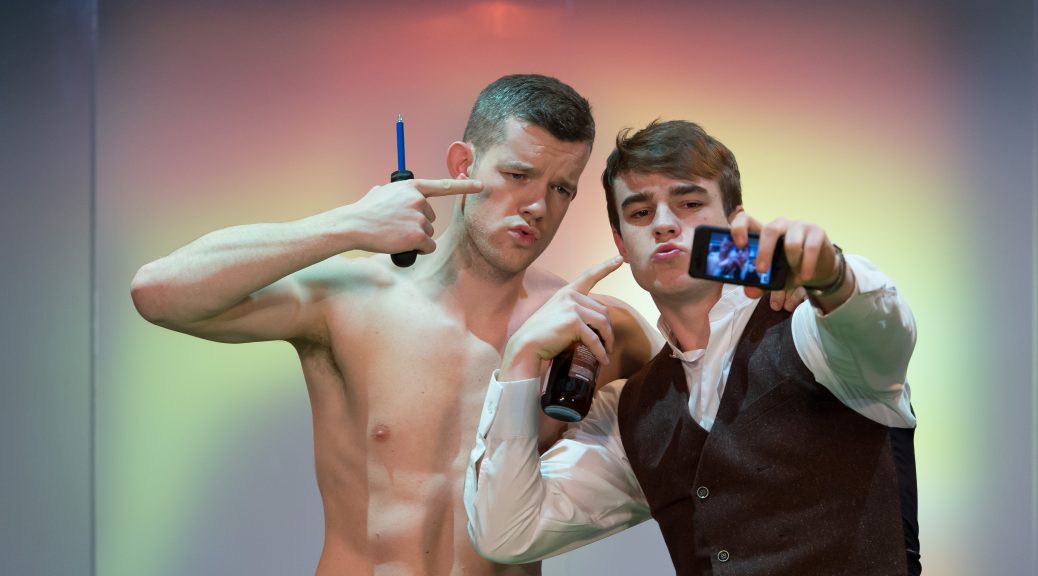
There’s also a good deal of music, composed and performed by the show’s narrator Oscar Gibbs. It’s easy to see the appeal of the songs’ lo-fi approach and poetic lyrics. And there’s an element of mystery, as bodies pile up around the eponymous lake, with a nod to Twin Peaks, and a Sarah Lundish detective (pictured above) who raises a smile. It may not quite hold together, and the inspiration – that some people find their children to be little devils – doesn’t have much drive – but it’s all monstrously good fun.

www.dirtymarket.co.uk

Until 28 September 2013

Photo by Jemima Yong

Written 6 September 2013 for The London Magazine

“Edward II” at the National Theatre

Director Joe Hill-Gibbins made his debut at the National Theatre last night with a radical version of Christopher Marlowe’s Edward II. He’s the King whose murder with a red hot poker makes him the medieval monarch schoolboys remember. This crazy collage of show revels in incongruous touches, using our current National anthem and the hokey cokey in its soundtrack, and wrenches the personal from an explicitly political text. Best of all, it boasts a lead performance from John Heffernan that must not be missed.

Hill-Gibbins’ inventive staging is bracing – a bag of tricks that updates Marlowe with a defiantly energetic touch. Projecting live films onto the walls, including scenes in an inside-out room (reminiscent of a Rachel Whiteread sculpture) that the audience cannot see into, gives a sense of intimacy and conspiracy. There are touches that will ruffle feathers – brash, bold and sexy – including the longest snog I’ve seen on a stage for a while. But the production is never obtuse; the court and its conflicts are consistently presented as a game played by debauched egoists.

The “base, leaden Earls” are deliberately overblown, outraged by the explicitness of Edward’s love for his minion Gaveston rather than questions of social status. Two roles, transformed into female parts, stand out, with Kirsty Bushell as Kent and Penny Layden as Pembroke, displaying sympathy toward the King that injects pathos. The biggest problem is for Edward’s wife Isabella. Vanessa Kirby proclaims her love for the King, between drags of her fag and swigs of bolly, well enough, but the production focuses so much on Edward’s homosexuality that it denies tension between the two of them.

Gaveston, the “ruin of the realm”, is performed by Kyle Soller with magnificent dynamism – when he kneels to the King it’s as if he’s about to start a race. In Soller’s performance the morbid playfulness of the production genuinely unnerves. But the suffering is all Edward’s and the scenes of his torture, filmed and projected throughout the final act, makes this a gruelling role that establishes Heffernan as an important actor. Despite the manic action around him, Heffernan has the power to create a stillness and deliver Marlowe’s poetry magnificently.

Until 26 October 2013

www.nationaltheatre.org.uk

Photo by Manuel Harlan

Written 5 September 2013 for The London Magazine

“Blue Stockings” at Shakespeare’s Globe

Education is, quite rightly, always a hot topic. While our own universities face many problems, even basic schooling is still denied to many around the world. With this in mind, Jessica Swale’s new play, Blue Stockings, which opened at the Globe Theatre last night, serves as a first-class tribute to those who fought for women to be able to graduate from Cambridge University.

On the brink of the 20th century, four young women and their tutors at Girton College are our heroines. Their determined pursuit of knowledge might have made them a little pious, but this is a jolly bunch, especially Tala Gouveia’s fur-clad, cosmopolitan Carolyn. What with that “modern miracle of engineering”, the bicycle, and that classic “French folk dance”, the Can-Can, there is plenty of fun to be had among all the inevitable (and occasionally portentous) discourses about the virtues of art versus science.

If £9,000 a year in fees puts some off university nowadays, the cost to these pioneers was different. Swale unfolds the price they paid gradually, and by the end we’re pretty hooked. The struggles of the college staff, played superbly by Gabrielle Lloyd and Sarah MacRae, and the sacrifice of ‘respectability’, is presented commendably. A disarmingly sweet love story for the lead role of Tess (wonderful Ellie Piercy) shows that a woman with an education was an isolated oddity, deemed a danger both to herself and to society. As the vote to allow women to graduate approaches, the tone darkens and events become disgracefully violent.

Appropriately enough, you’ll probably learn a lot from this play. These proto-feminists fight a tactical battle of ”patience and stealth”, forced to shun the suffrage cause in case it taints their demands. It’s only a shame that themes of class aren’t also developed, especially given a strong performance from Molly Logan as a poor scholar obliged to return home to look after her family. The play seems comfortable trapped in its period, using outrageous prejudices for comic effect; chaperoned silliness is performed well by Hilary Tones, but is overplayed.

Credit is given to the male tutors who taught at Girton (to the detriment of their own careers) but the many men in the piece otherwise come off poorly. And rightly so. Their two-dimensionality may be cartoonish but it serves a purpose — to enforce a connection with a contemporary audience. After all, Blue Stockings is also about the fight of an individual against the majority. The play graduates as a passionate plea for personal freedom, and its shocking conclusion shows just how long it has taken us to get where we are today.

Until 11 October 2013

www.shakespearesglobe.com

Photo by Manuel Harlan

Written 30 August 2013 for The London Magazine

“The Pride” at the Trafalgar Studios

Nearly six years after its premiere at the Royal Court’s upstairs theatre, Jamie Lloyd once more directs Alexi Kaye Campbell’s play, The Pride, this time at the Trafalgar Studios. A story of gay life, set in 1958 and 50 years later, it deserves to be seen again, and by more than those who could squeeze into the Royal Court’s smaller space. Examining changing attitudes and personal politics, the play insures a broad appeal – just – by virtue of its heartfelt emotions.

The Pride is occasionally verbose. Kaye Campbell doesn’t wear his learning lightly, but there is no doubt the writing is accomplished. Lloyd’s direction is the key to its success: he brings out the drama and speed in a script that could lag and his bold staging, with a mirror used to create a spooky confluence between the ages, injects theatricality.

A time-travelling structure, flying between the 1950s and the present with exciting speed, allows the actors to shine. Harry Hadden-Jones and Al Weaver play the lovers Philip and Oliver, wracked with guilt and fear in the Fifties and just as confused with their contemporary freedoms. Three cameo roles performed commendably by Matthew Horne provide the majority of the play’s humour. But the star is Hayley Atwell as Sylvia, Philip’s wife in the past and Oliver’s friend in the present – the most interesting roles in the play performed with great skill.

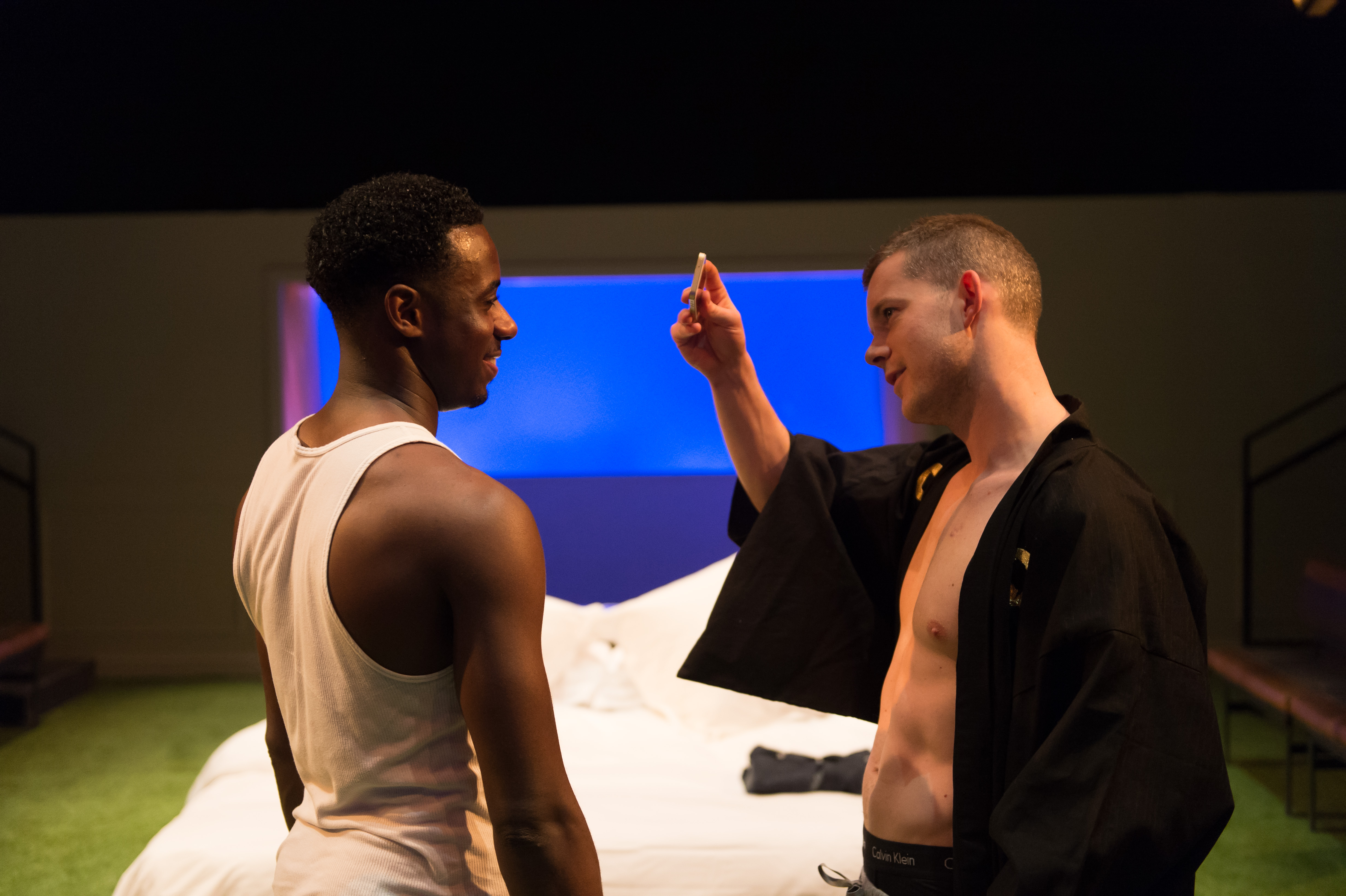
The historical scenes pack the most punch, as there seems to be so much more at stake. The contemporary version of Oliver’s character, battling with fidelity and a sex addiction, seems trivial in comparison. But Kaye Campbell has a powerful idea – highlighting hard-won freedoms as a call to action among the gay community for continued political involvement. At a time when legislation in Russia focuses attention on gay rights globally, the play seems topical and important: the cast’s appearance at the curtain call with protest placards, dedicating their performance ‘To Russia with love’, deserves applause.

Until 9 November 2013

Photos by Marc Brenner

Written 21 August 2013 for The London Magazine

“A Doll’s House” at the Duke of York’s Theatre

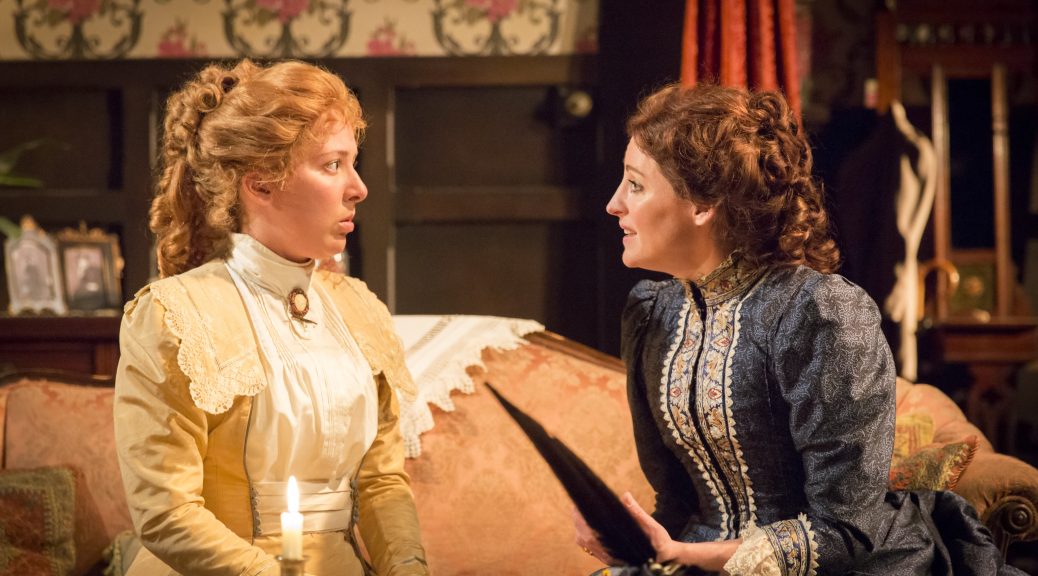
The Young Vic’s widely acclaimed production of A Doll’s House opened its West End transfer this week at the Duke of York’s theatre. Directed by Carrie Cracknell, Ibsen’s classic story of Nora, a housewife and mother in 19th century Norway, and the breakdown of her seemingly perfect marriage, is tackled with great verve and features a superb spinning set by designer Ian Macneil. The show deserves all its many critics’ stars and is not to be missed – it only runs until 26 October.

The star draw is Hattie Morahan in the lead role. She picked up both the Evening Standard and Critics’ Circle awards last year, and it’s easy to see why. She plays Nora as naïve – but only because of the society she was born into. Morahan makes the limitations women experienced at the time seem normal, no matter how bitter. Nora’s flashes of brilliance, as she comes to understand and rebel against constraints, are believable and moving.

Morahan is joined by a cast that is close to faultless. Caroline Martin (pictured above with Morhan) gives depth to the role of her old school friend, whose marriage of convenience has been a more obvious failure, and Nick Fletcher gives a magnificently understated performance as the money lender who wreaks havoc on Nora’s ideal home. Hiding her debts from her bank manager husband is only one of the lies her marriage is based on. As her partner Torvald, Dominic Rowan has to tackle sexist remarks it’s to be hoped make most people blush. The commodification of his wife may seem incredible, but Rowan manages to bring Cracknell’s pointed production home – Torvald’s fantasies about his wife raise uncomfortable questions relevant to men and women today.

This marital master and his slave are fantastic creations and with Simon Stephens’ adaptation of Ibsen’s text they breath anew. Injecting a strain of ‘Englishness’ into the play makes it recognisable, and there’s a cleverly suggested Pre-War feel to much of the language. Even better, ironic touches (again praise for Morahan here – her delivery is perfection) elaborate Ibsen’s dark humour and there’s even a sexiness here that has a disturbing edge. Stephens’ script is the key to this doll’s house being such a big success.

Until 26 October 2013

Photo by Richard Hubert Smith

Written 16 August 2013 for The London Magazine

“The Same Deep Water As Me” at the Donmar Warehouse

Following the success of Nick Payne’s award-winning Constellations, Josie Rourke, artistic director at the Donmar, has the coup of presenting his new play, The Same Deep Water As Me. Set in a ‘no-win-no-fee’ lawyers’ office in Luton, it’s a departure for the young writer, moving from intimate personal dramas into the wider world of work. Payne tackles big issues with humour and intelligence and deserves great success.

Superbly directed by John Crowley, the play’s plot, an attempt to swindle large companies via insurance claims, serves to explore the theme of lying. The rather desperate Kevin suggests the idea to his old school friend Andrew, who has made good as a lawyer. In a bravura performance, Daniel Mays takes the lead, deceiving his character’s older colleague Barry and renewing an attachment to his first love, now Kevin’s wife, Jennifer (a charming Niky Wardley). Payne’s strong characterisations emerge as they become embroiled in the scam.

There are some marvellous one-liners here, some of the funniest you’ll hear on stage in London at the moment, and the delivery from Marc Wotton’s Mephistophelean Kevin is superb. Nuanced observations on class are used to particularly great effect when a claim is contested in court: Peter Forbes and Monica Dolan play a sleek legal establishment magnificently and Isabella Laughland’s cameo as a lorry driver is arresting (if a shockingly small role for such a talented actress).

Payne’s writing has a strange modesty that makes for a unique voice – a joke denied a punch line, unstated emotions suggested with restraint – and surely many a dramatist would have opted for the more dramatic criminal court instead of a civil one? Playing down has a purpose: raising questions about access to justice is topical but, providing a further satisfying weight, a Kantian universalizability shows that this is deep water we really are all in together.

Until 28 September 2013

www.donmarwarehouse.com

Photo by Johan Persson

Written 12 August 2013 for The London Magazine