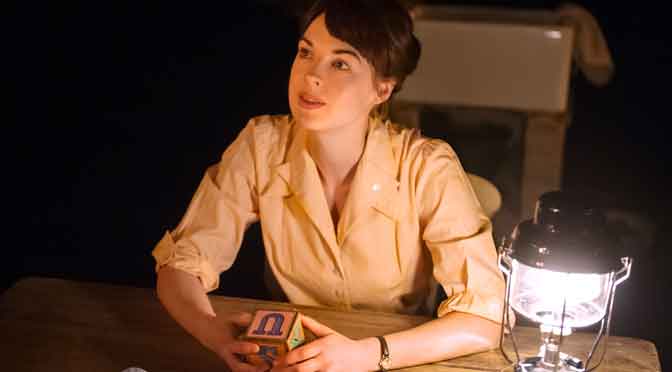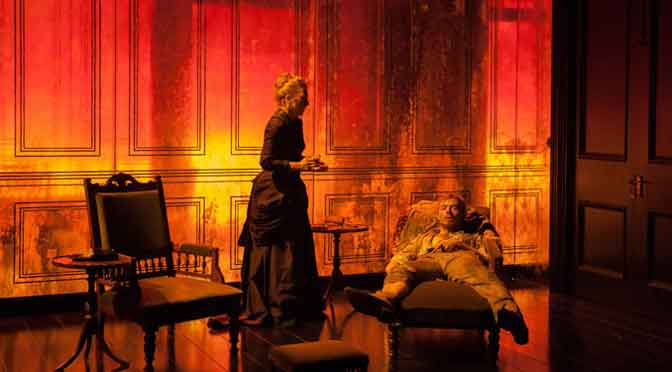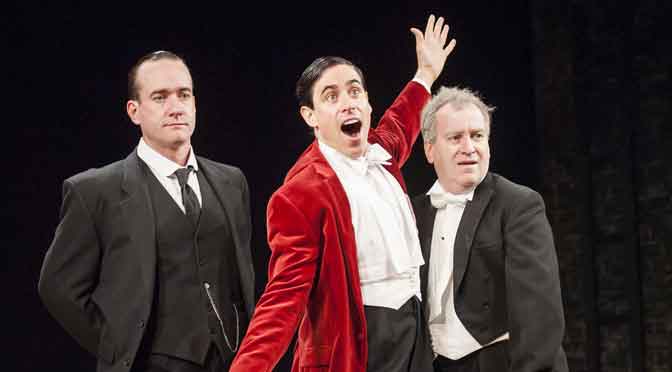
“As Is” at the Finborough Theatre

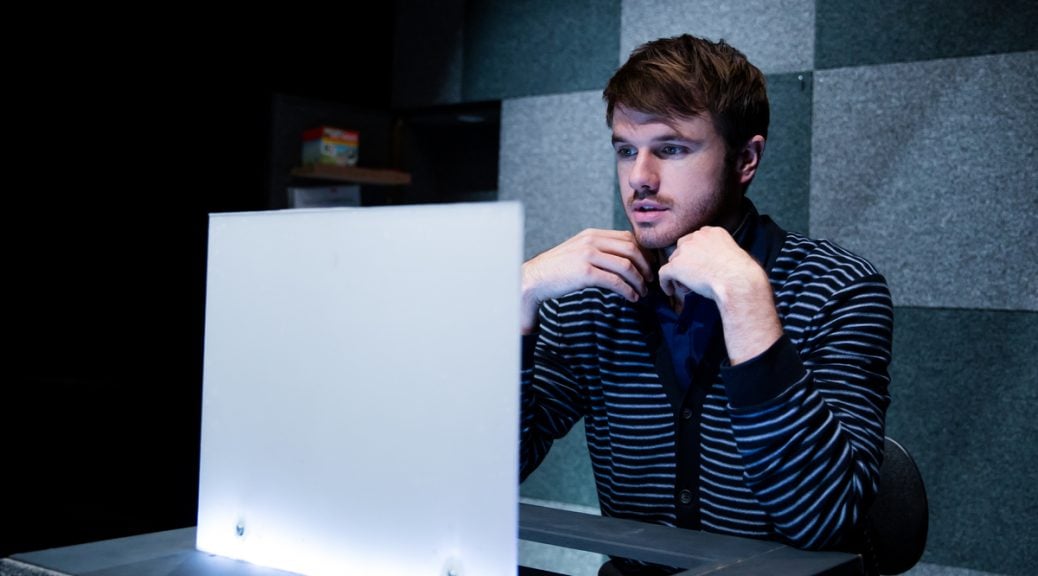
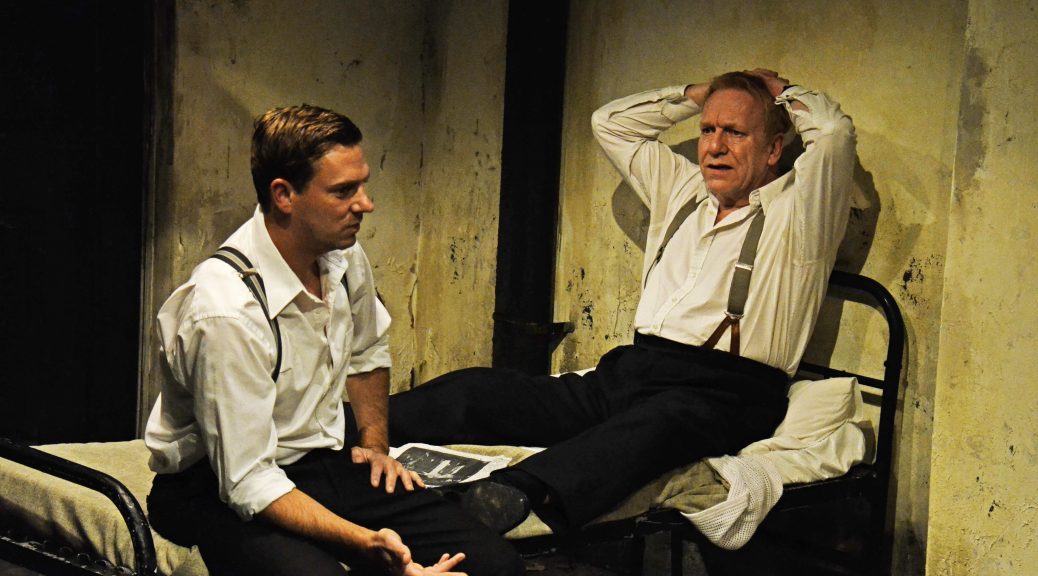
Reportedly the first theatrical response to the AIDS crisis, William H Hoffman’s 1985 play, As Is, receives its first revival in London for over a quarter of a century. The play takes us back to a dark age of paranoia and persecution. Estranged lovers Rich and Saul become reunited in the face of tragedy through their fear and resilience as they feel the epidemic “closing in” on their community. Set in the intimacy of the Finborough Theatre, the play has a rawness, anger and honesty that grab you and hold you.

As Is isn’t easy. Hoffman’s writing is poetic, with a staccato style and wealth of graphic detail that can overpower. His incessant irony becomes a touch laboured and some references are dated. All the more credit then to Andrew Keates’ direction: he keeps up to pace with the script and adds clarity. Using the cast as a chorus, frequently left on stage to react to events and take on a variety of roles, Keates makes the most of several set pieces, from bars to support groups and telephone helplines, with some intelligentstylised touches.

In the lead roles Tom Colley and David Poynor seem an odd couple at first, but they soon establish their characters’ shared history and manage to reflect the churning emotions experienced with a force that can make for uncomfortable viewing. Among the strong supporting cast Anna Tierney’s part as their friend stands out, as does Jordan Bernade, who plays Rich’s brother and a host of minor characters superbly.

For all this talent, As Is has a big problem – its jokes. There’s no reason any play dealing with dark subjects shouldn’t contain humour. Laughing in the face of death is common, but here those laughs seem too hollow. Some jokes fail because they are dated, a few are poorly delivered, most just aren’t funny. But the passion in the play is enough to recommend it. As a tragedy and a political statement, this work is important. As a love story in which commitment is promised unconditionally – as is – in sickness and in health, it is timeless in its power.

Until 31 August 2013

www.finboroughtheatre.co.uk

Photo by Scott Rylander

Written 9 August 2013 for The London Magazine

“The Sound of Music” at Regent’s Park Open Air Theatre

This year’s musical at Regent’s Park Open Air Theatre is Rodgers and Hammerstein’s firm favourite The Sound of Music. Whisper it, but not everyone is a fan of the family Von Trapp, or the novice-turned-governess Maria’s journey of self-discovery: tarnished by TV, the problem to solve here is one of over familiarity. Courageously, this production demands an open mind, presenting the piece with remarkable freshness.

The Sound of Music is one of those musicals where everything is expressed in a song, and a good tune can literally be your salvation. While it’s hard to imagine a heart hard enough not to melt at the children cast as the Von Trapp infants, the real achievement is that that sweetness doesn’t become saccharine. Rachel Kavanaugh directs the show with ruthless efficiency and creates a version devoid of silly camp theatricality – no small feat when everyone is dressed as nuns and soldiers with a smattering of lederhosen.

There is an impressive simplicity that serves the show well, even managing to inject menace and tension. Kavanaugh seems to have taken Maria’s back to basic approach to music making to heart. The songs we love are delivered without fanfare and are all the better for it. And this approach is echoed by Peter McKintosh’s superb meadow-fringed set, effectively changing from convent to mansion, concert hall to mountain range with a magical minimalism.

Taking on the lead role must be an uphill struggle for any performer, but Charlotte Wakefield gambols along, sounding great, with a gawky, infectious charm. Like policemen, it seems Captain von Trapps are getting younger – surely someone with seven children has to have a tinge of grey in the hair? – but Michael Xavier has a great voice and is a virile presence on stage (remember, seven children). And who can remember the supporting characters in the much re-played 1965 film? Here, Michael Matus and Caroline Keiff make room for their roles as the Captain’s cowardly friend and sophisticated Viennese fiancée with humour and grace and a couple of decent songs. But my favourite thing? Helen Hobson as the Mother Abbess and her superfluity of nuns performing their chorus numbers with a real feeling of religiosity. A brave move that injects weight into the show and, as night falls over Austria both literally and figuratively, provides a stunning finale that has both a bang and a wimple.

Until 14 September 2013

www.openairtheatre.com

Photo by Johan Persson

Written 7 August 2013 for The London Magazine

“Daytona” at the Park Theatre

Still in its inaugural season, the Park Theatre in Finsbury Park saw its first première of a new play open last night. Daytona by Oliver Cotton is a clever three-hander, well written and superbly produced. The story of three elderly Jewish emigrants to America, set in 1986, it sees a married couple’s well-ordered life disrupted by the unexpected return of a brother who had disappeared 30 years earlier. Arriving with the announcement that he has killed a war criminal while on holiday in Florida, he reopens wounds, both personal and political, posing moral dilemmas rich in dramatic potential.

Cotton is well known as a performer, so perhaps it should come as no surprise that he has written such wonderful roles. Under the skilful direction of David Grindley (fast becoming one of my favourites, given his excellent The American Plan currently at the St James Theatre), the performances here are truly accomplished. Surely, naturalism like this is only achieved with experience – the characters talk rather than recite, despite lengthy speeches that take us on a journey into the past. John Bowe plays charismatic, mellifluous-voiced Billy, whose return creates such shockwaves. His brother Joe is a retired accountant whose inner strength is revealed in a detailed performance from Harry Shearer. Completing the triangle is Elli, the marvellous Maureen Lipman, cleverly playing with stereotypes of the Jewish wife and injecting a steely tone that’s perfect for the play’s many surprises.

Elli and Joe make a great couple, not perfect – you can insert a shoulder shrug here – but, despite the trauma in their lives, their story is one of carrying on. Persistence, elevated to the point of a memorial to all their pain, makes Daytona an affirming play. And yet most of its power comes from the acting. For all its adroitness, Cotton’s text seems brief, leaving too many loose ends to satisfy. But the ambition to present an elderly trio as our sole concern is executed superbly. With theatre often obsessed with youth, it’s a welcome and original move.

Until 18 August 2013

www.parktheatre.co.uk

Photo by Manuel Harlan

Written 18 July 2013 for The London Magazine

“The Drowned Man: A Hollywood Fable” at the Temple Studios

When it comes to ‘immersive’ theatre, Punchdrunk are at the top of the list and their return to London with The Drowned Man: A Hollywood Fable is a hot contender for theatrical event of the year. Amazingly there are still some tickets left for August, so stop reading this, now, and book them.

Creating ‘The Temple Film Studios’, the production is unprecedented in its size. The scale, breathtakingly ambitious, is part of the point. As you venture around unaccompanied, ostensibly a guest at a wrap party waiting for filming to finish, you see behind the scenes and inside the minds of its inhabitants. There are spooky rooms of special effects and shrines to movie stardom, film sets and multiple characters you can choose to follow or ignore. You’re given a clue that the overriding story line follows two lovers, with infidelity driving one of them insane. You might see William killing Mary. Or vice versa. But there’s more going on here – an exploration of fantasies and fears dripping with a drug-induced hedonism. Mind-blowing stuff.

A whole movie-set town is recreated, along with a saloon bar and a cabaret room, a Twin Peaks style ball room and offices, oh, and a forest. Dancing on top of caravans? No problem. Or you might be drawn into a dressing room to watch one of the numerous cast prepare or perform some opaque ritual. But listing the sights seems to miss the point – the project is so mammoth selectivity is forced upon you and you come to live in this world rather than watch it. That each visitors experience will be unique is what makes it so especially theatrical.

Back to size again. It’s all a little overwhelming and the danger the whole thing will implode in on itself is clear. It’s no small achievement that the choreography, from Maxine Doyle, who also directed the show along with Felix Barrett, manages to makes a stand. There are times, in the dark, with the music very loud, you wonder where the action is and the sets, with Barrett working alongside Livi Vaughan and Beatrice Minns, are so crammed with detail you approach sensory overload – they even smell fantastic.

The masks the audience wear don’t make it comfortable (this seems a game for a young crowd all around) but they manage to claim back a strange intimacy for the show. They might also enable its sexiness; the plays on voyeurism are skilful and the casts’ interactions with the crowd bold. It’s a mixture of eroticism and death with a meta-text concerning the creation of our deep and dark desires that is potent. For atmosphere The Drowned Man surely can’t be beaten. It’s tempting to suggest it marks an apogee for this form of theatre that must not be missed.

Until 6 July 2014

www.punchdrunk.com

Written 8 July 2013 for The London Magazine

“The Ladykillers” at the Vaudeville Theatre

The Ladykillers are back. After last year’s super-successful run, with the show nominated for five Olivier Awards, a fresh cast has taken over the show, now playing at the Vaudeville Theatre. Father Ted writer Graham Linehan’s adaptation of the Ealing Comedy, from 1955, is respectfully inspired by the much-loved film. Its central premise – a group of incompetent villains determined to try and do away with their little old landlady after she discovers their heist ­– is employed skilfully to create a clever comedy.

It’s a light affair, with just a touch of farce, and although slapstick is used effectively, it’s the quantity and quality of one-liners that stands out. And the superb characters. Everyone will have their favourite for sure, but Ralf Little brings real energy to pill-popping wide boy Harry, and Simon Day steals many a scene as the confidence man with no confidence, Major Courtney. Few people can suggest transvestism quite so amusingly as Day – it’s a rare skill indeed. Holding the whole thing together, as the criminal not-so-mastermind Professor Marcus, is John Gordon Sinclair; spot on the button with his comic timing and with an air of improvising that makes everything feel fresh.

It is the set and costume designer Michael Taylor’s work that impresses most. A proper ‘look at that’ stage, full of gizmos and gags, that really adds to the show. Working on its slopping surfaces must be oddly disorientating but the cast make it look jolly. Wickedly, it’s hard not to laugh at the very idea of assassinating Angela Thorne’s gorgeous granny Louisa Wilberforce, and the crooks failure to do so brings yet more invention from Taylor’s set – there’s even a railway tunnel at one point. The Ladykillers is free from twee and manages to be perfect family fun throughout – even for your grandmother.

Until 26 October 2013

Photo by Dan Tsantilis

Written 10 July 2013 for The London Magazine

“The American Plan” at the St James Theatre

Arriving from the Ustinov Studio (Theatre Royal Bath), having already received a big thumbs-up from the critics, The American Plan opened in London last night at the St. James Theatre. Full of laughs and bittersweet wisdom, this exquisitely written play from 1990 by Richard Greenberg deals with not one but several love stories.

Here we have a fascinating trio of women. Eva and her “difficult” daughter Lili, wealthy refugees from the Nazis, are on vacation with their maid Olivia in the Catskill Mountains across a lake from other Jewish families who flock to the area. The women are isolated by an amusing, imported snobbery. Until a young man arrives.

Nick is a “blue chip stock” kind of guy, but true romance isn’t the story here. All these Americans, émigrés old and new, are full of plans and a warped determination to bring them to fruition. Plots might be a more accurate description if there wasn’t so much sincerity behind their motivation. The lies they tell are often deliciously funny but there’s real heart here, too.

Entangled with a family, not eccentric but “giddy around the circumference”, where the daughter is the wrong side of neurotic and the matriarch lives up to every stereotype of Jewish motherhood, you never much rate Nick’s chances. But he has secrets and pain of his own and watching them revealed is great theatre.

And the lies don’t stop with the introduction of the final character, Gil. In the part, Mark Edel-Hunt more than makes up for his later arrival with a great plot twist that, since I liked the play so much, I really don’t want to spoil.

Diana Quick is scene stealing as Eva (her accent alone fascinates), putting the metal in mittel European, and Dona Croll makes a marvellous foil for her as the “enduring” Olivia whose inscrutable privacy hints at yet more tales. Emily Taaffe fully embodies the “mercurial” Lili, delighting with her wit then shocking with a traumatic intensity. And effectively subduing his character’s hidden depths until just the right moment, Luke Allen-Gale is tremendous as Nick.

This production does true justice to a fine play and it’s clear those responsible have a thorough understanding of the text. More than his intelligent exploration of “intricately unhappy” lives, Greenberg brings a Jamesian flavour and intelligent humour to his examination of our deepest self-fashioning. The result is a play that resonates with depth.

Until 10 August 2013

www.stjamestheatre.co.uk

Photo by Jane Hobson

Written 9 July 2013 for The London Magazine

“Macbeth” at Shakespeare’s Globe

Olivier-Award-winning actress Eve Best makes her directorial debut at Shakespeare’s Globe this summer with an accessible and exhilarating production of Macbeth. It’s an assured first time effort that sends a chill down the spine even on a hot summer’s day.

Perhaps not surprisingly, given Best’s background, her version of the supernatural thriller puts the performers to the fore. Joseph Millson does a great job in the title role, his Macbeth’s fiery temper increasing the drama and sense of instability. Clearly at home in the Globe – like many of the cast, Millson’s direct addresses to the crowd create a sense of startling immediacy.

Best’s attention to her troupe only has one indulgence – an unnecessarily prolonged scene with the Porter. This aside, with such an excellent cast, giving every role its due is clever. Duncan’s court, at first sight, an array of powdered fops, develop their roles wonderfully and the short scene with Lady Macduff (Finty Williams) is superb.

Full of prophecy and portents rather than politics, Best downplays militaristic bravado, and the female roles in the play benefit from this. The witches, for example, are a beguiling bunch, ironically harmonious, using movement and music to cast a spell. Their fright-factor is all the greater for its understated spookiness.

Samantha Spiro is the star of the show. Her Lady Macbeth is dynamic, her transformation into a Queen astounding, and her performance one of great depth. Macbeth clearly blames her for the path he sets foot on and an alarming scene of domestic abuse is a brave and electrifying take on their famous conjugal complicity.

Until 13 October 2013

www.shakespearesglobe.com

Photo by Ellie Kurttz

Written 7 July 2013 for The London Magazine

“Julius Caesar” at St Paul’s Church, Covent Garden

For their fifth year of summer residence at St Paul’s Covent Garden, appropriately enough ‘The Actors’ Church’, Iris Theatre presents Julius Caesar. Shakespeare’s political thriller is given a contemporary touch, these Romans are riot police rather than Republicans, but the exciting thing is the collusion of two theatrical treats – outdoor theatre and a promenade performance – that make a winning combination.

Unlike some open-air venues, St Paul’s Church is surprisingly quiet, the acoustics are lovely, so it seems a shame that the acting is often too declamatory. But there are fine performances here: from Matthew Mellalieu, whose Tudor-inspired Caesar is a joy to watch (anyone looking for a Henry ?), Daniel Hanna’s streetwise Casca and Matt Wilman’s virile Mark Antony. Not forgetting Laura Wickham who has a busy night doubling up as two wives and also playing Cinna the Poet – acquitting herself admirably in all three parts.

This is a hard-working show all round. With only seven in the cast there are occasions when members of the audience take on non-speaking parts and all of us are cast as the Roman “rabble”. I am no fan of audience participation but can’t remember seeing it done this well before; director Daniel Winder shows intelligent restraint, creating complicity as we move around to characters’ homes or the steps of the senate.

Taking you through the church’s charming gardens proves ambitious and moving the audience around takes time, this short Shakespeare becomes a long evening, but it’s worth every minute. While the sound design from Filipe Gomes is effective, the actual music accompanying the show is its biggest problem, an inappropriate mismatch of styles, cinematic in inspiration and far too intrusive. It’s a rare bum note in this fine production. The intimacy created is remarkable – at times it’s difficult to work out how big the audience is – and the moments we enter the church itself, with scenes aided by Stephanie Bradbury’s movement direction and Benjamin Polya’s lighting, are coups de theatre you won’t forget in a hurry.

Until 26 July 2013

www.iristheatre.com

Photo by Phil Miler

Written 2 July 2013 for The London Magazine

“Fences” at the Duchess Theatre

A new production of August Wilson’s play Fences opened at the Duchess Theatre last night following a successful run in Bath that has already earned it strong reviews. A family drama, set in Pittsburgh in 1957, it focuses on the patriarch Troy Maxson, a fascinating creation, depicted by Lenny Henry in a performance that is not to be missed.

Now well established as a serious actor, Henry gives a thoughtful, hard-working performance that plumbs the depths of this unsympathetic character. Troy is almost a tyrant, sometimes despicable, but his determination to turn his life around after time in jail, and awareness of his responsibilities makes you grudgingly respect him. Henry brings out the man’s vulnerability, and deals superbly with Wilson’s wry humour – Troy is charismatic and imminently watchable.

Troy is also an ordinary, working class, man. His struggles and aspirations provide the insight into African-American experience Wilson dedicated his work to. A talented sportsman who feels racism prevented his career, Troy is a disciplinarian driven by disappointment. Relations with his sons (played admirably by Peter Bankolé and Ashley Zhangazha) are on a knife-edge. More complex still is that with his disabled brother, a veteran with religious delusions, an enigmatic part played with conviction by Ako Mitchel.

Wilson’s play feels strangely timeless. It was written in 1983 yet sits well alongside Miller, even O’Neill; all three American greats wrote works that are hefty, lengthy and never afraid of metaphors. Although director Paulette Randall could pick up the pace at times, the production is a quality affair with a serious tone that earns respect.

The heart of the play is strong enough to keep it very much alive, embodied by the role of Troy’s wife, Rose. In this part Tanya Moodie gives a tremendous performance, formidable yet bowed by Troy’s force, Rose’s plight and passion are truly moving. As her husband’s legacy is examined in the final act, it’s Rose you really want to hear from. Wilson leaves you wanting more – a sure sign of success.

Until 14 September 2013

www.nimaxtheatres.com

Photo by Nobby Clark

Written 27 June 2013 for The London Magazine

“PRIDE & Prejudice” at Regent’s Park Open Air Theatre

It’s a brave soul who takes on the task of adapting Pride and Prejudice, one of English literature’s best-loved novels, for the stage. Jane Austen is so famous she might be on a bank note soon, and the fact that this book is a masterpiece has to be – dare we say –universally acknowledged. But Simon Reade’s interpretation of the love lives of the Bennet sisters will please diehard Austen fans, preserving swathes of conversation rather than dumbing them down, while still presenting a light romcom that makes for a hugely entertaining evening.

A few minor characters are casualties of the adaptation (who would have thought you would miss Mr Gardiner?) and the Bennets are denied trips to Brighton and London. The action is concertinaed to satisfying theatrical effect, with an emphasis on laughter. Director Deborah Bruce uses designer Max Jones’ set dynamically (there’s a great scene in the portrait gallery of a palatial home that uses the whole cast). Toward the climax, the revolving stage could be joined by a revolving door to the Bennets’ home – visitors arrive so thick and fast – but the speed of the show employs the sillier aspects of Regency Romance to comic effect.

Ed Birch as Mr Collins

The biggest loss, unavoidably, is Austen’s own voice. The task of delivering her irony falls on the cast and the performances reflect Austen’s wit superbly. Rebecca Lacey is wonderful as the foolish Mrs Bennet and Timothy Walker gives a weighty performance as her long-suffering husband. There are strong performances from minor characters, with Jane Asher frozen with imperiousness as Lady Catherine De Bourgh. The Bennet sisters are portrayed convincingly as a family group, and differentiated effectively. Amongst their suitors, Ed Birch almost steals the show, with his crane-like Mr Collins – full of “servility and self-importance” – getting plenty of laughs.

Just as the novel belongs to Elizabeth Bennet, the night is, fittingly, owned by the actress playing her – Jennifer Kirby. Making her professional debut in the show, Kirby takes on the mantle of plenty of people’s favourite heroine with an unaffected charm. My bet is that Kirby was a fan of Elizabeth long before she landed the part, and her performance makes you love this great heroine even more.

Until 20 July 2013

www.openairtheatre.com

Photo by Johan Persson

Written 26 June 2013 for The London Magazine