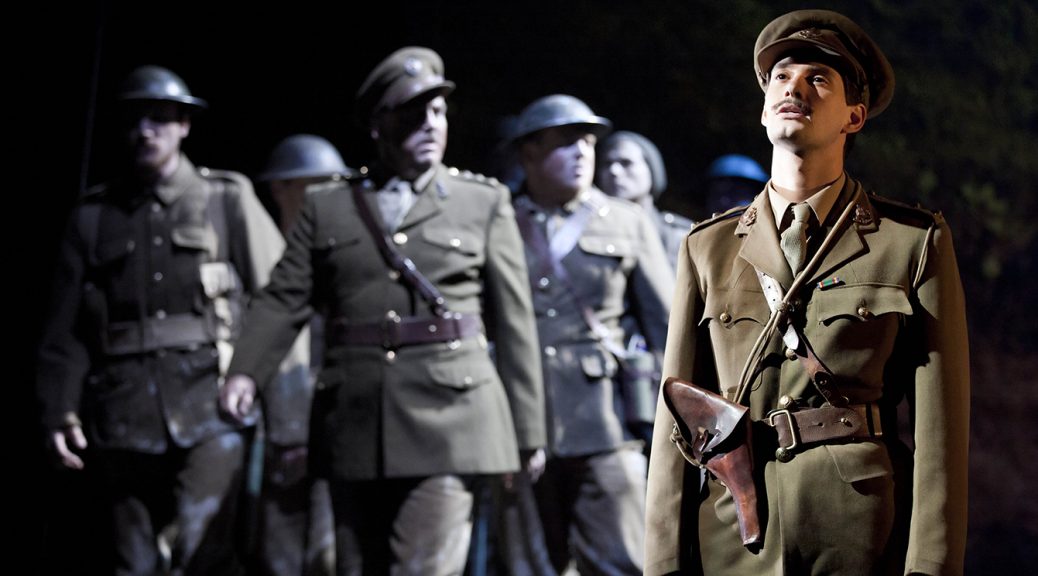
“Clybourne Park” at the Royal Court

Property is a London obsession, so American writer Bruce Norris’ Clybourne Park – the story of a neighbourhood told through the development of one house – has the potential to strike a chord with the audience at the Royal Court.

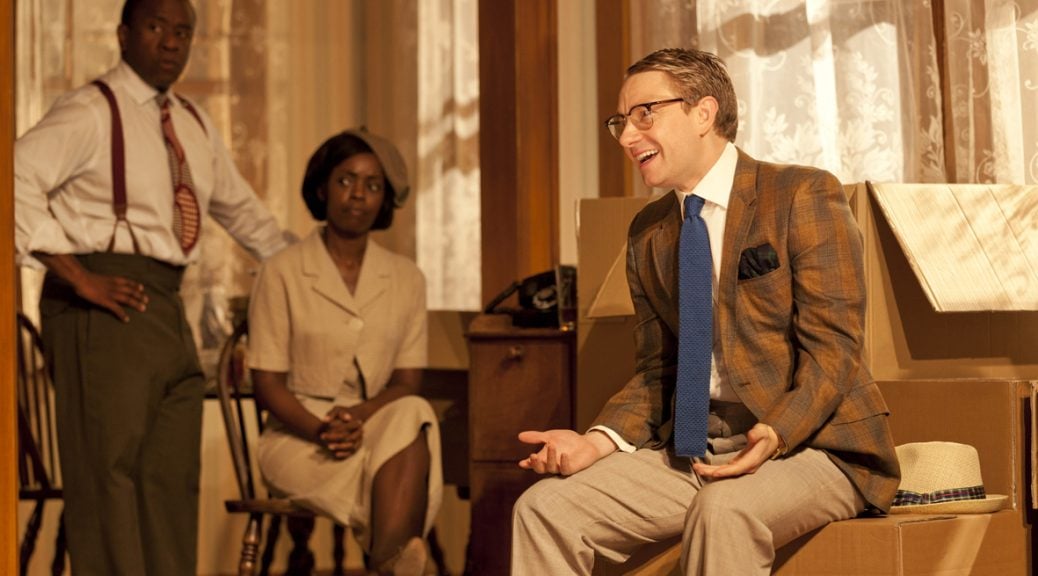
The house in question is not, like so many in literature, a repository of values. Rather it is blank canvas that, in two different times, characters project their ideas onto. Act one is set in the 1950s with the house about to be sold to the area’s first black residents – cue debate.
Unfortunately, Norris’ vision of the 50s doesn’t ring true. Director Dominic Cooke fails to reign in the sense of parody and the cast (with the exception of Lorna Brown and Lucian Msamati) lose themselves in it. There are some beautiful asides, often taking place just inside the front door, but the forced politeness we are supposed to laugh at is unconvincing.

Act two moves to safer ground, and better things, in the present day. The house is about to be pulled down and two yuppies plan to build a new home on the site. The same actors appear for a community meeting (a more satisfying scenario for discussion) concerning what is now considered the black heritage of the area. Norris’ observation and dialogue is sharp, dark and entertaining, his wit rapacious and cruel.

The performances take off with Martin Freeman justly confident in his comic ability, Sophie Thompson and Sarah Goldberg positively shinning, and Brown and Msamati again wonderful. There are some awkward moments as a series of tasteless old jokes are recited, less to entertain than to test reactions in a contrived manner, but generally this comedy of (bad) manners works superbly well.

A subplot concerning a tragedy in the house becomes lost, making the concerns of the present day characters seem trivial, and the danger is that we start to lose interest in them. The connections between eras, potentially so rich, are not given enough space. Norris’ play, which has been well received in America, needs further development. As it stands, Clydbourne Park should never have been given planning permission.

Until 2 October 2010

www.royalcourttheatre.com

Written 3 September 2010 for The London Magazine
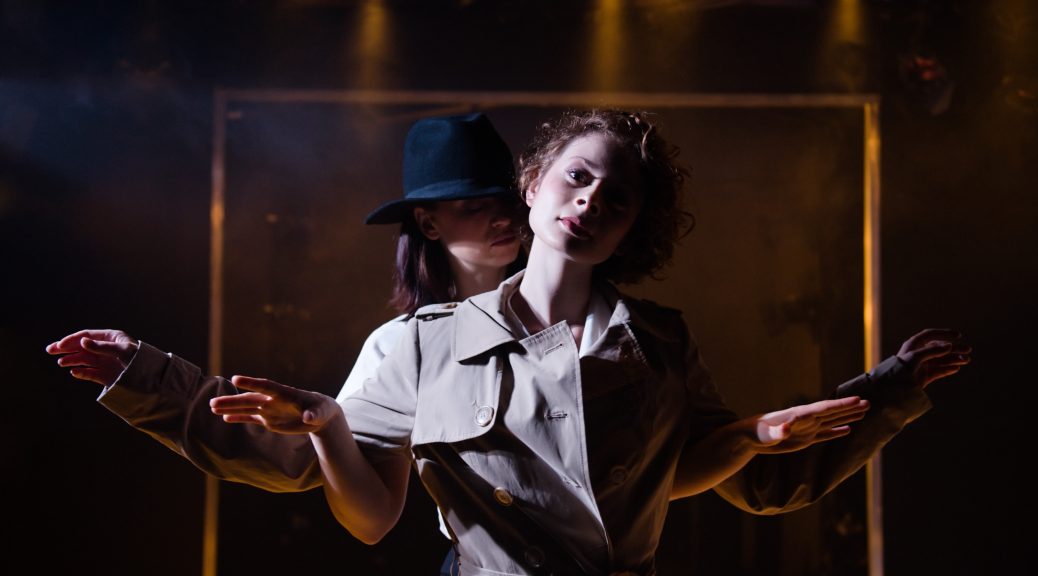
“How to be an other woman” at the Gate Theatre

How to be an other woman, at the Gate Theatre Notting Hill, is director Natalie Abrahami’s sassy adaptation of Lorrie Moore’s book. Taking the form of a self-help text, four talented actresses perform all the roles in a story of adultery. With its 80s soundtrack, witty lines and theatrical inventiveness, this short production is the most fun you could have in an hour – without having an affair.

Samal Blak’s marvellous design has the ensemble presented as fantasising shop assistants. Abrahami directs (using Aline David’s choreography) a seamless dance of emotions and laughter. Each actress takes turns at the role of Charlene, a young woman obsessed with possessions and Emma Bovary. From the thrill of her new role as a mistress, to the inevitable heartbreak that results, the performances are all fantastic. Both Cath Whitefield and Ony Uhiara are hilarious when they play the married man Charlene falls for, Faye Castelow has some wonderful moments as her friend at work, and Samantha Pearl does especially well in making us feel for Charlene when the truth of the affair dawns on her.

Because, of course, having an affair isn’t fun at all. Charlene’s paranoia about the woman who is her rival is darkly comic but becomes bitter. Wives are compared to cockroaches who ‘travel in packs’. Increasingly isolated, Charlene realises she has moved from being an other women to another woman – a person she no longer recognises in the mirror.

Thankfully, since we have come to like her so much, unlike Madame Bovary, Charlene can ‘reclaim’ herself, lie a little about being fine, and move on. I guarantee you will leave the theatre wanting to hear more of her adventures.

Until 2 October 2010

www.gatetheatre.co.uk

Photo by Simon Kane

Written 2 September 2010 for The London Magazine

“The Maddening Rain” at the Old Red Lion, Islington

When readers of The London Magazine go to the theatre in Islington, they go to The Almeida. I am just the same and quite devoted to the place. But a new play, The Maddening Rain, makes me recommend travelling down Upper Street to the Old Red Lion pub theatre for a very special fringe production.

Nicholas Pierpan’s tale of a working-class boy who becomes a City trader is so firmly rooted in the streets of London that it is instantly believable. We are swept along on a journey of success, then failure, in an exhilarating manner. Pierpan doesn’t just know his geography – he knows how to write, with imagery that is instant yet lingering and poetry of the everyday that is accessible and effective.

In this well-constructed, hour-long monologue, London is presented as alienating but full of exciting opportunities. The mix of sociology and psychology is heady, but in safe hands with director Matthew Dunster who paces the show expertly. Light and sound add atmosphere without detracting attention and Dunster maintains an intimacy that, along with Alison McDowall’s clever set, takes us behind the scenes of the City.

It’s an adventure that gets quite a telling – Felix Scott’s performance is riveting. Underneath a look as bland as any other commuter, out comes a sharp eye with a comic glint. Insights into the ‘dead time’ of work and the ‘herd’ he has to put up with endear, but Scott is accomplished enough to hold us back. His ability as a mimic becomes chilling as he transforms into the role of his boss, then frightening as the play reaches its tragic conclusion.

Scott’s character fixates on the privilege he sees all around him. It’s true that Londoners are spoilt. We never have to go a long way for anything, take seeing a great play for example – just go down the road from the Almeida.

Until 18 September 2010

www.oldredliontheatre.co.uk

Photo by Jenny Grand

Written 1 September 2010 for The London Magazine

“Oikos” at the Jellyfish Theatre

The Oikos Project sees a new temporary theatre, The Jellyfish, erected in Union Street, Southwark. Exciting enough – but this creature really has to be seen to be believed. Under the auspices of The Architecture Foundation, Berlin-based team Kobberling and Kaltwasser have used only reclaimed and recycled materials. As the pop-up phenomena becomes more commercialised, this project takes a stand – it was built by local volunteers and school children. Just gazing at this surreal, strangely beautiful thing is an unmissable experience, learning about the ideas behind it a humbling one.

oikos-project-credit-Brian-Benson
The Oikos Theatre photographed by Brian Benson

The building itself seems destined to overshadow whatever play it stages. And that’s a shame, since Oikos the play (the first of two productions scheduled) has plenty to offer. Appropriately it concerns climate change. Neil d’Souza convincingly portrays a successful city trader who, having escaped natural disaster as a child in India, now sees his home in Chiswick flooded and his personal life awash with problems. Dido Miles puts in a great performance as his wife, adrift in her new surroundings and claiming their wealth hasn’t made them happy. Their daughter, played by Amy Dawson, also has issues. Spoilt rotten, she seems trapped in an extended adolescence that is suitably irritating.

Director Topher Campbell and writer Simon Wu have problems that are not of their own making. Climate change quite rightly concerns us all but, with similar issues being addressed down the road at the National Theatre, comparisons are inevitable. These are not necessarily to this play’s detriment. Oikos is tightly constructed, with fascinating mystic undertones and the idea that our lives need a new kind of balance is intelligently presented. The problem is one of audience fatigue.

Serious environmental threats cannot be doubted – both play and project succeed in their aim of making us think. Yet, at the risk of sounding trivial, it should be remembered that theatre can also be a celebration. Given the achievement of building this wonderful new space, a testament to creativity in itself, the play’s dark warning seems at odds with the project’s optimism.

Until 18 September 2010

Photo by Robert Workman

Written 31 August 2010 for The London Magazine

“Into the Woods” at Regent’s Park Open Air Theatre

Into the Woods is Sondheim’s masterpiece. A musical score full of invention yet accessible, lyrics that are at once moving and hilarious, and both perfectly accompanying James Lapine’s wonderful book.

Interweaving fairy stories, questioning what these tales are really about and then, after the interval, returning to the characters to find out what happens after the happily ever after; it’s one of the cleverest things you’ll ever see and one of the most rewarding.

Director Timothy Sheader gives the show a production it deserves. His new spin is to cast the narrator as a child. This adds little, but where Sheader excels is to bring out the musical’s qualities. This is particularly well executed in the way he brings out the dark side of the fairy stories we tell children – the woods are a sinister place and we fear for the babies in them.

With Soutra Gilmour’s wonderful set and some startling choreography from Liam Steel, the dynamism of the piece is given full scope. The mix of stories is hectic and a controlled chaos appropriately challenges suspension of disbelief.

The characters’ knowledge of the artificial world they are a part of, along with the lessons they learn and impart, is relished by the cast. There are some wonderful performances here. Beverly Rudd is great as the greedy Red Ridinghood, managing a tune while she stuffs buns in her mouth. Michael Xavier and Simon Thomas play the Princes with a nod to Russell Brand and get the most out of their duets.

There are three great leading ladies. Hannah Waddingham is on excellent form as the witch and Jenna Russell is as superb as ever as the Baker’s wife. Helen Dallimore’s sweet voice serves well in the role of Cinderella, whose proclamation, “I wish”, starts the whole glorious evening.

It seems obvious to stage Into the Woods at Regents Park. There must have been a collective, “ah, yes”, when it was announced, yet it is to Sheaders’s credit that it is done so well. It is great to hear the wind in the leaves accompany Sondheim’s score and see the characters retreating into the trees at the end of the evening. The only problem with this production is the short run. Given the number of wonderful touches, and surprise voice over, it would be great to see it transfer or return to the park next year. That’s my wish anyway.

Until 11 September 2010

www.openairtheatre.com

Photo by Catherine Ashmore

Written 17 August 2010 for The London Magazine

“Earthquakes in London”at the National Theatre

Of the several excellent productions this summer from the Headlong Theatre Company, none has created quite the buzz of Earthquakes in London at the National Theatre’s Cottesloe auditorium.

Headlong’s star director Rupert Goold takes charge. While Broadway gave his production of Enron a drubbing, London loves Goold – and rightly so. A director of great style, his bag of theatrical tricks belies a precise hand adept at delivering unforgettable shows. Goold brings all his invention and courage to Earthquakes in London. He has to – Mike Bartlett’s play could easily have seemed unstageable.

Creating a time-travelling story of environmental apocalypse, Bartlett flirts with the past and future, but his play is really about the present – a condemning vision of our apathy and arrogance. Unashamedly political, if occasionally obtuse, the passion displayed is admirable. Akin to the National’s production of Rattigan’s After the Dance, the question that frustrates and angers is how society can carry on the party in the face of catastrophe.

Bartlett’s uncanny gift for characterisation shows his skill as a writer. While the wry observations on modern life are sometimes predictable, they can seldom be argued with and if the scope of his ambition doesn’t always pay off, his emotional insight creates a recognisable world of believable people.

Lia Williams is brilliant as Sarah, a newly appointed Lib Dem minister struggling with the conflict between her ideals and power. Lia has brought up her sisters: Jasmine (Jessica Raine) has ended up as a “natural disaster”, angry as only a post baby boomer can be, while heavily pregnant Freya (Anna Madeley) is given a haunting depiction that matches this harrowing role.

A massive cast live their lives around these women. Even their husbands, both men in crisis and played wonderfully by Tom Goodman-Hill and Geoffrey Streatfield fail to connect with them. Their father Robert (Bill Patterson) is a prophet whose vision of the future removes him from his family and provides this bleak play’s most exigent moments. Always surprising, Earthquakes in London is an epic with the most unusual hero as Bryony Hannah excels in two roles that show her enviable versatility.

But the stars of the show are designer Miriam Buether and the technical team at the National Theatre. Transforming the Cottesloe to an unprecedented extent makes the night exciting from the start. Performing amongst the crowd and in two pillbox stages at either end allows the breakneck speed required. It provides memorable tableaux and builds up connections that add further to an already rich work. The evening is often overwhelming, but it is never confusing. This is compulsive viewing that will run amok in the mind for a long time to come.

Until 22 September 2010

www.nationaltheatre.org.uk

Photo by Manuel Harlan

Written 5 August 2010 for The London Magazine

“Cyrano de Bergerac” at the White Bear Theatre

Gwilym Lloyd makes a dynamic Cyrano in this new production at the White Bear Theatre. His accomplished performance takes the audience on the emotional journey his life-long love Roxane makes – only quicker – we see past his prodigious proboscis to his charms well before she does. From a figure of fun and violence, we come to view Cyrano as ‘philosopher, duellist, wit and lover’. Lloyd achieves all this and, with such a firm foundation, director Simon Evans’ production does not fail.

Cyrano’s loyalty to his friends is one of many enduring qualities. They voice our concerns that his talents might be wasted for quixotic reasons, and also detail the depth of his virtues. Cyrano’s stoicism in the face of his, er, face is deeply philosophical. Chief amongst his retainers is Le Bret, whose down-to-earth delivery shows actor David Mildon’s appreciation of this fresh and engaging translation by Ranjit Bolt. Similarly, Ben Higgins makes his professional debut with a charming performance as Ragueneau, who is supported and inspired by Cyrano.

Evans skilfully uses the whole company in some playful moments of bandying wit that establish a camaraderie that pays off during darker moments. Cyrano’s proxy love affair has serious consequences, but there is plenty of fun along the way, including a scene-stealing performance from Samuel Donnelly as the dastardly De Guiche, who is also besotted by Roxane. And it is easy to see why everyone is mad about the girl – Iris Roberts gives a delightful performance as the playful yet sincere word buff. Philip Scott-Wallace (in another professional debut to be proud of) plays the handsome cadet Christian whose looks win her heart, with just the right amount of confusion to maintain sympathy for himself as well as Cyrano.

With a light touch, Simon Evans has brought out the complexities as well as joys of Rostand’s classic tale. It seems appropriate that even at Cyrano’s death there is laughter as well as tears and that neither seems out of place.

Until 4 September 2010

www.whitebeartheatre.co.uk

Written 5 August 2010 for The London Magazine

“The Prince of Homburg” at the Donmar Warehouse

The Donmar’s production of Heinrich von Kleist’s The Prince of Homburg is another attempt to provide London audiences with the chance to see a classic we should all be more familiar with. Written just before the author’s death in 1811, the play is a mixture of romance and military drama, pitting the emotions of its hero with his sense of honour.

The Prince is the kind of dreaming philosopher that director Jonathan Munby deals well with. Munby’s last production at the Donmar, Life is a Dream, shared concerns about the failings of human perception and this production has a similar ethereal feel. But the Prince is also a military leader and when he makes a mistake in battle and is court marshalled, he comes to believe that he should pay for his error with his life. A modern audience is bound to have problems finding this believable. His journey to the decision is too brief to dispel these doubts and Dennis Kelly’s new version bizarrely encourages them.

The problem of motivation seems shared by the cast as well. Charlie Cox as the Prince and Sonya Cassidy as his love interest do well to establish a magnetic relationship, but the emotions surrounding the Prince’s imprisonment and attempts to save, then sacrifice him for the cause of army discipline, are unbelievable. Cox is a fine hero, he ‘does’ dignity well, but you can’t help thinking he is a fool.

Cox gets your sympathy (which is the last thing the character should have) especially given who he is up against – the Elector Frederick in the form of Ian McDiarmid. Playing an evil emperor is bread and butter to McDiarmid (he is the bad guy in the Star Wars films) but he really does excel at it. Bringing every subtlety out of the character he adds humour as well as chilling efficiency to the role. You never doubt him. He is full of frustrations and fears as well as being the consummate politician.

The Prince of Homburg is a classy affair with a stylish design from Angela Davies and a strong supporting cast that often seems wasted. McDiarmid alone makes this production worth seeing. His performance is one of those masterclass affairs that occur far less frequently than we are led to believe. Just don’t expect to get very much else from the evening.

Until 4 September 2010

www.donmarwarehouse.com

Written 2 August 2010 for The London Magazine

“Danton’s Death” at the National Theatre

As anyone who has attempted Hilary Mantel’s supernovel on the theme will know, revolutionary France seems to have been a fairly confusing place. All those factions and ideologies and decapitations make our current coalition government look dull. And they can be hard to follow. Fortunately, Howard Brenton’s new version of Büchner’s classic, Danton’s Death, cuts to the chase and is light on history and politics.

It is Danton the philosopher that we meet at the National Theatre. His meditations on mortality and fame just happen to have political turmoil as a background. Unfortunately, thinking and politics don’t mix well for him.

Toby Stephens plays Danton. He shouts against corruption superbly but excels when showing the mania of his complex character. Charges of libertinism seem well founded but he is so full of life and charisma that he is appealing. Stephens is magnetic whether on the soapbox, in the bedroom or in prison with his friends.

It is clear we should be following him. Anyway, the opposition are a tiresome lot. Elliot Levey’s Robespierre is a sibilant schoolboy who holds your interest but is hardly terrifying. His followers do far too much arm waving to rise above pantomime.

More disappointing than our hero’s enemies is his wife. Danton’s philandering doesn’t seem to have disturbed Madame at all. I am not sure what would fluster her, as Kirsty Bushell’s performance is so understated as to be soporific. She might be annoyed at the mess he’s going to make of his collar, but that’s about it.

Thankfully the spotlight is on Danton most of the time. And what a spotlight it is – Paule Constable’s lighting for the production is stunning, working perfectly with Christopher Oram’s cliché-free set and aiding director Michael Grandage’s clear, fast-paced production.

Danton’s death comes quickly and the props department’s stunning guillotine is truly convincing. I panicked for a moment, thinking Toby Stephens had been sacrificed for the sake of his art. That would have been a tragedy indeed – this production can’t afford to lose him.

Until 14 October 2010

www.nationaltheatre.org.uk

Photo by Johan Persson

Written 2 August 2010 for The London Magazine

“Aspects of Love” at the Menier Chocolate Factory

Aspects of Love was a bold musical departure for Andrew Lloyd Webber back in 1989. Following the success of Phantom of the Opera, it seems the composer was determined to produce something different – a small, intimate chamber piece with a simple theme and storyline.

Reports of the original production at the Prince of Wales Theatre suggest the musical was somewhat lost in the West End. It faired even less well on Broadway. Now its original director, Trevor Nunn, is back to have another go and, thankfully, at the Menier Chocolate Factory the whole piece comes alive.

As we follow the characters’ lives and loves, through infatuation, betrayal, amity and familial affection, we cannot resist being pulled in. And David Farley’s clever set is the perfect minimal setting in which to develop the drama and embrace events and emotions.

Nunn’s rather indulgent direction takes a slower pace than we might expect. He clearly revels in the musical’s many tête-á-tête scenes. The care taken, combined with the strong cast assembled, pays off.
Katherine Kingsley plays Rose Vibert, and Rosalie Craig is Giulietta Trapani, and both make convincing love interests for the men of the piece. Kingsley has the difficult task of playing an actress who might have fallen for her own press, but she still manages to be appealing. Craig’s magnificent energy results in the most electrifying number of the night, the funeral celebration of both women’s lover, George.
The role of Sir George is played by veteran musical theatre actor Dave Willetts. He gives a vintage performance full of energy and technical knowhow. At the other end of the spectrum, we have a great stage debut in Rebecca Brewer as George and Rose’s daughter, Jenny.

Best of all, and it really is a close call, is the London stage debut of Michael Arden. He assumes the lead role of Alex with such charm that he is in danger of winning us over a little too much. From gangly adoration of Rose, to crazed passion and then a cool melancholic acceptance of her betrayal, his performance is as rich as his mellifluous voice. Just like the wine enjoyed on stage throughout the show, this is a fine performance within a full-boded production that’s a delight to savour.

Until 26 September 2010

www.menierchocolatefactory.com

Photo by Catherine Ashmore

Written 23 July 2010 for The London Magazine