“The Dance of Death” at the Arcola Theatre

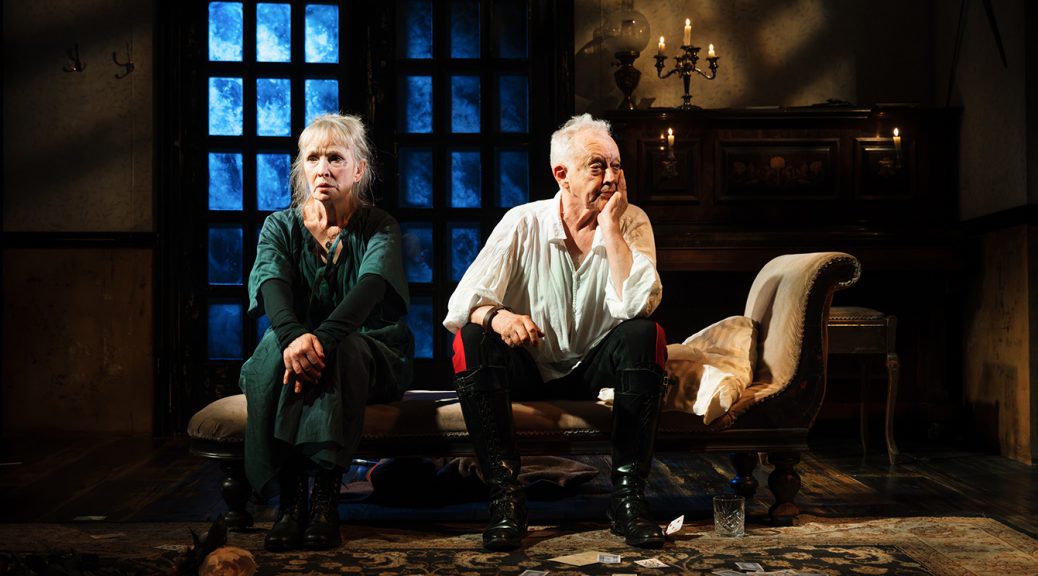
Rebecca Lenkiewicz’s new version of August Strindberg’s play about mortality and marriage is terse and startling. The warring couple we watch torment each other are more than mouthpieces for speculation about the meaning of life – they are entertaining, too. And not shy of expletives. A view of existence as “funny as well as tragic” permeates so thoroughly that director Mehmet Ergen’s production intoxicates.

Lenkiewicz’s contribution is original. Her full-blown embrace of Strindberg’s humour is as dark as can be. Wondering whether to celebrate their Pearl anniversary, Alice and Edgar’s viciousness towards each other is bizarrely creative. Their venom gets laughs and contains a strange respect. 

The degree of farce in Strindberg’s world view – the idea that life may have no meaning and is “preposterous – is highlighted. Ergen’s direction must deal with this absurdity, including the unsettling idea that we cannot quite believe what anyone says. But being discombobulated is part of Alice and Edgar’s game. Like the play, their psychodrama is a contest full of the unexpected.

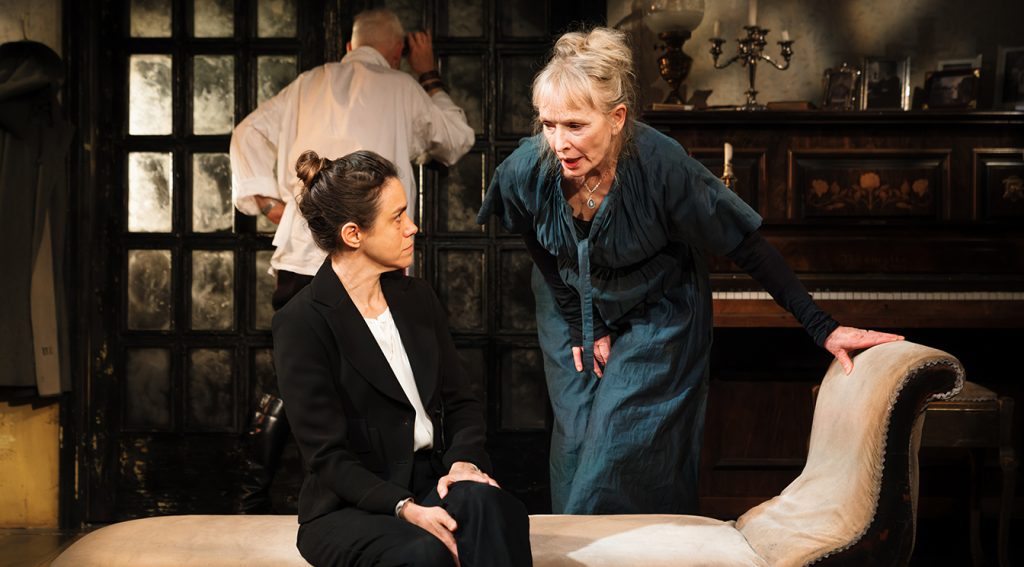
One thing that doesn’t surprise is the fantastic performances from the leads. The always excellent Hilton McRae and Lindsay Duncan are superb. McRae makes his bullish Army man imposing, but so independent and spirited that he still impresses. Duncan shows incredible subtlety while delivering the bluntest lines – viciousness drips from her mouth. While we feel sympathy for her life with her abusive husband, we can see she is a “devil, too”. Both performers show incredible control as the “bile that infects the air” is delivered in a frequently calm, almost deadpan, manner that works as comedy while reflecting chilling desperation.

Lindsay-Duncan-and-Emily-Bruni-in-The-Dance-of-Death-at-the-Arcola-credit-Alex-Brenner
Emily Bruni and Lindsay Duncan

A third role in The Dance of Death, Alice’s cousin, is skilfully portrayed by Emily Bruni. It’s hard not to see the character as overshadowed by the those who play with her – especially since why Alice and Edgar use her is at the back of our minds more than her predicament. Nonetheless, the cruelty behind the play is continually enforced by what happens to Bruni’s character.

Resignation – about all life as much as its end – in The Dance of Death is active, a powerful force. There’s plenty of fantasy, including the deliberate misconstruction of narratives, capably enhanced by lighting and sound design from David Howe and Daniel Balfour respectively. The play should be impossibly grim, but with humour and glimpses of humanity there are surprisingly consoling moments. I wouldn’t want to get an invitation to that anniversary party – these guys are frightening company – but I think it will go ahead. As for getting a ticket to see the show – that is a must.

Until 23 July 2022

www.arcolatheatre.com

Photo by Alex Brenner

“Favour” at the Bush Theatre

Six months and 40 shows into 2022, Ambreen Razia’s new play is the best thing I’ve seen so far. A deceptively simple story about three generations of one family, the script is hilariously funny and deeply moving. Four unforgettable characters are brilliantly realised by a talented cast. 

First up for praise – Favour has a decent plot. Beginning with Aleena’s release from prison, we want to know why she is late? What has happened to her mother, Noor, and daughter, Leila, while she has been away? And why was she in prison? Family secrets and feelings are revealed with skill under the careful direction of Róisín McBrinn and Sophie Dillon Moniram. It isn’t all doom and gloom either – there’s a magical fantasy scene for Aleena and Leila with “sugar and TV allowed” that is winning. As for why we care so much – the answer comes with Razia’s excellent characters.

With Aleena, Avita Jay portrays a mercurial woman with mental health and addiction problems who is both dangerous and inspirational. The role of Noor is taken by Renu Brindle, who shows us a figure of fraught dignity gradually transforming. The youngest character Leila is exceptionally well written with a mix of smart remarks and naivety that is wry and emotional. Ashna Rabheru, who takes the part, is fantastic, especially in scenes that show the character suffering from anxiety.

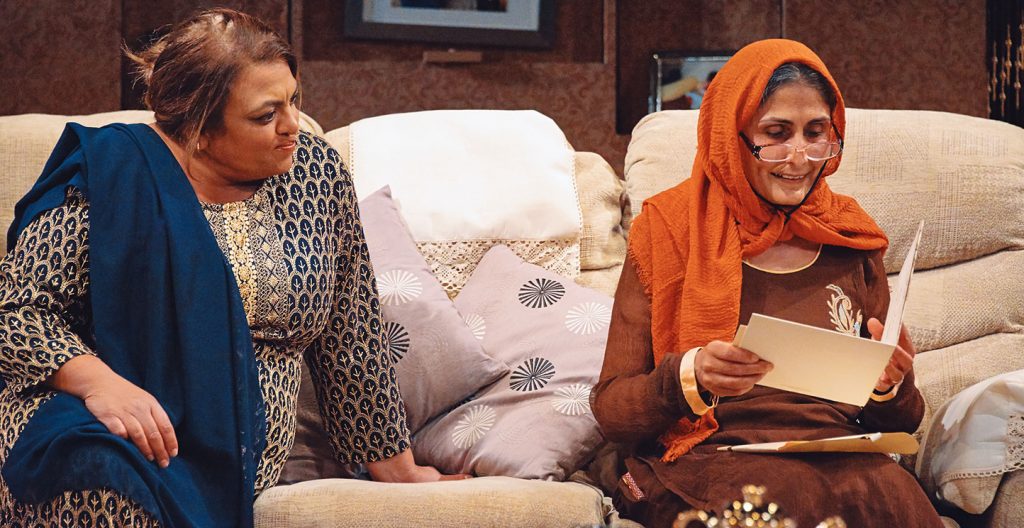
Rina-Fatania-and-Renu-Brindle-in-'Favour'-at-the-Bush-Theatre-credit-Suzi-Corker
Rina Fatania and Renu Brindle

There’s a fourth character too – Fozia, played by Rina Fatania – a busybody whose barbed comments get the audience howling with laughter. Fatania provides brilliant comedy though Fozia is more than a clown (note her departure from the stage).

Presenting different ages could be a clumsy shortcut for conflict.  But Razia is careful to provide depth so that Favour is continuously stimulates. And Razia’s intelligence is seen as the play tackles serious ‘issues’ too. It is notable that this is a story of working-class women and that the play is firmly rooted within a London Muslim community. Furthermore, the play is co-produced by Clean Break (whose members include women with lived experience of the criminal justice system). But this is all addressed with a matter of fact, fresh, feeling; none of these factors define the characters, no matter how much they must negotiate life with them.

Instead of problems, the love that comes with motherhood is the focus of these women’s lives. No matter accusations to the contrary, you never doubt the love the family feel for one another, and this drives the play. Razia has created a dramatic space for powerful reflections and truths. That the youngest character takes the lead is a suitably upbeat conclusion to a superb show.

Until 6 August 2022

www.bushtheatre.co.uk

Photos by  Suzi Corker

“My Fair Lady” at the English National Opera

Visiting the London Coliseum this summer, New York’s Lincoln Centre’s revival of Lerner and Loewe’s masterpiece matches the musical’s classic stature. Like the piece, the production oozes quality from start to finish. The show is as consistently close to faultless as you could wish.

It’s the story of flower girl Eliza Doolittle and her Pygmalion transformation by Professor Higgins and Colonel Pickering. But, of course, you knew that. The way in which the lower-class Eliza is treated by the toffs is handled with as much sensitivity as it can be. Director Bartlett Sher’s adoption of a thoughtful pace allows nuance to come through.

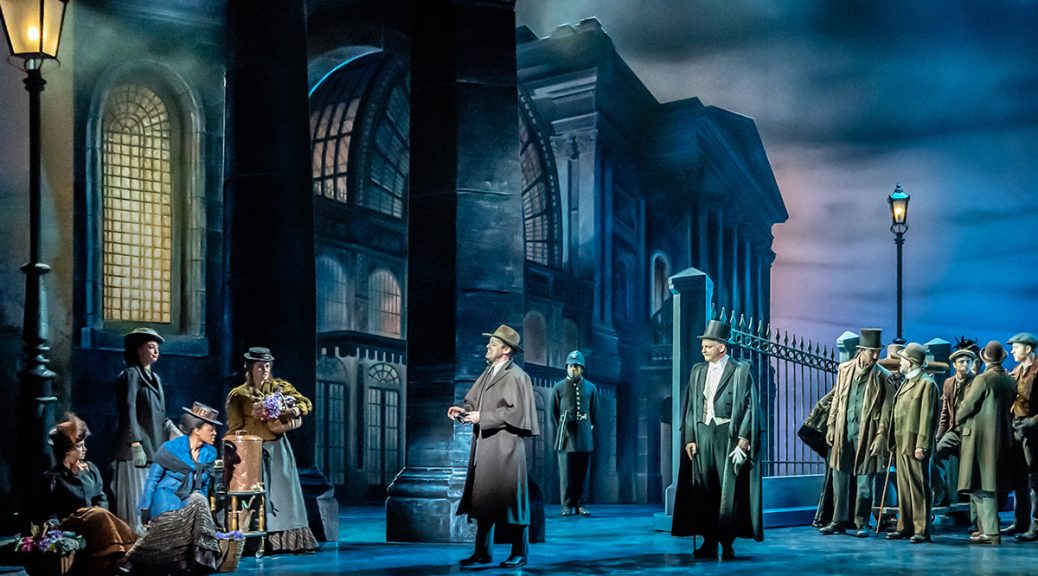
The slow(ish) treatment – there is little action here – might be expected to make the almost three-hour show drag a little. But entertainment is guaranteed by the hit score and the consistently clever lyrics. The cut-out-style sets (Michael Yeargan), including Higgin’s revolving home, are appealing, while the costumes (Catherine Zuber) are full of inventive touches.

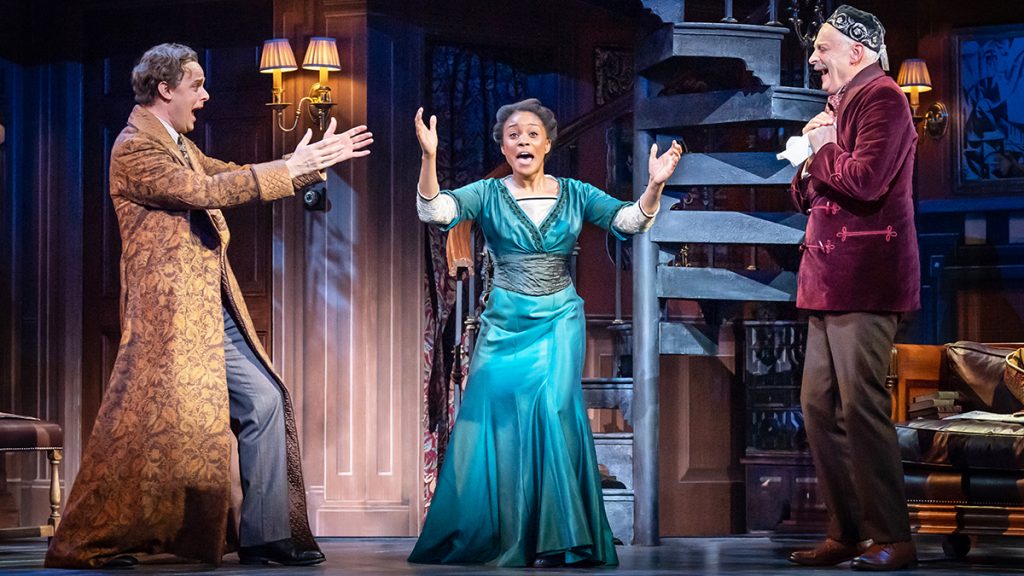
Harry-Hadden-Paton-Amara-Okereke-and-Malcolm-Sinclair-credit-Marc-Brenner
Harry Hadden-Paton, Amara-Okereke and Malcolm-Sinclair

The production’s biggest strength comes with the strong cast. There is excellent support from Shariff Afifi as Freddie, who sounds wonderful. And strong work from Maureen Beattie’s housekeeping Mrs Pearce. Just don’t get too excited for the too brief appearance of Higgins’ mother (Vanessa Redgrave). Malcolm Sinclair takes the part of Colonel Pickering in his stride – an effortless performance that is a joy to watch. Above all, the leads are a delight. Amara Okereke makes an excellent Eliza, balancing the character’s fearful and feisty qualities; her voice is one of the sweetest I’ve heard but can also be full of temper. Okereke manages to make the number Show Me her own. Travelling with the show from the States, Harry Hadden-Paton is a suitably imperious professor with impeccable comic skills.

Sher is respectful of the show’s heritage all the way to the end. It’s a great moment but, overall, the production is a traditional affair. For critics, the show suffers a little in comparison to another US import, a radical reimagining Oklahoma! at the Young Vic. But few will question these performances or the forceful vision behind the show. Making sure a musical like My Fair Lady gets its fair due is a fantastic achievement.

Until 27 August 2022

www.myfairladymusical.co.uk

Photos by Marc Brenner

“Back to the Future” at the Adelphi Theatre

The nostalgic appeal of bringing films to the stage makes them a safe bet for ticket sales. But to make the transition special, some risks need to be taken. Just plonking this story of time-traveller Marty McFly, stranded in the 1950s, on stage isn’t enough. Leaving aside whether Robert Zemeckis’ mid-1980s movie is any good (it isn’t), this adaptation has so little imagination it will only please the most die-hard fans.

Back to the Future is a big show – you get your money’s worth. The production, designed by Tim Hatley, looks expensive. The special effects, especially those with the famous DeLorean car, are impressive. But behind the sleek scene changes, the choreography is disappointing and the fight scenes poor. The action is well marshalled by director John Rando, but what’s going on is dull and the book from Bob Gale is slow.

Hugh-Coles-&-Olly-Dobson-in-Back-to-the-Future-the-Musical-credit-Sean-Ebsworth-Barnes
Hugh Coles and Olly Dobson

Maybe this time travel drags because the characters are thin and the humour weak. Take Marty’s girlfriend, present to provide a ballad, or the school bully given malapropisms instead of jokes. Our hero is bland, which Olly Dobson’s energetic performance does little to correct. The only characters who stand out are Marty’s father and his scientist friend Doc Brown, played respectively by Hugh Coles, who makes an excellent West End debut, and Broadway star Roger Bart. But note how both men use to silly strutting or voices to get laughs – both effortful techniques that tire quickly.

You might forgive this if the score was any good. But both music and lyrics, by the hugely successful Glen Ballard and Alan Silvestri, just aren’t memorable enough. These are tunes you forget before they finish. The lyrics are leaden and long-winded with far too many references to self-help and time passing. It’s frustrating, as the potential is clear – the mix of 1980s and 1950s sounds could be interesting. But what about a musical dialogue between the decades? Instead we have a collection of humourless pastiches lacking any excitement.

While I’d usually be grateful that a show has an original score at all, this music is too close to songs heard in the background of a film, and they cannot hold a stage. Sentimental numbers are particularly painful. Even worse, the songs aren’t performed particularly well. Leaving aside whether the film’s hit number, The Power of Love, is any good (it isn’t), its brief rendition is the evening’s highlight.  Back to the Future ends up a waste of time.

Until 12 February 2023

www.backtothefuturemusical.com

Photos by Sean Ebsworth Barnes

“Jitney” at the Old Vic Theatre

August Wilson’s great play gets a good revival under the directorial guidance of Tinuke Craig. Set in the office of a taxi company (the cars give the play its name) the piece is a close look at a community, full of emotion and drama.

The co-op business is headed by the admirable Becker (Wil Johnson) who is struggling to keep the premises open and about to meet his son who has just been released from prison. Old-time drivers struggle with drink (leading to a sensitive performance from Tony Marshall) or their past, while in conflict with a younger generation. Arguments between the gossiping Turnbo and the aptly named Youngblood are a highlight and make strong scenes for Sule Rimi and Solomon Israel. In all cases, Wilson’s characterisation is impeccable.

Unlike the writing, the performances are uneven. Some scenes feel more rehearsed than others. It’s an odd fault but Johnson – who is outstanding – possesses considerably more confidence than his colleagues which leads to uncomfortable moments. Johnson’s is a performance not to be missed as he portrays his character’s dignity and trauma with considered attention and intense passion. The production sags after Becker and Johnson finally leave the stage.

The play’s 1970s Pittsburgh setting is evoked in costume design and video projections (strong work from Alex Lowde and Ravi Deepres). But the period feel doesn’t always come through in performances – accents are hit and miss and the odd declamatory moment jars.

The production works from firm ground though. There’s an excellent balance between humour and darker moments that shows the writing’s sense of rhythm. And some serious thought-provoking antagonism as younger characters – Becker’s son especially – are told to take responsibility for their lives. Wilson draws us into the characters’ complex lives with consummate skill and Craig’s calm understanding of script’s strengths ensure the revival’s overall success.

Until 9 July 2022

www.oldvictheatre.com

Photo by Manuel Harlan

Tony! [The Tony Blair Rock Opera] at the Park Theatre

You might remember our former Prime Minister’s appeal for Cool Britannia pop stars, or that the man himself was once in a band. But a musical about Tony Blair is still a crazy idea. Which is partly the point of this gloriously mad show from Harry Hill and Steve Brown. Tony! must be seen to be believed.

This trip through Blair’s life and career is crammed with jokes, from simply awful puns to references and catchphrases. But note that you need be a specific age to appreciate the show. The interval saw some frantic Googling and puzzled under-40s.

As a history of New Labour as much as one man, Hill and Brown are so keen not to eulogise their subject that they end up a touch fanatical. The show isn’t scared of offending anyone – which a lot of people commend – and some of the jokes are jaw-droppingly tasteless.

Tony is presented as a grinning idiot. Charlie Baker does well in the lead role. Howard Samuels’ Peter Mandelson is predictably Mephistophelean, but drives the action effectively and gets to do a trick with a balloon. Just how much Holly Sumpton’s Cherie gets out of a Liverpudlian twang is a constant surprise. There are so many cameos I lost count, but I won’t forget Madison Swan’s perfect Princess Diana in a hurry. The joke is that the production is rough, ready and self-referential – I’ve never seen so many bad wigs – and the technique is effective if you have a good memory.

Unfortunately, the musical performances are underwhelming. As for the songs themselves, your toe might tap and the mix of pop pastiche is enlivened by ballroom variations that could be made more of with a bigger band. Tony! is more a revue than a musical, which is fine, but some of the singing is just poor.

It’s Hill and Brown who end up the stars. As well as their comedy careers, they produced the underrated I Can’t Sing and their distinctive sense of humour has a great surreal touch. Combining satire with silliness, you can never quite guess what’s coming next. A lot of it is crazy, some of it cheap and nasty, but I did laugh a lot.

It’s a shame the production doesn’t end happily. But then neither does any career in politics. How to handle the war in Iraq is a concern literally voiced by characters. Inspired by music hall, numbers for Osama bin Laden, Colonel Gaddafi and George Bush aren’t a bad idea. Director Peter Rowe’s efforts to speed up the pace are wise, but the laughs dry up. It’s a shame, really. There’s plenty of talent and clear intention, but it all goes a bit wrong. Now what does that remind me of?

Until 9 July 2022

www.parktheatre.co.uk

Photo by Mark Douet

“Cancelling Socrates” at the Jermyn Street Theatre

Well done to the wag who decided the sign for the toilets should be in both Greek and English at this première of Howard Brenton’s new piece. The bilingualism is indicative of the show’s playfulness and learning – a combination that makes the evening more fun than you might expect.

If you like philosophy in your plays, telling the story of Socrates’ last days is a sure-fire winner. There’s a lot of debate, all of it interesting, and director Tom Littler treats the arguments with swift efficiency. Clarity is appropriate and essential when bringing so much discussion to the stage, and Littler has done a great job.

Socrates’ engagement with future philosophy (more later on how literal this is) provides strong moments for William Reynolds’ lighting design. But, I confess, I found the show increasingly hard work. You’ll spot references to Descartes and Kant and, I think, Deleuze (but don’t hold me to that).

What impresses more is that the constant questioning is given a camp appeal. That Socrates, depicted expertly by Jonathan Hyde, is such a pleasant, genial figure to watch is balanced by the potential threat he poses – combining sincerity with mischievous. It isn’t hard to see why some felt threatened by his famous, continual probing. “But” is said to be a ”lethal” word – and Socrates says it a lot.

When it comes to the famous death, the play lacks an emotional appeal. Again, you could argue that’s appropriate. There is a fine performance from Robert Mountford, who appears as the jailer after having served as Euthyphro, whose eponymous dialogue forms the first scene. The temptation to find contemporary connections, not surprising given the play’s title, pick up pace but raise smiles rather than convince.

Home vs world

The real highlight in Cancelling Socrates comes with Brenton’s focus on women. The characters of Xanthippe (Socrates wife) and Aspasia (who it is suggested was his mistress) make fine roles for Hannah Morrish and Sophie Ward. Both characters feel freer of cliché and fully rounded despite (yet again) presenting two sides to an argument. The scene of them “quarrelling over how to live” is great drama.

The women’s roles take us to the core of an exploration of mysticism and religion within the play, which is a keen reminder of ritual and magic in Ancient Greek culture. Discussion of Socrates “demon” comes with the voice that drives him to argue – the thing that sees him “testing everything to destruction”. This isn’t just a metaphor, but a stage presence, lending some much-needed theatricality to the show. To cram so much into a short piece, with a mostly light touch, is a magical achievement.

Until 2 July 2022

www.jermynstreettheatre.co.uk

Photo by Steve Gregson

“Starcrossed” at Wilton’s Music Hall

Aside from the Greeks, can you think of a play that’s inspired as many others as Shakespeare’s Romeo and Juliet? Rachel Garnet’s 2018 take is to tell the tale from the perspective of Tybalt and Mercutio. And to make the men a new pair of star-crossed lovers.

The idea shouldn’t be a surprise, given how much Shakespeare is played with. But if it sounds a little sensational, think again. Starcrossed is a serious piece – if it has a failing it’s a lack of humour – that shows deep thinking and sensitivity, and a firm grasp on its source material that is super smart.

The development of Shakespeare’s minor characters is a huge success. Yes, Garnet has plenty to work with, but she creates solid, interesting characters that are an exciting prospect for performers.

Mercutio – a “fickle creature” – is a pacifist and an all-round outsider, vividly brought to life by Connor Delves, who has travelled with the show from New York. It’s easy to see Mercutio captivating all he meets with his intelligence and dangerous flair. Tommy Sim’aan takes the role of Tybalt and is just as magnetic to watch. The character’s confusion about his status as well as sexuality are evoked in equal measure and never overstated.

Gethin-Alderman-in-Starcrossed-Photo-Pamela-Raith-Photography
Gethin Alderman

Starcrossed has charm too – which brings us to the final performer, known as The Player, who takes on all the other roles! So, Gethin Alderman becomes Lord Capulet, Paris, Romeo (and Juliet) as well as Tybalt’s father – a great creation whose scenes are a real highlight. Switching so many roles cannot fail to impress, and Alderman adds a playfulness that is welcome.

Tomorrow, and tomorrow, and tomorrow

Garnet’s script is a marvel, a verse play with snatches of Shakespeare (not just from Romeo and Juliet) cleverly incorporated. Stimulating and erudite, this is a text to treasure. It is a credit to the performers and Philip Wilson’s impeccable direction that such learning is worn easily. As with the best Shakespearean productions, we appreciate the wit but don’t feel excluded by it.

Garnet manages to look at the circumstances she creates from the perspective of gay men and pays attention to the history. The couple’s fear and the degree of acceptance they have about keeping their love a secret is moving. There’s a consistent tension in seeing how the script fits into the bigger story, what lines are used or ignored, as well as the exciting speculation about how much change we’ll see.

Best of all, concerns for the future, wrapped up in questions of honour and legacy, are explored with insight and originality. Creating a story “never told” has a powerful impact. Along with Mercutio’s speculation about how lives might be different in 500 years’ time, the idea that so much LGBTQ+ history has been lost is used by Garnet to great effect.

Until 25 June 2022

www.witons.org.uk

Photo by Pamela Raith

“Girl on an Altar” at the Kiln Theatre

For all its emotional power and intellectual sophistication, the triumph of this retelling of Clytemnestra’s story from Marina Carr is its directness. The play is moving and stimulating but, above all, it is marvellously, beautifully, clear. Writing this skilled should not be missed.

In this story of Clytemnestra’s revenge after her husband Agamemnon sacrifices their daughter Iphigenia, every character is incredibly detailed. Each role narrates the action (like a Greek chorus) as well as soliloquising, addressing the audience, and engaging in blistering argument. Flipping effortlessly between approaches is a credit to every performer and Annabelle Comyn’s flawless direction. And the mix, applied with impeccable naturalism, lulls us towards a breathtaking finale.

It is easy to see Carr’s efforts as a welcome feminist take on the story that brings women to the fore. Eileen Walsh is stunning in the lead role, with a performance that is raw but also calculating. Walsh cannot be praised enough. But there are also strong role for her servant, Cilissa, and Cassandra, played by Kate Stanley Brennan and Nina Bowers respectively, who have their own stories fully realised.

And let’s not underestimate Carr’s achievement, as the role of alpha-male Agamemnon, and the performance from David Walmsley, are just as strong. Can the daughter-killing-tyrant really have any defence? Believe it or not, Carr plays devil’s advocate and puts forward some strong sophistry. You can almost… possibly… feel a little sorry for the hero? In a play obsessed with war, and what war does to men, Agamemnon is trapped by politics, machismo and battle lust – the latter so vividly evoked by bloody and metallic imagery that you can practically taste this play.

Clytemnestra and Agamemnon still love each other – adding further impact to the tragedy. Carr shows how grief can transcend all as Agamemnon says his wife is “moving somewhere beyond men and women”. In a pivotal scene of seduction, Walsh seems to overpower Walmsley physically as much as emotionally. It must be seen to be believed and is a credit to both performers. This is a superb text – daring and original – executed expertly. 

Until 25 June 2022

www.kilntheatre.com

Photo by  Peter Searle

“The House of Shades” at the Almeida Theatre

Beth Steel’s new play is a working-class family history with politics… and ghosts. The story is bold – scenes include a home abortion – but overblown, and the overall effect is powerful, if messy.

The family, whose house we watch through the years, is an unhappy one. The events they live through, personal and political, are depressing. Plays normally provide light relief no matter how much time is spent around the kitchen sink, but humour here is, like the characters, bitter.

Steel is brave to make her lead, Constance, so unsympathetic. But despite an abusive background and frustrations around her limited opportunities, the character is impossible to care for. It’s a full backstory for Anne-Marie Duff, who excels in the role, but might Steel alienate us from Constance too much? With a series of scenes that challenge belief, the character is simply monstrous.

There’s no reason why all the spite and anger in House of Shades shouldn’t make good drama. But Constance causes an imbalance in the play. The other characters are reduced to reacting to her or mouthpieces for political positions. Only Stuart McQuarrie, as the long-suffering husband, manages to hold his own.

As for the politics (a big part of the play), a potted history of the Labour party all the way up to Brexit tensions is just a rehash of old arguments. Agree with them or not, there’s too much shouting (which director Blanche McIntyre should have stomped on) and nothing new to hear.

So, what about those ghosts? It is stated that “Death silences no one, least of all the dead.” which might strike you as just silly… but let’s go with it. Having characters reappear and have a say when they are deceased leads to strong moments. These scenes are the best of McIntyre’s generally fussy direction (at least all the messing around with plates and food stops).

Yet well before we get an appearance from Aneurin Bevan (who would be haunted by him?) it’s clear that a good idea has been used to little effect. Like the presence of a chorus style figure (well performed by Beatie Edney) who makes an appearance in two very different guises, there is little new to the drama or argument. There’s no shock, call to action or addition to the debate – just a long play that ends up saying nothing new.

Until 18 June 2022

www.almeida.co.uk

Photo by Helen Murray