“John Gabriel Borkman” at the Bridge Theatre

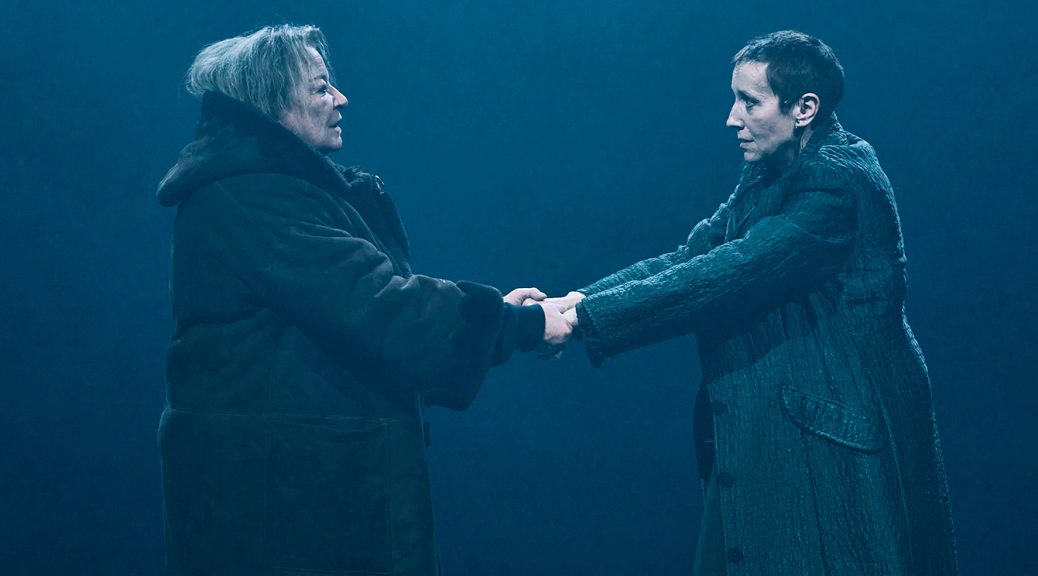
Lucinda Coxon’s new version of Ibsen’s 1896 play gains power from its terseness. Played without an interval, at rapid speed, the story of disgraced banker and his complex family, is an existential exploration conducted in a refined manner.

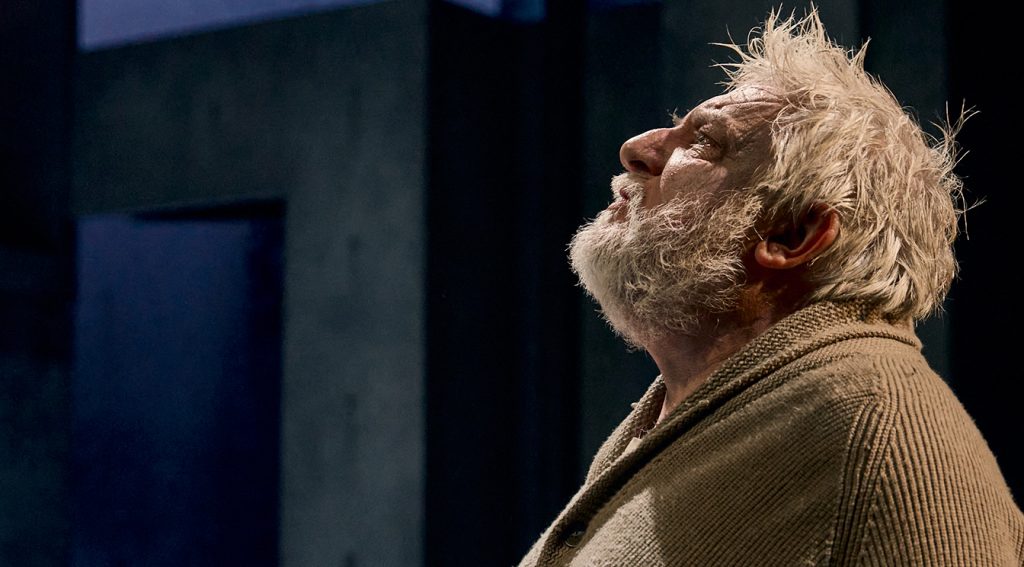
Borkman’s love of money isn’t quite the kind of capitalism we get nowadays, and Coxon refuses to map some kind of Ponzi scheme onto his actions – bravo. This businessman is a more of mystic. His relationship to the earth, albeit exploiting resources, can’t help but seem odd. Taking the title role, Simon Russell Beale manages to make the character’s conviction believable. And the more we hear from Borkman, the more amazing Russell Beale’s achievement becomes.

Along with astonishing misogyny and arrogance come Borkman’s pleas for his innocence (years after finishing his prison sentence). He lives estranged from his wife, Gunhild, in the same home, which is actually owned by her sister, Ella, who is the women Borkman really loves. And it’s not just a love triangle. Ella turns up to ‘claim’ her nephew, hoping he will reject his parents in favour of her. So much for the traditional family unit.

The bizarre dynamics could leave supporting roles out in the Nordic cold. Strong work from Michael Simkins, Sebastian De Souza and Ony Uhiara (as Borkman’s friend, his son and the latter’s lover) avoid the roles being lost. The psychodrama is fascinating… if extreme. But any melodrama is avoided by a dark sense of humour and Nicholas Hytner’s energetic direction. The sparse staging in monochrome tones in Anna Fleischle’s design contrasts with these colourful personalities. 

Two shadows and a dead man

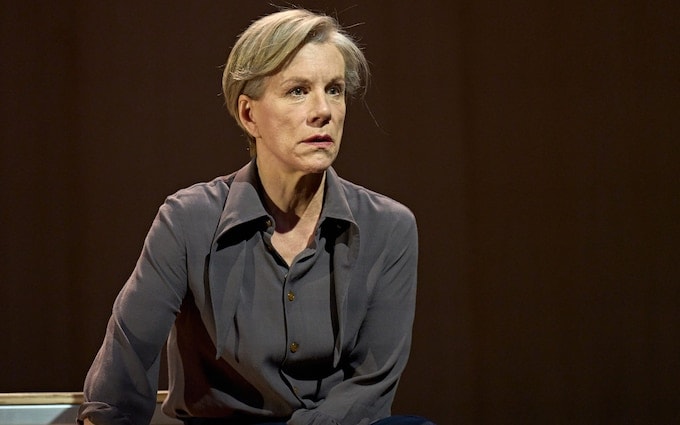
Ella compares herself and her sister to ghosts accompanying the long-deceased Borkman. But her description is wrong – both women are vivid and Borkman full of life. The performances show this admirably. Clare Higgins’s Gunhild is a study of rage, her scorn tremendous. Lia Williams as Ella conveys resignation and desperation in turn, creating a role that’s riveting to watch. Russell Beale is as good as ever as a man utterly deluded yet compelling; Borkman is a caged animal, a wolf, his wife says, containing tremendous power while possessing… none. The bleaker the situation for all three, the more potent the play becomes.

Until 26 November 2022

www.bridgetheatre.co.uk

Photos by Manuel Harlan

“The Cherry Orchard” at The Yard Theatre

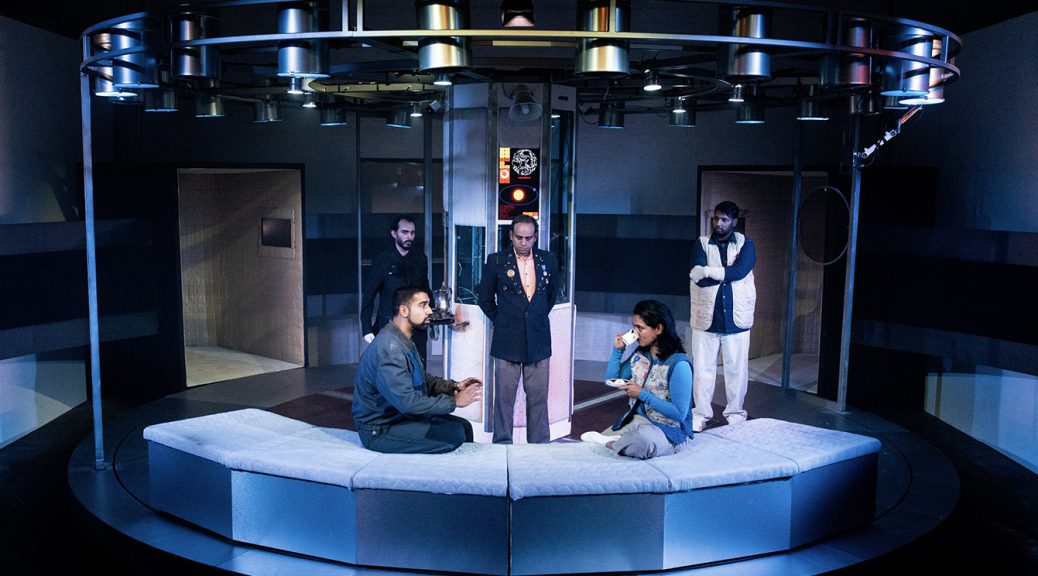
Chekhov in space turns out to be a great idea. Vinay Patel’s inspired version of the Russian classic has theatre’s most famous trees on a spaceship that is searching out a new home for humanity. The mission is led by successive generations of clones, who have plenty of time to philosophise while those below deck do the work. With a new take on an aristocracy (whose members are actually inbred) and plenty of speculation on the human condition, Patel’s adaptation is stellar.

It makes sense that the astronauts are either wildly busy keeping the ageing ship going or have plenty of time to lounge around displaying a mix of ennui and desperation you can recognise as Russian. But Patel’s version stands happily on its own – you don’t have to know the source material. True, some dialogue is clunky (maybe it seems strangely dated)? But the characters are dealing with the weight of the past, even if the action is set in the future. The mission started centuries ago and how much old aims and rituals should shape lives becomes a burning question.

The performances are overall good – but not all are great. While Patel handles the classic plus another genre on top, juggling both proves too much for some actors, who seem stuck in a more traditional version of the play. There’s some waving of hands (ironically, explicitly warned against in the script) and stagey yawning (you know the type). And some delivery emphasises rather than accommodates long-winded speeches. It should be stressed that possibly the hardest role, a reimagining of the play’s manservant, isn’t part of these reservations. Despite being literally robotic, Hari Mackinnon’s Feroze is full of life.

Thankfully, a central trio of relationships – between the Captain, one of her daughters and an aspiring engineer – is strong, with excellent performances from Anjali Jay, Tripti Tripuraneni and Maanuv Thiara, respectively. Jay’s matronly role is aided by a focus on the fate of her son that leads to emotional moments. Her character aims to be “warm but at a remove”. That she does not quite manage this gives Jay a great deal to work with.

The production glides over some of the odder moments of Chekhov – the characters’ strange emotional intelligence and obsessions – which Patel, wisely, doesn’t linger on. All that misery and unrequited love can prove tiring if the pace isn’t strict, and director James Macdonald handles this perfectly. There’s also an atmosphere of menace that is particularly impressive.

Final praise goes to the convincing design. Even a decrepit spaceship on a budget isn’t easy, but Rosie Elnile makes shabby touches work for her. And her design suits the space perfectly. The use of a revolve and windows in the ship are simple, subtle and effective. Which really sums up the whole production. Behind the headline of a radical new version, the show works in a clear and concise manner.

www.theyardtheatre.co.uk

Until 22 October 2022

Photo by Johan Persson

“Brown Boys Swim” at the Soho Theatre

Karim Khan’s play deserves the acclaim it received at this year’s Edinburgh Festival and it’s easy to recommend seeing this London transfer. The story of two school friends learning to swim so that they can attend a pool party starts out charming, takes on the issue of racism boldly and has a big sting at the end.

The play serves as an excellent showcase for the talents of Anish Roy and Varun Raj, who play Mohsen and Kash respectively. Both boys are smart but very different – the performers show this skilfully. Kash’s bravado means Raj can bring some humour to the show, while Mohsen’s sensitivity and diffidence are clear from Roy’s performance. There are laughs, ahhhs and a real sense of getting to know these guys.

The friendship is endearing and makes a clever vehicle for showing the everyday racism Khan investigates. It is heart-breaking to see how teenage insecurities are enhanced by stereotyping. That prejudice infuses their lives is clear to both characters, and their discussions on how to deal with it provide engaging arguments. Khan’s highlighting exclusion – how that engenders privilege – is instructive.

The accomplished script is matched by an excellent production. John Hoggarth’s direction has bold moments that create the sensations of swimming in a poetic fashion. And the show is paced perfectly, allowing time to breathe between some very short scenes. The lighting by James Bailey is excellent at complementing quick changes of setting and tone, and James Button’s design is exemplary – a simple set with two benches that takes us to mosque, gym, bus and, of course, swimming pool.

As for the twist at the end of Brown Boys Swim, I don’t want to ruin it. But a cruel revelation brings home the affection between the boys and makes a case for how deep the consequences of racism are. Khan, like his characters, has an eye on the future that makes the ending of his short play painful but sure to live long in the memory.

Until 15 October 2022

www.sohotheatre.com

Photo by Geraint Lewis

“The P Word” at the Bush Theatre

The letter in the title of Waleed Akhtar’s play covers two insults – slurs against people from Pakistan and homosexuals. The play makes important political points with clarity and skill. Still, the best moments come when the writer confounds expectations.

The P Word is a close examination of two very different men. Bilal (or Billy) is British and deliberately written as unlikeable. His life is work, the gym and Grindr. It’s a harsh view of gay culture, and any humour is bitter. It takes time to appreciate the problems the character faces, a journey the author Akhtar, who performs the role, tackles superbly.

Audience sympathy is channelled towards Zafar, who is seeking asylum having fled Pakistan when his homosexuality was discovered. Esh Alladi brings an intense energy to the role, which is agitating to watch. Anxiety surrounding the future and the trauma Zafar is running from are depicted with sensitivity. But it’s moments of joy, despite everything, that add originality and appeal most. What Zafar goes through is a wakeup call, delivered with conviction, that many need to hear – and the theatre has worked with the charity Micro Rainbow during production.

The two stories are told in tandem, woven together in the skilled script and by Anthony Simpson-Pike’s strong direction. Presenting the men in such detail – so they aren’t just cases or examples – leads to examining prejudices and provides insight especially into the characters’ sad self-hatred and questionable behaviour.

'The-P-Word'-inset-at-Bush-Theatre-Photo-credit-Craig-Fuller

The P Word gets even better when the men meet. A friendship that develops with fits and starts acknowledges how complex their lives are. The performances blossom, but will romance?

There’s tension around this love affair, some coming from the fact that the characters see themselves as an unlikely couple. And, of course, there’s Zafar’s potential deportation. To avoid plot spoilers, let’s just say the play becomes both exciting and rousing. What impresses most is Akhtar’s clever handling of the sentimental, which leads to a superb finale.

Until 29 October 2022

www.bushtheatre.co.uk

Photos by Craig Fuller

“Sherlock Holmes and the Valley of Fear” at the Greenwich Theatre

Director and writer Nick Lane has experience when it comes to Arthur Conan Doyle’s work. A previous adaptation of The Sign of Four was entertaining but this new production is even better – harder working and more serious. In addition to a fine mystery story, a “snorter of a case” for Sherlock Holmes, we get romance in America’s Wild West. Sherlock Holmes and the Valley of Fear is great value, high quality theatre.

Lane’s adaptation is smart. Flipping back and forth between crimes in Sussex and Pennsylvania is a sensible change from the source material and is impeccably handled. Tristan Parkes music for the show aids comprehension and creates atmosphere.

The lead performers are experienced, too. Luke Barton is an energetic and sometimes playful Holmes. Joseph Derrington is an affable Watson you can care about. Watson’s narration is a highlight – wonderfully clear – while identifying Holmes as the one with “the true flair for drama” shows both the character and Lane as astute observers, adding insight and theatricality to the master detective. Barton and Derrington have fantastic chemistry and there is a tender moment between them, superbly acted, that is further neat addition on Lane’s part.

Blake-Kubena-and-Alice-Osmanski-in-Sherlock-Holmes-The-Valley-of-Fear-credit-Alex-Harvey-Brown
Blake Kubena and Alice Osmanski

There’s more, namely the valley of fear itself, which we visit a lot. The supporting cast takes on a lot of roles. Blake Kubena makes a fine romantic lead, while Gavin Molloy has a good line in psychopaths (there’s a bold twist in the adaptation here that’s a real delight). Alice Osmanski is particularly hard working with characters that are less well written and a lot of costume changes (well done to designer Naomi Gibbs).

Even Barton and Derrington double up roles. The extra parts they play make clever contrasts and they perform them well. The production does need another body (two more wouldn’t hurt), but the cast gets to impress by bringing so many characters to life. A great job from start to finish with big brains behind it.

On tour until 26 November 2022

www.blackeyedtheatre.co.uk

Photos by Alex Harvey Brown

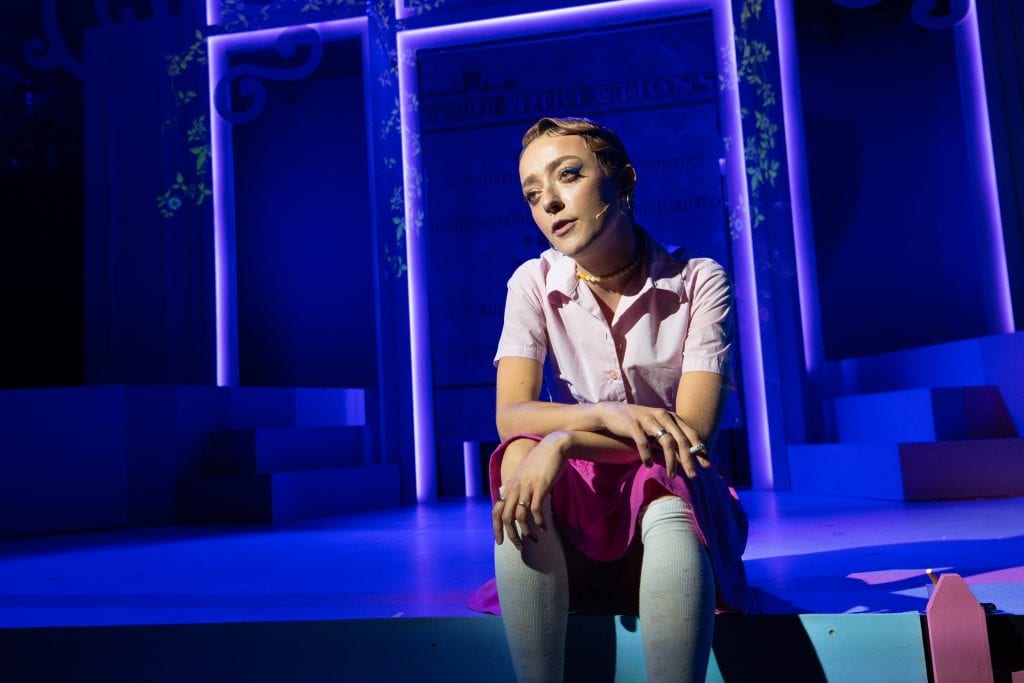
“Help! We Are Still Alive” at the Seven Dials Playhouse

What a sweet little show Tim Gilvin and Imogen Palmer have made. Imagining a couple after the apocalypse, making a life together that’s a bit like lockdown (but in this case without the baking), this play with songs is entertaining, endearing and obsessed with comfort food.

Palmer’s book takes the cliché about falling in love with the last person on earth and adds extra flavour – think Worcester sauce on your cheese on toast. Because Jass and Finn were a couple in the ‘old world’… yet she has a secret. Even after world catastrophe, true love doesn’t run smooth.

The action relies too much on audio diaries for exposition, going back and forth in time. Director Georgie Rankcom tries hard to keep the action moving and uses the sparse stage well. Gilvin’s music and lyrics are catchy and satisfyingly neat but leave you wanting more.

If this reaction seems lukewarm, like a pizza slice from Gregg’s after five o’clock, then why am I so keen on the show? And I really am. The answer is its humour, its characters and its performers.

Jass and Finn are adorable. For want of a better description, they are as cute as chocolate buttons. Their affection for each other is believable, as are their problems, sensitively examined in the light of their self-proclaimed Queer status. Deep-rooted anxieties and misgivings are intelligently explicated and – surprise – they have little to do with the end of the world.

The glacé cherry on top of the Mr Kipling cake is the show’s humour. This is what makes Help! We’re Still Alive memorable. With songs about canned pineapples and supermarkets, the mix of quirks and down-to-earth concerns is just… lovely. The jokes provide that je ne sais quoi, as Jass might say, that great shows require.

Elijah Ferreira and Jade Johnson play Finn and Jass. The casting and the chemistry are perfect – they are both superb comedians who aid the script enormously. Angst is acknowledged, but Ferreira and Johnson make you care and try to reassure.

The affection and respect the characters share give us a sense that things will be all right in the end. After all, even if your Ginster’s pasty is cold, it is still delicious.

The affection and respect the characters share give us a sense that things will be all right in the end. After all, even if your Ginster’s pasty is cold, it is still delicious. The affection and respect the characters share give us a sense that things will be all right in the end. After all, even if your Ginster’s pasty is cold, it is still delicious.

Until 15 October 2022

www.sevendialsplayhouse.co.uk

Photo by Danny Kaan

“Handbagged” at the Kiln Theatre

It feels odd to watch not one but two versions of Queen Elizabeth on stage so soon after her death. A respectful minute’s silence before last night’s show, lead by director Indhu Rubasingham, indicates careful thought has gone into letting Moira Buffini’s five star play go ahead.  But for all the fun in this hilarious piece, which cheekily imagines the Queen’s private meetings with her Prime Minister Mrs. Thatcher, her Majesty comes off very well.

That public statements were not allowed to our constitutional monarch means Buffini can make the Queen a contrast to the Prime Minister. Turns out the richest woman in the world had a lot of concerns about social inequality. And her passion for the Commonwealth gives a global perspective in contrast to Thatcher’s little Britain. But there’s also tenderness in Buffini’s writing about the Queen – she’s presented as a fun, witty woman and a caring mother.

All the Queen’s admirable qualities are conveyed by the actors taking on what must be a particularly challenging role right now. Both Abigail Cruttenden and Marion Bailey, as younger and older versions respectively, give strong performances and make a lot of the lines even funnier than they already are; you could happily spend the night watching Bailey’s every expert move.

Buffini is harder on Thatcher. The role is written with more anger and is possibly closer to caricature. The performances from Naomi Frederick and Kate Fahy respond appropriately. Frederick, as the younger version, manages to suggest nervousness about dealing with a figure she reveres that generates a little sympathy. Fahy’s line in dignity, as she looks back on her time at the top, is convincing no matter her views. The scorn with which both women can say the word ‘socialist’ or ‘wet’ is tremendous.

The way all four characters interact as they try to take charge of the story about Britain during the Thatcher years is hilarious. The blend of sarcasm and sincerity is perfect – the quartet of perspectives battle to tell and interpret what happened. The subject of Thatcher’s dementia provides a moving moment and yet another layer of consideration about interpreting the past. Buffini’s script is dazzling and you don’t want to miss a word.

There’s more to Handbagged than some fantastic comedy and strong impersonations – although both of these make the show a must-see. Two more characters join the stage – ‘Actors’ played by Romayne Andrews and Richard Cant who also impress as a variety of famous faces with great lines. The main role of these super supernumeraries is to highlight what putting on a play – and a play about history – entails.

Pointing out what Thatcher and the Queen don’t want to discuss, slowing down the show to their frustration or embarrassment, the ‘Actors’ interjections are often funny and make sure that their characters are satisfyingly full. Attempts at directing these powerful women are brilliant moments, aided by the show’s real director too. Rubasingham directed the first production of the play, almost ten years ago, and her knowledge shines through, brimming with joyous confidence about the strength of what’s on stage: the respectful, you might say faithful, approach to this modern classic seems very much in keeping with our times.

Until 29 October 2022

www.kilntheatre.com

Photo by Tristram Kenton

“Frozen” at the Theatre Royal Drury Lane

Everybody knows what they are getting when Disney puts a show on stage. And that’s not just the story – in this case a fairy tale about a magical queen and her sister – and the songs, but what every scene will be. I’m not sure it’s the best introduction to theatre, but Disney does bring its films to the stage very well.

In the case of Frozen, the book, by the film’s writer Jennifer Lee, is sweet and has some surprises. This fairy tale focuses on two female leads and there’s some complexity in their characters. They make nice roles for Samantha Barks and Stephanie McKeon. And the romantic interest isn’t what you might expect – or maybe it is, Prince Charming has had a bad rep for a quite a while, after all. Regardless, there are strong supporting roles for Obioma Ugoala and Oliver Ormson (the latter very much a cartoon villain) that carry a moral well… if not lightly.

The songs, with music and lyrics by Kristen Anderson-Lopez and Robert Lopez, are simple but are effective: pleasant rather than memorable (though many younger fans are likely to disagree) but with a good mix of power ballads (which Barks does very well with) and waltzes. The latter are a nice touch. We want some old-fashioned costumes, after all, and Christopher Oram’s work here is lovely. The humour is better than might be expected, the snowman Olaf (Craig Gallivan, with puppet design from Michael Curry) has a good number.

Make no mistake that Frozen is a kids’ show to its core. So, for me, it’s the staging and the special effects, designed by Jeremy Chernick, that are the first highlight. Oram’s scenic design is impressive and Finn Ross’ video work adds immeasurably. The kids really do want to see the film on stage. There’s a superb reveal and, after that, the appearance of Elsa’s pig tail gets its own squeal of delight.

Cast-of-Disneys-Frozen-photo-by-Johan-Persson
Rob Ashford’s engaging and inventive choreography

A quick pace is adopted by director Michael Grandage that hides potential dull moments. Rob Ashford’s engaging and inventive choreography is the second high point. Using the ensemble to create atmosphere or even suggest scenery – an especially strong moment – makes a nice contrast to high-tech touches. Frozen looks expensive and is sure to leave (younger) members of the audience breathless. For me, its genuinely theatrical touches are even more exciting.

www.frozenthemusical.co.uk

Photos by Johan Persson

“Antigone” at the Regent’s Park Open Air Theatre

Inua Ellams’s adaptation – after Sophocles – is a strong piece full of bold thinking. As a play about democracy, the work feels timely. And there is a passion to both the writing and the production that creates a formidable energy.

Antigone is re-imagined as a youth leader from a Muslim background. One of her brothers becomes a police officer and the other a terrorist. It’s the latter who is denied a burial by Prime Minister Creon, who passes oppressive anti-terrorist laws and gets rid of the bill of human rights.

The changes are though-provoking and benefit from fulsome characterisation: not just Zainab Hasan’s lead role, which she performs with aplomb, but all Antigone’s family, who are depicted with equal care. The result is great roles for her brothers Eteocles and Polyneices, played by Abe Jarman and Nadeem Islam respectively. And her sister Ismene, played by Shazia Nicholls, is far more than the usual foil. Creon, who has been looking after the family, is made a strong study in power and Tony Jayawardena’s performance in the role is superb.

Ellams’s appraisal is full of intelligence, leaving the efficacy of protest an uncomfortably open question. Our heroine is released from prison through public opinion rather than debate – it’s ratings that count for rulers. And Ellams has a strict eye on privilege; it’s made clear that Antigone and her family have power. The roles of Haemon and Eurydice come to the fore, making important parts for Oliver Johnstone and Pandora Colin who bring a great deal of emotion to the show.

Sections of the script in verse are the highlight: Ellams’s language brings force to the stage. But while the choreography from Carrie-Anne Ingrouille is good, the music by Michael ‘Mikey J’ Asante is overpowering. Sound is often tricky at Regent’s Park but isn’t the only problem in the production. Ellams’s plotting is great – this Antigone is exciting – but Max Webster’s direction feels rushed. A fast pace doesn’t always make a play more thrilling; the production comes across as nervous.

There are, also, tensions between the original and what Ellams’s has made from it. The contrasts are welcome but cause clucky moments. The remnants of Sophocles’s play, like the characters’ names or concerns for the city state, lead to stumbles. The show needs more change rather than less. Overall, this isn’t a big problem. And the solution seems easy – keep the structure of the source but do away with the ornament – but it does stop good ideas becoming great theatre.

Until 24 September 2022

www.openairtheatre.com

Photos by Helen Murray

“Who Killed My Father” at the Young Vic

One area of director Ivo van Hove’s considerable expertise is monologues. As with a former fantastic production, Song From Far Away, close work with a single performer and an intense script can yield powerful results. This show, starring Hans Kesting, shares potent subjects and fantastic acting that deserves acclaim.

Adapted by van Hove from the book by Édouard Louis, Kesting takes the author’s voice as well as depicting his parents. Growing up gay in rural France, dealing with his father’s homophobia and violence, are exposed in harrowing detail. These sections have undoubted force.

Yet the title tells us this is a work about a father as much as a son.  It’s a memoir and a political lecture. How the father is a victim of violence himself – by the ruling classes – is Louis’ concern. Along with the repercussions on both men in the past and present. How the personal and the political imbricate is the point laboured. But I’m not sure it works here. And it’s not because Louis is incorrect. The source material (and Returning to Rheims by Didier Eribon which covers similar ground, if you’re looking for further recommendations) is worth reading. The problem lies with the adaptation.

The “negative existence” of the father’s life arrives too late. It’s understandable that the author discovered this as an adult. But for the audience, there’s a lot of Louis – and the trauma around a childhood performance of a pop song – to get through first. Dramatically, the impact of life limitations on his father feels rushed. The theatricality of the show is aided by Jan Versweyveld’s sound and lighting design. But van Hove’s adaptation sells his source material short and given the director’s track record, that disappoints.

Until 24 September 2022

www.youngvic.org

Photo by Jan Versweyveld