Tag Archives: Shakespeare

“King Lear” at the Almeida Theatre

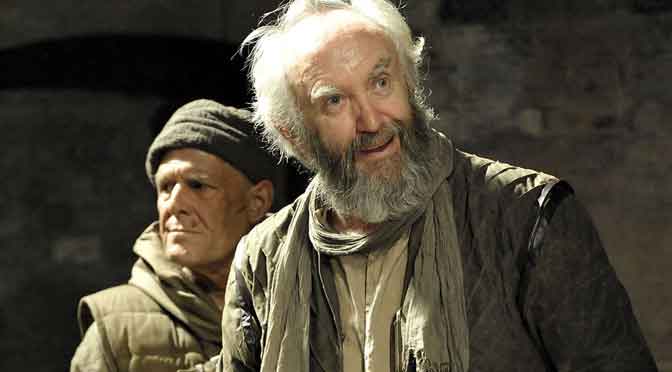
London audiences are spoilt when it comes to stars and Shakespeare. Depending on their age, anyone aspiring to credibility tackles Hamlet or King Lear, and we all get to benefit from the results. Among the exciting celebrity strewn shows, none is more splendid than Michael Attenborough’s latest production of King Lear at the Almeida, with Jonathan Pryce in the title role. Not only is Pryce gut-wrenchingly good – every aspect of this riveting production deserves praise.

Pryce’s Lear is full of subtlety and dynamism. By turns forceful and frail, he makes the character’s decline unbearably moving, even while injecting an unusual degree of humour into the role. But any banter comes with a steely edge – this is a man used to people laughing when he tells a joke. There is a residual power that makes it easy to imagine what kind of ruler he was.

There are also fine performances in the supporting roles, especially from the women in the cast. Phoebe Fox is a spirited Cordelia whose prickly edge makes it easy to identify her as her father’s daughter. Zoe Waites and Jenny Jules play Goneril and Regan with a terrifying ferocity that remains credible despite the extremity of their actions.

Tom Scutt’s design makes the most of the stripped-back venue, evoking prisons and army camps, adding to a tense production that at times is paced like a thriller. Attenborough’s attention to detail is captivating – watching the actors’ hands, as they reflect emotions from repression through to violence, becomes compelling. You will be gripped the whole way through.

Until 3 November 2012

www.almeida.co.uk

Photo by Keith Pattison

Written 12 September 2012 for The London Magazine
“Troilus and Cressida” at the Riverside Studios

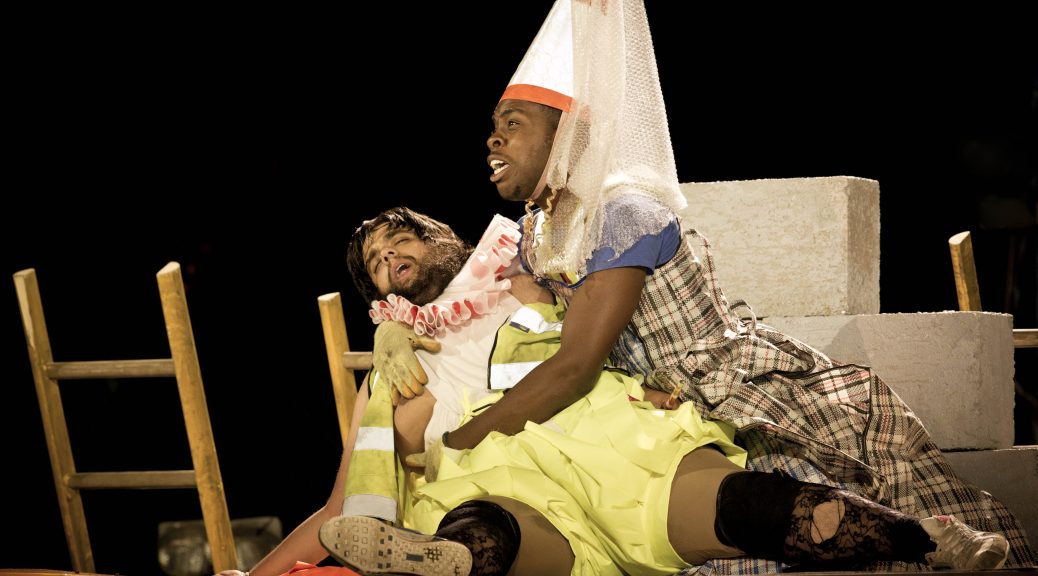
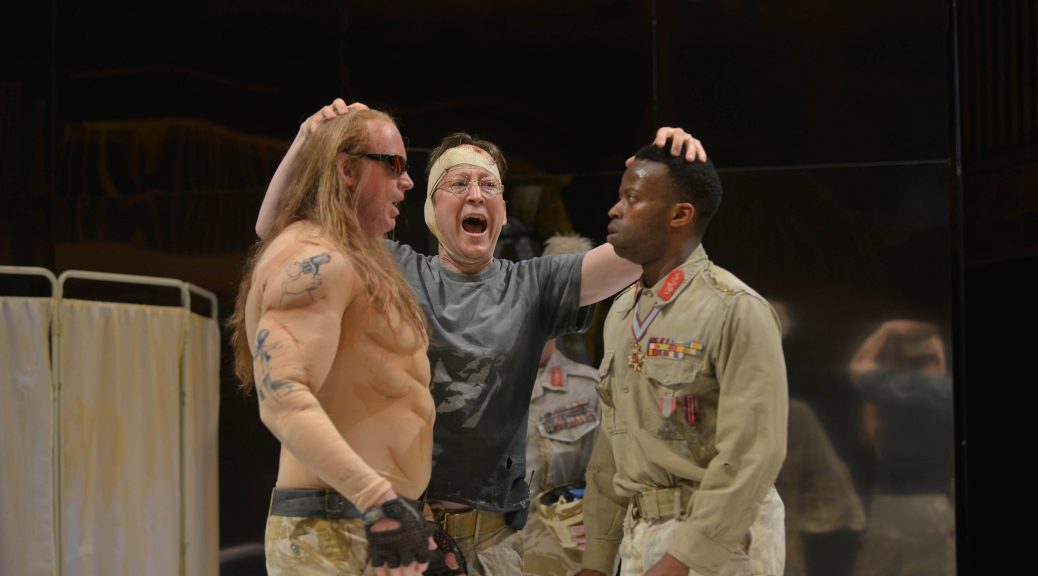
The World Shakespeare festival, which this new production of Troilus and Cressida at the Riverside Studio includes, has made audiences more familiar with radical versions of the canon. But this co-production between the RSC and the renowned American company, The Wooster Group, is staged in such a bizarre fashion, the play becomes confusing and alienating. It doesn’t help that the actors interact with videos mounted on big poles as they perform. This gives rise to seemingly erratic movements which have been prompted by the videos. Frankly, makes the whole show downright odd.

Co-directors Elizabeth LeCompte and Mark Ravenhill set Shakespeare’s Trojan war love story in an unspecified location with Native Americans against contemporary British soldiers. Sort of. The Trojans have futuristic costumes (by Folkert De Jong) and the British troops have a tendency to don drag. You certainly won’t be bored, but there is no balance – the play is made into a puzzle. It’s true that Troilus and Cressida is full of contradictions, but this company is obsessed with abandoning any coherence: the ideas and delivery may be eye-catching, but they add little humour or, more importantly, drama.

It is the actors who suffer most by this treatment with their performances reduced to bizarre cameos. Marin Ireland and Scott Shepherd deliver the title roles in a deliberately monotonous, stylised, fashion. Among the Trojans only Greg Mehrten’s Pandarus manages to break this spell by the force of his stage presence. The British contingent do better (maybe their delivery is more familiar), but Aidan Kelly’s WWF-inspired Ajax and Zubin Varla’s Thersites stubbornly reject any subtlety and quickly become annoying. Scott Handy has a better night of it as an asthmatic Ulysses, but his brief appearance as Helen is such bizarre casting, it jars. Most damning of all, Shakespeare’s text is delivered so differently that comprehension suffers. Whatever points that LeCompte and Ravenhill wish to make are unclear. Most of the plot is lost as well.

Until 8 September 2012

www.riversidestudios.co.uk

Photo by Hugo Glendinning

Written 31 August 2012 for The London Magazine

“Richard III” at Shakespeare’s Globe

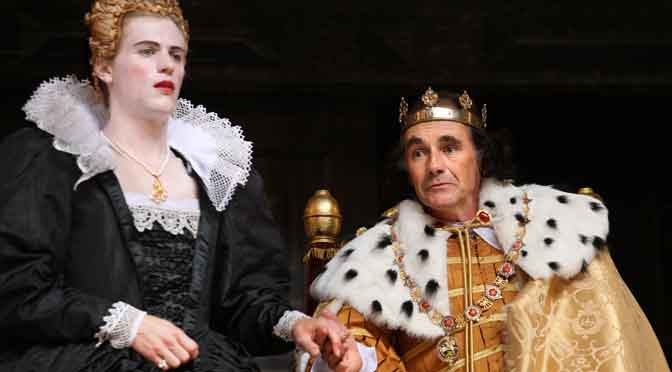
Mark Rylance, former artistic director of Shakespeare’s Globe, makes his return to the theatre in the title role of Richard III. The play is always a star vehicle, and Rylance’s Richard is a stuttering, often jovial figure who gets plenty of laughs. Playing with the theatricality of his character, a smart move that suits Rylance, his conspiratorial tone delights. It takes time to appreciate Richard’s darkness, but when he chooses, Rylance shows a startling, unashamedly psychotic King, making sure his depiction will be one to go down in theatre history.

Alongside Rylance the whole production, under the direction of Tim Carroll, shows skilful pacing. The speed of the action is breakneck but the riveting ensemble seize the attention masterfully. Special notice must go to Roger Lloyd Pack as the King-maker Buckingham, matching Richard in his cynical malevolence up to the point of murdering the princes in the Tower: when Lloyd Pack exits to consider the usurping King’s request, it is a moment of great tension, superbly performed.

This is an all-male production. Without revisiting the debate on this approach, and stressing that those taking on female roles give superb performances (especially Johnny Flynn, who plays Richard’s unwilling wife Anne), the move is indicative of a traditional approach to the play. There’s no dwelling on the history here or the superstition rife in early modern society – Shakespeare took both for granted after all. The emphasis is on drama and entertainment.

Thoroughly at home on his old stomping ground, Rylance leads the cast in exploiting the dominant feature of the Globe – its ability to encourage audience participation. Whether it’s knowing glances that create complicity or shared outrage at Richard’s demonic actions, Carroll’s production is always engaging. With direct appeals for cheers as he is encouraged to take the throne, Richard gets the applause Shakespeare’s play has denied him as a figure in history – in the case of this production, the cheers are well deserved.

Until 13 October 2012 and then transferring to the Apollo Theatre from 6 November 2012

www.shakespearesglobe.com

Photo by Simon Annand

Written 26 July 2012 for The London Magazine

“Timon of Athens” at the National Theatre

While directors seldom shy away from interpreting Shakespeare, sometimes searching almost perversely for a spin that promotes their production, Nicholas Hytner’s Timon of Athens offers something different. As Shakespeare’s least known work, we have the unusual situation of an audience coming to the show fresh. As a result, the new production at the National Theatre makes a remarkable contribution to the World Shakespeare Festival, presenting a contemporary sounding voice that demands to be heard.

Timon of Athens contains more parable than plot and traces the downfall of the eponymous protagonist, who is ruined by his generosity in a mercenary world. It’s easy to see the writing on the wall for Timon, but filling the play with contemporary references, setting the action in Canary Wharf and Parliament, and casting the rebel Alcibiades as a political protestor in the mould of ‘Occupy’ movement, give the production a powerful resonance in our financially unstable times. It’s a wicked world out there; you’ve only got to watch out for the on-stage product placement from Jaeger to have your cynicism reinforced.

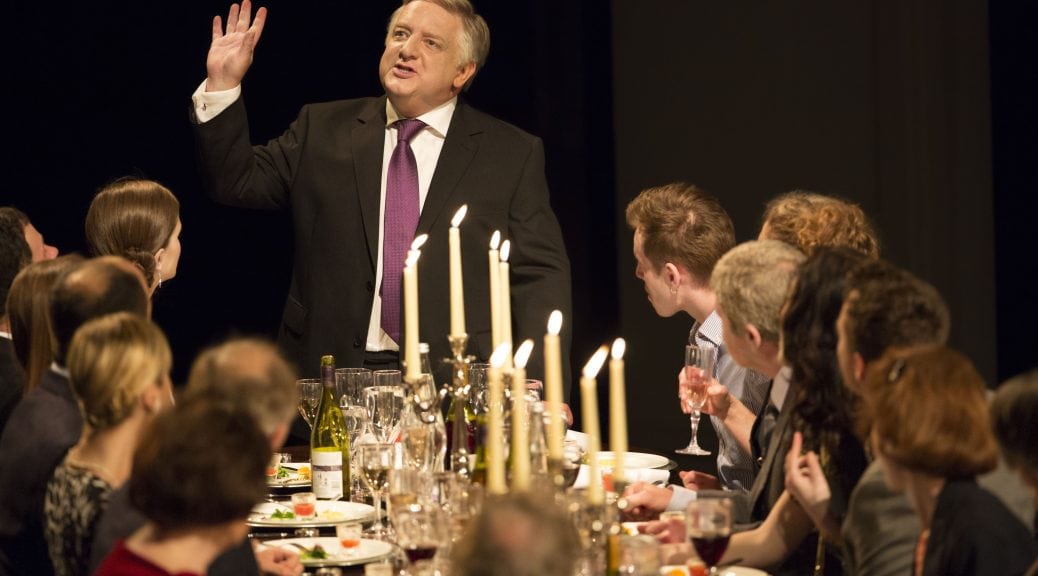
The play’s main fault lies with its characterisation but Hytner’s cast manages to deal with this. Deborah Findlay is superb as Timon’s steward, adding emotional punch to the play, while Hilton McRae is excellent as the philosopher Apemantus. In the lead role, Simon Russell Beale gives a magnificent performance: his powerful presence matches the play’s directness – there are no byways here, just a monotonous misanthropy. Few actors could carry the violence of Timon’s language, his prayer of vengeance, this convincingly. Both Russell Beale and Hytner convey the bleakest view of humanity, making Timon of Athens the National’s most radical, challenging production for quite some time.

Until 31 October 2012

www.nationaltheatre.org.uk

Photo by Johan Persson

Written 18 July 2012 for The London Magazine

“The Taming of the Shrew” at Shakespeare’s Globe

The Taming of the Shrew is surely Shakespeare’s most objectionable play: its politics can’t help offending a modern audience and its conclusion leaves a bitter taste – never a good move for a comedy. But director Toby Frow’s new production at Shakespeare’s Globe comes as close as possible to redeeming the piece. With a simple approach, Frow makes sure we don’t take the misogyny too seriously, expanding the comedy and saving the show in masterful style.

Frow, aided in dealing with the text by Samuel Adamson, adds plenty of slapstick and interjections that enliven frankly duller moments and acknowledge that few of us are up to speed with Shakespeare’s verbal dexterity. The result is two fold. The ensemble truly excels with even the smaller roles shining: Pearce Quigley’s deadpan Grumio is just one example, and the often sickly sweet lovers Bianca and Lucentio get to have a go, with superb performances from Sarah MacRae and Joseph Timms. Secondly, Frow establishes a fantastic, farcical rhythm (often quite literally – his use of music in the production is inspired) that escalates wonderfully. There’s a touch of One Man, Two Guvnors sometimes and more than dash of Carry On. And why not, if it works?

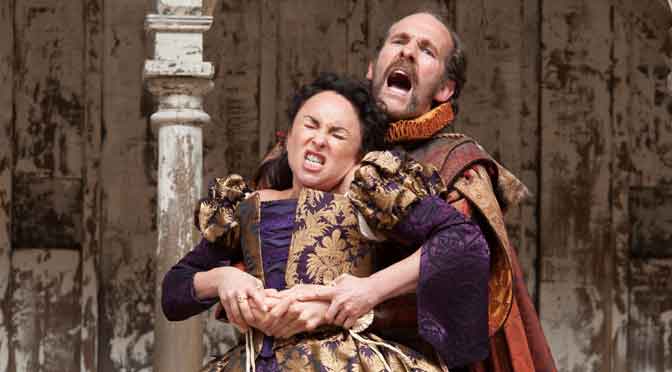
When it comes to the most unpleasant aspects of “taming”, Frow exploits the play’s dream theme and also sets up a relationship between Katherina and Petruchio that treads a fine line between feigned lunacy and the possibility of equality – this is a subtle, complex relationship underneath the broad comedy and works through the intelligence of its lead performers. Simon Paisley Day plays Petruchio in fine bombastic style, believable as the “devil” people describe him as and reducing the audience to fits of laughter. But his intended is more than a match, with Samantha Spiro putting in a tremendous physical performance as a head-butting, door-bashing Kate that steals every scene. Even if you can’t understand why anyone would want to tame Spiro’s shrew, you can still laugh along at the attempt.

Until 12 October 2012

www.shakespearesglobe.com

Photo by Manuel Harlan

Written 5 July 2012 for The London Magazine

“Henry V” at Shakespeare’s Globe

The Globe has a special relationship with Henry V: the play opened the new theatre and any bardophile is sure to thrill at the lines referring to “this wooden O” when they hear them in situ. With the bunting still out on the streets, Shakespeare’s most patriotic king is in tune with this summer. Henry’s rallying “once more unto the breach” is addressed so directly to the audience that it receives spontaneous applause. And it is richly deserved: Dominic Dromgoole’s new production is a triumph.

Droomgoole is too intelligent a director to reduce Henry V to jingoism. Fully at home in The Globe, he brings out the nuances in the play with all its bittersweet humour. There’s a tremendous performance from Brendan O’Hea as the leek-loving Welshman Fluellen, providing a cynical twist on patriotism. Leading the low life is the superb Sam Cox as Pistol, getting the laughs while reminding us that those who suffer most in war are often the poor.

The production is aided immeasurably by a wonderful performance from Brid Brennan in the role of the chorus. She sets the scenes, urging us to “work our thoughts” with beautiful clarity, perfectly reflecting Droomgoole’s simple, no-nonsense approach. This Henry V is full of confidence, it has faith in the play, and the production’s achievement is to show off Shakespeare at his very best.

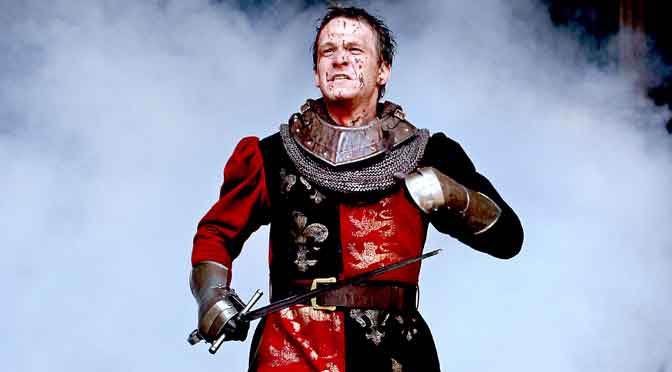
The jewel in the crown of Droomgoole’s Henry V is Jamie Parker in the title role. Martial certainly, blood curdling when he has to be, but also full of charm, Parker’s frequently understated performance shows total control (he’s even better than Branagh), and you want to back him and even fight for him. This is a truly glorious reign, certain to make any theatre lover happy.

Until 26 August 2012

www.shakespearesglobe.com

Photo by John Haynes

Written 14 June 2012 for The London Magazine

“A Midsummer Night’s Dream” at Regent’s Park Open Air Theatre

Regent’s Park Open Air Theatre has such a long association with A Midsummer Night’s Dream that any production of the Shakespearean favourite is highly anticipated. Director Matthew Dunster’s bold version seeks to challenge any tendency to see the play as comfortable by reimagining the setting as a gypsy camp.

There’s nothing wrong with the idea: it allows a fresh look at a well-known text and affords designer Jon Bausor the chance to create a fantastic set, full of surprises, that Laura Hopkin’s costumes look great on. Unfortunately, it’s a concept that pays few dividends and results in a misguided midsummer night.

The gypsy theme works fine for the play’s quartet of lovers. Making their entrance mid-fight, Demetrius and Lysander, finely performed by Kingsley Ben Adir and Tom Padley, are full of youthful virility. As Hermia and Helena, Rebecca Oldfield is spirited and Hayley Gullivan superb.

In comparison, the fairies are conventionally supernatural. Despite a BMX-riding Puck, they seem to have little connection with the rest of the play and this is hampered by some histrionic performances and laboured choreography. When Titania falls in love with Bottom, the result is crude and silly.

The workmen who perform for the now Gypsy King are another unhappy fit. Valiantly led by George Bukhari, their extended party scene is a surreal mix of My Big Fat Gypsy Wedding and Britain’s Got Talent that pleases the crowd but creates an unbalanced production. Their play within a play is performed in mock-operatic style with great energy, but the laughs they get become a problem as their success jars with the overall feel of the production.

Dunster makes many efforts to inject menace into A Midsummer Night’s Dream, emphasising violence from the start. Theseus’ confession to his bride – “I woo’ed thee with my sword” – remains a threat throughout: their wedding celebrations are fraught. But as a device to add tension the idea is overplayed. Dunster has to add to the play – to the extent of including a karaoke performance! Like much of the show, it’s inventive, but this is a problem that Dunster has created in the first place.

Until 5 September 2012

www.openairtheatre.org

Photo by Johan Persson

Written 13 June 2012 for The London Magazine

“Richard III” at The Old Vic

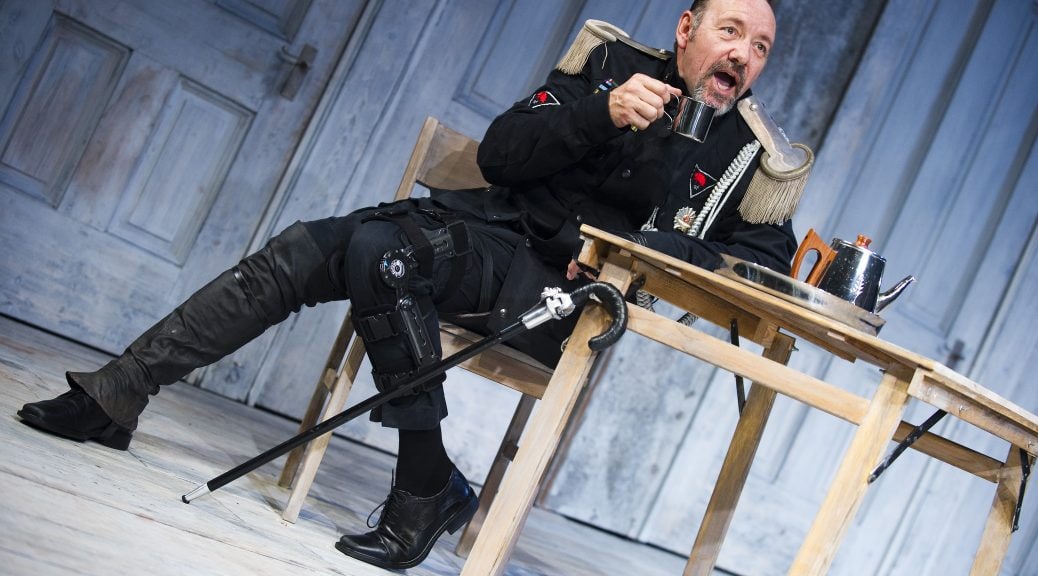
Kevin Spacey’s Richard III has been London’s most anticipated play for a while – there just seemed something so right about the casting. And for once you can believe the hype, since Spacey is superb as Shakespeare’s villainous king.

This Richard is a spin-doctoring politician. Not a subtle one, which gives rise to plenty of humour, but the tin-pot dictator of a nation ravaged by civil war. Sounds familiar? It’s supposed to – the surtitle that welcomes us at the Old Vic proclaims the winter of our discontent to be NOW. Spacey is an actor with his eye on the news, and bringing Richard’s mad-dog qualities to the fore gives his performance plenty of bite.

Surtitles also serve to introduce scenes with the names of Richard’s numerous victims, giving each episode a focus. It’s a simple, bold device on the part of director Sam Mendes that aids comprehension and adds tension. It also allows the women in the piece to shine through. Annabel Scholey as Lady Anne, who Richard woos in such bizarre circumstances, and his nemesis Elizabeth (Haydn Gwynne) both give striking performances.

Mendes infuses his production with the supernatural, courtesy of Gemma Jones in the role of Margaret. Victim of a previous coup in the Wars of the Roses, she’s not just full of curses but capable of enacting them, even making an appearance on the battlefield. Mendes’ treatment adds a fascinating dimension to the play – martial drums, used so effectively, double up in a chilling ritual of revenge.

So it’s really Sam Mendes who is the star of the show. Richard III marks the culmination of the Bridge Project, and taking the lead in this last production reflects Spacey’s dedication as part of the massive touring company. Uniting together British and American talent on a global stage brings out the best in both men and has resulted in a magnificent and long overdue rematch.

Until 11 September 2011

www.oldvictheatre.com

Photo by Tristram Kenton

Written 5 July 2011 for The London Magazine

“Double Falsehood” at the Union Theatre

The Union Theatre in Southwark gives us the opportunity to see a ‘lost’ play by Shakespeare. Double Falsehood has been declared by the Arden Shakespeare to be a late collaboration with John Fletcher, and director Phil Willmott’s fascinating production provides us with the opportunity to decide if they are right.

The debate over authorship rages: the play has plenty of Shakespearean cross-dressing and a villain that seems familiar. However, the poetry is weak and there is a distinct lack of humour. But what does make the evening exciting is the chance to watch a ‘Shakespeare’ without knowing the plot! For that reason I’ll avoid any spoilers so you can see for yourself how gripping the story really is.

As Willmott has stated, academic speculation surrounding the text is less interesting than whether or not Double Falsehood works as theatre. He presents the play clearly and embraces some melodramatic vignettes that are compelling. Deciding to set the play near a monastery has some hairy moments – it can feel a little Carry on Cloisters at times, but the denouement feels all the more miraculous for its religious connotations.

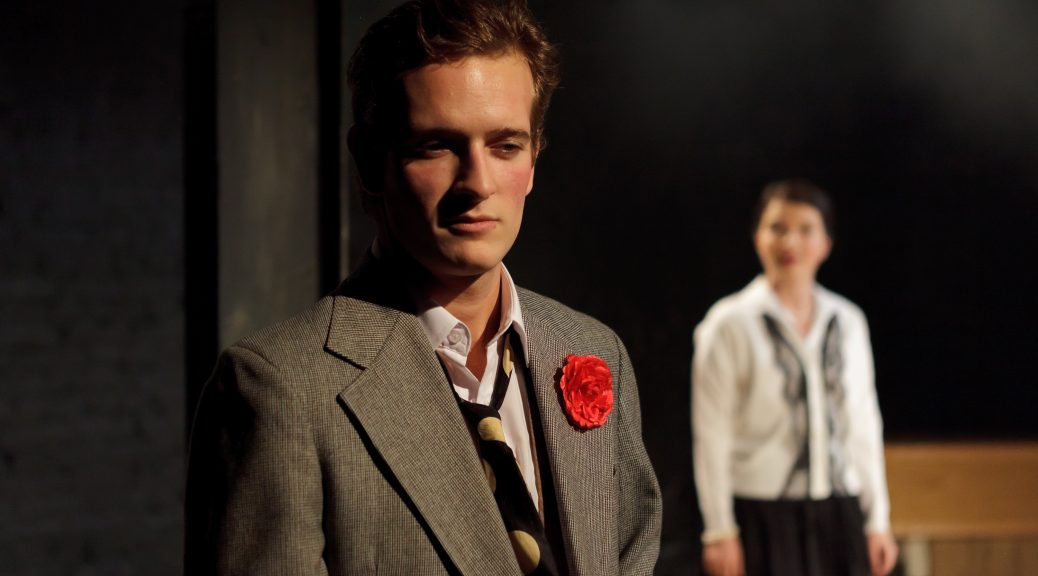
There is a super cast to watch. Richard Franklin is suitably dignified as the Duke Angelo. His diabolical son Henrique is played by Adam Redmore with appropriate mania. Henrique’s victims are many (there’s more than a double falsehood going on here) and include the convincingly heroic Julio (Gabriel Vick) and courageous Leonora (Emily Plumtree).

The main victim is Violante (the clue is in her name). Jessie Lilley makes a professional debut to be proud of but the role itself poses problems for a modern audience. We are more or less comfortable with the outmoded beliefs of Shakespeare’s time, but Violante’s decisions take us too far. She certainly isn’t the kind of woman Shakespeare usually harps on about.

But join the debate – at the Union Theatre and online (the play’s website has a guestbook for your opinions). With the RSC preparing its version of the text (to be staged as Cardenio in April) the talk isn’t going to stop anytime soon.

Until 12 February 2011

Photo by Scott Rylander

Written 24 January 2011 for The London Magazine

“As You Like It” at The Roundhouse

Nowadays, productions of As You Like It are often sensitive to the political content of the play. Duke Frederick is a tyrant, after all, and the Forest of Arden a liminal space where all kinds of conventions are negotiated. Michael Boyd’s production at The Roundhouse takes on board and enforces these ideas. The strength of his vision results in an As You Like It that is as startling as it is entertaining.

It’s snowing in this Forest of Arden. This arcadia is populated by the dispossessed. Heading up a fugitive court with an edge of desperation about it, the exiled Duke Ferdinand (Clarence Smith) has a harrowed look and Jaques’ melancholy makes a lot of sense. Boyd directs his cast towards a deadpan delivery that modern comic sensibilities will appreciate. With Forbes Masson’s Tim Minchin-inspired Jaques this really pays off. Masson’s is a terrific performance – direct, deep and very funny.

Boyd’s treatment is both realistic and high pitched. The court seems an almost gothic place. The best wrestling scene I have ever witnessed is a bloody match between Orlando (Jonjo O’Neill) and Charles (David Carr), who look more like cage fighters than gentlemen at sport. And vegetarians might wish to linger at the bar after the interval in order to miss a rabbit being skinned on stage.

Spring comes to Tom Piper’s minimal design, as his wall of squares opens up to allow shoots of greenery. Not just the auditorium, but also the whole of the Roundhouse is bedecked with Orlando’s verses. It’s an idea the RSC is expanding on with its Adelaide Road project: commissioning the poet Aoife Mannix to conduct writing workshops around the stories of Camden residents, and a promenade on the 14 May along the street that connects The Roundhouse with the RSC’s other London home, The Hampstead Theatre.

Back in Boyd’s forest, things become increasingly enchanting. There is always an edge to this Arden: the dreams and fantastic beasts are frightening, Sophie Russell’s Audrey is hilarious but a little cruel and Richard King’s Touchstone plays too close to the edge for comfort. Yet what romance the play contains bursts out and the real joy of the evening is Katy Stephens’ Rosalind. Hers is a star turn that makes the whole play revolve around her character. Rosalind’s intelligence is combined with a giddy energy in an enormously physical performance that is not to be missed.

As You Like It plays in rep until 5 February 2011

www.rsc.org.uk

Photo by Ellie Kurttz

Written 18 January 2011 for The London Magazine