Tag Archives: Shakespeare

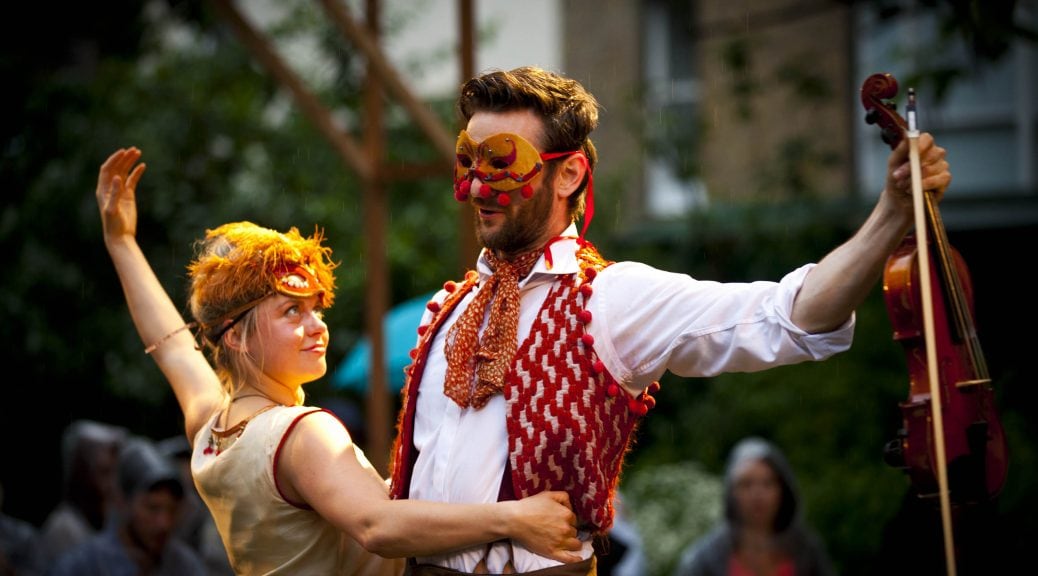
“Much Ado About Nothing” at St Paul’s Church, Covent Garden

Damp weather did nothing to deter the Iris Theatre Company last night at the opening of its summer season. Comfortably resident at ‘The Actors’ Church’, it always expertly navigates the grounds and building for its promenade performances. Director Amy Draper’s production of Shakespeare’s romantic comedy is no exception, and proves funny and heart-warming, whatever the weather.

The best thing about Iris Theatre’s shows sounds boring – that you can hear every word. This is no small achievement when actors are unmiked, outdoors and competing with all and sundry in the Piazza. While the declamatory acting style can be off-putting, Draper’s performers make exaggeration work for them, emphasising the tricks and tales, including nasty plots, our four lovers have to endure.

This is a stripped-back show, with only seven in the cast, and you might wish for more, even though the ensemble delivers. Jennifer Clement is particularly hard working: despite plenty of costume changes, she’s never breathless and has terrific comedy skills. Emma McDonald benefits from the economy, performing as a sweet Hero, and then ordering the audience about as a belligerent Dogberry, the “ass” heading up the Prince’s Watch. Abbreviating this sometimes-tiresome bunch into a Keystone Cops couple really works, and their marshalling the audience around the grounds is clever stuff.

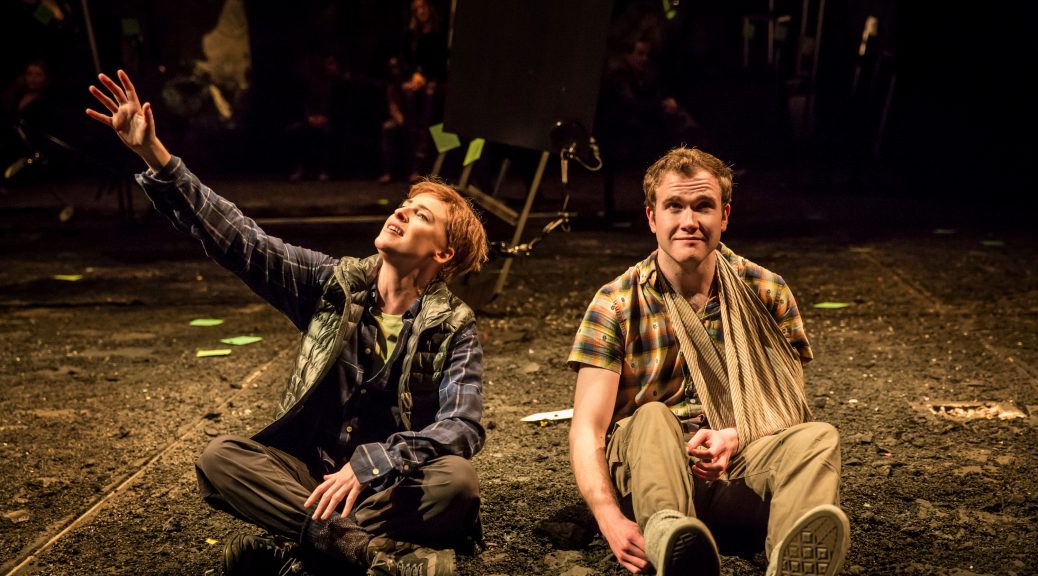
Anne-Marie Piazza is a brilliant police officer alongside McDonald, climbing lampposts and stealing snacks from the crowd. Yet this isn’t her main achievement – her Beatrice is top notch. Funny, bike riding, accordion playing… is there nothing the woman cannot do? Joined by Nick Howard-Brown (another natural comedian) as a charming Benedick, the querulous couple’s bickering and courtship is the highlight of this speedy, accomplished and appealing show.

Until 22 July 2016

www.iristheatre.com

Photo by Hannah Barton

“Gertrude – The Cry” at Theatre N16

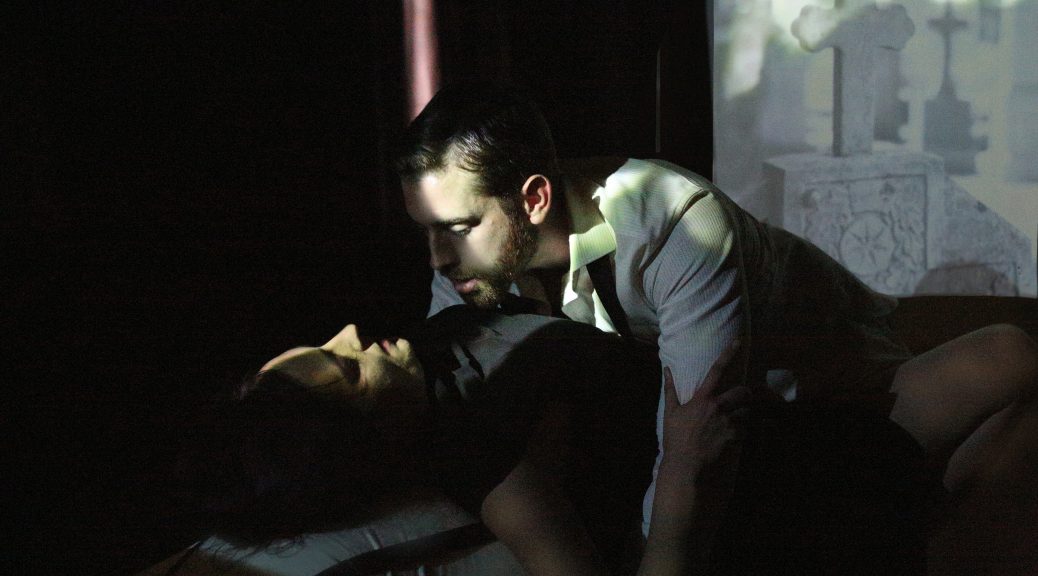
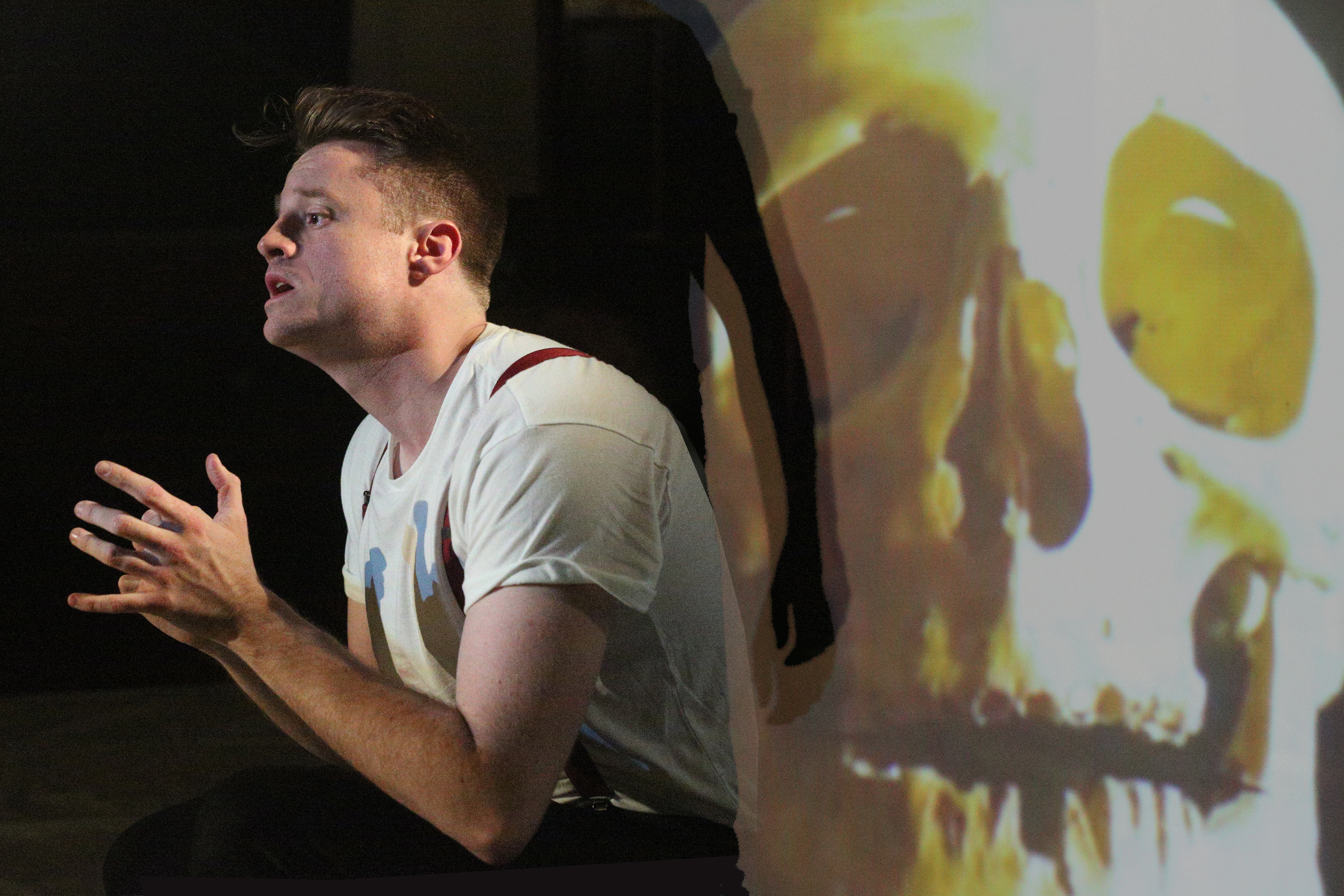
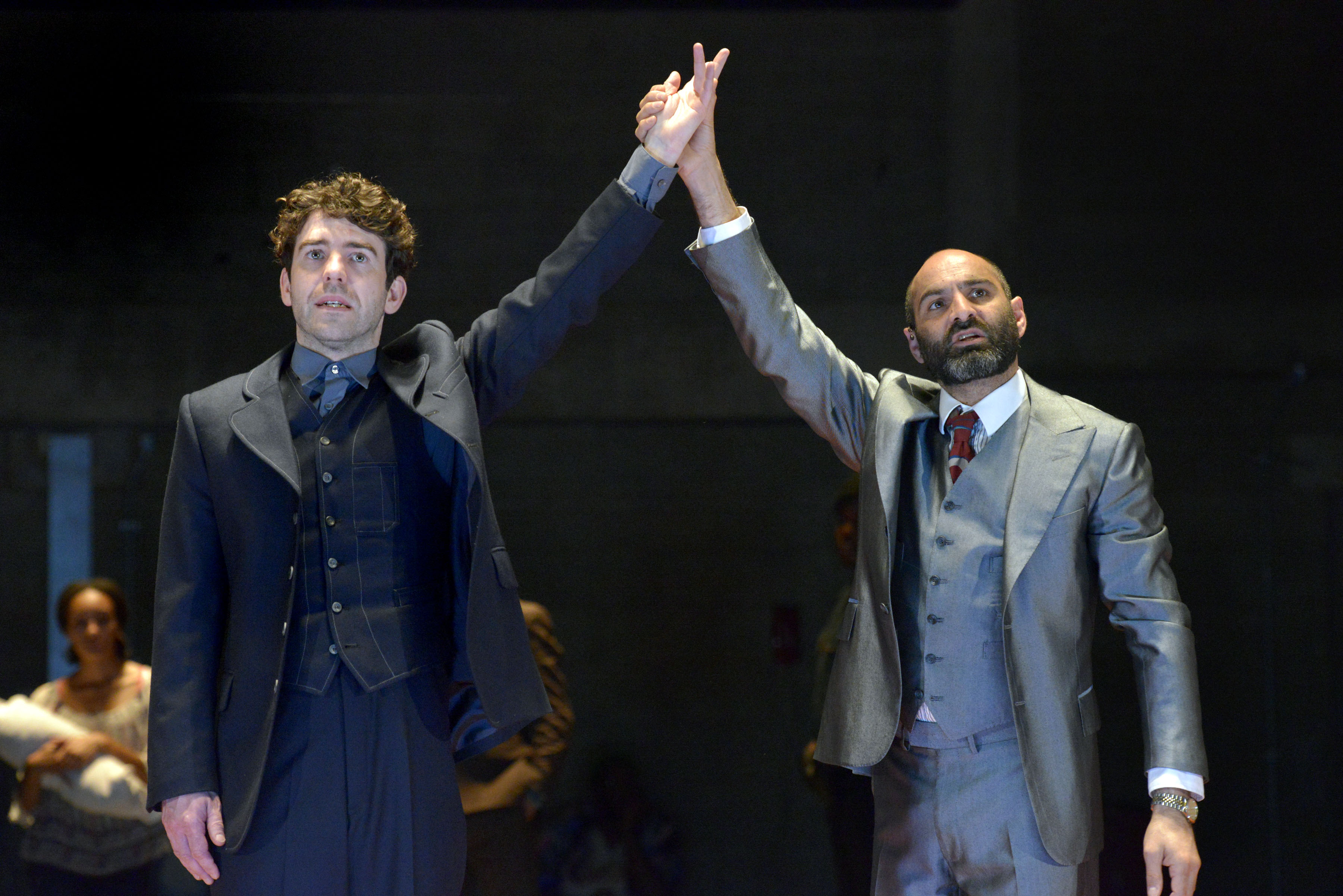
Chris Hislop is a brave director. Staging the first revival of Howard Barker’s 2002 play is not for the faint hearted. The play refocuses Shakespeare’s Hamlet through female characters and makes for an interesting puzzle. The controversy comes with a tense subservience to Barker’s own themes – this is some explicit Shakespeare. X-rated and extreme, the text’s obsession with sex and death is allied to the idea of ecstasy, and there are plenty of downright odd ideas and actions. Opening on Gertrude and Claudius fornicating over a corpse is hardly subtle stuff, but a kinky, adventurous streak is to the production’s credit.

Jamie Hutchins as Hamlet

Hislop deserves further praise for the strong performances garnered from his cast, and there’s a deserved sense of pride in showing these off. In the title role Izabella Urbanowicz is “severe” and sex crazed, and skilled at showing the character’s pain – even when Gertrude starts referring to herself in the third person, there’s still fragility. All the men are in thrall to Gertrude, and Alexander Hulme and David Zachary play Claudius and Albert with a suitably visceral brutality.

The more interesting characters, who bring out the sly humour in the text, are the servant Cascan, well played by Stephen Oswald, and our former hero, Hamlet. Taking on a very different Dane, one in “the last days of infancy”, Jamie Hutchins excels, “saying less, suffering more”, with outrage and oddity perfectly embodied. There are two further fascinating roles for women. L J Reeves plays Ragusa (no, I’m not sure why she isn’t called Ophelia) and Lisa Keast, the “vile and peculiar” Queen Mother. More than a foil for Gertrude, Barker spoils us by giving these women quirks of their own. Their brave performances add substantially to the show.

None of the roles Barker has written is easy. The accusation against him is one of misogyny – it’s easy to see why – but misanthropy might be more precise. Ragusa’s lament, that “man is better than this, surely?”, is one line most of us would agree with. More problematic, the characters are so deliberately stylised (yet more credit to the cast) with a yen for the abstract, it’s easy to disconnect from them. Barker’s poetic dialogue, expletives included, is so defiant it’s hard not to admire it. But discussion of that cry – a mysterious signifier of orgasm, childbirth, betrayal (a lot, then) – is both overplayed and opaque. Suspiciously in need of capitalisation, The Cry takes over from Gertrude as the subject of this play. Frequently hysterical, the text becomes shrill. My response to Barker, a polite request to “Calm down, dear.”

Until 30 June 2016

www.theatren16.co.uk

Photos by Roy Tan

“A Midsummer Night’s Dream” at Shakespeare’s Globe

Emma Rice’s first production as artistic director at the Globe has provided controversy for the much-loved venue and tourist hotspot. Fans of Rice’s work with her previous company, Kneehigh, will recognise some techniques here. But applied to Shakespeare, her irreverence and inventiveness proves invigorating.

First a caution – for some odd folk – this approaches Dream: The Musical. No excuse necessary, but it is striking how much of the play is sung. Stu Barker’s score is accomplished, dramaturg Tanika Gupta’s lyrics (drawing on the Sonnets and John Donne) are exciting and the singing West End standard. There’s a clever Indian twist and an electric sitar, so let’s describe the sound as Bollywood Rock. Is Rice being provoking? I do hope so.

Raucous is de rigueur at the Globe but, for good or ill, Rice has upped the stakes. If it weren’t for fear of sounding hopelessly out of touch I’d suggest some age advisory warning. There were squeals of horror in the crowd at some pretty full-on audience participation.

midsummer 1
Zubin Varla and Meow Meow

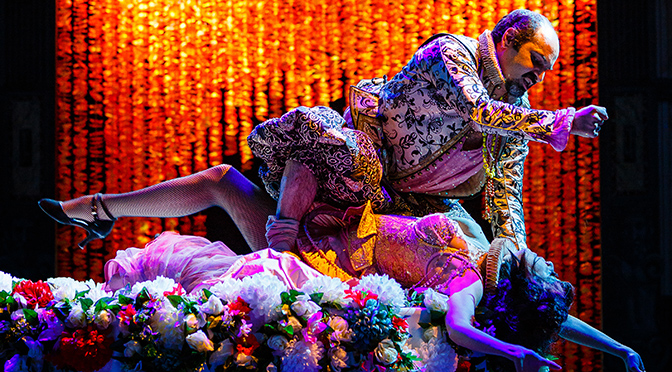
The show is sexy – many clothes are shed – and the polymorphous sexuality in Shakespeare is emboldened. Most impressively, with the King and Queen roles played by Zubin Varla and cabaret star Meow Meow – both intense performers –their chemistry is captivating. We’re reminded how creepy Titania being “enamoured of an ass” really is and both stars hold the stage, despite too much going on.

There are reservations. When Beyoncé is first quoted, your heart might sink at such an easy appeal to a younger audience. There’s a great deal of movement and some of it is messy. With water pistols, crazy costumes and a lot of accents, it’s anything for a lark. And the problem? Too many lines are difficult to hear, even lost. Rice lands the laughs, but they often fall at the expense of Shakespeare or, more generously, use the play as merely a springboard.

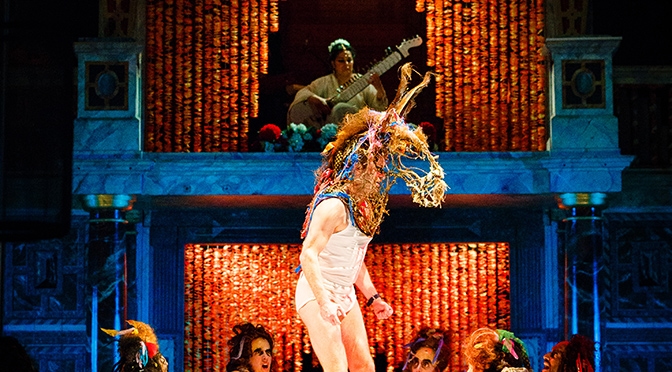
The hyped gender-bending casting (which is hardly new) may have been seen before, but not with the bite that Rice manages. Katy Owen does a superb job as Puck, working the crowd brilliantly, despite that water pistol. The rude mechanicals are recast as women. Only Bottom remains male – Ewan Wardrop doing the guys proud. Updating the wannabe theatricals into Globe volunteers is sweet and leads to excellent cameos, especially for Lucy Thackeray, whose calm ad lib, “my nephew’s gay”, tickled me pink.

midsummer 3
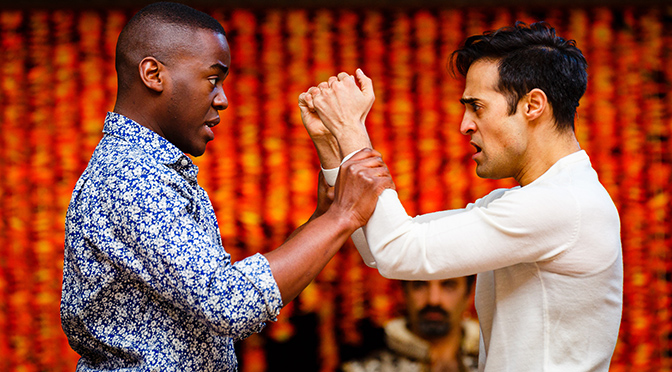
Ncuti Gatwa and Ankur Bahl

But it’s most with the Athenian lovers that Rice’s indiscretions are forgiven. Updating the couples into Hoxton hipsters is very funny. Ncuti Gatwa and Edmund Derrington make an energetic Demetrius and Lysander. Anjana Vasan gets roars of approval for her very modern Hermia. Ankur Bahl plays –hold on – Helenus, with wit and courage. There’s more to this decision than giving the line “ugly as a bear” a new twist. An uncomfortable response from some, admittedly young, audience members gives pause for thought. The Globe is a global institution (listen to how many visitors are from abroad). To see love between two men portrayed with complexity on such a stage is remarkable. There may be touches of over enthusiasm here but Rice balances public appeal with a radical streak that makes this show, and her direction, one of the most exciting things around.

Until 11 September 2016

www.shakespearesglobe.com

Photos by Steve Tanner

“Table Top Shakespeare” at the Barbican

Shakespeare with a cast of condiments sounds simply daft. Presented on a desk, as advertised, bottles and objects make their entrances and exits, standing in for the characters, controlled by a single performer who retells the plot of the play. That all this is perilously close to parody can’t be lost on Forced Entertainment, the company responsible for hosting the whole of Shakespeare’s canon in this fashion. There’s a reverential air to the hour-long retellings that raises an ironic smile. But against the odds, it’s all strangely compelling and affords an insight into the plays that makes it a tremendous theatrical experience in its own right.

The performance I attended was Richard II. The monarch was a bottle of water, his attendants salt and pepper pots. Terry O’Connor recounted events slowly and carefully, occasionally pointing out famous lines. The retelling isn’t as neutral as it seems – alongside O’Connor’s engaging and clear delivery – there’s a subtle commentary added. Forced Entertainment’s technique exposes the mechanics of the play’s construction, which proves enlightening. Bereft of alarums and excursions, it’s an intense experience. The objects, empowered by your imagination, hold attention with surprising force – I don’t think I have ever felt so much for the role of Richard’s queen – here a cut-glass vase. Brilliantly simple and simply brilliant.

Until 6 March 2016

www.forcedentertainment.com

“Richard III” at the New Diorama Theatre

Another admirable production from The Faction company, Mark Leipacher’s rendering of Shakespeare’s villainous king is full of bold moments. There are flaws, but the show’s scale and ambition impress.

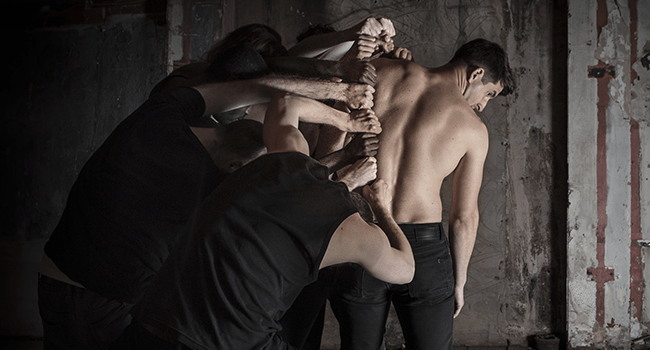
Leipacher uses his cast of 19 with careful restraint and an emphasis on physical theatre. His vision of Richard’s nightmare before battle, with his victims crawling towards him, is startling. No props are used and powerful tableaux result: Hastings’ head on the battlements or the ensemble creating a horse for the king to ride. It’s a shame some of the miming is sub-standard and the accompanying sound effects overblown.

With a cast this large in a fringe show, perhaps it’s not surprising there are some weak links. It’s not a question of commitment – this is a tight crew – but some roles lack polish. There are fine performances from Gary Richards as Hastings, Carmen Munroe as Richard’s mother and Anna Maria Nabirye as an Amazonian Buckingham (a gender swap that really adds tension). Kate Sawyer gets a great deal from the role of Elizabeth, all the more impressive since she is hampered by some God-awful head gear. These performers are the ones whose lines you hear most clearly – too much dialogue is lost, sacrificed to action or poorly delivered.

Thankfully, there are few instances when you can’t hear Richard’s lines. Taking the title role, Christopher York excels, presenting an intimidating figure with a conscious lack of humour. The cleverest stroke is that his disability comes and goes. York becomes contorted or straightens himself out at chosen moments – such a brilliantly simple idea that I’m surprised I haven’t seen it before.

While there are strong scenes, Leipacher doesn’t draw the production together – it’s linked by style rather than an overriding idea. Especially disappointing is a messy final battle scene – a low note on which to end an interesting evening.

Until 6 February 2016

www.newdiorama.com

Photo by Cameron Slater

“Henry V” at the Barbican

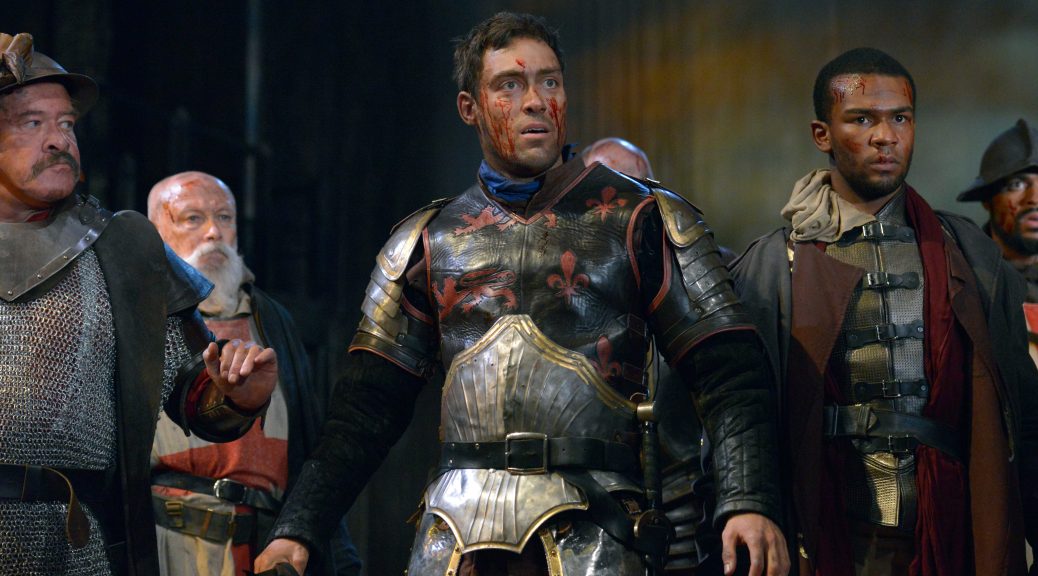
Reprising his role as Hal, after last year’s turn in Henry IV Parts I & II, Alex Hassell ascends to the throne in a Christmas treat for Londoners from the RSC. Gregory Doran directs, offering a fulsome and classy production. Hassell is a suitably thorough performer. Strongest when showing the nervousness of a new monarch dwelling on the morality of war, his transformation into a convincing martial leader is a carefully paced achievement.

Doran’s populous show looks and sounds great. There’s an exhibition about the gorgeous lighting, designed by Tim Mitchell, in the Barbican’s foyer space. Period instruments and a beautifully sung Te Deum (performed by Helena Raeburn) are highlights. Most memorable is an avuncular performance from Oliver Ford Davies as the chorus. Placed to the fore, his humorous calls to our imagination give the show a surprising intimacy and his modesty makes a pleasant foil to the production’s grandeur.

This is a long Henry V. Scenes of light relief are given plenty of time: one section of Act 3 Scene 2, often discarded, has not just an Englishman, Irishman and Scotsman but also a Welshman thrown together for fun (Joshua Richards’ Fluellen is satisfying throughout the show). And Doran wants to address the peace as much as the war – perhaps a little more than Shakespeare can be bothered with. The romance between Henry and Kate is rather dragged out (despite Jennifer Kirby’s charming Katherine) and Jane Lapotaire’s Queen Isobel takes centre stage for a speech on the state of France that is, again, sometimes skipped. Even though you might be left agreeing with productions that condense the action, this luxury edition of the show drips quality.

Until 19 December 2015. The King and Country four play cycle of productions, including Richard II, will be performed in January 2016.

www.rsc.org.uk

Photo by Keith Pattison

“As You Like It” at the National Theatre

The usurping Duke Frederick’s court is a surveillance state in director Polly Findlay’s new production of Shakespeare’s comedy. The colourful but cumbersome office setting thankfully disappears when our heroines, Rosalind and Celia, escape the city – chairs and desks ascend, transforming into the Forest of Arden. Lizzie Clachan’s Cornelia-Parker-inspired vision is a breath-taking use of the Olivier auditorium – a design to applaud.

The forest, brilliantly lit by Jon Clark, is sinister and cold, but romance is at the heart of the show, ensured by strong performances from the young cast. Rosalie Craig is captivating as Rosalind, with an immaculate transformation into her disguise as a man, while Joe Bannister matches her in appeal as a boyish, modern Orlando. Patsy Ferran makes a strong Celia and the two women’s relationship is satisfyingly explored. All three leads are on top of Shakespeare’s comedy, making this a production of big laughs rather than the usual small smiles. Joining in, Gemma Lawrence is an energetic Phebe, Mark Benton a convivial Touchstone and there’s a superb cameo by Siobhán McSweeney as his love interest, Audrey.

Findlay has no shortage of ideas. A choir fills the forest with music and bold sound effects; Orlando Gough’s score buoys the whole show. A scene where the vast cast perform as sheep in Arran jumpers is memorable – flirting fills the flock, too. The “shade of melancholy boughs”  the forest casts is probed with style but unfortunately this leaves Paul Chahidi’s Jacques making less of impact. There is also a big problem in the production’s notable lack of tension. Some suspense is sacrificed for laughs (that Orlando’s wrestling match is a Mexican one means he is never in danger) while both Dukes suffer from roles that feel truncated and a little flat. Findlay’s forest looks great and her take on the play is fresh, but journeying into these woods isn’t as interesting as it should be.

Until 5 March 2016

www.nationaltheatre.org.uk

Photo by Johan Persson

“Measure For Measure” at the Young Vic

It requires a director as bold as Joe Hill-Gibbins to revel in the oddness of Shakespeare’s ‘problem’ play. Taking licence with the tragi-comic text and its complex moral questioning, this production is radical in the true sense of the word: a far-reaching, thoughtful interpretation that strips it of context and relies on emotional realism.

On the Saturday matinee I attended, Ivanno Jeremiah was unable to perform as Claudio, so first a big thank-you to Raphael Sowole, who stepped up and allowed the show to go on. It’s not ideal conditions but one absence did little to detract from how forthright Hill-Gibbins’ vision is. And, besides, the supernumerary cast of sex dolls more than manages to fill the stage.

That’s right – inflatable sex dolls, which are inevitably what the production will be remembered for. This is a shame since, while irreverent fun, they are not the best thing on offer. With live video recording projected onto the stage, this show gets up close and personal. And, with some help from Hans Memling’s apocalyptic artwork, arresting imagery is everywhere, with a pulsating soundscape from Paul Arditti adding to the atmosphere.

Paul_Ready_Zubin_Varla_and_Natalie_Simpson_in_Measure_for_Measure_at_the_Young_Vic._Photo_by_Keith_Pattison
Paul Ready and Zubin Varla

Best of all are the performances. The cast, like the text, is slimmed down and works hard. Romola Garai is brilliant as an indignant Isabella, as is Paul Ready as a cool Angelo – both performers root out the essentials of their characters. There are also strong roles for Cath Whitefield’s Mariana (although why she should be a fan of pop star Pink baffled me) and John Mackay’s Lucio, whose joke with the Duke has far more mileage than usual. It’s with the Duke, given a towering portrayal by Zubin Varla, that Hill-Gibbins should get most credit. This ‘power divine’ is displayed in his twisted benevolent best – a Rasputin gone right, with an injection of tension that suggests his plans could go awry. The conclusion, shuffling the cast into a deranged and confused photo opportunity, makes quite a picture for this flash-bang-wallop of a show.

Until 14 November 2015

www.youngvic.org

Photos by Keith Pattison

“Henry V” at Temple Church

Benefitting from a fantastic location, the show that marks theatre company Antic Disposition’s tenth birthday serves to commemorate World War I as well as the 600th anniversary of the battle of Agincourt. If that sounds like a lot for even Henry V to take on, rest assured that the play is neatly manipulated and finely produced.

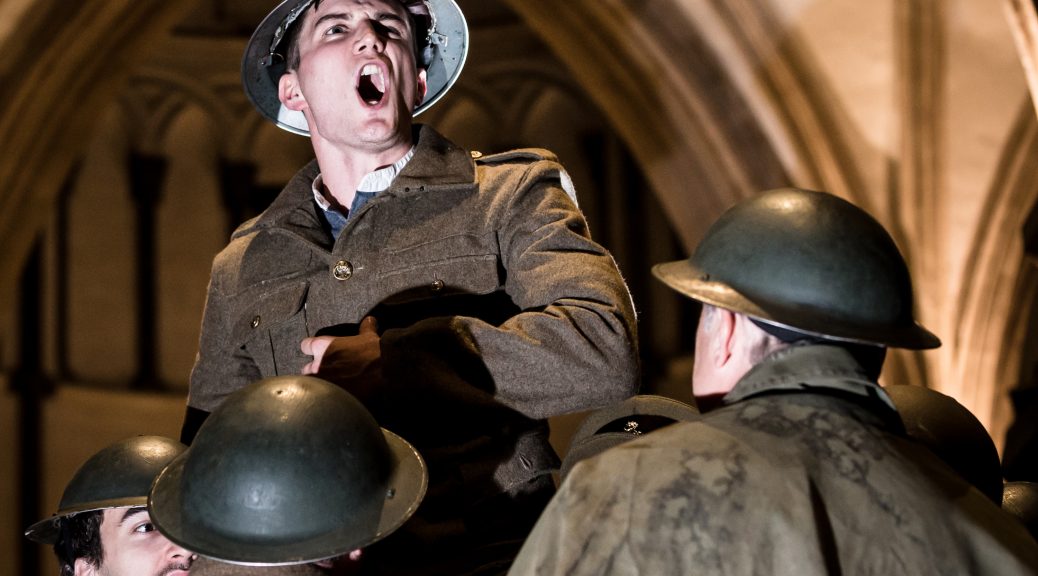
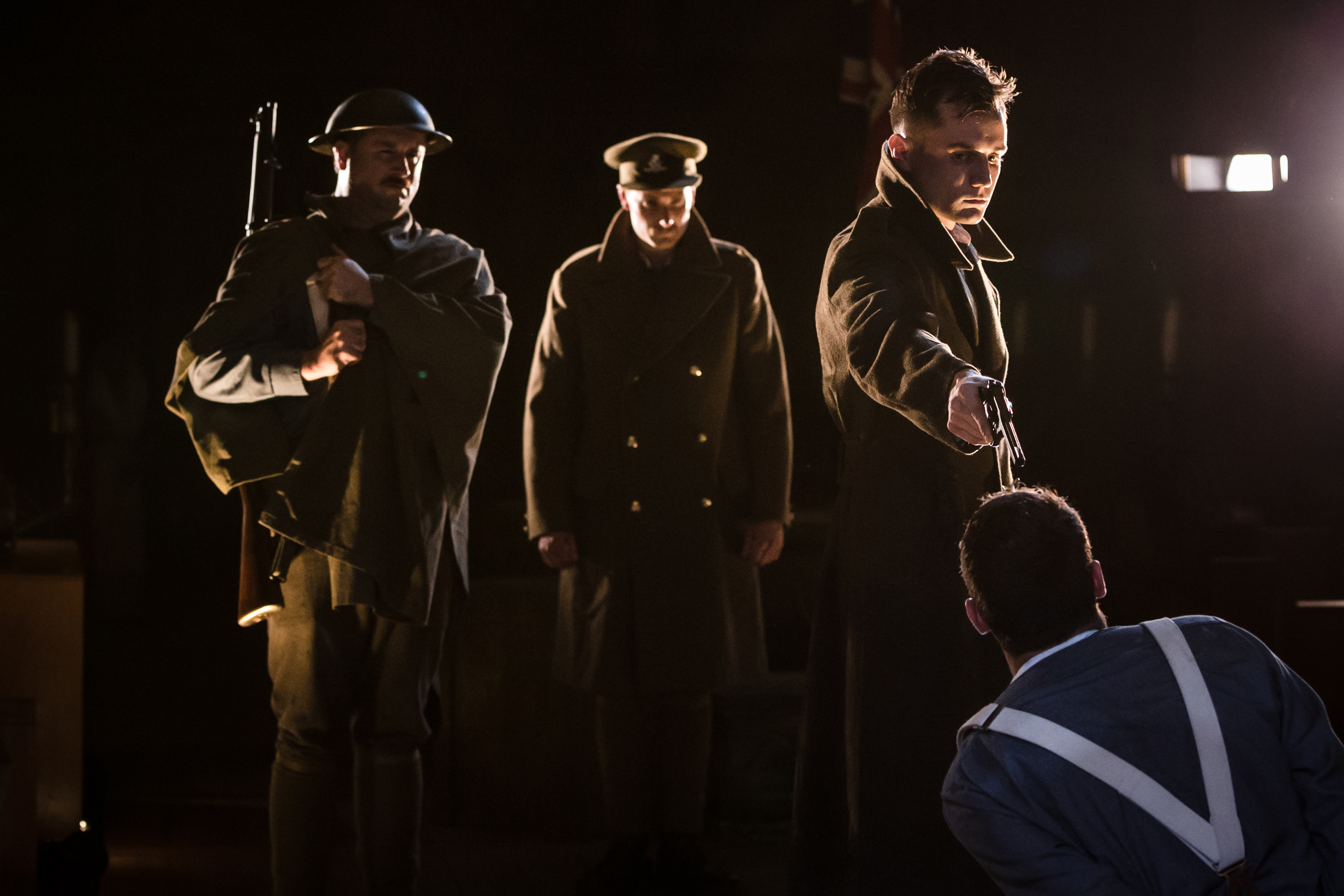
Joint directors Ben Horslen and Jon Risebero have a group of convalescing British and French soldiers putting on the play during a break from the trenches. You might question the efficacy of this as a therapy – it’s hardly It Ain’t Half Hot Mum material – but impressive gains result. Poignancy comes from the prologue’s excuse for a “crooked figure” performing – these men are injured. And there’s a lovely sense of complicity, with pretend fumbling at the start and lots of addresses to the audience. The play’s female roles benefit from the backdrop, especially the courtship scene with Floriane Andersen, whose character we also see as a nurse. Henry V Temple Church 4 Andrew Hodges, Alex Hooper, Freddie Stewart (Henry V) James Murfitt Photo- Scott RylanderAnother particularly strong moment (pictured above) has the soldier playing the role of Bardolph breaking down as he faces his execution, performed painfully well by James Murfitt.

Freddie Stewart shows exciting promise in the title role. His youth is a slight barrier when it comes to Prince Hal’s transformation into a responsible royal; it’s difficult to imagine him having time for “greener days”. But this plotline is downplayed and we enjoy a virile and appealing King under pressure, juggling bluster and humanity, while examining his duties.

The play is presented in traverse, with an accomplished mobility that shows this is a team used to touring. With the church’s acoustics, the whole production sounds sublime – it’s a genuine aural treat. And it’s easy to understand the addition of well-performed songs by George Butterworth to poems by A E Housman, although this extra layer to the show brings it close to overload. There’s a surfeit of ideas here – and all credit to the ambition of Horslen and Risebero. But the show – well worth seeing – aims for more bite and emotional impact than it has time to deliver.

Until 5 September 2015

www.anticdisposition.co.uk

Photos by Scott Rylander

“Richard II” at Shakespeare’s Globe

While The Merchant of Venice quote, handily emblazoned on tote bags in the Globe’s shop, tells us “all that glisters is not gold”, the theatre’s new production of Richard II is a solid 24-carat affair. Shakespeare’s deposed king is often presented as a star vehicle, but director Simon Godwin provides a carefully crafted ensemble piece that gives every character their due and is all the better for doing so.

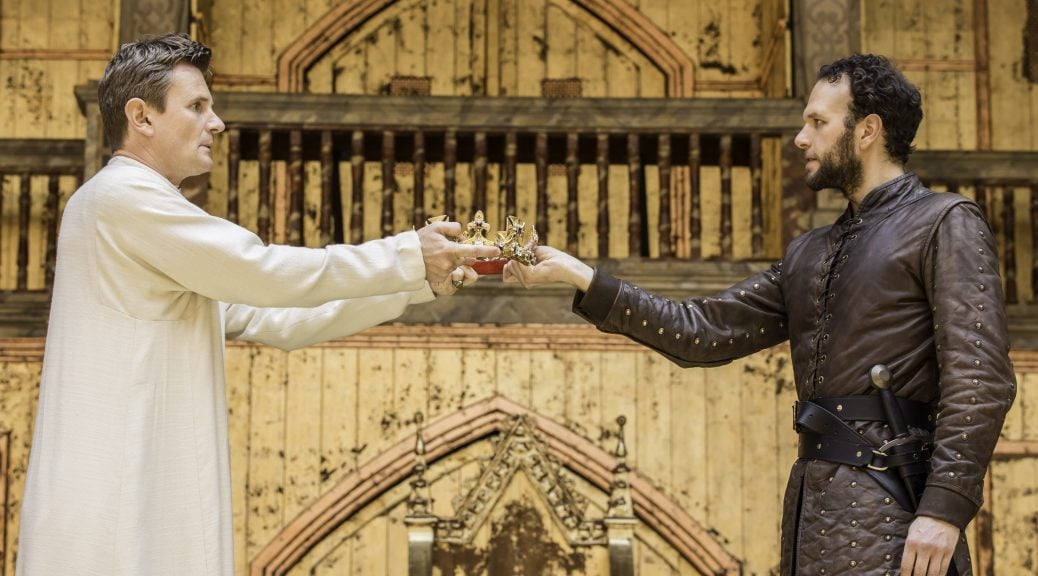
Which is not to say that Charles Edwards isn’t magnificent in the title role. Against the golden backdrop of Paul Wills’ set and accompanied by Stephen Warbeck’s impressive score for trombones, Edwards strikes a suave figure. But it doesn’t take long to see a delusional aspect to this infantile King, set up by a prologue scene of his childhood coronation. In an admirably understated performance, especially during his imprisonment, Edwards shows this hollow crown is unhinged and tarnished by religious fervour.

The impact Richard’s divine right to rule has on society is highlighted by the luckless Aumerle, a role that Graham Butler gets a great deal from. One of Richard’s “caterpillar” sycophants, then betrayers, like his ruler, he seems strangely juvenile. One reservation: in this serious show, Godwin introduces humour into the scene of Aumerle’s treachery. While the text suggests jokes and the piece allows William Chubb and Sarah Woodward to shine as the Yorks, surely going all out for laughs is a misfire.

Much better are the muddled motivations of Richard’s courtiers. Godwin creates a sense of unprecedented events unfolding – with Chubb, again excellent, as a conflicted Regent and a superbly sinister Northumberland played by Jonny Glynn. Even the gardening scene, which I always think should be pruned, is handled well, using the audience in the complicit manner that directors at the Globe can seldom resist.

Godwin’s usurping Bolingbroke is a relatively complex figure, suggesting that events might have overtaken a once loyal subject. David Sturzaker gives a sterling performance in this strangely opaque role; a virile presence, we see the politician but also an emotional intensity that adds a layer to a play so much about surface presentation. Underlying the production’s traditional feel and gorgeous look is a satisfyingly intelligent assessment of the play’s themes.

Until 18 October 2015

www.shakespearesglobe.com

Photo by Johan Persson