Tag Archives: Old Vic Theatre

“The American Clock” at the Old Vic

Of the current and forthcoming productions of Arthur Miller plays in London, this piece from 1980 may count as the oddest and perhaps the most personal. The play gives an outline of The Great Depression, based on the work of oral historian Studs Terkel. And with much of the action focusing on a young man, similar in age and ambition to Miller in the early 1930s – whose family loses its money just as his did – it’s hard not to see it as an autobiographical fragment. Unfortunately, as a trip into the past it’s too potted. And as analysis of events it’s too pedestrian. That American optimism is relentless is rammed home, but doing so brings monotony. And while the idea of an American political left that challenges corporations might be intriguing, it has clearly been consigned to history. It all makes for a text that’s both slim and slow.

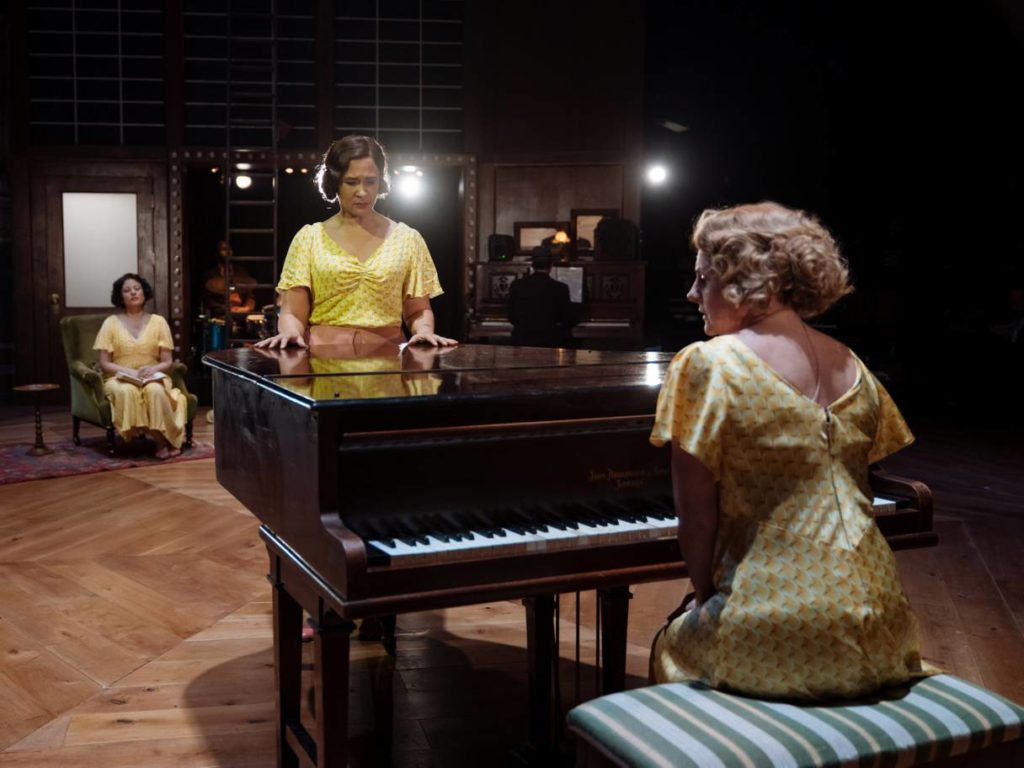
Clare Burt, Golda Rosheuvel and Amber Aga

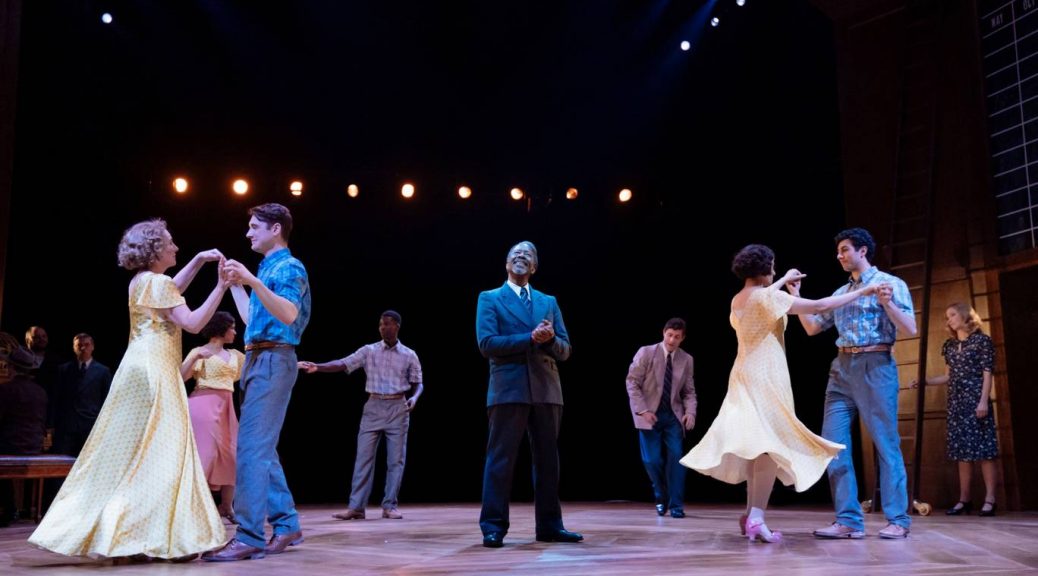
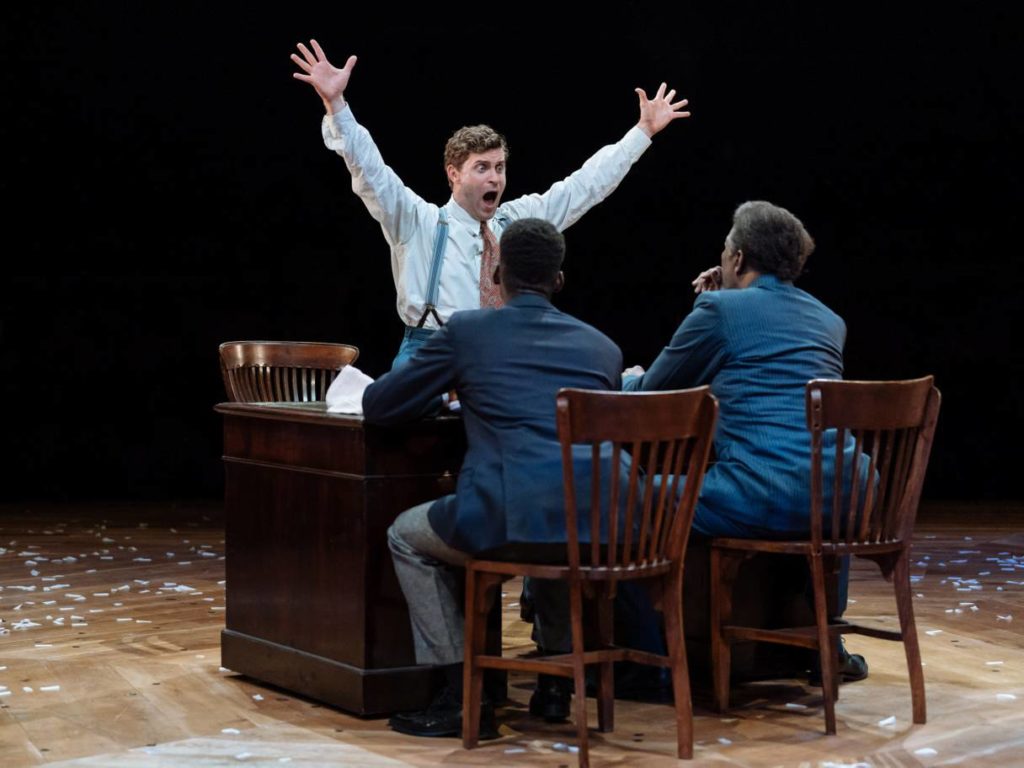
With an episodic structure and presentation that includes song and dance An American Clock still intrigues and the work of director Rachel Chavkin is strong. Making the lack of plot a virtue, the central family is played in triplicate: there are three sets of once wealthy mothers and struggling fathers, while a trio of sons grow up and start careers. It’s a neat way of showing the universalism of the economic disaster and is staged superbly – the device works to make the large ensemble cast really stand out. Clare Burt and Amber Aga both excel as the mother Rose while Golda Rosheuvel becomes the star by also punctuating scenes with a powerful singing voice. James Garnon has most time in the role of the father, and leaves the biggest impression, while three youngsters performing as the son Lee – Fred Haig, Jyuddah Jaymes and Taheen Modak – all impress. Worried about losing track? Thankfully, Clarke Peters is on board as the show’s narrator to make everything smooth. Few actors could make a story this predictable still entertaining and Peters is, as ever, superb.

Ewan Wardrop

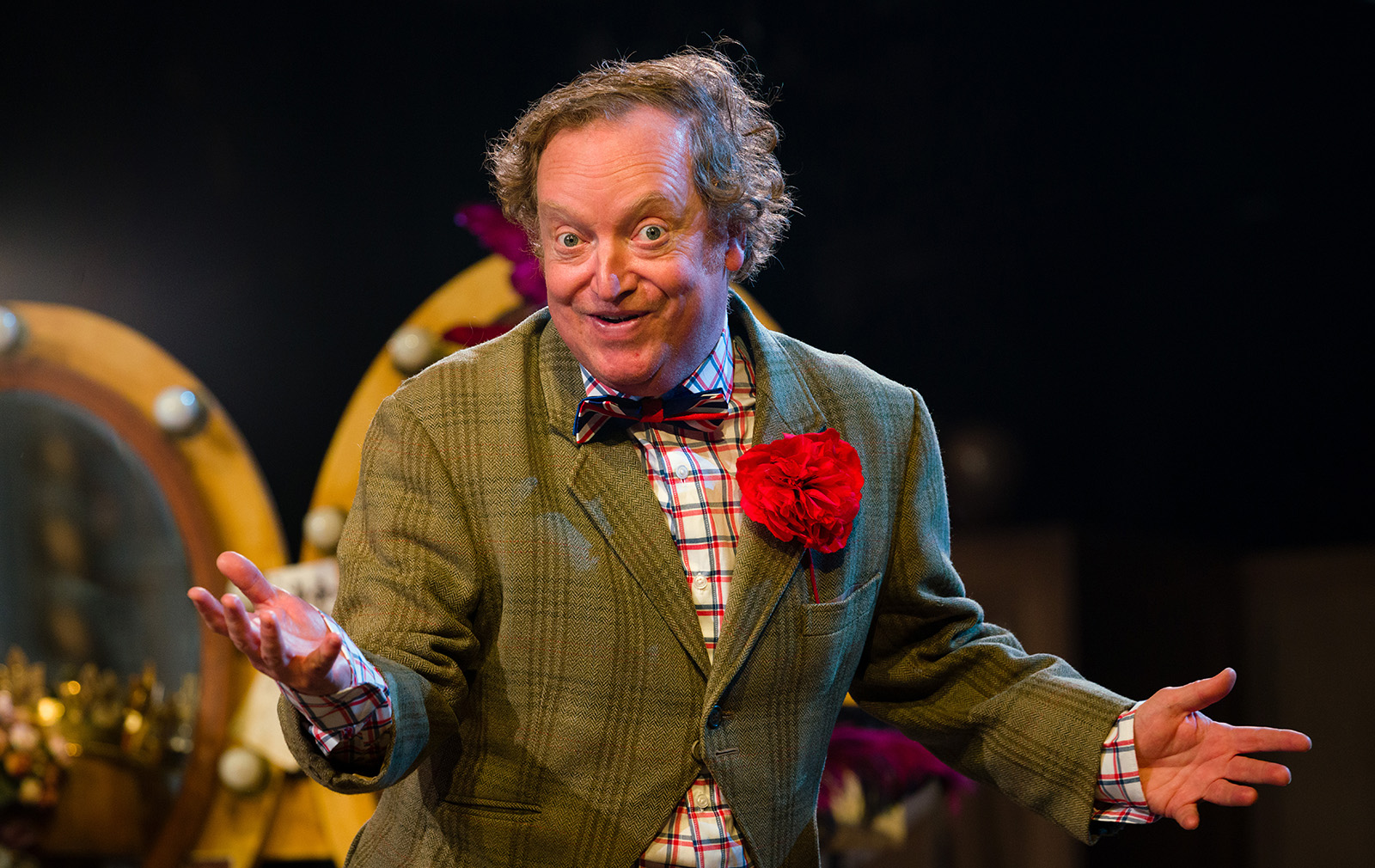
Miller renamed the play a Vaudeville piece after its flop on Broadway. Chavkin embraces this by ensuring her production has variety, fun and also rhythm. There are songs throughout and the choreography from Ann Yee is excellent, not least in taking into account that the cast are not dancers. It’s a good way to inject much needed energy; Ewan Wardrop’s tap-dancing CEO proves a real highlight. The music makes points – a manic lust for money and then panic with the Stock Market crash – while complementing the sketch-like quality of the play itself. With the motif of marathon dancing competitions that runs throughout the play, Chavkin’s vision is clear, akin to a live Reginald Marsh painting, but the scenes themselves amount to little, feeling anecdotal or didactic. It’s Chavkin’s skill to weave them together so skilfully – and it’s easy to see why she is one to watch. Still, this play isn’t one to give time to.

Until 30 March 2019

www.oldvictheatre.com

Photos by Manuel Harlan

“Wise Children” at the Old Vic

Emma Rice and the late Angela Carter make a fine match – their works are full of invention, wit and fantasy. This new adaptation of Carter’s 1991 novel is a great yarn that distils, through its fairy-tale exaggerations, themes of family that are universal while being original and surprising. The story of twins Nora and Dora Chance is full of pain, but also joy – combined with blissful theatricality.

As both director and adapter, Rice has a defined style, well-honed, with plenty of trademarks and I, for one, can’t get enough of them. Instilling a complicity with the audience from the start, the show is a mix of music, dance, even mime. The aesthetic is ramshackle and peripatetic, with a caravan that’s moved around. Costumes become the key to character (with great work from Vicki Mortimer). Rice’s talented cast takes on a head-spinning number of parts with such skill that it’s difficult to work out how many people are performing.

The multiple roles are especially important for Wise Children as six people play our heroines throughout their lives. The performers interact and look over one another’s actions to magical effect. All are wonderful but, taking the lead as the oldest incarnations, are Etta Murfitt and Gareth Snook, whose interaction with the crowd is truly expert. The twins’ past takes in abuse, abandonment, death and war. But throughout there is a sense of humour and mischief. Leading the laughs, complete with a fat suit and big attitude to match, are Katy Owen as Grandma Chance, who takes in the girls when they are babies. And Paul Hunter’s turn as end-of-the-pier comedian Gorgeous George is a real gem.

Paul Hunter as Gorgeous George

The twins have a life in theatre and their stage career provides a lot of value, including a Shakespeare revue (with surely an eye down the road to Rice’s ex-residence, the Globe) that’s a real hoot. Their birth father (another great role for Hunter) is an old-fashioned mummer, while his acknowledged children, who manage to get to RADA, provide further roles for Mirabelle Gremaud and Bettrys Jones to excel in.

Alongside all the fun and fantasy, Carter retains an edge that injects realism into her story. Rice respects this balance and her multi-disciplinary approach is perfect for bringing out the text’s complexity, including its dark moments. Attacking events with fantastic energy, there’s all the lust you can handle in this genre-defying, gender-bending production, which culminates in a paean to the idea of the logical family. “Oh, what joy to sing and dance” is the twins’ refrain. And what a joy to watch, too.

Until 10 November 2018

www.oldvictheatre.com

Photos by Steve Tanner

“Mood Music” at the Old Vic

Ben Chaplin plays a successful record producer and Seána Kerslake an up-and-coming singer-songwriter who battle over creative pre-eminence in Joe Penhall’s new play. The roles make for good viewing: the unbelievable arrogance of Chaplin’s Bernard is as entertaining as the vulnerability of Kerslake’s character, Cat, is moving. And the contrast between their approaches to music, focusing on his obsession with “precision”, are dramatically effective. As their disagreements exacerbate tensions, and come to include undertones of sexual exploitation, the mood turns increasingly sour and the play comes to comment on our times. Given The Old Vic’s recent history, there’s piquancy to hear such issues here. But, although it isn’t Penhall’s fault – his big theme is who and how someone might own creativity – the topic of sexism in the arts is raised so obliquely it is discomforting.

The play is as much about the music industry as it is about the musicians. That this might excuse behaviour is offered as an explanation too many times. But Roger Mitchell’s direction and Hildegard Bechtler’s impressive set – with the stage reaching out well into the auditorium ­– make the connections between those making music and those behind the scenes clear. The creatives are overwhelmed, each having their own psychotherapist and their own lawyer. There are strong performances (from Pip Carter, Kurt Egyiawan, Jemma Redgrave and Neil Stuke), but all the characters are clearly there to prove points. A lot of what’s said – about artists and mental health or intellectual property and justice – is funny, a little of it thought provoking. Unfortunately, nearly all of it is predictable.

The writing, however, is stunning: the text has an impressive musicality of its own, conversations interweave and tone varies constantly. But, with depressing prescience, it’s all too easy to see what’s coming next. A flippant complaint from Cat is propelled into a criminal issue. That this is instigated and escalated by professionals who could potentially profit from her misery is an uncomfortable suggestion. There are some brave opinions expressed, alongside some pretty awful ones, and Penhall puts drama on the flesh of issues in a way that newspaper headlines can’t. But, despite its sharp subject matter, Mood Music is flat. For all the importance of these topics, the danger is that they don’t make good drama. For a general audience these trials and tribulations of the creative industries come close to solipsism; no matter how well Penhall vocalises this, it is a dreary sound.

Until 16 June 2018

www.oldvictheatre.com

Photo by Manuel Harlan

“Woyzeck” at the Old Vic

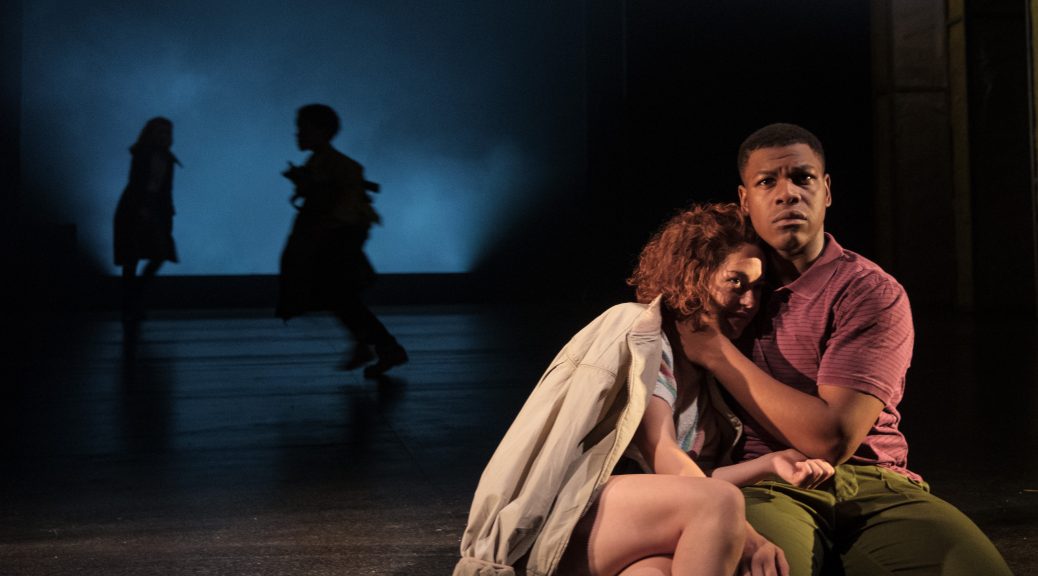
John Boyega is the young actor who impressed everyone in the reboot of the Star Wars franchise. Bringing him a further credibility it’s questionable he needs, this stage foray is a serious affair, with lots of forehead slapping, that shows he can handle angst with ease. In the title role as a soldier suffering a nervous breakdown, Boyega establishes sympathy for his character commendably. As his health deteriorates, the magnetism increases – it’s tough stuff to watch but gripping, too.

Boyega is star material, but the revelation of the night is young director Joe Murphy. It’s top man Matthew Warchus’ idea to give him the title of Baylis Director, offering emerging talent ‘main stage’ shows. And it’s an opportunity Murphy has embraced. Woyzeck can work well in any space, but the cavernous stage of the Old Vic is used to emphasise a lost, lonely, quality. Tom Scutt’s brilliant design has panels that suggest both walls and beds – sliding in and out, up and down – brilliantly lit by Neil Austin.

Jack Thorne has updated George Büchner’s unfinished play from the German provinces of the 19th century to Berlin at the end of Cold War, with Woyzeck traumatised by action seen in Northern Ireland. The move makes the play approachable but better still are changes to Woyzeck’s unfortunate love, Marie, played by Sarah Greene. More than a foil to her troubled partner, Greene’s modern sensibility makes the play’s domestic violence potent. Along with the addition of a plot about a medical trial Woyzeck participates in to raise cash, the play’s first half feels like a thriller.

Unfortunately the tension falters. As the play becomes ‘madder’ it feels too drawn out. The staging remains impressive but secondary characters, seen through Woyzeck’s eyes and affected by his increasing paranoia, become tiresome rather than threatening. The roles of Woyzeck’s Captain and his comrade, Andrews, are well performed and funny – but thinly written. It’s a great show for Nancy Carrol, playing the Captain’s wife and transforming in flashbacks into Woyzeck’s mother, but her posh cow character shows the problem best – an interest in the army’s class structure feels forced. Woyzeck becomes a victim in search of an excuse. Exploited by all and trapped by his past, causes are crammed in rather than explored.

Until 24 June 2017

www.oldvictheatre.com

Photo by Manuel Harlan

“King Lear” at the Old Vic

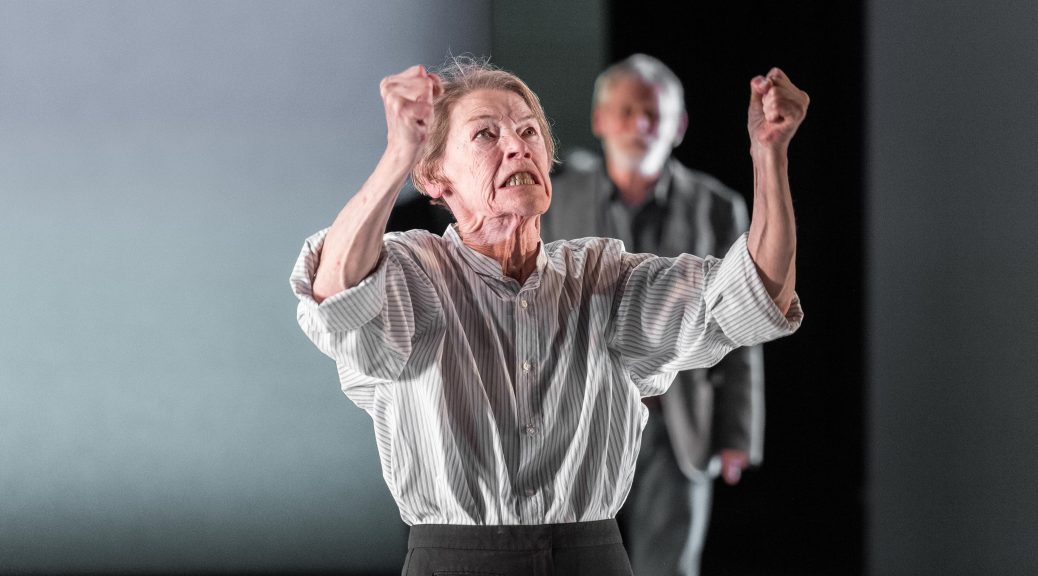
Returning to the stage after working as an MP for 23 years, Glenda Jackson’s decision to take the title role in Shakespeare’s tragedy has made this show hotly anticipated. It’s something of a relief, then, to report that the Oscar-winning actress gives a commanding performance. Her Lear may not be the most emotional, but it is subtle and intelligent. No time is wasted debating the gender blind casting – she’s doing Lear, get over it – the delivery sounds fantastic while pathos and power build masterfully. As if confirmation were needed, it’s clear Jackson is not afraid to take risks, showing a surprising element of mischievousness during the most painful scenes.

A stellar line-up joins Jackson, but nobody challenges her eminence – which is not surprising, but perhaps a little disappointing? Too many cast members seem burdened by ideas from director Deborah Warner. There are great performances from Celia Imrie and Jane Horrocks (Goneril and Regan). But overall there’s a tendency to try too hard to make a mark: case in points are Simon Manyonda’s yoga-posing Edmond, Morfydd Clark’s over-earnest Cordelia and a misguided choice of accent for Sargon Yelda’s Kent. Harry Melling holds his own as Edgar, despite a ridiculous bin-bag nappy. Rhys Ifans is less successful with his Superman costume for the Fool. There’s more to his role than being funny, of course, but some lines are supposed to tickle us – instead Ifans eats a raw egg to get attention.

With a set of projections and black rubber sheeting, designed by Warner with Jean Kalman, there are plenty of clever moves and gory touches (watch out for flying eyeballs) that provide excitement. But abandoned, surely deliberately, is a sense of a society – when and where all this is taking place. Warner wants to deal with abstracts, which is her prerogative, and some of the play’s themes do gain when treated in this way (the lust for power is seen more starkly without a context). But surely a trick is missed in making this King Lear feel outside politics? More concerning, drama is distinctly lacking as a sense of predestination comes to the fore. It’s admirable that no laurels were sat on, but attempts to make this more than Glenda Jackson’s show don’t quite work.

Until 3 December 2016

www.oldvictheatre.com

Photo by Manuel Harlan

“The Master Builder” at the Old Vic

Matthew Warchus’ finest work since taking charge at the Old Vic marks new ground for the director – his first Ibsen play. With a vivid new adaptation by David Hare and a lavish set – with a trick up its sleeve – from Rob Howell, this is a luxurious production with a superb cast. In this demanding play of ideas, there’s a marriage in turmoil, plenty of hypocrisy, painful psychological insight and a mid-life crisis that, at times, poses as philosophy. Miraculously, it’s all present and correct.

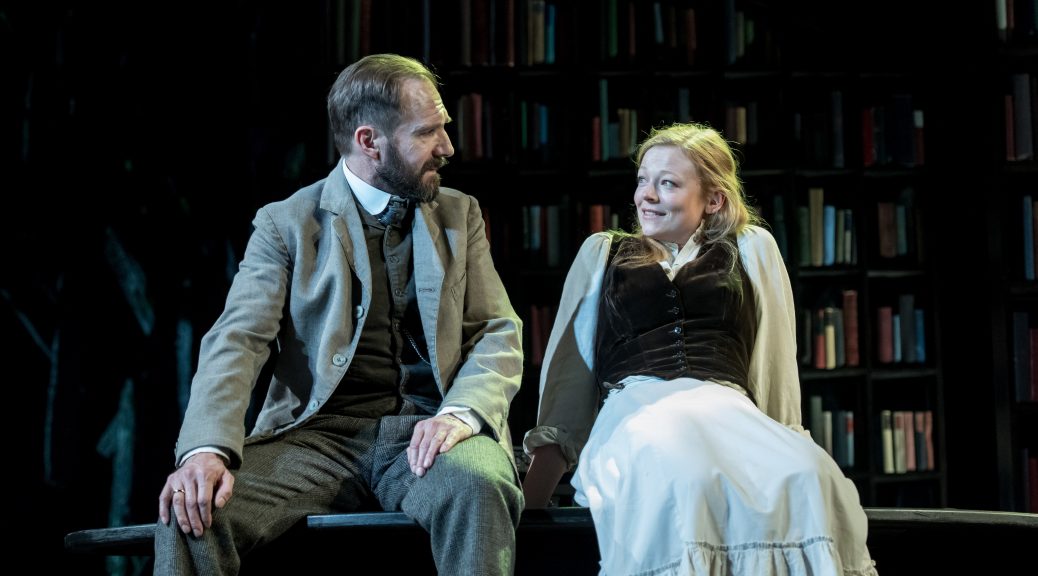
A trio of women make life, let’s say, complicated, for the eponymous subject of the play, Halvard Solness. Fearing for the future, Solness is paranoid that “the young will arrive”, while also guilty about his past – his career success making him the archetypal Man who had all the luck. There’s the overdevoted bookkeeper (Charlie Cameron) he uses despicably. There’s his dutiful wife, a role made weighty by an excellent performance from Linda Emond. Above all, there’s the enigmatic Hilde, who Solness once encountered as a child and creepily promised to make a princess. Now Hilde’s at the door, demanding her castle in the air and showing an unhealthy interest in steeples. This London debut from rising Australian star Sarah Snook is one people will be talking about for a long time – Snook brings a deep-voiced, earthy quality to this ethereal, childish and dangerous heroine.

Linda Emond (Aline Solness) and Sarah Snook (Hilde Wangel) in The Master Builder at The Old Vic. Photos by Manuel Harlan.
Linda Emond and Sarah Snook

In the title role, Ralph Fiennes gives one of the finest performances of his career. In his studio, his bullying lothario is convincingly charismatic and dry witted – Fiennes has always been good at lofty but here we’re allowed to laugh at the character as well, a clever layering that squeezes out the text’s suggestions and innuendo. Solness’ ego never takes a break. But there’s something wrong. His artistic output is linked to an argument with God and any mistakes or errors of judgment become a question of free will. Accounting for Hilde’s strange hold over him, there’s talk of trolls and devils, and a belief that he has some kind of supernatural help, making his wishes comes true “mercilessly”.

With Ibsen revealing cruel truths and Fiennes up to the job of depicting them, we come to see the “soft and gentle” side Solness’ wife claims exist. The pain at the loss of his children and disappointment that, while he builds homes, there is “nothing but despair” in his own, means the solipsism slips. And finally, there’s fear, expressed as crippling vertigo, through which we fully appreciate the deconstruction of the character Fiennes so carefully presents. It’s a masterfully built performance that should not be missed.

Until 19 March 2016

www.oldvictheatre.com

Photos by Manuel Harlan

“The Lorax” at the Old Vic

Legendary children’s author Dr Seuss’s environmental fable, of the titular forest creature who tries but fails to save trees from a fanatical businessman called The Once-ler, is a surprisingly joyous and thought-provoking piece. With inventive theatricality, director Max Webster’s production should please the widest of audiences with puppetry, songs and spectacle, all in rhyme, with both laughs and tears along with way.

If there’s a fault, you wouldn’t describe Charlie Fink’s effective and eclectic songs as quite top notch. But The Lorax isn’t quite a musical. And it would be hard not to focus on David Greig’s adaptation for the stage. The expanded script is in the Seuss spirit – you can feel the great man smiling down on Greig – with lovely modern twists. The inventive and intricate language keeps your attention, with smogulous smog-polluting factories replacing the truffula trees – felled to produce useless thneeds – this show is biggerer than Christmas.

Comfortably short of preachy, the important message is delivered intelligently. Greig’s masterstroke, aided by Simon Paisley Day’s energetic performance, is to show The Once-ler’s argument. Progress has a point and though The Once-ler brings disaster, his motivations aren’t all bad. We get to see how he is corrupted, and the show’s best number is with his lawyers, McCann, McGee and Von Goo. As for wider complicity, there’s the media and consumers who become distracted from The Lorax’s protest by a pop-fuelled fashion show.

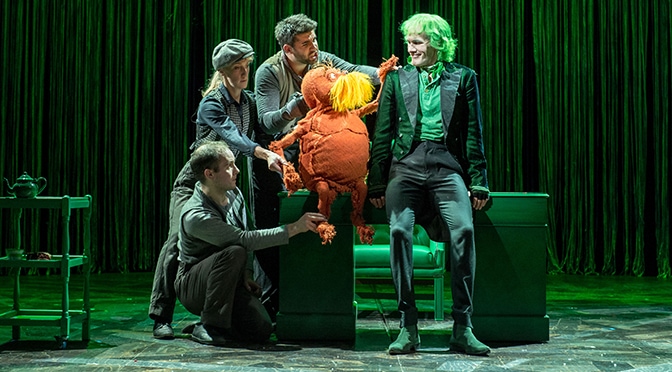
Of course it’s The Lorax who is the star and guaranteed to win hearts. Performed by Laura Cubitt, Ben Thompson and Simon Lipkin, who also voices the character, this is a hero remarkable for his sensitivity and simplicity, as well as (hurrah), age and moustache. The puppetry in the show, masterminded by Finn Caldwell, is superb, perfectly matching Rob Howell’s clever design. The Lorax speaks loud and proud to all and it is to be hoped that many get to hear him.

Until 16 January 2016

www.oldvictheatre.com

Photo by Manuel Harlan

“Future Conditional” at the Old Vic

Marking Matthew Warchus’ first production in charge at the Old Vic, Tamsin Oglesby’s new play is literally about education, education, education, with three views of schools crammed into one, like an overcrowded classroom. The evening is entertaining and feels fresh, and one or two parts might have passed on their own, but cumulatively the play doesn’t score highly.

Lucy Briggs-Owen (Hettie) and Natalie Klamar (Suzy) in Future Conditional. Photo credit Manuel Harlan
Lucy Briggs-Owen and Natalie Klamar

There are those pushy mums at the primary school gates, desperate for their kids to get on. OK, predictable, but the social observations are funny. There’s a strong turn from Lucy Briggs-Owen, as her character justifies going into the private system, and heartfelt angst from Natalie Klamar with a struggle to stay state. There’s a stilted amazement at class differences – are the school gates one of the few places people mix? I suppose I’m not qualified to say. The scenes are fun if slight.

Then there’s an education committee, a talking shop that Oglesby gets more laughs from. Warchus comes into his own here with the direction far tighter than the writing. Talk about shooting fish in a barrel: the arguments are so simplistic and the many characters so transparent it’s almost insulting to an audience. Ironically, the chances of learning anything about education, or being challenged in your thinking, are far too slim.
Rob Brydon (Crane) in Future Conditional. Photo credit Manuel Harlan (2)
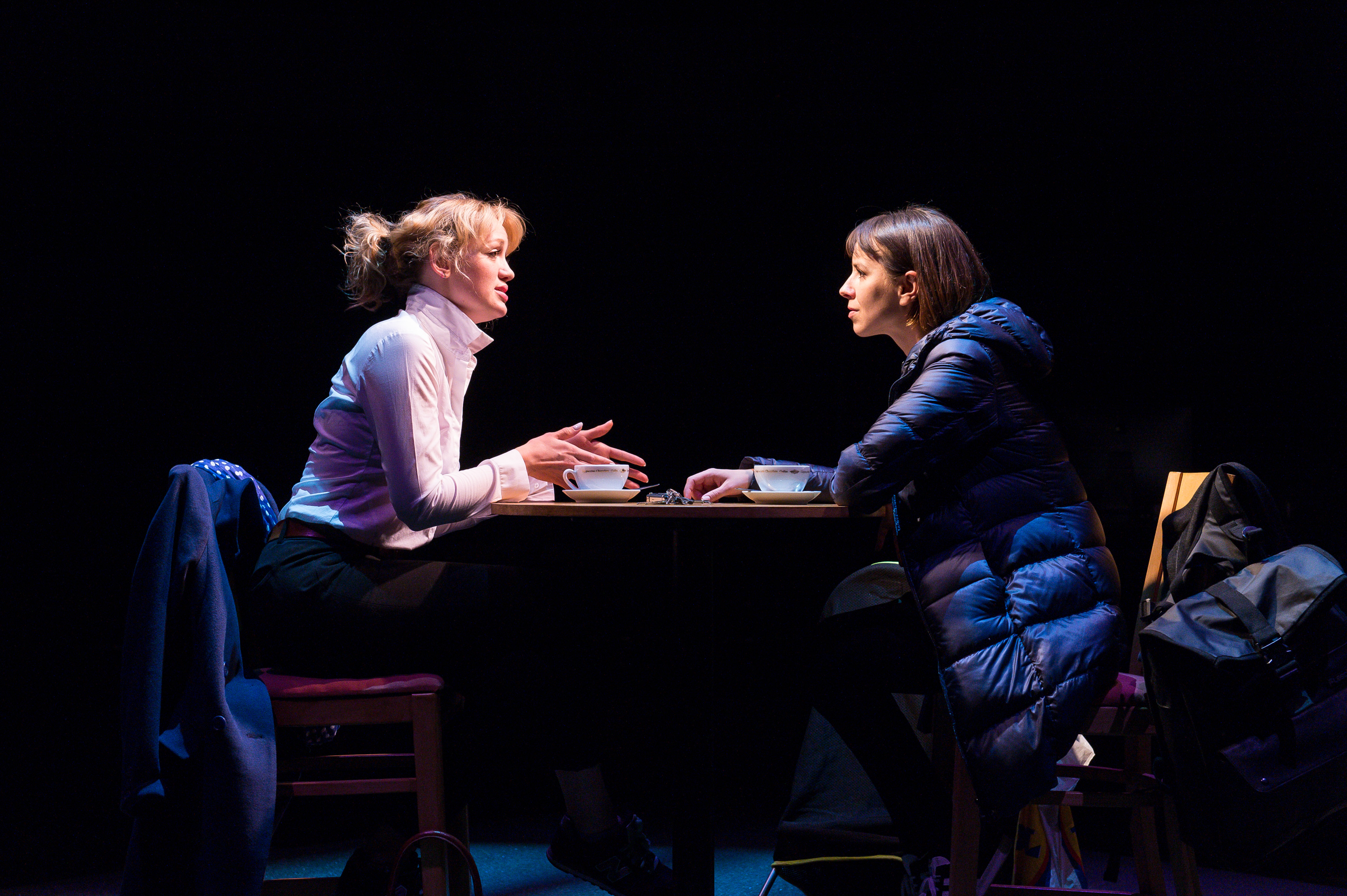
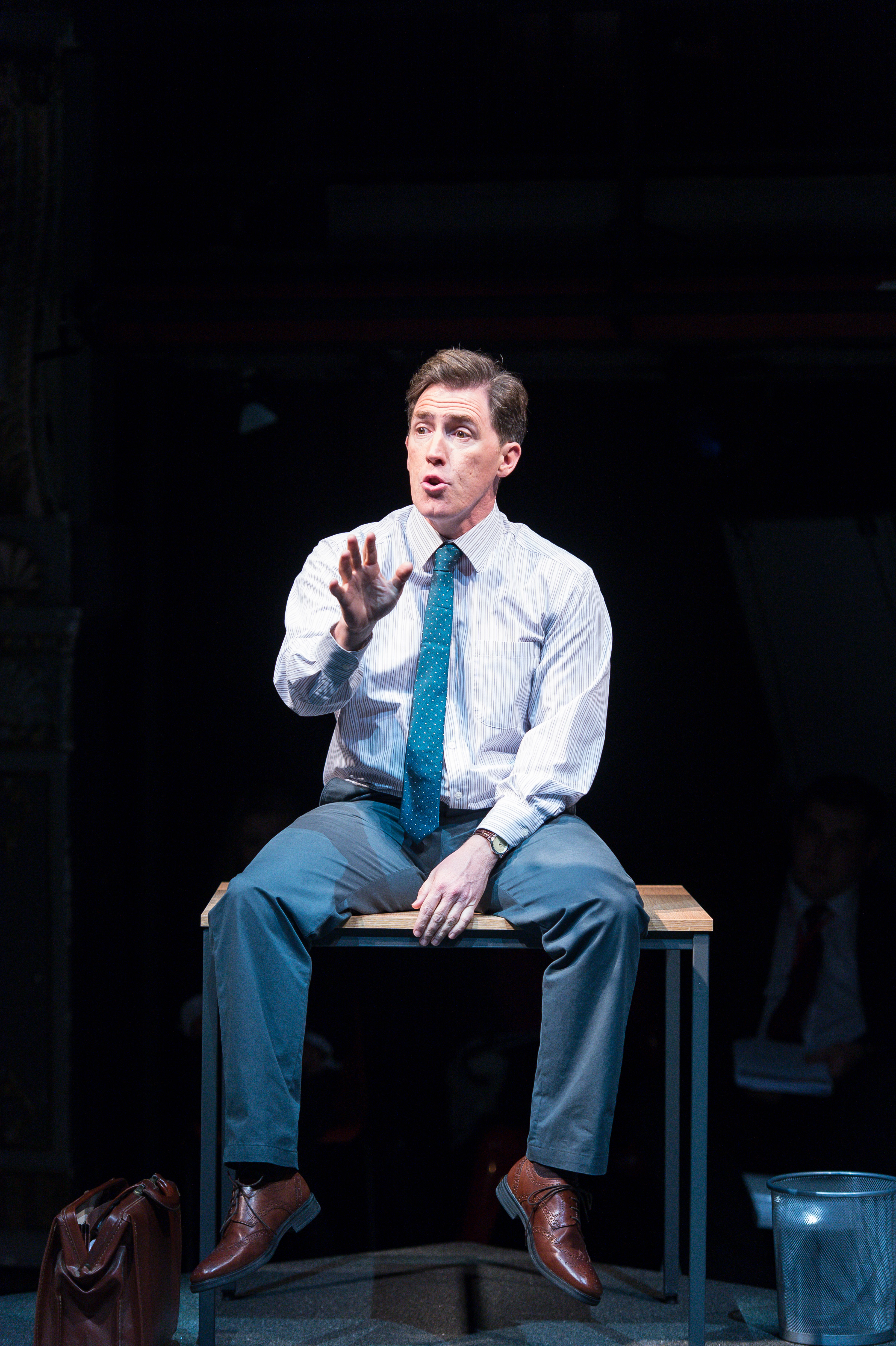
Future Conditional’s most moving narrative has an emotional topicality, with the story of a Malala-like refugee from the Taliban, played impressively by Nikki Patel. She is joined by a woefully underused Rob Brydon as her inspirational teacher, sadly reduced to a trite little speech about how teachers are societal scapegoats. Patel’s Alia is the only character to appreciate learning and her story is uplifting. That her destination is, you’ve guessed it, Oxford, points to the play’s flaw: Warchus and the young cast have plenty of energy and create an exciting feel, but Ogelsby tries to tackle so much that originality goes to the back of the class.

Until 3 October 2015

www.oldvictheatre.com

Photos by Manuel Harlan

“High Society” at the Old Vic

Here’s a bold claim: Maria Friedman’s production of High Society has more laughs than the much loved film it’s based on. More than an amusing trip down memory lane, the show is laugh out loud funny, making the most of Cole Porter’s hit-crammed score and the humour of Arthur Kopit’s book. Updating the original 1930s setting to match the movie’s 1956 date injects a rock and roll feel, making the piece energised and a whole lot sexier.

Admittedly there’s a somewhat slow start. The sound could be bolder and some characters take time to establish themselves. The initial preamble to the wedding of wealthy socialite Tracy Lord and her arriviste fiancé George Kittredge lacks tension, despite her ex-husband CK Dexter-Haven being around. It feels like we’re being served a good prosecco rather than the champagne that plays such a big part in the show.

But by the time I Love Paris is sung, by Tracy and her feisty young sister Dinah, to bemuse two gate-crashing journalists, we’re onto the real thing and laughing a lot. And after the interval the use of the Old Vic’s current in-the-round format is embraced. When the cast sing What A Swell Party, we really feel part of it – it’s a tremendous scene that makes you glad you’ve been invited. The finale also uses the space cleverly as Tracy announces that the wedding is off to the audience, who at this point double as the congregation.

Of course, we’re all happy Tracy ends up with the right man. Rupert Young makes a suitably charismatic CK, while it’s best not to think too much about the fate of the unfortunate George. Dinah and the rogue reporters, played superbly by Ellie Bamber, Jamie Parker and Annabel Scholey, are on our side to allay complicity in the snobbery.
Amongst such a talented cast it’s all the more remarkable that Kate Fleetwood’s Tracy stands out so much. Her sexy voice and stunning comic skills mean you daren’t take your eyes off her. And she looks fantastic in Tom Pye’s glamorous costume designs. I’m not classy enough myself to know the best brand of champagne, but whatever it is, it should serve as a metaphor for Fleetwood’s performance. And she deserves a jeroboam of the stuff.

Until 22 August 2015

www.oldvictheatre.com

Photo by Johan Persson

“Electra” at the Old Vic

Frank McGuinness’ version of Electra is currently playing at the Old Vic. Directed by Ian Rickson, with satisfying confidence, this no-nonsense version of Sophocles’ tragedy, about a daughter’s revenge on her mariticidal mother, is direct and powerful.

This is a fine production with Kristin Scott Thomas in the title role. She’s the star attraction, but it should be stressed that the whole cast is strong. Diana Quick is suitably regal as the detested mother Clytemnestra and Jack Lowden gives a moving depth to Electra’s prodigal brother Orestes.

Hauteur has been a career specialty for Scott Thomas and, since Electra is a princess, it’s used to advantage here. But this is a remarkably earthy performance, free from vanity and physically charged. She is dynamic, pacing around as if caged. Even when on the ground, little of her body touches the earth. Convulsed with grief, every muscle is expressive. And animalistic: her centre of gravity is low and every sense heightened to suggest a hunted figure. This intimation of the feral doesn’t disappear with a cry of joy as Orestes reappears – Electra sniffs her brother as if to confirm that he is one of her brood.

As well as its easy appeal, McGuinness’ text gets to the heart of the tale with efficiency. Along with the horror of the story, dilemmas are presented cogently with an emphasis on religion that Rickson develops.
Quick and Lowden both represent the questions surrounding their bloody family legacy well. The urgency of Electra’s need for justice, which creates a manic “fire in her head”, is balanced with cogent arguments, delineated by Scott Thomas with eviscerating intelligence.

Until 20 December 2015

www.oldvictheatre.com

Photo by Johan Persson

Written 8 October 2014 for The London Magazine