“Footfalls & Rockaby” at the Jermyn Street Theatre

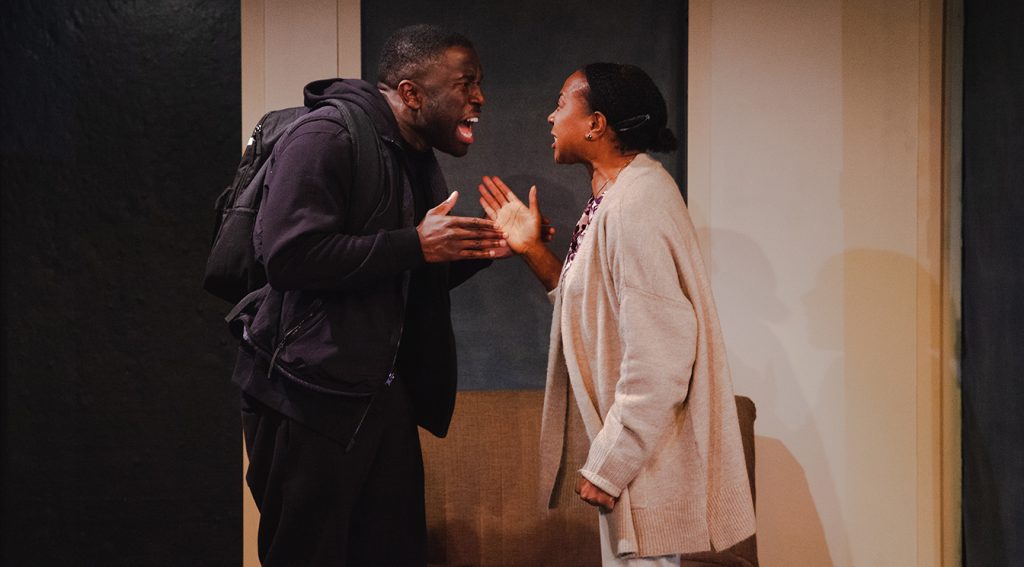
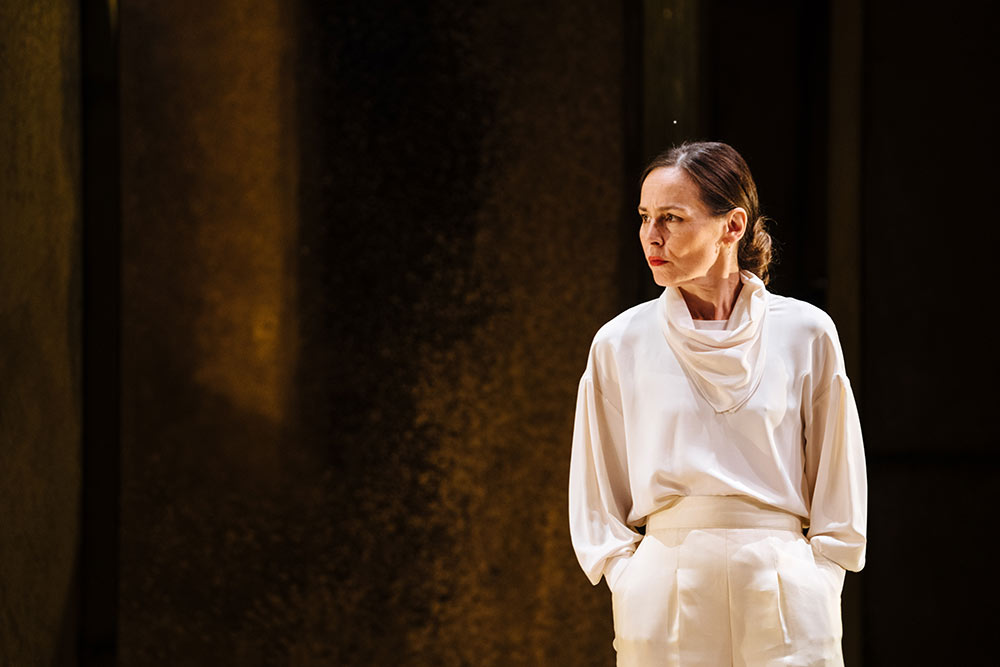
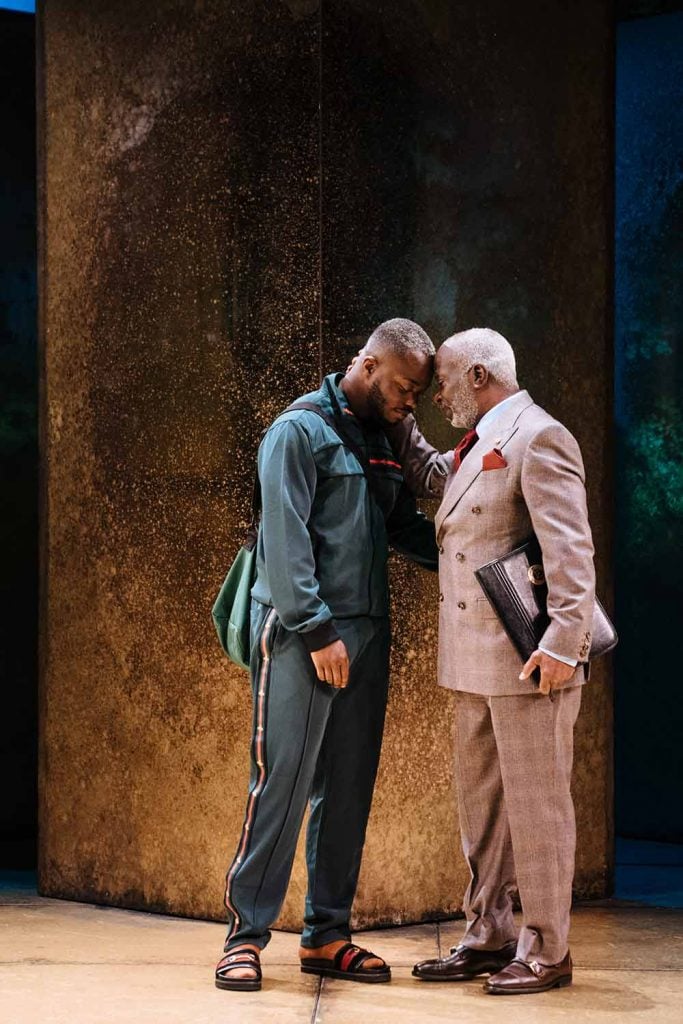
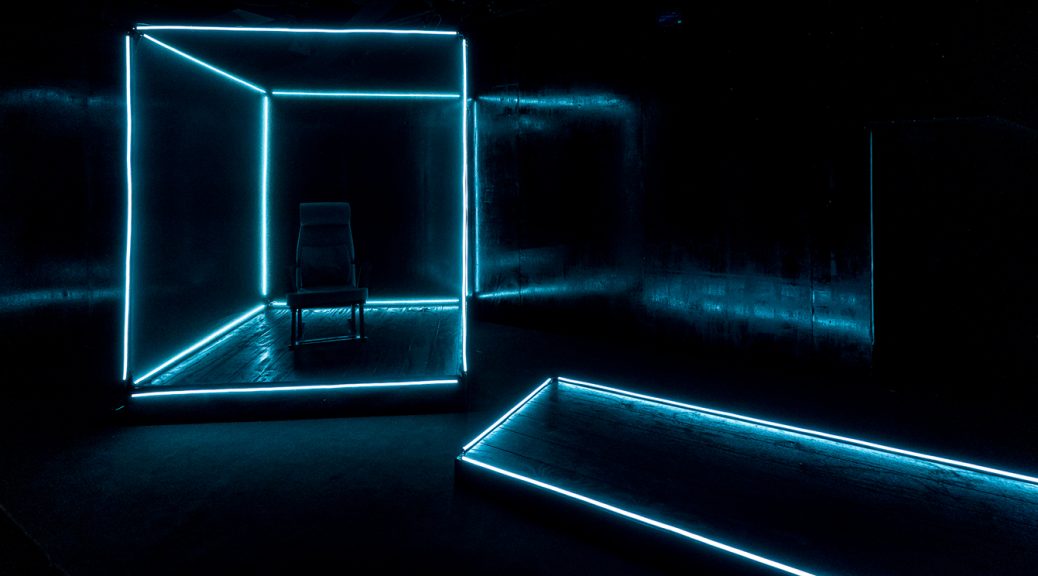
Not everyone makes a beeline for Samuel Beckett plays. It sometimes feels as if the legendary modernist is more beloved of theatre-makers than theatregoers. Fans will, of course, jump at the chance to see these seldom performed shorts, but director Richard Beecham’s stylish work and two brilliant performances should also secure appeal for a wide audience.

Footfalls
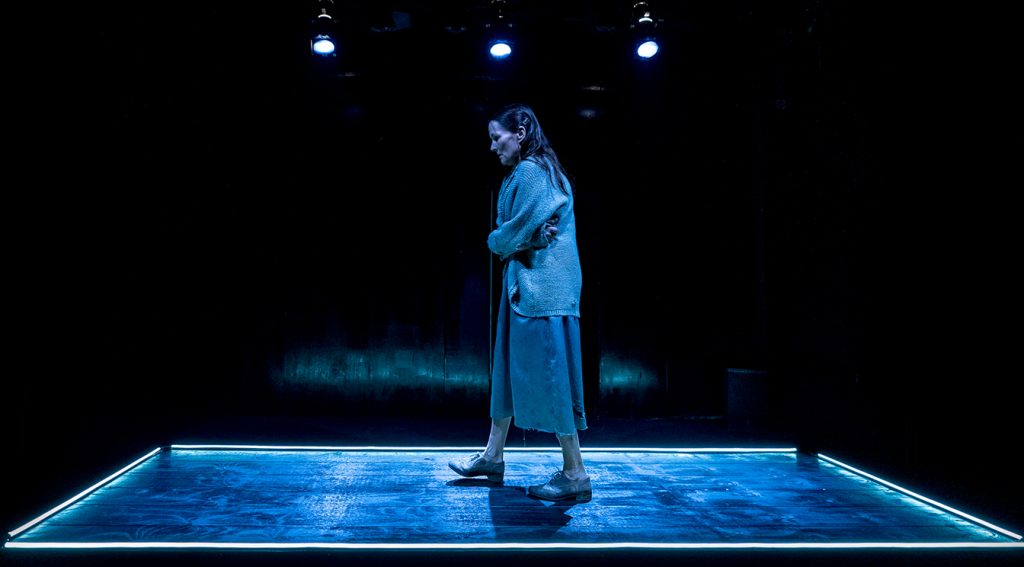
Charlotte-Emmerson-in-Footfalls-at-Jermyn-Street-Theatre-photo-by-Steve-Gregson
Charlotte Emmerson

A woman having bizarre conversation with an offstage voice might sound almost a cliché of experimental theatre. The woman, May, or maybe Amy, may or may not be talking to her dead mother. The voices address one another and then the audience.

The spectre of poor mental health haunts the piece and the appropriately ghostly character, depicted by Charlotte Emmerson, is mesmerising. Emmerson’s timing – so crucial for this piece – is spot on.

Beckett was specific about staging and instructions for lighting and sound – cleverly elaborated by Beecham and his designers Ben Ormerod and Adrienne Quartly. Within these constrictions, a performance of incredible control notches up the tension marvellously.

Rockaby

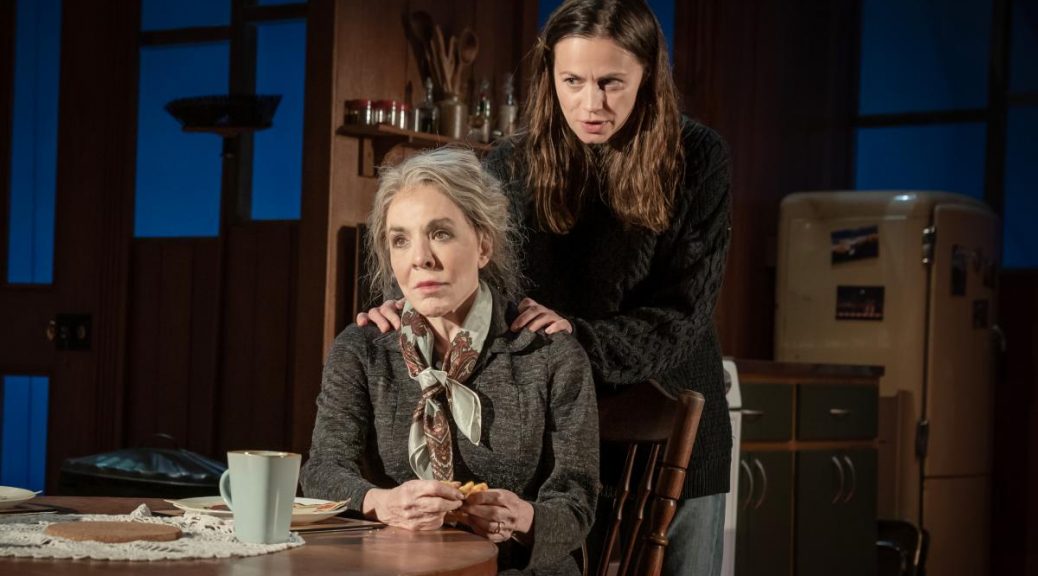
Siân-Phillips-in-Rockaby-at-Jermyn-Street-Theatre-by-Steve-Gregson
Siân Phillips

The sense of isolation for the lonely old woman in Rockaby is overwhelming. There’s a lot of philosophy again – what kind of existence does this unperceived character have? But sitting in her chair, looking for any sign of life with “famished eyes”, the piece becomes painful and deeply moving.

A brilliant performance from Siân Phillips brings home the emotion within the play. Phillips never finds it hard to be magisterial. And there is a dignity to the character that makes us take her wish for more life seriously. But there’s a frailty, too, which compounds a sense of sadness.

The rocking chair, with credit to set designer Simon Kenny, also becomes a character. And a very spooky one. Is it fanciful to say it has a life of its own? As with the sound design within Footfalls, there’s a quality far from lulling in the ceaseless, yet cleverly varied, presence of its back and forth.

Footfalls and Rockaby are late works, from 1975 and 1980, respectively. Minimal and experimental, they set the mind spinning. Concerning mortality and memory, we are presented with vivid, mysterious characters. That intrigue drives both shows for me. It may be simplistic, and far from grand intentions, but both pieces work as bizarre ghost stories that are strangely exciting as well as profound.

Until 20 November 2021

www.jermynstreetheatre.co.uk

Photos by Steve Gregson
“Punchy! The Musical” at the Courtyard Theatre

It’s nicer to emphasis the good things from any trip to the theatre. After all, nobody sets out to put on a bad show. There is talent on and off stage at this friendly venue in Hoxton, but Punchy! is a show with serious problems.

The wafer-thin coming-of-age story follows the titular character (capably performed by Robert Hook) from an anti-climactic brush with the law to an unconvincing romance. Jack Terroni’s story, with a book by Kevin McMahon, drags despite being only 90 minutes long.

Punchy! is not the musical promised – rather, it’s a play with songs, and these are frequently interrupted and hard to hear. The songs, by Terroni, aren’t bad, but the sound quality is poor. And there’s a baffling amount of recorded music used considering a band is on hand.

Director Tiffany King does her best to inject life into the show and she has earned her money, dealing well with rapid changes in the emotional tone of the script. The choreography has its moments (possibly better suited to a screen than the stage), and the costumes are impressive.

The big issue comes with the characters. Various salt-of-the-earth types try to help our hero. And there are his Soul and his Ego, amiably depicted by Jaymes Sygrove and Peter Parker Mensah, following him around. If the trio sounds like an interesting idea… well, in practice, it isn’t.

It’s good that Soul and Ego are a ‘team’ and not simply at odds. And the chemistry between Sygrove and Mensah, like that between Hook and his love interest, played by Lucy Penrose, is good. But the babble spouted – including chats with the dead and a veritable choir of guardian angels – is awful. “It’s a struggle,” says Soul at one point. Yes, yes it is.

The attempts at humour are terrible and the dialogue leaden, painfully blunt and insultingly didactic. There’s only one thing worse than a character asking, “What’s the point of it all?” And that’s another character answering them. Nearly every line sounds like something from a self-help book. Hold on…

Here’s the plot spoiler. Punchy’s journey is based on Richard Barrett’s book, What My Soul Told Me, and his seven ‘levels of consciousness’. The latter are helpfully reproduced in the programme. Whether The Barrett Academy is useful, I can’t say – but applying such ideas to a drama hasn’t helped here. Base characters on a diagram and they end up sketchy. It’s little comfort to those involved but, in this confused show, at least it’s clear what has gone wrong.

Until 21 November 2021

www.punchythemusical.com

Photo by Guido De Mara

“”night Mother” at the Hampstead Theatre

This revival of Marsha Norman’s Pulitzer Prize winning play offers the chance to see brilliant performances from Stockard Channing and Rebecca Night. But be warned – the play deals with the subject of suicide in a provocative and strange fashion.

Night takes the role of Jessie who decides to tell her mother, played by Stockard, that the evening the play recounts will be her last: she calmly reveals that she is going to kill herself. She’s planned it all, including telling her Mama all about it.

Questions arise quickly. Does Jessie have the right to take her own life as she argues? Do her reasons make sense? And what of this sharing. Can that be rational or even, in some way, kind?

It is the powerfully calm tone of the play that proves striking. Credit to Channing and Night for their consistency. With touches of dark humour, the frank discussions, flipping from mundane domestic details to family secrets, avoid histrionics.

night Mother gains much of its power from a cool look at life in a small community. But does Jessie have too many troubles? Epileptic, divorced with a troubled child and agoraphobic – her problems cloud the play’s cerebral intentions. Jessie’s anhedonia is heartbreaking but make her arguments unreliable.

You may have sympathy for Jessie and her desperate wish for control. But the pain she inflicts on her mother is unquestionable. Channing excels in showing her character is far from the “plain country girl” she claims, revealing a repressed intelligence and wit. Trying all manner of persuasion, cajoling then cruel, Channing is awesome to watch.

There is a bravery to Norman’s writing and Roxanna Silbert’s impeccable direction that is commendable. And an originality that impresses – trying to be objective about such an emotive topic is beyond me. Far from easy viewing, ‘night Mother is hard to recommend but is an evening sure to live in the memory.

Until 4 December 2021

www.hampsteadtheatre.co.uk

Photo by Marc Brenner

“Tender Napalm” at the King’s Head Theatre

With a series of exciting monologues last year, prolific playwright Philip Ridley had a good lockdown. But I’m not alone in wanting Ridley’s work back on stage. This expert revival of a real gem is a thrilling treat.

Tender Napalm is a romance, told with startling originality. The memories and fantasies of a couple swing from love to hate. The stories they concoct between them are gripping – passionate and violent.

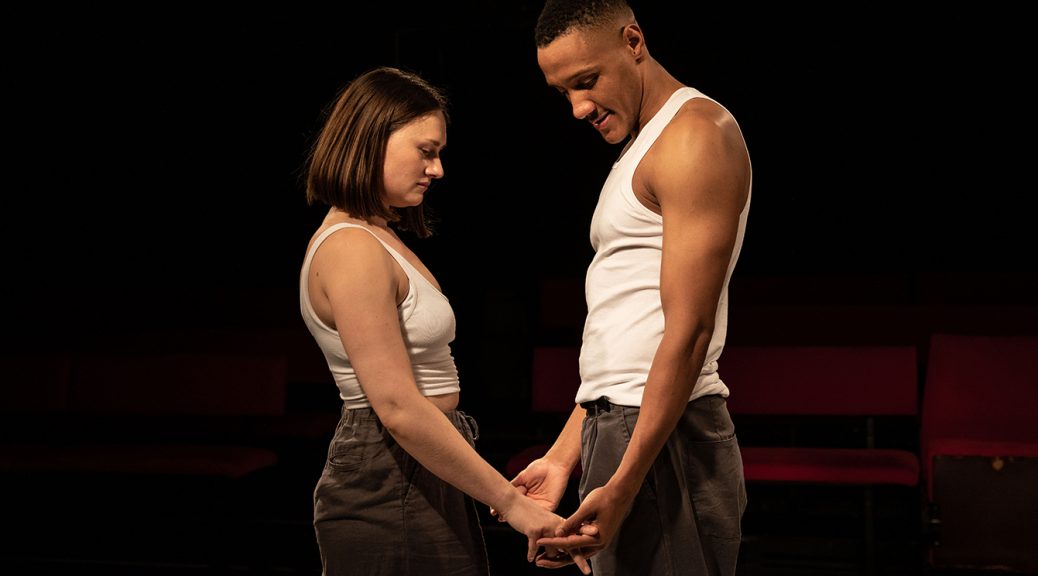
Tales you’d “hardly believe” feature unicorns, UFOs and a common or garden tsunami! In suggesting spontaneity, while delivering Ridley’s poetic lines, performers Adeline Waby and Jaz Hutchins are superb.

Kit Hinchcliffe’s minimal design is a perfect blank canvas for colourful displays of imagination. A potentially static piece, Sam Angell’s bold work as movement director is strong. The occasionally childlike movements are particularly unsettling.

What is poisoning the relationship we watch, the motive for a kind of therapeutic exercise, is surely the death of a child. Ridley isn’t explicit: emotions, like the scenarios, are fluid. But whatever is wrong creates increasing tension.

Yet tenderness is present too. It’s in allowing the care between the characters to show that Hutchins and Waby excel. A change of pace towards the end of the piece is exquisitely handled.

Director Max Harrison has a thorough appreciation of Ridley’s brilliant text. Best of all, Harrison balances a peculiar dark humour with Ridley’s astonishing imagination. The “universe of dreams” this production provides a view of is, in all senses of the word, fantastic.

Until 20 November 2021

www.kingsheadtheatre.com

Photo by Mark Senior

“The Normal Heart” at the National Theatre

Several theatrical responses to the AIDS crisis might be labelled ‘ground-breaking’. Epics by Tony Kushner, or the recent marathon effort from Matthew Lopez, as well as William H Hoffman’s As Is, could all make the claim. Larry Kramer’s play from 1985 deserves the label, too. But, as this excellent revival inadvertently demonstrates, breaking ground doesn’t always age well.

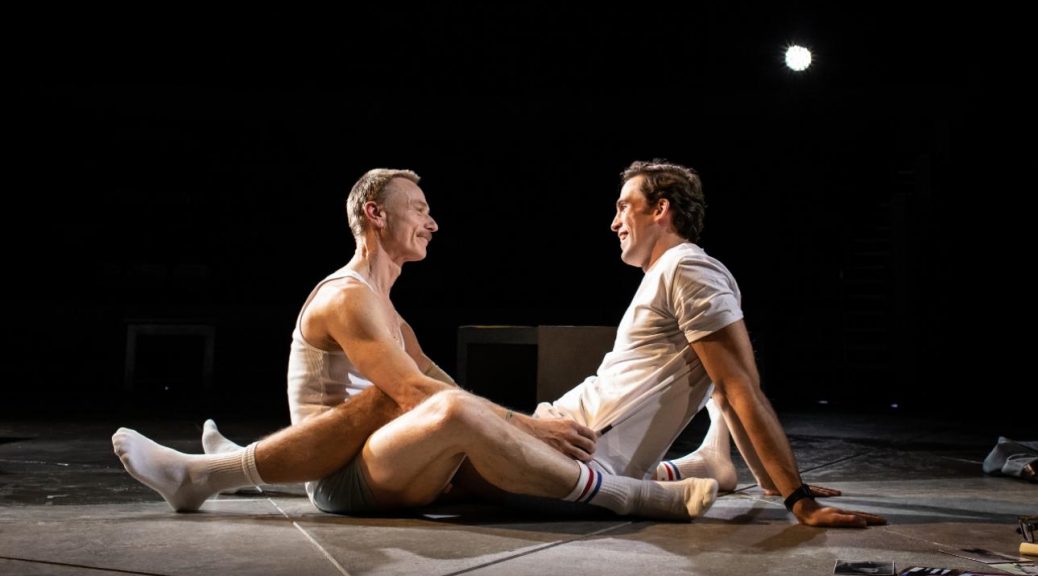
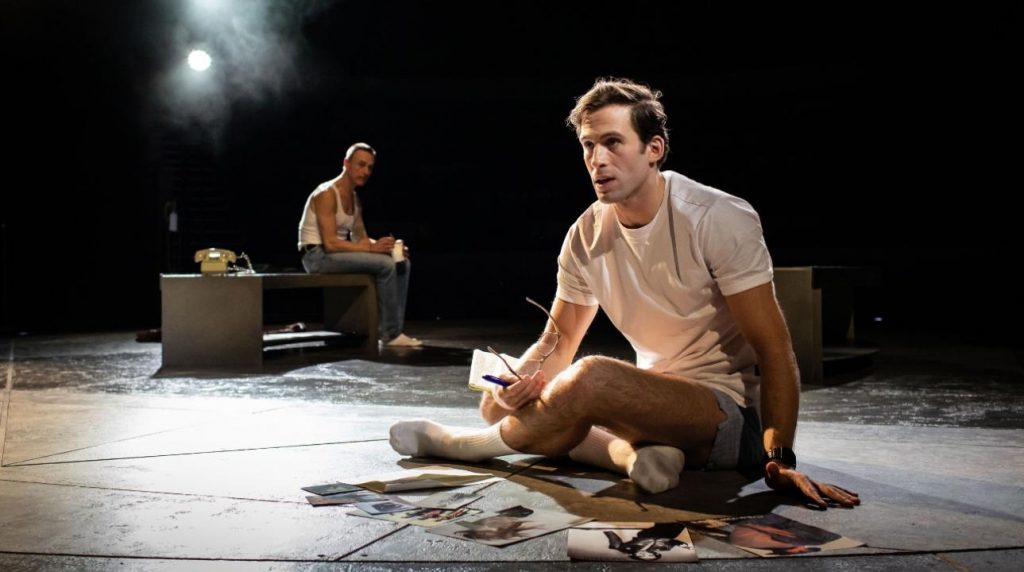
There’s no doubt you will be moved by the central love story between characters Ned Weeks and Felix Turner, played by Ben Daniels and Dino Fetchser with such tenderness. The usher who told me to get some tissues ready knew what she was talking about. Fetchser is brilliant at showing romance alongside his character’s illness, while The Normal Heart marks a career high for Daniels – it’s an extraordinarily demanding role that he delivers with conviction.

Dino Fetscher and Ben Daniels in The Normal Heart at the National Theatre
Dino Fetscher and Ben Daniels

As Weeks starts to campaign for research into the then new disease his partner suffers from, Daniels makes the urgency and desperation palpable. The history of neglect in the early years of the AIDS crisis is still shocking. With the help of Liz Carr’s Dr Brookner, the advocacy organisation Weeks helps found makes the play a microcosm for the topic of activism. Almost incidentally, there are strong characters for Daniel Monks, Danny Lee Wynter and Luke Norris, who show different personalities – and arguments – within the campaign.

Weeks’ anger and energy are phenomenal (the role must be exhausting) and driven by a fierce intellect. The play addresses issues of identity and community, reflecting political tensions through energising polemic. The ideas are interesting, although Kramer’s handling of them is far from even. And there’s another strong role when it comes to Weeks’ calls for acceptance: scenes with his brother, played so well by Robert Bowman, could be explored further.

For all director Dominic Cooke’s efforts to emphasis activism and Weeks’ abstract thinking, neither is what the play is about. The piece has such a definite purpose that a tension within the revival becomes increasingly clear.

The Normal Heart was political in a very direct way. With its statistics and documentation, Kramer wanted to educate and hold others to account. He wanted to incite action and inflame emotion. Debates are detailed. The pressing question was how to best get results. No matter how skilfully conveyed, that question is no longer relevant. Even the staging in the grand Olivier Theatre feels incongruous, despite Vicki Mortimer’s cleverly stripped-back design. A show with the capacity to tour smaller venues feels like the intention.

Written as a call to action for an event now thankfully past, both play and production command respect but feel lost in the present.

Until 6 November 2021

www.nationaltheatre.org.uk

Photo by Helen Maybanks

“White Noise” at the Bridge Theatre

An African American man volunteering to be the slave of his white friend is the core idea that guarantees Suzan-Lori Parks’ play is memorable. Is it brilliantly provocative, instantly horrifying or a gimmick? That Parks acknowledges all possibilities is to her credit.

Coming after a police assault, Leo says he will be safer as the wealthy Ralph’s property. Commentary doesn’t come more damning. Parks uses the experiment to raise the issue of inherited trauma and invites scepticism – Leo’s an artist and there’s the chance his project is a performance.

The ramifications, set over 40 days, prove dizzying even if they are well handled. Even the harshest critic couldn’t say White Noise has just the one trick. In exploring the ‘virus’ of racism Parks thinks big and commands respect.

There is an intelligent contribution on the topic of ‘woke’ culture. As the men’s partners, Dawn and Misha – a YouTuber and a lawyer respectively – try to make the world a better place, and Parks documents their trials and hypocrisies with a steely eye and a keen ear (the verbose dialogue is something else).

The idea of privilege is examined, too – forcing all the characters to ‘check’ themselves. This high-achieving quartet of college graduates seems to have no money worries. Instead, there is a cloying concern for status. And there’s the superb conceit of a – literal – ‘White Club’ that Ralph ends up joining. A conspiracy I found particularly creepy.

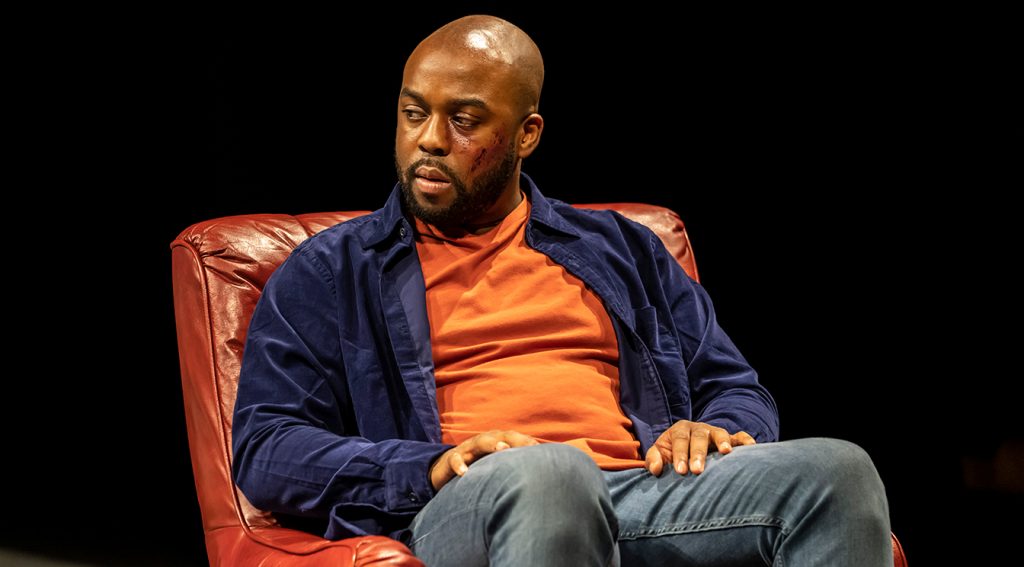
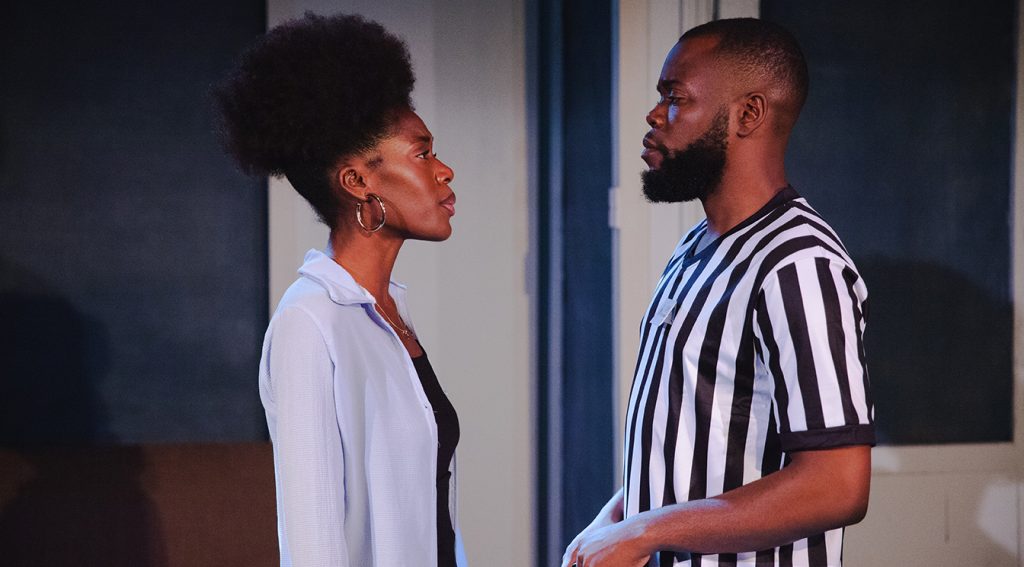
The play fizzes with ideas – but not the stage. Of course, the experiment ends badly – that’s no surprise – but the effects on all disappoints. Despite the efforts of a strong cast – Ken Nwosu, Helena Wilson, Faith Omole and James Corrigan – the friends fall apart too quickly and feel like puppets for Parks.

Ken-Nwosu-in-White-Noise-Photo-by-Johan-Persson
Ken Nwosu

The confused relationships and affairs between the four prove tiresome and predictable. A desire to be comprehensive and even-handed results in four excellent monologues (Nwosu’s comes first and is especially strong), but these make the show very long indeed. Each character spends too much time thinking about themselves to be appealing. With all the self-awareness, much of dialogue sounds like a mission statement.

Director Polly Findlay respects Parks’ considered arguments and adopts a slow, even pace that compounds the problem. The scope and insight of Parks’ writing is impressive, but more focus might make a better play.

Until 13 November 2021

www.bridgetheatre.co.uk

Photos by Johan Persson

“Love and other acts of violence” at the Donmar Warehouse

There is nothing easy about Cordelia Lynn’s new play. Given that it looks at anti-Semitism, and the legacy of violence through the prism of a troubled relationship, the fact that it’s difficult to watch isn’t surprising. The shock is that the play lacks power.

Setting up connections between a historic pogrom and its effects on a single couple living much later is an intriguing idea – the kind of question theatre should be addressing. Good intentions and topicality aside, the subject isn’t well handled.

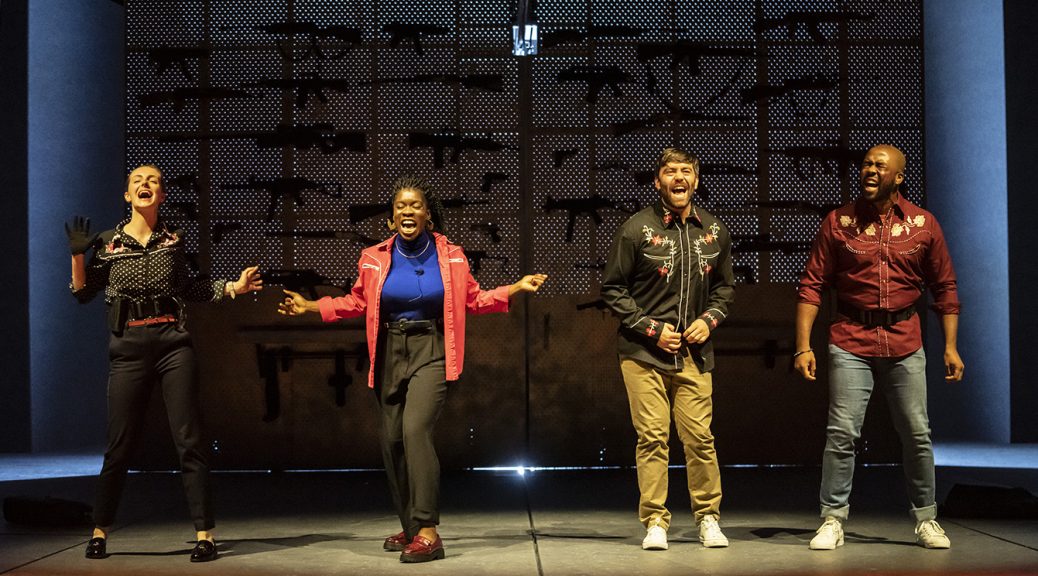
Being deliberately vague makes the piece too hard to follow. That it’s set in a generic near-future, in a Fascist Poland, takes a while to work out. I’m sure there is some point to being so generic, but too little context makes the action and connections opaque and frustrating. And we are robbed of preparation for the play’s final scene, set in a past that hasn’t been addressed adequately.

There are problems with the love affair too – lacking chemistry, it’s hard to believe in it. A political poet (named, sigh, ‘Him’) is energetic and superficially appealing. ‘Her’ is a scientist who has to come around to his enlightened thinking as her life is impacted by populist politics. But the characters are uneven: she far more interesting, imaginative and full of surprises. Snippets of poetic internal dialogue strive achingly hard to be profound but add little.

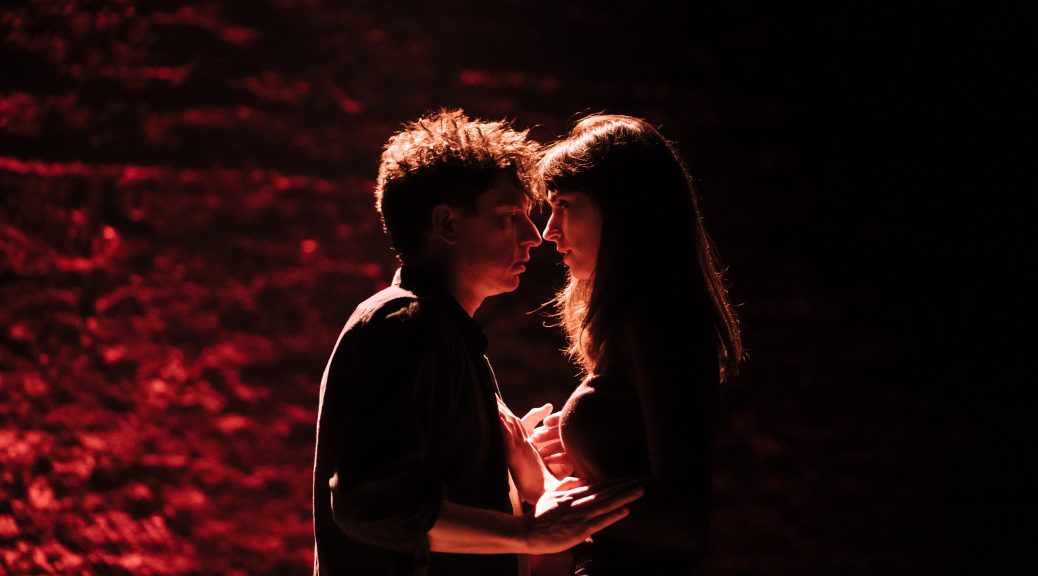
The series of short scenes, dropping the audience into dramatic situations, are sometimes funny and often bold. And the acting is good. Tom Mothersdale and Abigail Weinstock give committed performances, the latter being notable as a professional debut of great confidence. But Lynn’s skill as a provocateur ends up wasted with vague arguments that aren’t as original as the theatricality of the production.

For the show is strong visually. Credit to director Elayce Ismail and an excellent technical team. The lighting design by Joshua Pharo is innovative, especially when it comes to disturbing scenes of violence. And Basia Bińkowska’s set, with a surprise for the finale, is superb. That last scene takes us to 1918 and Lemberg but I’m not sure I’d have worked that out without a programme.

Lynn isn’t obliged to write for a simple soul like me. Pointers to the past might be enough for some, and it’s clever to have a play that looks to the near future flip into the past for its conclusion. There is a charge as Mothersdale arrives in the character of a soldier to confront Weinstock in the role of her grandmother. But I wasn’t interested enough in a future already seen to bother as much as I should. The subsequent bleak union, thankfully separated from most realities, is too divorced from dramatic interest.

Until 27 November 2021

www.donmarwarhouse.com

Photos by Helen Murray

“Foxes” at Theatre503

Dexter Flanders’ carefully modest play is an impressive character-driven family drama. Shortlisted for the Alfred Fagon Award, Foxes is a winning piece that is easy to recommend.

Daniel’s church-going family opens its home and heart to his pregnant girlfriend Meera when she is rejected by her Muslim parents. But the family is torn apart when Daniel comes out as gay. It’s the play’s next move that really surprises.

The plot is part of Flanders’ skill and strategy to question the nature of acceptance – and what we compromise on to gain it. Presenting complex, contradictory emotions makes this debut play mature.

It seems a shame to define the strong characters in Foxes in relation to David – they are all so good. Arch yet adorable Meera and her sister-in-law Deena are brilliantly elaborated by director James Hillier and performers July Namir and Tosin Alabi. They don’t just present arguments, but are recognisable people that you care for.

July Namir and Michael Fatogun in FOXES credit Adiam Yemane
July Namir and Michael Fatogun

Both young women light up the stage. As a stark contrast, Anyebe Godwin, playing the man in Daniel’s life, does a brilliant job of showing the dark toll that living in the closet has taken on a bright young man. His clandestine existence gives the play its title.

Tosin Alabi and Anyebe Godwin in FOXES credit Adiam Yemane
Tosin Alabi and Anyebe Godwin

What I suspect is the origin of the play – Daniel’s coming out scene – is another highlight. The scene is stunning. Not least for Doreene Blackstock, who plays Daniel’s mother with such ferocity and tenderness.

Michael Fatogun and Doreene Blackstock in FOXES credit Adiam Yemane
Michael Fatogun and Doreene Blackstock

So, Flanders can write characters. The off-stage father who all mourn is further proof – he is a tangible presence. But it’s the central role, played by Michael Fatogun, who really grabs the attention. Confusion isn’t easy to show on stage, but Fatogun manages to convey the trauma and elation of his first gay kiss brilliantly. Throughout, Daniel’s youthful bravado and sensitive intelligence are made clear. It’s a performance, and a role, to dream about.

Breaking up Flanders’ short scenes might be handled better by Hillier, as Foxes is slightly longer than needed. The production’s projections are impressive but feel unnecessary. And I’d welcome a stronger sense of place than Flanders provides. But these are minor quibbles against a strong show.

Chances for Daniel to change, through several scenes in Act Three, build momentum nicely. A series of potential conclusions impress – and depress – by turn. How will Daniel and his family solve their dilemma? Dexter appreciates that any happy ending is going to be messy. How many lies will each character put up with? One certain truth is that everyone should see this play

Until 23 October 2021

www.theatre503.com

Photos by Adiam Yemane

“Hamlet” at the Young Vic

The star casting of Cush Jumbo in the title role of Shakespeare’s tragedy does not disappoint. One of the finest Hamlets I’ve seen, Jumbo gives a stirring performance of clarity, considerable humour and intelligence. This is the philosopher prince, keen to debate and discuss – a wit with a love of words.

In case you’re wondering, Jumbo plays Hamlet as a man (there’s no change of gender in the text). It’s how convincing she is as a swaggering youth that surprises, balancing bravado with insecurity just like many a teenage boy. The humour is excellently handled. Let’s be honest, not all the jokes in Hamlet work – some need a little extra help – and Jumbo seems to know exactly when to provide this.

Tara Fitzgerald in Hamlet credit Helen Murray
Tara Fitzgerald

Surprisingly, beyond casting a woman in the lead, director Greg Hersov’s commendable production ends up conservative, in the sense that it is restrained. Firstly, some performances are strikingly muted. Adrian Dunbar’s Claudius is a forceful study in minimalism. Incredibly understated, he barely raises his voice. The performance is all the more powerful for its control. The same praise can be given to Tara Fitzgerald’s Gertrude. Her delivery of Ophelia’s death, and even her own death, are remarkably flat. The royal couple are so repressed they are frightening.

Jonathan Ajayi and Joseph Marcell

As a contrast, Laertes and Ophelia carry much of the burden of emotion in the play. Hersov reminds us that Hamlet is the story of two families. Along with Joseph Marcell’s appealing Polonius, Norah Lopez Holden and Jonathan Ajayi create the sense of a family unit with remarkable speed and efficiency. 

This Hamlet is an austere affair, from Anna Fleischle’s minimalist design to the sparse modern touches. There’s an edit, too – a bold one – as Fortinbras is excised. It’s all to focus on how cerebral both character and play are: this is a Hamlet for thinkers.

Plotters, too, of course. There’s Hamlet’s procrastination – but note how Jumbo carefully lays out thoughts. Hersov emphasises what a bunch of thinkers this court contains. Claudius doesn’t really try to pray; he’s working out why he can’t. And the scene of his plotting with Laertes is a proper sit-down meeting.

The production is a move away from those that have emphasised performance and acting. The travelling players suffer a little as a result and action is minimalised. But, as an interpretation focusing on argument and discussion, Hersov starts a debate about the play that this excellent production wins.

Until 13 November 2021

www.youngvic.org

Photos by Helen Murray

“Shining City” at the Theatre Royal Stratford East

A ghost story that isn’t interested in the supernatural? That’s the idea that makes Conor McPherson’s play original. Therapy sessions for John, who thinks he is haunted by his wife, are combined with scenes from the life of his therapist, Ian. But Shining City doesn’t have much time for spooks… or does it?

McPherson highlights how our perceptions shape our lives – not just John’s hallucinations but Ian’s history, too. Whether they appreciate that they are deluded or believe they are taking control is open to debate. These are lives that seem lonely or stuck. The characters are indulged but interesting, and McPherson’s telling of the tale is excellent

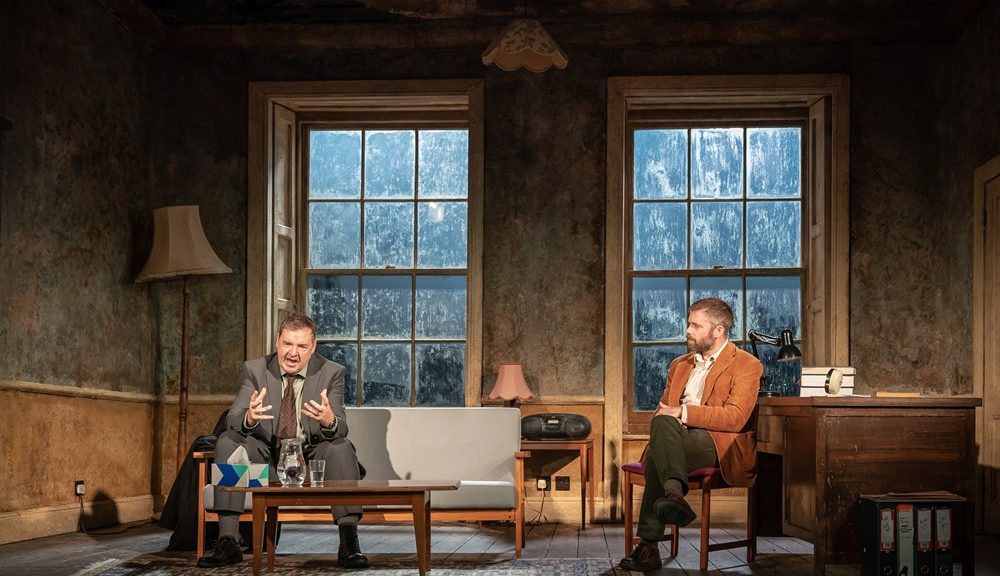
Without doubt, McPherson writes great roles. Rory Keenan as Ian is in every scene and is fantastic. And there’s strong support from Brendan Coyle, Curtis-Lee Ashqar and Michelle Fox. 

Might Coyle’s John be funnier? McPherson is famed for his dark wit, even if this play is restrained, but humour isn’t on director Nadia Fall’s agenda. As Coyle recounts “all the silence” in his troubled marriage – behaviour that now makes him guilty – you can appreciate the depth of a skilled portrayal.

The quiet power of Ian anchors the show. A lot of time is spent listening to others talk and an unrushed Keenan becomes fascinating to watch as he suggests the slightest touches of not just boredom, but of someone hiding the fact that they are bored! Balanced with revelations (and questions) about the therapist’s past and future, showing different sides of his character, it’s great stuff. Nonetheless, Fall takes the slow pace too far, which – combined with some lengthy scene changes – dilutes tension too much.

Even if this production is a narrow view of what the text offers, the writing and performances are strong enough to earn it plenty of stars. 

As the characters try to convince themselves that their lives are getting better and their perceptions improving, McPherson wants to be clear – those perceptions are only personal. If John buries his guilt, might Ian, somehow, be about to inherit the ghost? There’s a surprise in store that makes sure you leave the theatre with goosebumps.

Until 23 October 2021

www.stratfordeast.com

Photo by Marc Brenner