Tag Archives: Joshua Pharo

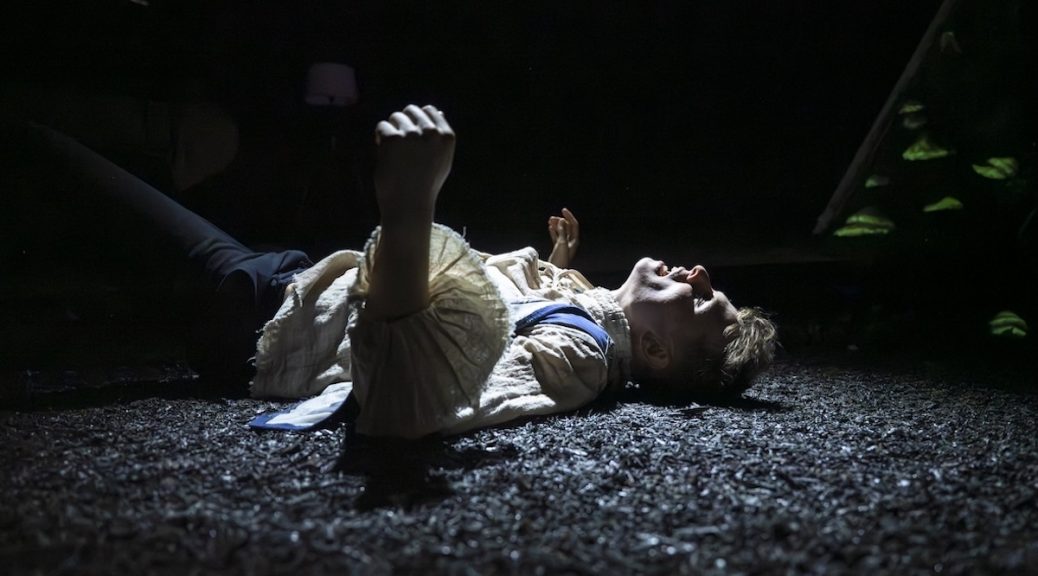
“It Walks Around The House At Night” at the Southwark Playhouse

If you like a good ghost story, then this is for you. Tim Foley’s play uses traditional elements, such as a haunted house and creepy strangers, but brings them smartly up to date and provides plenty of unexpected turns. Neil Bettles’ direction is tight and the production – with lighting, video and sound design from Joshua Pharo and Pete Malkin – first class. Best of all, It Walks Around The House At Night embraces the stage and live performance, proving there’s nowhere better than the theatre to get a good scare.

Foley gives us a very contemporary narrator called Joe and George Naylor makes the most of the role. At first, he brings out a lot of humour, some of it surprisingly gentle (Naylor is hugely endearing). But there are depths here that provide shocks and make the character fulsome. An out-of-work actor and writer, Joe is hired to perform as a ghost at a haunted house. The neat scenario turns sinister quickly and in every way you might imagine, including a potential romance between actor and producer. The steps to increase tension are piled on and add excitement as the ‘ghost’ walks night after night.

Foley’s structure is strict, with a firm knowledge of the genre – a creepy painting and picnic, as well as hallucinations, are always good. But he appreciates the importance of clever twists. So, the jump scares are grand and the spooky details effective, but it’s the addition of dance that is most welcome. I’m not quite sure about an obsession with class, although it’s a clever observation that “those bastards in their mansions” do feature large in supernatural stories. But the chip on Joe’s shoulder, while understandable, isn’t as eloquent as the rest of the play.

That shouldn’t stop anyone from enjoying such strong writing. Foley builds momentum deliciously and Bettles controls the action while Pharo and Malkin rise to the clear ambition. The action gets more physical and Naylor, joined by dancer Oliver Baines, pull off some very neat moves. Concern about the fate of Joe’s ex-boyfriend and the vivid inclusion of his friends, none of whom we see, indicate how wrapped up in the story I became. By the end, there are fewer effects. The team knows the need for them subsides – a storyteller on a stage is enough.

Until 28 March 2026


www.southwarkplayhouse.co.uk

Photo by Tommy Ga-Ken Wan

“Love and other acts of violence” at the Donmar Warehouse

There is nothing easy about Cordelia Lynn’s new play. Given that it looks at anti-Semitism, and the legacy of violence through the prism of a troubled relationship, the fact that it’s difficult to watch isn’t surprising. The shock is that the play lacks power.

Setting up connections between a historic pogrom and its effects on a single couple living much later is an intriguing idea – the kind of question theatre should be addressing. Good intentions and topicality aside, the subject isn’t well handled.

Being deliberately vague makes the piece too hard to follow. That it’s set in a generic near-future, in a Fascist Poland, takes a while to work out. I’m sure there is some point to being so generic, but too little context makes the action and connections opaque and frustrating. And we are robbed of preparation for the play’s final scene, set in a past that hasn’t been addressed adequately.

There are problems with the love affair too – lacking chemistry, it’s hard to believe in it. A political poet (named, sigh, ‘Him’) is energetic and superficially appealing. ‘Her’ is a scientist who has to come around to his enlightened thinking as her life is impacted by populist politics. But the characters are uneven: she far more interesting, imaginative and full of surprises. Snippets of poetic internal dialogue strive achingly hard to be profound but add little.

The series of short scenes, dropping the audience into dramatic situations, are sometimes funny and often bold. And the acting is good. Tom Mothersdale and Abigail Weinstock give committed performances, the latter being notable as a professional debut of great confidence. But Lynn’s skill as a provocateur ends up wasted with vague arguments that aren’t as original as the theatricality of the production.

For the show is strong visually. Credit to director Elayce Ismail and an excellent technical team. The lighting design by Joshua Pharo is innovative, especially when it comes to disturbing scenes of violence. And Basia Bińkowska’s set, with a surprise for the finale, is superb. That last scene takes us to 1918 and Lemberg but I’m not sure I’d have worked that out without a programme.

Lynn isn’t obliged to write for a simple soul like me. Pointers to the past might be enough for some, and it’s clever to have a play that looks to the near future flip into the past for its conclusion. There is a charge as Mothersdale arrives in the character of a soldier to confront Weinstock in the role of her grandmother. But I wasn’t interested enough in a future already seen to bother as much as I should. The subsequent bleak union, thankfully separated from most realities, is too divorced from dramatic interest.

Until 27 November 2021

www.donmarwarhouse.com

Photos by Helen Murray