“Paradise Found” at the Menier Chocolate Factory

Coming to the Menier Chocolate Factory’s new musical, Paradise Found, slightly later than the first-night critics, it was hard for this writer to avoid the early reviews. These began with an assault by the bloggers and were followed by the pros, who seemed to enjoy panning the show with only marginally less enthusiasm than their amateur colleagues. Combine the Menier’s recent record (success in the West End and on Broadway) with the cast and creatives imported for this show and it is hard to see what could go wrong. Co-directed by Hal Prince and Susan Stroman and starring a fantastic Broadway cast, could it really be as bad as everyone is saying?

At turns dreadfully, offensively, old fashioned and then novel to the point of eccentricity, Paradise Found is odd and unsettling. However, with a cast this talented, the evening is always entertaining. Set to music of Johann Strauss II (see what I mean about odd) with musical direction by Charles Prince, it often sounds lovely and, with a clever set by Beowulf Boritt, it looks pretty good as well.

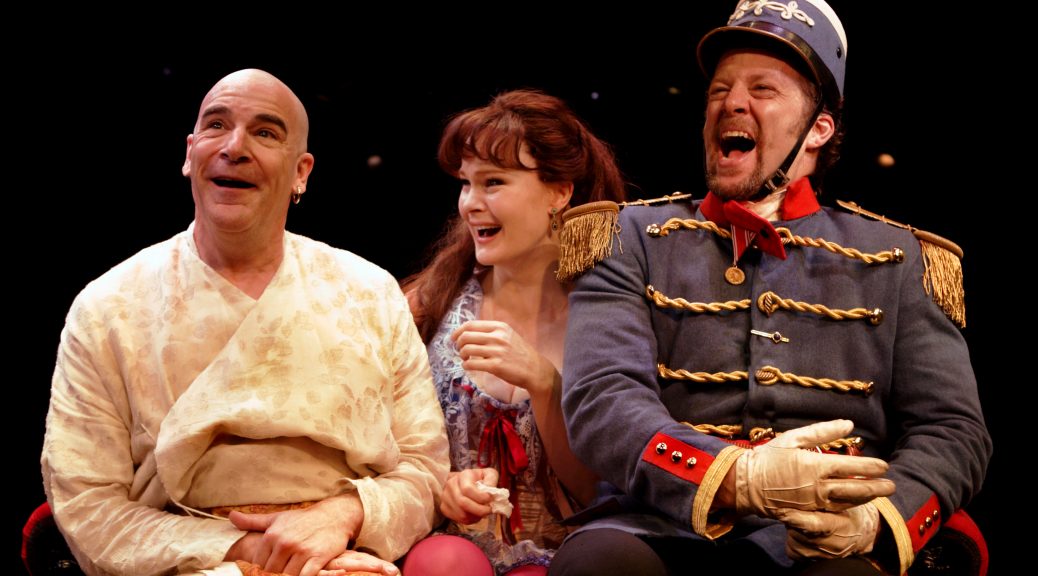
There is some great comic talent here. John McMartin is very funny as the Shah of Persia travelling to Austria to revive his libido. And it is a privilege to hear Shuler Hensley and Kate Baldwin as the Baron and the prostitute who fall in love. And then there is Mandy Patinkin, who jokes, sings and pauses for thought as a (strangely Zen) eunuch from the Shah’s court.

Although the story is silly (and it is inspired by real life events) this shouldn’t be a huge problem for musical theatre. Things start to fray when the ratio of deliberately bad jokes outweighs those that get genuine laughs. The show is also strangely disjointed, with an interval located before the end of the first act. In the latter part of the evening the action takes place 15 years on and things become darker in tone. The now destitute Baron is performing in a musical of his own story. This vaudeville version of events that bordered on pastiche might have sounded post-modern and clever. It is actually just a bad idea.

Paradise Found is messy, but it is a bold mess with moments of brilliance. Many of its failings don’t really sink in until later. With Prince and Stroman behind it, the faults may be surprising, but these two are big enough to learn lessons and I suspect this won’t be the last we hear of their show. The Menier is to be commended not only for bringing so much talent to our shore but also for taking risks. This is what has brought it so much success recently, and it must be careful that it doesn’t lose this quality.

Until 26 June 2010

www.menierchocolatefactory.com

Photo by Catherine Ashmore

Written 7 June 2010 for The London Magazine
“Romeo and Juliet” at the Leicester Square Theatre

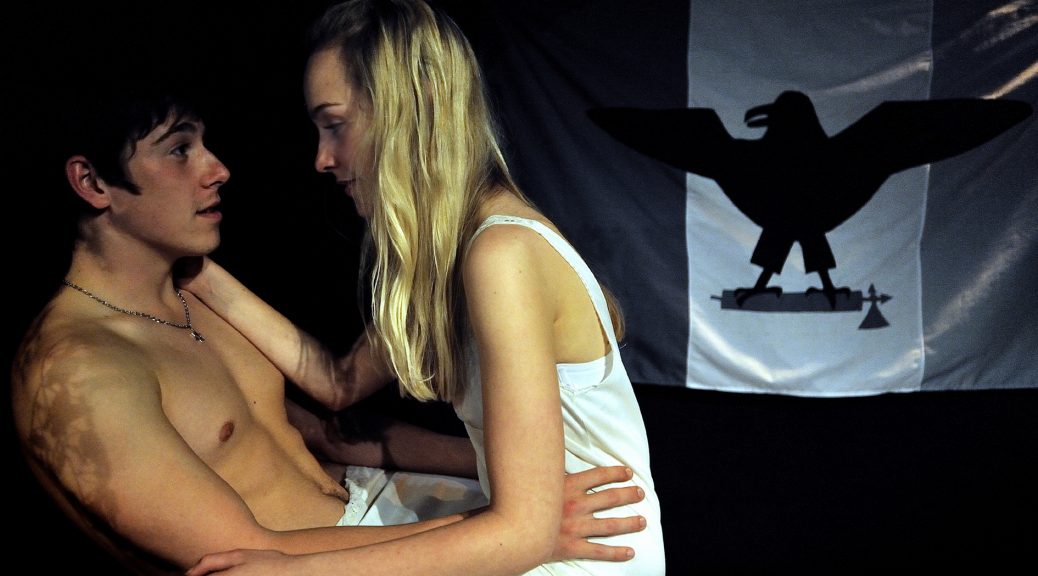
The young Ruby In the Dust Theatre company now have a semi-permanent home in the basement auditorium of the Leicester Square Theatre. Having done so well with their production of Dorian Gray they now present a fresh and bold version of Romeo and Juliet.

The action is set in Fascist Italy, with the warring families recast as either Mussolini’s “blackshirts” or Jews. At the risk of sounding mean-spirited, this ambitious concept adds little to the production (apart from the odd Star of David). Some people despair at the slightest change in the Bard’s text, but that isn’t the objection here. Unless you’re a purist, you’ll be happy with the changes made by director Linnie Reedman, especially as the result is a fast-paced and exciting show.

Very much in the spirit of Shakespeare, this is a show with plenty of music. Joe Evans has composed some delightful tunes that sit well next to an eclectic soundtrack. It is a shame that we can’t hear more, as the score adds to both romance and drama.

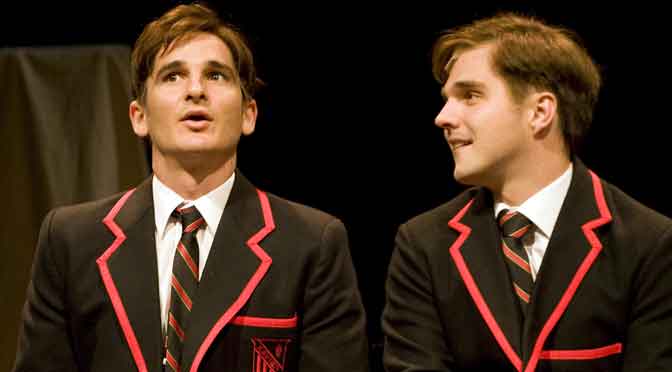
The cast take on board the show’s adventurous spirit, resulting in a series of virile performances. Dan Moore plays Paris with great stage presence. He rises above the sinister overtones of his black shirt to show why his character is described as having so much promise. Martin Dickenson does well as Tybalt, instantly establishing his strong-arm credentials and excelling in a superb fight scene with Christos Lawton’s dandyish, yet dangerous, Mercutio. A strong, appropriate sensuality marks all three performances and is echoed by Imogen Viden-North in the role of the Nurse. A considerably younger actress than we are used to in this part, she uses her age cleverly and makes the indulgence she shows her ward convincing.

Any production of Romeo and Juliet depends on its leads and here the evening excels. Daniel Finn and Olivia Vinall are young, vital and sexy. They treat their speeches naturally and bring out plenty of nuance. Their love is convincing, as is their fear of the situation they find themselves in. We are sure to see more of these young actors in the future and with this eye for casting are keen to see more Ruby In The Dust productions as well.

Until 11th July 2010

www.leicestersquaretheatre.com

www.rubyinthedusttheatre.com

Photo by Patrick Dodds

Written 7 June 2010 for The London Magazine
“All My Sons” at the Apollo Theatre

Now is a good time to revive Arthur Miller’s 1947 masterpiece All My Sons. The story of a war profiteer whose faulty goods killed U.S. airmen, is so full of moral dilemmas that it is always entertaining and powerful. But currently, as corporate responsibility is in the news and questions of social justice become vital in our increasingly divided society, All My Sons has become more important than ever.

This summer, at the Apollo Theatre, All My Sons gets the production it deserves. William Dudley’s beautiful set wins you over before the action even starts. It is the perfect stage for what at first seems to be a homely drama. In the skilful hands of director Howard Davies, this is developed into a perfect mix of touching domestic tension and complex politics expressed with intellectual vigour.

The dual concern for both family matters and society as a whole is also well expressed by the uniformly brilliant cast. Stephen Campbell Moore plays Chris Keller – having survived the war he is now in the position of taking over the family business. A devoted son and noble man, he wishes to marry his dead brother’s sweetheart – Jemima Rooper gives a superb performance in this role. Desperate for love and sharing high principles the couple are haunted by mistakes and lies that began long ago.

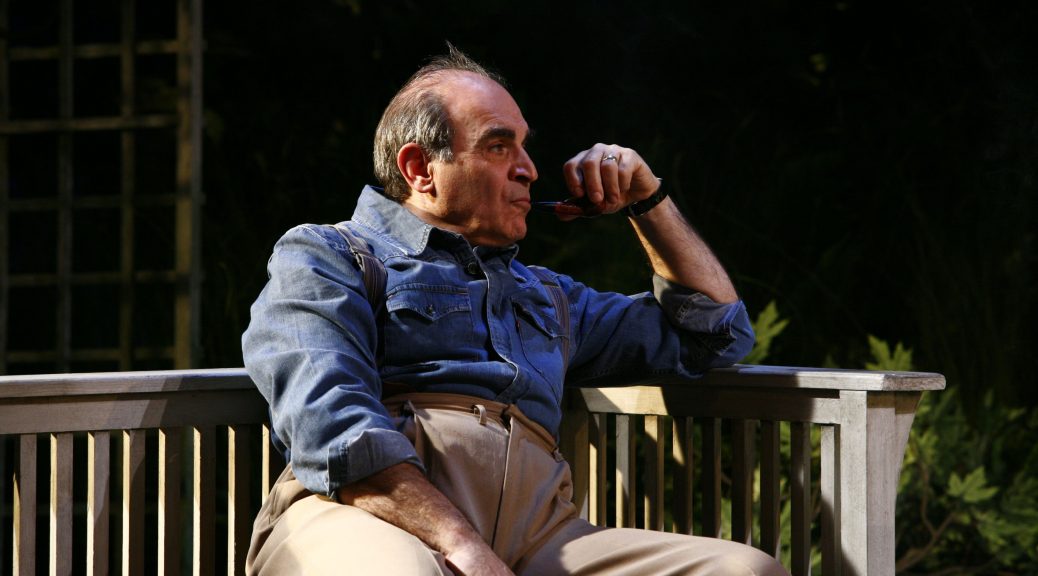
Chris’s parents, Kate and Joe, are presented first as a devoted older couple, so comfortable together that they share mannerisms and know each others thoughts. We come to see they are also linked by the lies they tell each other and the world. Zoë Wanamaker’s fragile Kate is hard as steel underneath. David Suchet as Joe, has the slightly harder job of showing the opposite – a genial father figure who is a mess of nerves deep down. Both actors are impeccable throughout.

Kate and Joe have a “talent for lying” and this is where the performances become truly remarkable. A frightening conviction is revealed when their backs are against the wall. Right up until the end both of them seek to control and manipulate. These are technically wonderful performances but there is even more to it than that. Wanamaker and Suchet’s skills have a purpose, their craft is well applied and functions to bring home Miller’s message. Together, they make this the play you simply must see this summer.

Until 2 October 2010

Photo by Nobby Clark

Written 3 June 2010 for The London Magazine

“Limehouse Nights” by the Kandinsky Theatre Company

Limehouse once had a thriving Chinese population and, along with this, a lively reputation as an exotic den of vice. From Dickens to Conan Doyle, the area’s opium dens were a gift to writers seeking to create racist stereotypes of immigrants. The Kandinsky Theatre has taken over the sadly decrepit Limehouse Town Hall to allow us our own intoxicatingly intelligent journey back in time.

Make no mistake that we are tourists. Director and writer James Yeatman opens the play, based on a real-life story, with a group much like ourselves – turn-of-the-century Londoners on a tour and looking for escapism. Limehouse has had lots of gentrification since the time of the play – desirable terraces and modern flats surround Hawksmoor’s St Anne’s – but the Town Hall itself has seen better days. Despite clever efforts by designer Amy Cook, it isn’t well suited as an auditorium. The idea of staging the play there is neat, but the production is a success despite, rather than because of, its location.

Following the death by drug overdose of a musical-hall actress, police inspector Thomas Burke heads for the East End to investigate the source of her supply. There follows an entertaining detective story that includes plenty of wry observation about cultural encounters. The whodunit is presented well, with a series of interviews and statements that allow Alex Marx and Sarah Sweeney to show off their talents as various characters.

The politics is less successful. Tom Ferguson does well to show the Inspector’s excited exchange with his new Chinese friends and even better to show a creepy side when his interest in the exotic turns erotic. However, his supervisor MacReady, is understandably confused about his modern approach to community policing. Ed Hancock plays the role too much for laughs. He gets them but it doesn’t sit well with the rest of the play’s more subtle approach.

The pressure to find a solution to the case becomes about providing a story for the sensation-loving press. As interludes of musical theatre mimed by the cast reinforce, this story doesn’t have to be real so much as entertaining –with prejudices never questioned just confirmed.

Lee Chee Kong and his Irish wife Mita are the couple forced to take the blame. They are utterly believable as a devoted pair and the scenes of their romance and intimacy are the play’s highlights. Their exploitation to fit a bigoted narrative is made tragic by wonderful performances from William Mychael Lee and Kerry-Jayne Wilson. These actors alone make it a Limehouse Night to remember.

www.kandinsky-online.com

Until 11 June 2010

Photo by Dan Patrick

Written 1 June 2010 for The London Magazine

“Canary” at Hampstead Theatre

Jonathan Harvey’s Canary is an epic story of gay rights that stretches over 50 years, from imprisonment and aversion ‘therapy’, through political activism and the fear of AIDS, up to the age of celebrity ‘outings’. Harvey knows his subject matter possibly a little too well – analysis is sometimes less than subtle, with action and issues too condensed. Fortunately, he is an entertaining writer who gives us more than a history lesson. He creates an engaging, ambitious story packed with as much drama and humour as it is with politics.

Harvey adopts the sensible device of recounting the history through the life of one man. We begin as Tom, a senior policeman, is about to be exposed as gay by the press and then travel back through his life to see how his decision to remain in the closet affects those close to him. From his betrayal of the men he loves, his marriage and his rejection of his own gay son, we see the long-term repercussions of his lies.

There is a touch of soap opera here and that isn’t meant to sound derogatory. The characters are skilfully crafted so that their part in the story comes to be about them as individuals – no small feat when political issues are involved. They aren’t just symbols but complicated people living through dramatic events. It is often gripping stuff driven by passion and conviction that this politics still matters.

The play is also superbly acted. The younger members of the cast do well to represent what their older selves would have been like years ago. Appropriately, though, in a play that celebrates the achievements of previous activists, it is the older members of the cast who shine. Philip Voss is breathtaking in the variety of roles he has to play. Moving from a wicked impersonation of Mary Whitehouse to standing by his estranged son’s deathbed in a matter of moments. Paula Wilcox is also fantastic playing his wife Ellie. Driven to distraction by her own guilt as well as her husband’s she retreats into fantasy, travelling through time and space and, in between, putting in a splendid Margaret Thatcher impersonation.

The fantastic elements and shifts in time make Harvey’s play highly theatrical. Director Hettie MacDonald deals well with this – actors fly through the air and demonstrate from the audience seats. There is a lot of fun here only slightly let down by a minimal staging that feels as if it consists solely of sofas. The upholstery (and costumes) set the time of the action as well as they can, but some further help might be useful. If the whole thing takes some following, these shifts in time and reality serve well to emphasise the repercussions of events. Scenes when characters look at, or talk to, their younger selves are amongst the most poignant moments in a play bold and powerful enough to have no shortage of them.

Until 12 June 2010

www.hampsteadtheatre.com

Photo by Helen Warner

Written 23 May 2010 for The London Magazine

“Ditch” at the Old Vic Tunnels

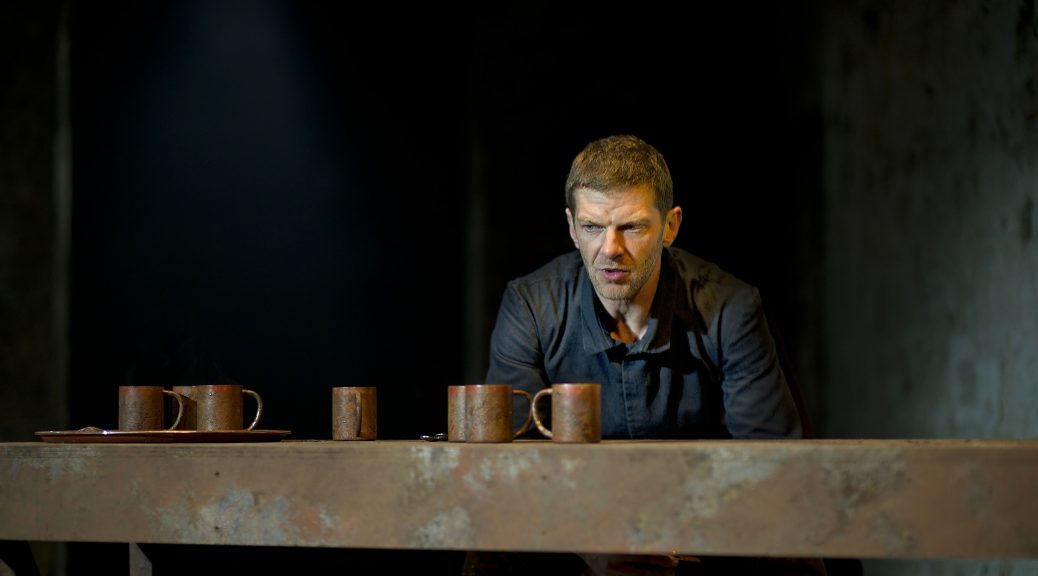
As The London Magazine’s resident theatre mole, your intrepid reviewer went subterranean to visit The Old Vic Tunnels for Beth Steel’s apocalyptic new play Ditch.

Located beneath Waterloo station and approached along a depressing back street, the venue is actually a happy compromise away from the more adventurous site-specific locations that can be something of an ordeal. It still gets cold and it smells a bit but, with comfy seats donated by Banksy and a bar that boasts no fewer than four designers, it is achingly cool and London’s most exciting new theatrical space.

More importantly, the creative team behind Ditch have used the venue well. Installations surround the auditorium. Plant-covered mill wheels are atmospherically lit and a dismembered tree hovers, upside down, over a bright red circle of cloth. It’s great scene setting and appropriate for the dystopian scenario that unfolds.

Although Ditch is set in the countryside and much of the action takes place out of doors, the survivor’s predicament is perfectly reflected by the large design team headed by Takis. Superb lighting and sound by Matt Prentice and Christopher Shutt add to constructing this frightening world. Here, while ‘security’ forces live in isolation with their housekeepers and search out ‘illegals’, there are some captivating moments – the sighting of a stag in the mist or the creation of a sunset that subtly suggests an atomic cloud.

There’s some superb acting as well. Sam Hazeldine plays the foul-mouthed Turner, dedicated to his soldier’s life with edgy brutality. Danny Webb is his commander, Burns, and convinces as a thoughtful, broken man who can remember what civilisation used to be like. Fighting off memories of the past as a strategy to survive is Dearbhla Molloy’s formidable Mrs Peel. This is a wonderful performance, as she looks after the men and herself with humorous, steely determination. Her other charge is the young Megan (Matti Houghton) who gives a touching portrayal full of small rebellions and a quest for love with spirited new recruit James (Gethin Anthony).

But what of the play itself? Steel has set out a standard science-fiction scenario with the odd little tactic of leaving out all the details. We are never told what has happened to the world and given next to no back-story for the characters. Avoiding specifics deprives us of questioning events or degenerating into adolescent paranoia. I suspect the idea is to focus instead on the characters’ reactions and some abstract ideas about the environment. This isn’t a trade off worth paying. Perversely, Steel ignores her own lesson that people can live in the moment and snatch joy in the worst of times to persist in a vision of the future both bleak and vague.

Until 26 June 2010

www.theoldvictheatre.com

Photo by William Knight

Written 21 May 2010 for The London Magazine

“That Joke Isn’t Funny Anymore” at the Barons Court Theatre

”Fame, fame, fatal fame.” Morrissey’s desire for celebrity, which he sang about in 1985, is one now widely embraced. The Smiths singer imagined embellishing his autobiography in order to boost his creative credentials. Is this a step many of us would make in order to acquire fame? And if we did this, what would the toll be on our loved ones and ourselves?

Michael Ross’s new play, That Joke Isn’t Funny Anymore, poses this question of how we narrate our life stories with intelligence and wit. Mark Elias plays Leon Shepherd, a stand-up comedian driven to the edge of sanity while waiting for his big break. Elias conveys his desperation and then astonishment as a series of figures begin to appear from his wardrobe to perform their own stand-up routines.

These ghosts from his past are presented to him by Pete Picton, a delightfully Faustian figure who poses as an experienced comedian and clearly thinks little of Leon’s efforts, despite his own jokes coming from another age. He introduces Leon’s mother (Sacha Walker) and drama teacher (Isabel Carr), whose performances as radical feminist and visionary pedagogue are well-observed caricatures.

Both women seem to have left a scar but, as the plot thickens, we learn that Leon may have a darker secret. The next guest is his old partner Jimmy. Julian Farrance plays the role as a foil to Leon. He possesses the confidence Leon lacks and, while his comedy routine plays around with the truth, he has a sincerity that makes us question his old partner’s story. It’s a suspicion confirmed as Tony Rowden’s Inspector of Police arrives to cap off the wonderfully surreal proceedings – let’s just say a glove puppet is involved.

This is a well-constructed and thought provoking play. At only an hour long, it leaves you wanting more with a resolution that seems too short. There is great ambition here – it takes courage to write and perform consciously bad jokes that will unsettle an audience. Ross’s knowing remarks about the construction of comedy and performance show us we are in safe hands though. There is a sensitive, somewhat maudlin touch here that leaves a lasting impression.

Until 23 May 2010

Photo by Radjan Wahera

Written 19 May 2010 for The London Magazine

“Love the Sinner” at the National Theatre

Playwright Drew Pautz has set himself a challenging task in writing Love the Sinner. His new play, premiering at the National Theatre’s Cottesloe auditorium, takes as its subject matter internal politics within the Anglican Communion. This is not, for many of us, the hottest of topics.

Thankfully, the play opens up rather beautifully. The debate, taking place in Africa, questions the role of religion in the modern world. The African delegates stand in contrast to their European counterparts. For them, religion is a powerful force, and they have a faith that might be commended by Kierkegaard. The church should take a stand – preservation not progress is needed. Discussions are ostensibly about the rights of homosexuals in the church and, when a volunteer at the conference has a sexual encounter with one of the hotel’s porters, Pautz begins to explore how abstract arguments impact on personal conscience.

Jonathan Cullen plays Michael, the volunteer who finds himself in a distinctly awkward post-coital conversation with a hotel staff member. Joseph, touchingly insistent on his name being remembered, is desperate and dangerous. Described subsequently as a Furie, Joseph is played by Fiston Barek with a febrile energy. Cullen, by contrast, risks being too meek to be believable.

Anxiety follows Michael back to England where, to the detriment of all, religion becomes an increasingly important part of his life. Charlotte Randle is a highlight as his wife Shelly. So obsessed with having a child that having a husband seems an annoyance, she is exasperated by the man she now lives with who, seems to just ‘sweat and pray’. As the distance between them grows, Randle crafts a moving portrayal. At work, a skilful mix of embarrassed glances and confrontations make for an amusing farce whose comedy is tempered by melancholy. And Michael’s problems have really only just begun.

Joseph finds his way to England and Michael providing a skilfully written, tense final act. Here, Scott Handy is superb as the church’s PR man who sees realism, not God, in a situation, while Ian Redford does well as the play’s liberal bishop.

What the Bishop and Michael both want is reconciliation. An agreement, at least, to disagree. Throughout the play, such a step seems impossible and, if God can’t provide it, then it is unreasonable to expect that Drew Pautz can, no matter how satisfying it would be for an audience. The effort made by Joseph to progress past the shame he is supposed to feel ultimately fails to convince. It seems inevitable that this thought-provoking play leaves us feeling unreconciled and unresolved.

Until 10 July 2010

www.nationaltheatre.org.uk

Photo by Keith Pattison

Written 13 May 2010 for The London Magazine

“Holding The Man” at the Trafalgar Studios

On paper, Holding The Man is a potentially grim prospect – a gay coming-of-age story at the start of the AIDS era. The play might also risk seeming dated, as the confusion and fear surrounding the deadly disease has changed. The Australian Griffin Theatre Company’s triumphant arrival in London blows such qualms away in a startlingly effective production. Holding The Man is, quite simply, a beautiful love story.

Romance with a capital R exudes from playwright Tommy Murphy’s adaptation of the late Timothy Conigrave’s celebrated memoirs. Guy Edmonds, who plays Conigrave, and Matt Zeremes, his lover John Caleo, are utterly convincing as the two men in love. They show passion, tenderness, anxiety and pain in their rich performances
The lovers have their faults, but Conigrave’s is also his virtue – his honesty. Blunt to a fault, his writings reveal how hurtful he could be. Often painfully crude and cruel, his desire to be open about his sexuality and then to have an open relationship comes before others’ feelings. He isn’t always an attractive character, but his truth wins our admiration.

The truth has a power to make us laugh. Holding The Man reminds us that laughter goes on even when we are so ill that it hurts us to do so. From the touching naivety of the boys as they fall in love, through Conigrave’s time at college and even in sickness, there is fun to be had. Along the way we get a fantastic soundtrack and costumes so spot on that they deserve a stand up comedy show of their own.

However, director David Berthold and designer Brian Thomson have created more than a supremely funny period piece full of guilty pleasures for those who remember the 80s. Thomson’s beautifully poetic set of lights and mirrors reflects the magic of romance and theatre. Equally, Berthold creates a highly inventive production with a tight ensemble cast using the most of basic props and techniques powerfully.

The play has hundreds of characters. Amazingly, just four actors play all of the other roles with dazzling transformations of gender and age. Jane Turner is given star billing. She succeeds in differentiating her performance as both boys’ mothers from her famous role in cult TV show Kath & Kim. Along with great lines and an easy ability to make people laugh (every gesture gets a giggle), she can also be deeply moving. There is a danger she might steal the show.

Turner is disciplined enough to prevent this and she has some stiff competition anyway. Simon Burke is excellent in the diverse roles he has to perform and outstanding when it comes to portraying Caleo’s father. The British performers joining the cast are Oliver Farnworth and Anna Skellern. Their roles include Farnworth playing a school friend’s mother and Skellern a sexually charged teenage boy in a candid group masturbation scene.

For some this might sound a little unpalatable, but it is fitting that Conigrave’s frankness provokes. For others it will sound like a great deal of fun. Holding The Man is terrific and there is more joy than shame here. The sense of loss as its characters die tragically young turns into a celebration of their lives. The pain felt is embraced, as it must be, in any true romance.

Until 3 July 2010

Written 5 May 2010 for The London Magazine

“Women Beware Women” at the National Theatre

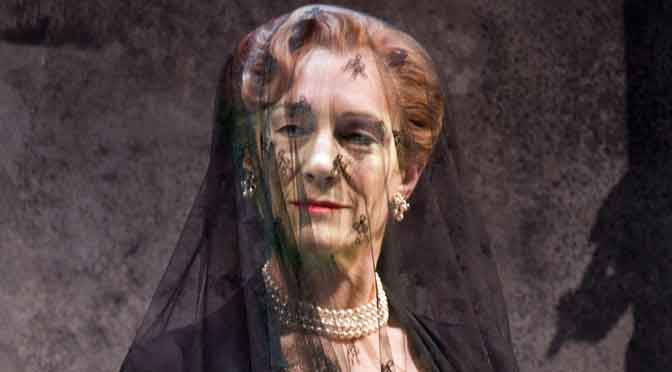
Harriet Walter is a woman to be scared of, at least, she is in the National Theatre’s current production of Thomas Middleton’s Women Beware Women. She plays Livia, gifted and cursed with a demonic persuasive power. Through deceit she organises an incestuous affair between her brother and her niece and engineers the rape of a newly married neighbour. Yet she does it all with a great deal of charm. She’ll manage to persuade you that she isn’t all that bad.

Her victims are Bianca (Lauren O’Neil) and Isabella (Vanessa Kirby). They transform from young, innocent women in love into killers bent on revenge. It’s a delicious change, and one the actresses clearly relish. Taking their lead from Walter, they adopt a cool, clever and cynical approach to marriage while passion boils inside them as they plot murder. As their metamorphosis occurs, Livia falls in love herself – she decides to take Bianca’s husband as a toy boy. Unfortunately for her, the transformation allows emotions to begin clouding her judgement.

And what of the men? They should have plenty of reason to beware these women, but their own arrogance and hypocrisy make them oblivious as to how they are manipulated. Richard Lintern is suitably villainous as the Duke who abducts Bianca, and Raymond Courtauld genuinely creepy as the uncle who loves Isabella. If Samuel Barnett seems slightly miscast as the man who manages to get Bianca to elope, he makes a good show of playing the doting husband and gets his fair share of laughs.

Focusing on the melodrama as a strategy for getting humour out of a revenge tragedy might seem like a risk. Making characters less rounded than they are written only works if you have a strong cast. Fortunately, director Marianne Elliott is working with fine actors and the payoff is a great deal of fun. Elliott has great skill as a storyteller and can cut through complicated plots to provide refreshing clarity. She is also visionary when it comes to staging and here the production takes off.

Designer Lez Brotherston’s set is magnificent. A decadent mixture of art deco glamour and baroque drama, it manages to reflect the grand and intimate, rich and poor, while evoking the games and perils of seduction. And it works in more than one way. Making the most of the Olivier’s revolving stage, the final scene of murderous mayhem is perfectly choreographed and truly thrilling.

Until July 4 2010

www.nationaltheatre.org.uk

Photo by Simon Annand

Written 29 April 2010 for The London Magazine