“Grief” at the National Theatre

The way Mike Leigh makes a play is unlike anyone else. His new work, Grief at the National Theatre, was devised in collaboration with his cast and crew, in secret and from scratch. The result is something very special indeed.

The story of a 1950s war widow and the life she shares with her brother and only child is grim. The period detail of repressed emotion is familiar ground but Leigh presents it devoid of cliché – we see the price paid for such control and it isn’t pretty.

The long period of gestation that made the play results in an investment from the cast that produces magnificent performances. Lesley Manville has created one of the finest roles of her career: continually on brink of tears, the way she holds back is astonishing. Joined by Ruby Bentall, in a remarkable performance as her troubled daughter, as well as a host of other Leigh regulars – this is one of the finest ensemble you will see onstage in London at the moment.

Ironically, the quality of the acting makes Grief very hard to watch. For a play obsessed with death there are some very funny lines, but there is a sting in the tale: each laugh brings us closer to the characters, makes them seem unbearably real. The sense of foreboding Leigh manipulates in the audience becomes cruelly oppressive.

Be warned. The dark denouement that ends Grief is shocking and deeply disturbing. Manville’s final break down is harrowing: occurring offstage the effect is akin to Timanthes depiction of Agamemnon, covering his face to hide his pain, and all the more harrowing for being unseen. The plays rejection of any resolution makes it one of the most powerful nights at the theatre you can imagine.

Until 28 January 2012

www.nationaltheatre.org.uk

Photo by John Haynes

Written 27 September 2011
“One for the Road” and “Victoria Station” at The Print Room

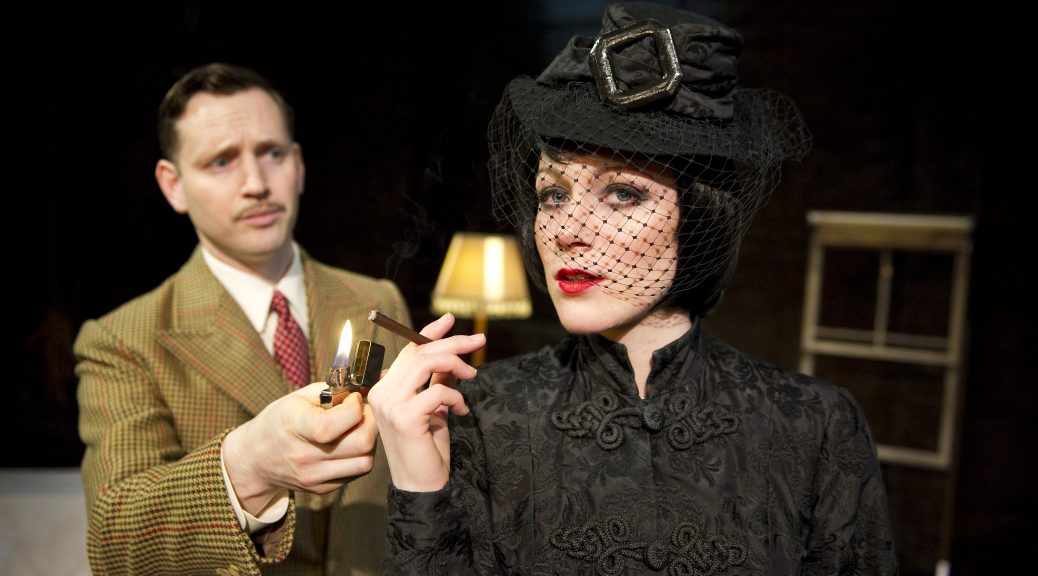
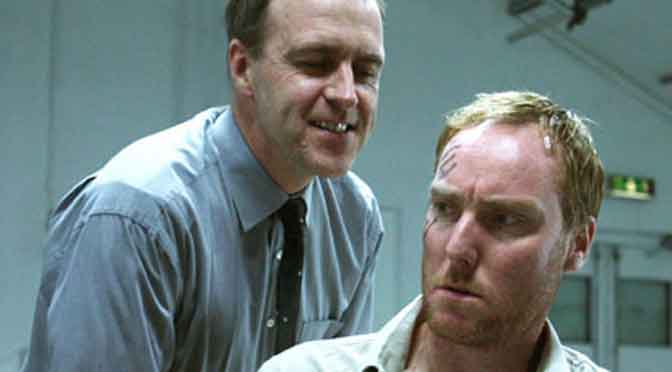
One for the Road and Victoria Station are two short works by Notting Hill local Harold Pinter, and what would have been his neighbourhood theatre, the Print Room, provides a rare chance to see these disturbing, powerful mini-masterpieces together for the first time since their premiere in 1984.

Victoria Station is a Kafkaesque dialogue between a taxi driver and his controller – darkly comic with a sinister twist and only ten minutes long. One for the Road is a violent, sadistic interrogation drama (with a nod to Orwell and its date of composition) that lasts a truly harrowing half-hour.

Keith Dunphy is superb as the taxi controller in the first work – Pinter’s humour is slippery and needs intelligence to pull it off. Kevin Doyle takes centre stage in the second piece, playing the brutal questioner with a spine-chilling wish to be “scrupulous”. Jeff James’s direction retains the intensity of the writing and Alex Lowde’s design, looking like an installation from an art gallery, enhances the bizarre atmosphere.

Both pieces are at once obtuse and complex. It is remarkable that such short works can generate so much speculation and carry such emotion. The evening is one that Pinter fans simply shouldn’t miss.

Until 1 October 2011

www.the-print-room.org

Then transferring to the Young Vic 6 – 15 October 2011

www.youngvic.org

Written 21 September 2011 for The London Magazine

“My City” at the Almeida Theatre

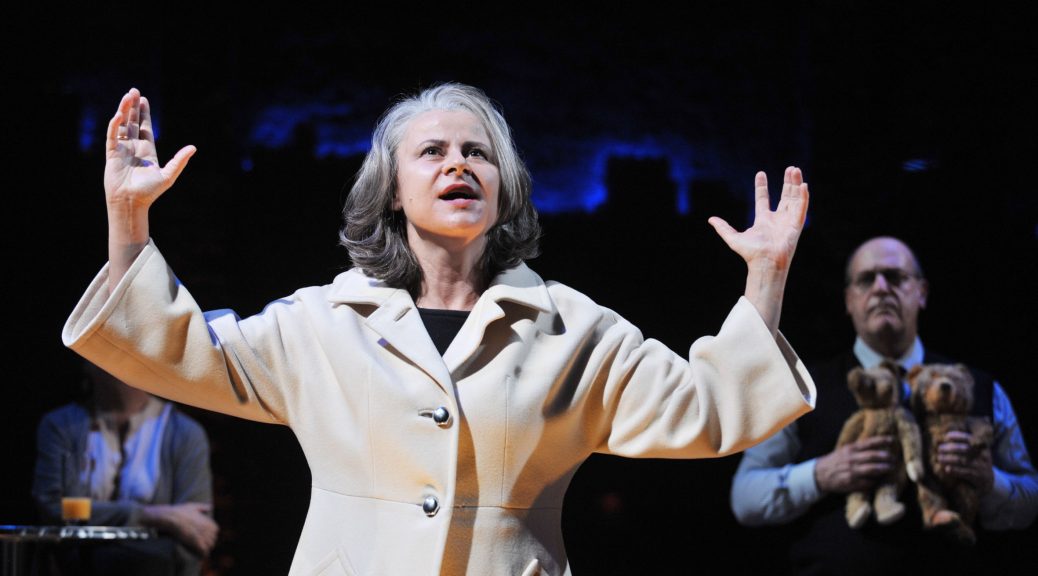
Stephen Poliakoff’s first play in 12 years, My City at the Almeida Theatre, is a story about stories. Told by a teacher, in flashbacks to school assemblies and to former pupils she meets in the present, the play is a modest, appealing affair.

Also making a welcome return to the London stage is Tracy Ullman who plays the teacher, Miss Lambert. Ullman is convincing as an inspirational mentor, captivating with her true stories of walking the city streets at night. The reason behind her nocturnal rambles interests less than it should, though, and the explanation for her phengophobia – the focus of the play’s finale – lacks power. Nonetheless, Miss Lambert is a wonderful creation and Ullman superb.

Joining Ullman to perform these narratives are two highly theatrical pedagogues, Mr Minkin (David Troughton) and Ms Summers (Sorcha Cusack). The three make a provoking trio, casting a magical hold over their ‘old children’, performed by Tom Riley and Siân Brooke. The youngsters are a rapt audience for everything from time-travelling history lessons to macabre tales from the present (both inspired by former North London student Edgar Allan Poe), and the impact the teachers have on their lives is moving yet unsentimental. Many of us are lucky enough to have known life-changing teachers and My City celebrates this intelligently.

When My City touches on topical themes it falls somewhat flat and while all Londoners can appreciate the pleasures and perils of walking the city, the play seems surprisingly lacking in a sense of place. But when the focus is on the art of storytelling – as it often is – Poliakoff and his cast excel. With Lez Brotherston’s subtle set and Poliakoff’s own direction, My City is back to basics theatre that should appeal to all.

Until 5 November 2011

www.almeida.co.uk

Photo by Hugo Glendinning

Written 20 September 2011 for The London Magazine

“The 39 Steps” at the Criterion Theatre

The British love a little light self-deprecation. And jolly good we are at it, too. With an adaptation masterminded by Patrick Barlow (of National Theatre of Brent fame) of John Buchan’s 1914 boy’s-own spy thriller, The 39 Steps is full of clichés ripe for poking fun at and has earned plenty of awards for doing just that: the stiff upper lips, sexism and jingoism of the past have been making audiences at The Criterion theatre rock with laughter for the last five years.

The stage show is as much a tribute to Alfred Hitchcock’s 1935 film as it is to the original story. Scenes are re-enacted, including the famous escape on the Forth Bridge, and, if that sounds impossible, other movies and a cameo from the great director are thrown in as well. But this is pure theatre – laughing at its limitations while showing the power of the medium. The inventiveness of a hardworking cast of four, minimal props and faux improv are something to celebrate.

Actress Maria Aitken directs and makes The 39 Steps a joy for its absurdly versatile cast – the actors even get to draw upon all that drama school training pretending to be trees and rocks. Rufus Wright is the dashing Richard Hannay, who goes from worrying about his pencil moustache to running away from a dastardly spy ring. Laura Rogers plays all the women admirably, especially Annabella Schmidt, the spy that Hannay takes home and offers kippers to. The other 135 roles are performed by just two men: Dermot Canavan (having great fun in drag) and, on the performance I saw, the understudy James Hurn who put on such a jolly good show that my only quibble is that he didn’t get the extra bow he deserved.

The 39 Steps isn’t for everyone. Steer clear if you hate slapstick and be prepared for some awful puns. But here’s a tip – the show is great for visitors, even those that might have English as a second language. The humour’s broad appeal means Johnny Foreigner will be able to laugh along as you show you’re a true Brit by laughing at yourself. In fact, seeing this show is practically a patriotic duty – so come on chaps!

www.love39steps.com

Written 13 September 2011 for The London Magazine

“The Kitchen” at the National Theatre

Bijan Sheibani’s spirited revival of Arnold Wesker’s The Kitchen provides audiences with an insight into 1950s catering and post-war Britain. The acting is commendable, the production values high – but it is difficult to recommend going to see it.

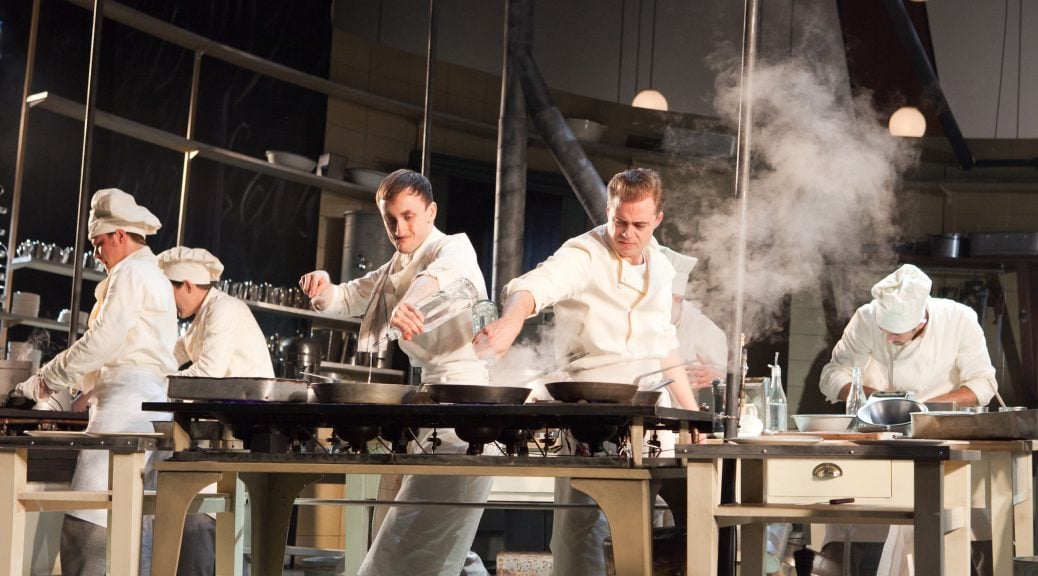
The 30-strong cast perform impeccably. They convince us that The Kitchen is a working environment, overflowing with rows and romances, consuming their lives and making them fight to retain their individuality. Tom Brooke does especially well as the German chef Peter and becomes the focus of the plays finale. Along the way, Samuel Roukin impresses and Rory Keenan’s comedy skills stand out.

The mechanics behind running a massive restaurant are brought to life by Sheibani quite remarkably. Giles Cadle’s set echoes the mass of the Olivier Theatre, with space for the impression of chaos and enough cookers to make you worry about the National’s gas bill. With a touch of fantasy (cue flying waitresses) the kitchen is presented as another world.

But the kitchen isn’t another world. The first act serves as an extended entrée to deeper concerns about the place of work in our lives, using the “united nations” of kitchen staff to look at life after the war – and dreams of improvement that began when the fighting stopped.

Much humour comes from the dated nature of what’s on the menu – the characters dream of chicken Kiev as an adventurous dish – but the nostalgic appeal of The Kitchen mixes uncomfortably with its politics. The first act isn’t meaty enough to make us care about the characters, while in the second the politics are too dated to engage with.

The 1950s are in vogue along the South Bank and celebrating Arnold Wesker makes sense, but The Kitchen seems so much of its own time that reviving it, no matter how thoughtfully, fails to whet the appetite.

Until 9 November 2011

www.nationaltheatre.org.uk

Photo by Marc Brenner

Written 9 September for The London Magazine

“The God of Soho” at Shakespeare’s Globe

The 18th century philosopher, Bishop Berkeley, posited that the world only exists in the mind of God. So if something goes wrong with the celestial cerebellum you’re in trouble – which is what happens in Chris Hannan’s new play The God of Soho, resulting in a mind-boggling – and ambitious – new drama.

Big God (the inimitable Phil Daniels) resides in a heaven in disarray. His daughter, the Goddess of Love, the excellent Iris Roberts, has an unrequited love for New God (a brave performance by William Mannering). The couple descend to earth where they mingle with Essex celebrities such as Natty, a commendable Emma Pierson, and the unhinged homeless on the streets of Soho. All of Hannan’s self-absorbed characters are searching for something real. However, this is far more interesting than merely an exploration of celebrity culture – these are people searching for a “raw skinned, butcher naked” reality.

Hannan appears to have none of the self-doubt that affects his characters. It is difficult to be bawdier the Elizabethans (this is the Globe, after all) but The God of Soho manages just that. It is positively filthy in every way: verbally and visually, with the laughs relying on obscenity. Nor does Hannan shy away from big themes. He juggles plenty of abstract concepts with a surfeit of allusions and enough topicality to make your head spin. The really impressive trick is the way in which he deals with so many ideas while creating characters real enough to care about.

Director Raz Shaw does a great job of marshalling Hannan’s text and injecting plenty of debauchery. Both writer and director have an eye for involving the crowd, essential at The Globe. With appropriately eclectic music provided by King Porter Stomp, The God of Soho is often a riotous affair. The production has a distinctive vision that is also disconcerting. Certainly, the world inside Hannan’s mind is a weird and wonderful place.

Until 30 September 2011

www.shakespeares-globe.org

Photo by Simon Kane

Written 2 September 2011 for The London Magazine

“Halcyon Days” at the Riverside Studios

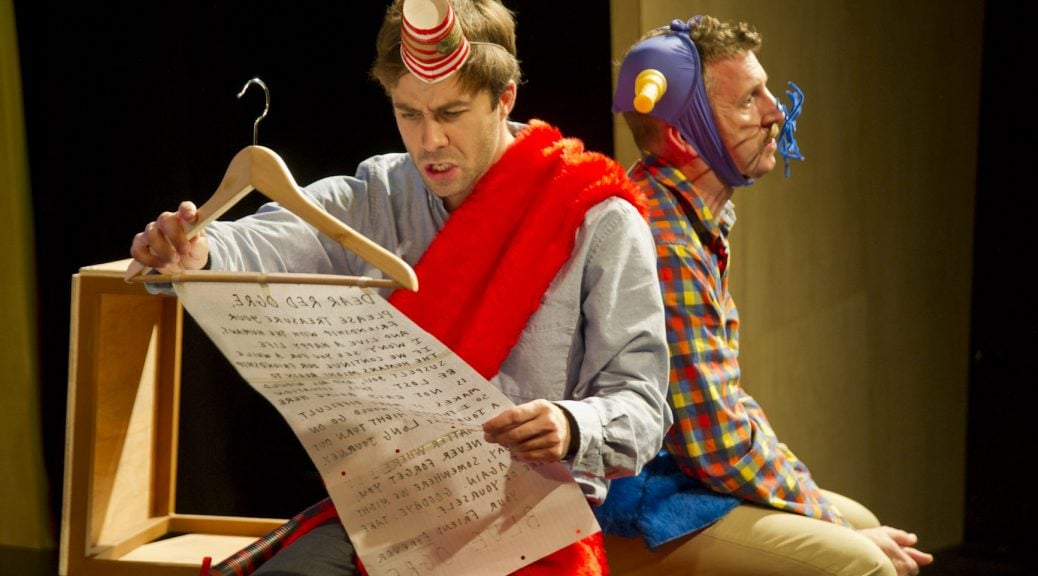
Halcyon Days, the story of strangers who meet on an Internet suicide forum, is a surprising comedy. Writer and director Shoji Kokami takes what could be an earnest, morbid subject matter, and handles it so imaginatively that this potentially grim tale is rendered funny, even bawdy at times.

Kokami presents the story, not as reportage on an Internet phenomenon, but as a real life drama, toying with the fantasies his characters invent in the process. Mark Rawlings plays Hello Kitty, a closet homosexual seeking a flamboyant suicide as an end to his debts. He meets the delusional Masa, performed with intensity by Dan Ford, who is suffering from information overload, and believes that his own suicide could save the world.

This odd couple are joined by a counsellor called Kazumi, a character brought to life by Abigail Boyd, in a skilfully layered performance. Followed everywhere by a ghost (Joe Morrow, making an impressively impish London debut), Kazumi’s intention is to help the men but it’s clear she has issues of her own. A therapy session like no other ensues as the cast prepare a play about a lonely ogre and his friends – it’s deliciously mad stuff ‘yet there is method in’t’.

The blackest of humour pervades Halcyon Days, but there are also touches of farce. Aya Ogawa’s translation of Kokami’s play reveals puns a Carry On film would be proud of, and Rawlings does an especially great job playing up to them. But the halcyon referred to here is a sleeping drug: for all the fun that they are having, the characters are in no Arcadia. They have responsibilities in the real world, all revealed at a clever tempo to ensure that they are misfits that matter to us.

Halcyon Days has an elegiac streak that is central to Kokami’s precise pacing. As the cast gaze at the beauty of the night sky, they learn lessons about themselves and the world. Theirs is a trip to the dark side of the moon well worth watching.

Until 18 September 2011

www.riversidestudios.co.uk

Photo by Gerald Nino

Written 26 August 2011 for The London Magazine

“Top Girls” at the Trafalgar Studios

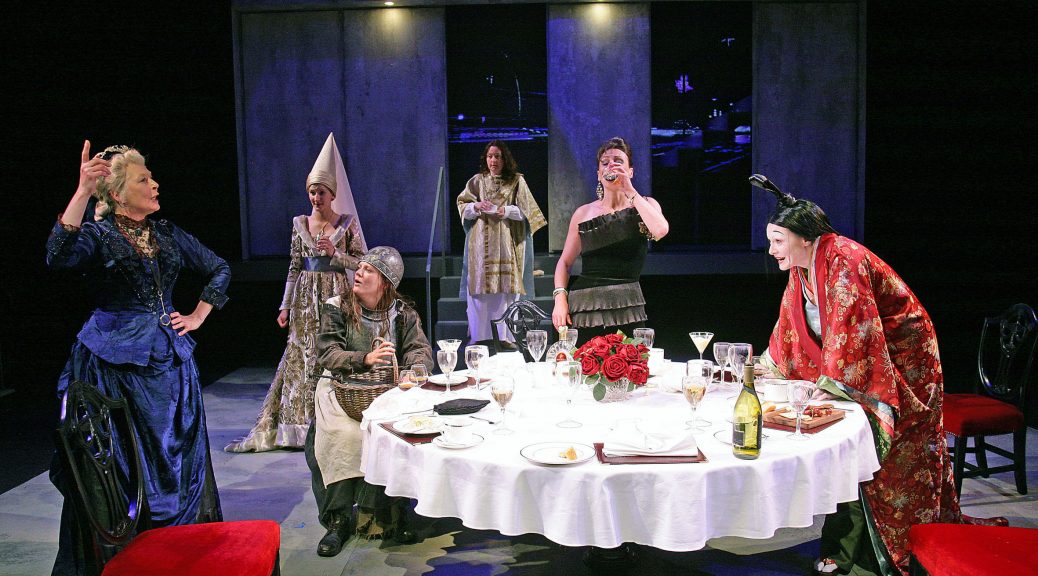
What an opening: given its first act, it’s no wonder Caryl Churchill’s Top Girls has such a great reputation. A riotous dinner party unites women from myth, history and fiction in an Absurdist tableau to discuss their lives, loves and deaths. The stuff of doctoral thesis is seldom this funny – witness the Victorian explorer’s racist faux pas towards the medieval Japanese noblewoman – but what makes the scene so riveting is Churchill’s ability to bring the pain these women experienced so close to the surface.

How this connects to the rest of Top Girls is another chapter in that thesis. The play becomes the story of the party’s host Marlene. An 80s career women with a recruitment agency, the role is performed superbly by Suranne Jones. Wonderfully attired and every inch the thrusting executive, Joseph Epstein could have had her in mind when he coined the phrase ‘yuppie’.

Marlene’s is a cruel world. One of her clients, in a stand-out performance from Lucy Briers (who has a great night, also playing Pope Joan), is a bitter middle manager of 47, who’s told that her age is a “disabling handicap”. And Marlene’s back story, escaping to the city, has enough drama when she returns to Ipswich to match The Homecoming.

Max Stafford-Clark’s assured direction does a lot of favours to Churchill’s text. He has the experience, having directed the premiere in 1982 at the Royal Court, and this new production arrives from Chichester with rave reviews.

Marlene’s casual rejection of her daughter Angie, played cogently by Olivia Poulet, is devastating – she’s no “top girl”. The family confrontation that centres on Angie’s future is electric, with a passionate performance from Stella Gonet, the character who gets to ask what will happen if the young girl just can’t “make it”.

Top Girls is political to its core. Marlene’s pin-up girl is Mrs Thatcher – she’d give her the job – and Churchill’s particular politics of fear, debatably, makes the play feel dated. But the strength of this revival is to show the nuances within this landmark play. The complexity of the characters indicates that there are still questions to ask – Churchill’s provocative presentation demands they are answered.

Until 29 October 2011

Photo by John Haynes

Written 17 August 2011 for The London Magazine

“Crazy For You” at Regent’s Park Open Air Theatre

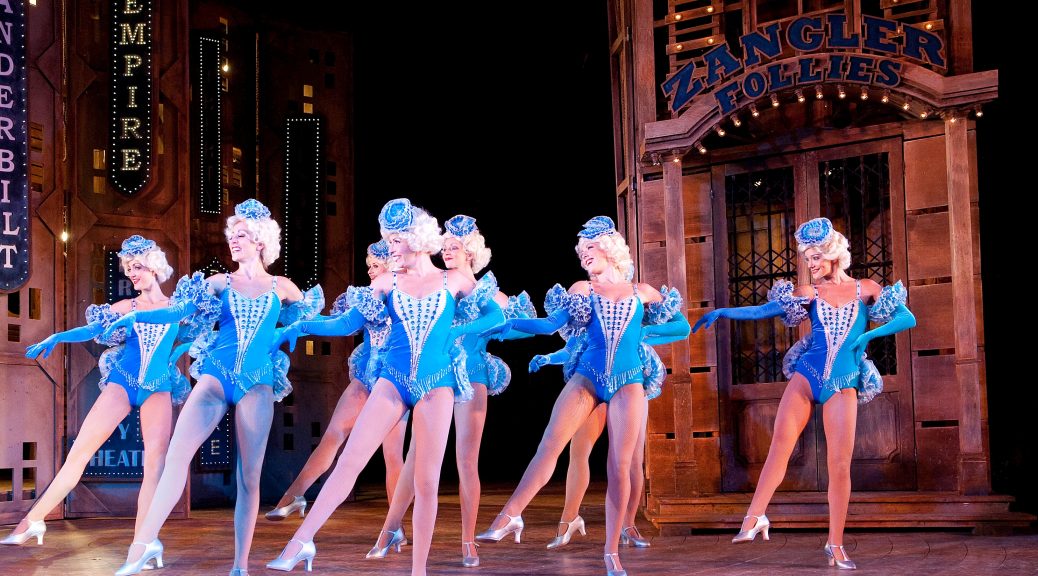
Crazy For You, which had its Broadway debut in 1993, is a tribute musical woven from the work of George and Ira Gershwin. Inspired by the 1930 stage hit Girl Crazy, Ken Ludwig provides a new book and adds hit songs. An appropriately slim, yet seamless, plot has a banker-cum- wannabe-dancer disguising himself as a theatrical impresario in order to save a neglected theatre and win a girl.

Taking us from New York to Nevada, mixing the Ziegfeld Follies with the Wild West, there are plenty of laughs and, more importantly, plenty of tunes. Musical theatre takes any opportunity to sing -‘Let’s put on a show’ – and witness, without questioning, the power of a show tune to change lives. This is joyous stuff full of the feelgood factor.

The Regent’s Park production is marked by a justified sense of confidence, most notably in director Timothy Sheader’s lightness of touch. These days, Sheader has an enviable reputation for musicals and he has reunited the team that brought us Hello Dolly, including Peter McKintosh, whose intelligent costume design surely merits him another Olivier nomination.

Sheader gets the best out of his cast. Sean Palmer takes the lead of Bobby with ever-present charm and elegance. His love interest, Polly, is played by Clare Foster. Her voice doesn’t zing, but it is wonderfully sweet and her acting skills are superb. And there’s a thrilling supporting cast, including Harriet Thorpe and Kim Medcalf, with a string of great numbers.

Gershwin’s music is made to dance to. This is the real joy of Crazy For You and Stephen Mear’s choreography, full of wit as well as grace, does it justice. McKintosh provides a moon to ride and Tim Mitchell’s lighting design means the stars aren’t just in the skies above you. This team succeeds in making Regent’s Park more glamorous and romantic than it has ever been.

Until 10 September 2011

www.openairtheatre.org

Photo by Tristram Kenton

Written 11 August 2011 for The London Magazine

“Double Bill” at The National Theatre

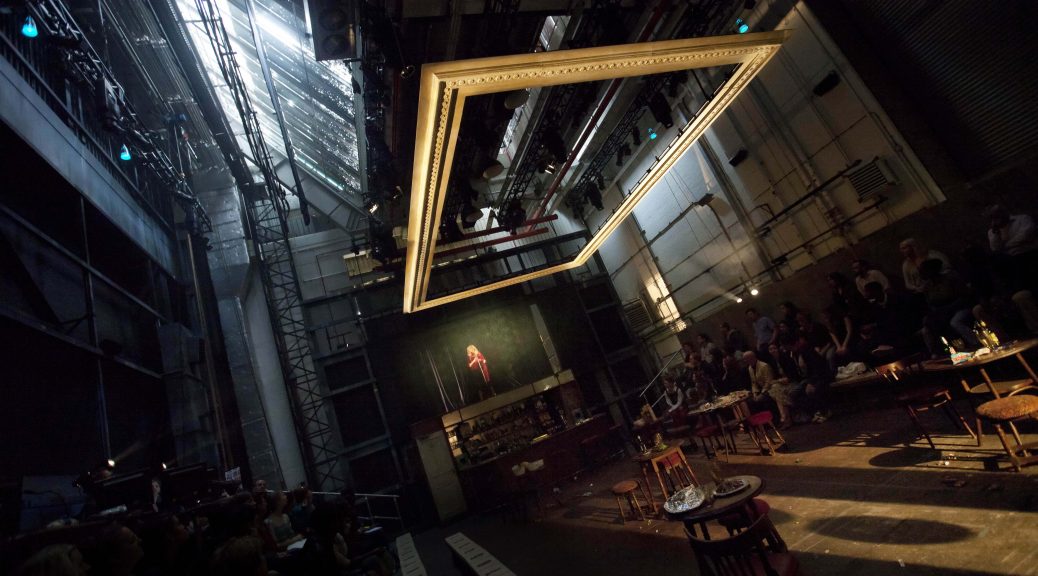
Double Bill, The National Theatre’s programme of four short plays by new writers, finds itself located in the theatre’s paint frame. An impressive working space, it’s a startling location for the pieces: edgy and exciting, this minor reworking of Lasdun’s building does the theatre credit.

First up are Edgar and Annabel by Sam Holcroft and The Swan by DC Moore. Both writers already have exciting reputations. It’s only fitting that the National gives them a platform, and they rise to the occasion.

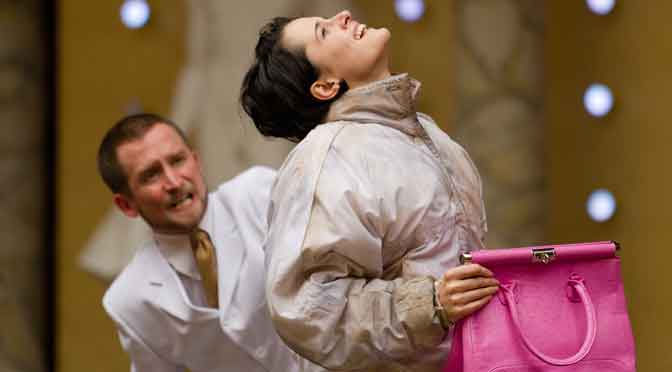
Holcroft presents a dystopian future with swift precision, turning a political scenario into a domestic drama with such wit and originality it doesn’t deserve a plot spoiler. The eponymous couple have a dark secret that leads to hilarious dealings with a karaoke machine and explosives. In the title roles Trystan Gravelle and Kirsty Bushell deal with their characters’ double lives impeccably.

DC Moore takes us to a more familiar place. The London Magazine readers won’t visit many pubs such as The Swan, certainly not on the occasion of a wake for a crowd like this one, but Moore’s family tragedy contains both compelling humour and drama.

With a star turn from Trevor Cooper as the patriarch Jim, who delivers every line with an obscenity, and a superb cameo from Claire-Louise Cordwell, damaging secrets are hidden to preserve a deeper truth – brought home to us with a little help from Spandau Ballet. Moore’s characters have to be seen to be believed and they are well worth watching.

Both Holcroft and Moore have an unfailing gift for dialogue; vital since despite superb design here, and hard work for the back stage crew whose home we are invading, these are modest productions. The conversations that occur in any relationship when it becomes mundane and the talk you might overhear in a less than salubrious South London local are wonderfully observed and then developed to another level with a mature concern for the truth.

Any institution with the longevity and largesse of the National Theatre will have a chequered history of new writing. Playwrights coming to work there are placed in the spotlight and automatically join a debate about the state of the arts, whether they want to or not. If these first two plays are anything to go by, new writing is in superb shape – Double Bill is an event that one hopes will become a fixture.

Until 10 September 2011

www.nationaltheatre.org.uk

Photo by Johan Persson

Written 5 August 2011 for The London Magazine