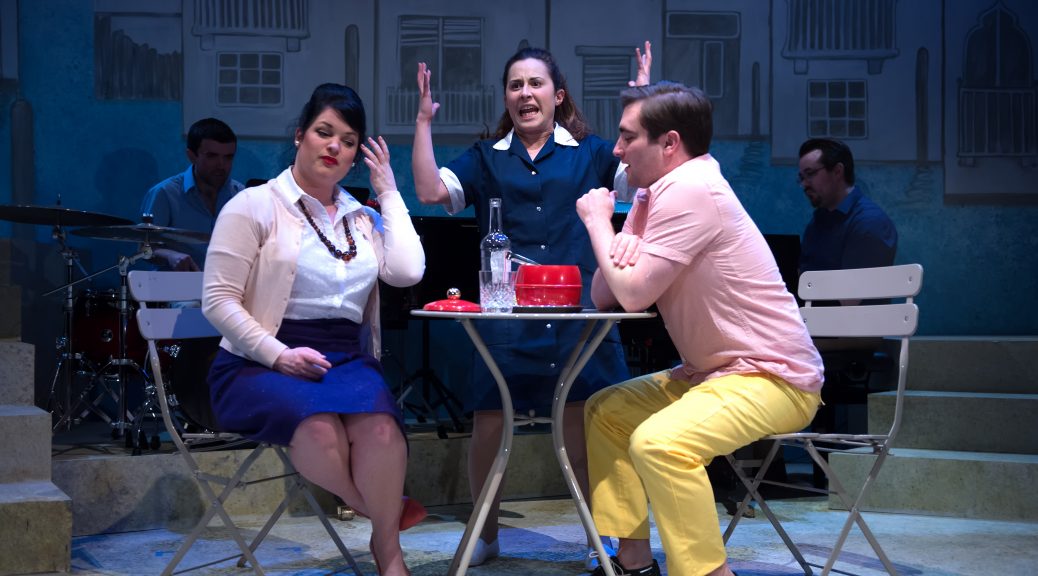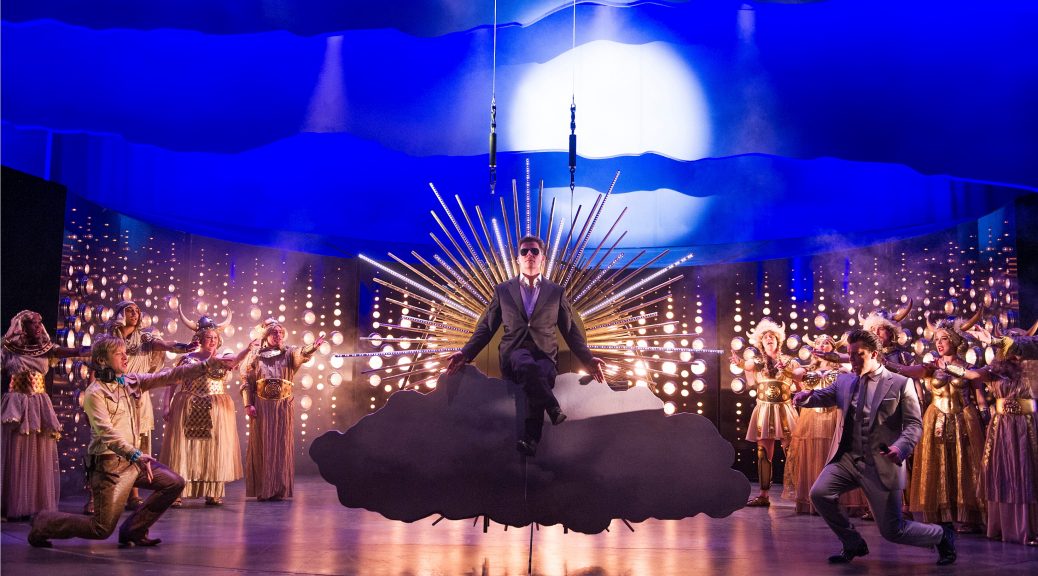
“The Weir” at Wyndham’s Theatre

With queues for Josie Rourke’s Coriolanus starting crazily early, adding to her string of hits as artistic director of the Donmar Warehouse, she now has a West End transfer to boast about with The Weir, which opened at Wyndham’s Theatre last night.

This much admired and awarded play dates from 1997 and sees various ghost stories told by its misfit characters in a small rural pub. Fortifying this tried and tested concept are Conor McPherson’s beautiful writing and mythic undertones: suggesting our longstanding psychological connections to storytelling and the supernatural.

Rourke’s production is spookily precise. Like one of the play’s characters, Finbar, she clearly has “an eye for the gap” – pauses are perfectly measured for both comedy and tragedy and space is created for the captivating stories. The pace is wonderfully controlled, and the banter in between, the majority of which is very funny indeed, fills out the characters, adding further layers to the play.


Ardal O’Hanlon

Each of the roles is interesting and exceptionally well acted. Risteárd Cooper and Peter McDonald give fine performances as a local entrepreneur and the landlord of the pub. Their different ambitions are just one example of a cleverly injected sense of community, covering the petty differences of life in the country and a network of personal histories. Crowd-pleasing Ardal O’Hanlon joins them as Jim, a bashful handyman who still lives with his mother.

Upsetting the group’s equilibrium is Valerie, a new arrival or “blow in”, who soaks up local folklore then reveals her own ghost story. In the role, Dervla Kirwan delivers the most moving moment of the evening, bringing home the pain and loneliness all feel and fight against. But it’s Brian Cox – as the finest storyteller and bar room wit – that you can’t take your eyes off. Playing an ordinary man with a quiet sadness slowly revealed with great skill, Cox heads a high-powered cast that’s sure to really pack them in. And deservedly so.

Until 19 April 2013

Photos by Helen Warner

Written 22 January 2014 for The London Magazine
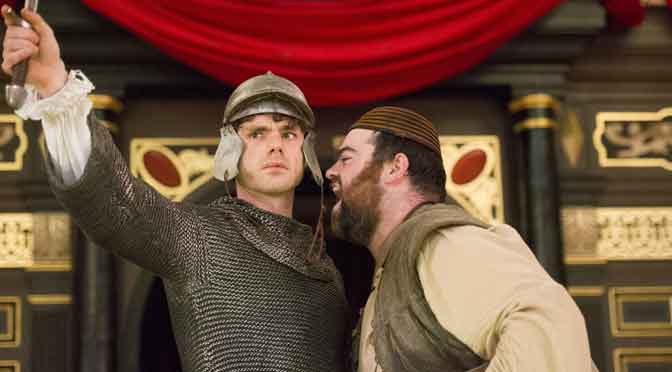
“The Body of an American” at the Gate Theatre

The Body of an American, which opened last night at the Gate Theatre, is an intriguing docudrama. Written by Dan O’Brien, it explores his friendship with the war reporter and photographer Paul Watson. Focusing on Watson’s Pulitzer Prize-winning photograph of a butchered American soldier in Mogadishu in 1993, O’Brien’s questioning of the older man’s motivation is matched by an examination of his own life and work.

The play and production are ingenious. William Gaminara and Damien Molony perform as Paul and Dan, but they also share each other’s lines (this works better than it sounds), as well as taking on a host of minor roles. Performed in traverse, photographs by both men are projected and create a companion dialogue.

While impeccably directly by the talented James Dacre, the piece comes perilously close to being overwhelming. What makes it so absorbing is that it seems such a collaboration between writer and subject. The latter’s memoir is credited as an inspiration and his voice is rendered so convincingly by O’Brien that he almost becomes dominant. But it’s really two stories. O’Brien reveals much of himself: like his friend he is haunted by events, and he skilfully creates an uneasy question as to the reliability of his ‘reporting’.

The terrifying events and atrocities that make up Watson’s work naturally make better drama. The fact that the stakes are so different are always acknowledged – think Hemingway meets Henry James – but the imbalance between the jobs leaves you questioning your own position. O’Brien’s struggle to make sense of Watson’s life, and make a play about it, creates a link with us all. His blend of passion and perspicacity makes this an unusual play that’s well worth watching.

Until 14 February 2014

www.gatetheatre.co.uk

Photo by Simon Dutson

Written 21 January 2014 for The London Magazine
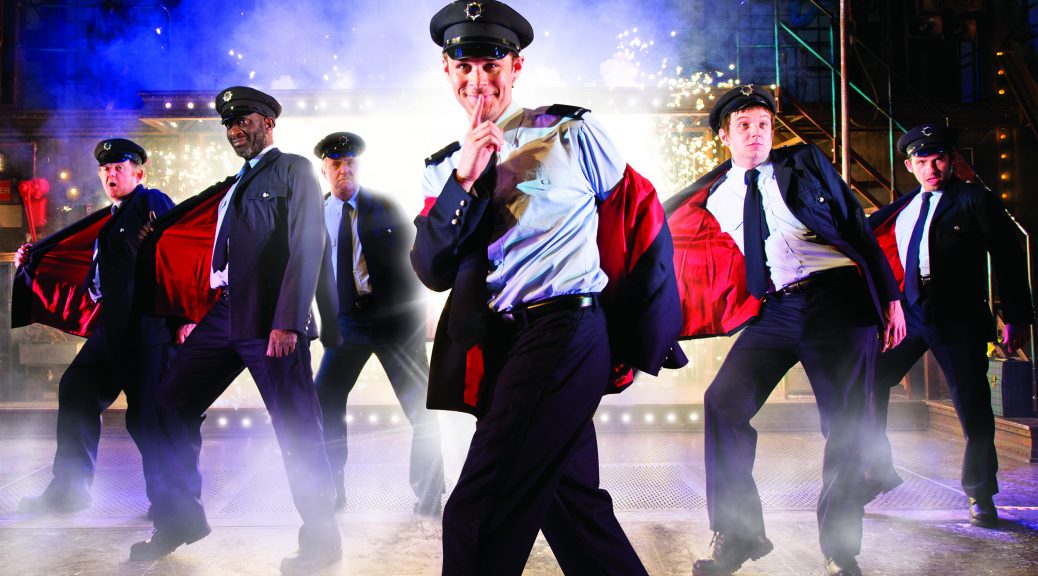
“The Pass” at the Royal Court

This month former Premier League footballer Thomas Hitzlsperger revealed that he is gay. It adds some topicality to John Donnelly’s new play The Pass, currently showing at the Royal Court, which examines a footballer’s sexuality in three scenes during his career. But if you caught the news, you probably weren’t that bothered. And this is where Donnelly really scores: The Pass only uses its characters’ sex lives to explore something we find much more interesting nowadays – fame – and it does this in exemplary fashion.

At first it’s all juvenile fun: two teenagers in a hotel room, reeking of hormones. The banter is disgraceful, no surprise, but an uneasy twist comes with the suggestion that Jason is toying with Ade’s affections: literally using sex as a weapon to put his fellow fledgling player off his game. Things take a darker turn as Jason’s career takes off. Exploiting a cliché, a one-night stand with a table top dancer, Donnelly adds enough twists and turns for a thriller. Already corrupted by celebrity status Jason has become a monster, albeit one with an indefinable charm, and like all scary villains he has plenty of plans.

the pass-142
Gary Carr and Russell Tovey

There are minor issues with the text that even John Tiffany’s skilled direction can’t quite hide but a talented cast ensure they don’t become irritants. Gary Carr deals remarkably with the years separating his appearances, transforming from a boy into a confident man. Lisa McGrillis is superb in her scene, keeping you on the edge of your seat. All eyes are on Russell Tovey in the lead role. Few do matey straight roles better than Tovey: his comic skills are perfect, but the play’s time scale and his character’s development give him the chance to show great depth. Maybe his performance will be enough to get the show a transfer (apologies).

While Tovey never falters, The Pass doesn’t keep up the wonderfully high standard of its first two scenes. The introduction of a fourth role, a young boy who works in a third and final hotel, marks an able debut from Nico Mirallegro, but the character, who shows the same faux naivety Donnelly uses so well elsewhere, fails to convince. Jason’s connection with reality becomes a little too strained now he is a megastar. But admittedly the tension continues and The Pass still thrills. A reunion between Jason and Ade brings us more power games and moral questions – the price of fame and failure – formulated in an insightful fashion.

Until 1 March 2014

www.royalcourttheatre.com

Photos by Manuel Harlan

Written 19 January 2014 for The London Magazine

“The Duchess of Malfi” at the Sam Wanamaker Playhouse

2014 is off to a great start for lovers of the stage, as the late Sam Wanamaker’s visionary plan for an indoor theatre, next to Shakespeare’s Globe, is now open. Deservedly taking Wanamaker’s name, this reimagining of a Jacobean indoor theatre is an exciting opportunity to see plays of the period in an authentic context.

So what’s it like? In a word: fascinating. The tiny space is instantly appealing. Candlelit, it is full of charm and even smells wonderful. The acoustics are shockingly good; this will surely be its major contribution to our understanding of Renaissance theatre. That it’s lit so differently to the theatres we are used to, and you can hear a pin drop, makes for a very different interaction between the audience and the play – one that, for me anyway, felt heightened and cerebral. It is also, it has to be admitted, rather uncomfortable. Bench seating is never luxurious and the theatre is crowded, potentially hot, with some awful sightlines. Go, but avoid the restricted view seats.

The first production is John Webster’s The Duchess of Malfi. The gore filled revenge story unexpectedly benefits from being staged in this space. It all seems much quieter than we are used to. Much more about listening to the horrors inflicted on a widowed Duchess who dares to marry again than seeing blood splattered everywhere. First directorial honours go to the Globe’s boss Dominic Dromgoole, who does a superb job embracing the new theatre. The famous scene where the Duchess is visited in the dark, which here really is pitch black, is thrilling.

Inevitably there’s the sense of a company still finding its feet. Gemma Arterton’s performance as the Duchess is understated and seems spot on as a result. But her wicked brothers, played by David Dawson and James Garnon, who oppose her marriage and then torture her when they discover it, seem overplayed as the play progresses.

Webster’s exuberant language often raises a smile nowadays but playing it for laughs (a common way of dealing with his wild metaphors) seems a missed opportunity here. Duke Ferdinand’s insanity certainly isn’t supposed to be funny nor, I am sure, are the mad people sent to live with the Duchess as part of her punishment. Just possibly, this is the place to play the text straight.

But these reservations only serve to support what is so exciting about this new old theatre. The chances it offers to explore well-known plays, and hopefully soon to rediscover lost works, make the Sam Wanamaker Playhouse brim with potential. London has a new star venue.

Until 16 February 2014

www.shakespearesglobe.com

Written 17 January 2014 for The London Magazine

“Stephen Ward” at the Aldwych Theatre

Let’s face it, Stephen Ward is a terrible name for a show and, given that its eponymous subject ends shamed and committing suicide, it’s also an unlikely topic for a West End musical. But Andrew Lloyd Webber’s new work deserves the kind words received from critics. An adult affair, looking at the 60s Profumo scandal, the focus is on hypocrisy and injustice – on how revenge was meted out to Ward by the upper classes he once counted as friends.

The show’s credentials are impeccable. Lloyd Webber’s score lives up to his reputation and the book and lyrics are provided by Don Black and Christopher Hampton. This is a complicated story presented in exemplary fashion, with startlingly confident lyrics and efficient directing by Trevor Nunn.

The show rests on the lead and Alexander Hanson is terrific at conveying the complexity of this “man of many parts”. And Charlotte Spencer and Charlotte Blackledge (above with Hanson) depict the more famous stars of the real-life drama, Christine Keeler and Mandy Rice Davies, with depth. Secondary characters also satisfy: Anthony Calf is perfect as Ward’s fair-weather friend Lord Astor and there’s a tremendous turn from Joanna Riding as Profumo’s wife. It’s a lovely twist to see the betrayed minister’s spouse get to have her say.

The show isn’t perfect – rousing emotion has to wait until the end (Hanson again delivers) and this seems too late. Attempts at humour when it comes to both Keeler’s Russian lover and the police who frame Ward on a trumped-up charge are frankly embarrassing.

Stephen Ward has a quiet ambition. A concise, penetrating view of British culture, it scores many a hit. The scene of an upper-class orgy may raise eyebrows amongst Lloyd Webber fans but, sensibly, it doesn’t try to shock. There may be some Coco de Mer style accessories on sale in the foyer (a riding crop and silk blindfold) but humour is used well here. Another highlight is a song for The News of the World journalists, set to twist Keeler’s kiss and tell story, demanding she “give us something juicy”. Keller’s lyrics go further than the hacks are willing to print, but Lloyd Webber and his team don’t shy away from the explicit – even crudity is used intelligently in this smart work.

Until 1 March 2014

Photo by Nobby Clark

Written 23 December 2013 for The London Magazine

“The El. Train” at Hoxton Hall

Hoxton Hall has been transformed for a short run of three one-act plays by Eugene O’Neill. Billed as The El. Train, with the action set beneath the bustle of the New York Subway at the turn of the century, there are no long journeys to endure here as the short pieces run right on time. O’Neill’s bleak themes of desperation are easily recognisable, but this is an night of drama and action, backed by a superb jazz soundtrack, with original music from Alex Baranowski, that adds a satisfying unity to the evening.

The first two plays, Before Breakfast and The Web, are superbly directed by Sam Yates. Both star two-time Olivier Award winning Ruth Wilson who gives versatile performances as a downtrodden wife and an abused prostitute. Before Breakfast serves as a commanding monologue, produced with gripping precision from both director and actor. Special praise goes to the carefully delivered humour brought out in the production – a clear indication of the intelligence behind the whole evening. The Web is an even darker exploration of a criminal underworld. The unbelievable cruelty of a pimp, portrayed effectively by Zubin Varla, an heroic rescue, and a baby thrown in for extra emotion – there’s a little too much going on for its own good. But Yates does a superb job to embrace and pace the action. Wilson’s reappearance in this role, as a consumptive streetwalker, close to death, is tremendous.

A transformation marks the finest theatrical moment of the final piece as well, with Nicola Hughes metamorphosing into an elderly woman as she sings between the plays. In The Dreamy Kid, Hughes’ Mammy Saunders is on her deathbed, waiting to say goodbye to a beloved grandchild. He is being watched by the police and his visit will be a trap as his crime catches up with him. The play marks Ruth Wilson’s directorial debut, a cleverly modest one, which takes a lead from Yates’ work and maintains the high standards and exciting tension.

And to round off a fine evening, an accompanying bar benefits from the atmosphere the talented musicians on stage have established so well. The Hell Hole Saloon is a pop-up venue that ostensibly takes its inspiration from the Golden Swan saloon O’Neill frequented. It’s much nicer really, with themed cocktails, including a delicious hot buttered rum which is perfect for the season, and fantastic service under the supervision of award-winning bartender Joe Stokoe.

Until 30 December 2013

Photo by Marc Brenner

Written 14 December 2013 for The London Magazine

“Let the right one” in at the Royal Court

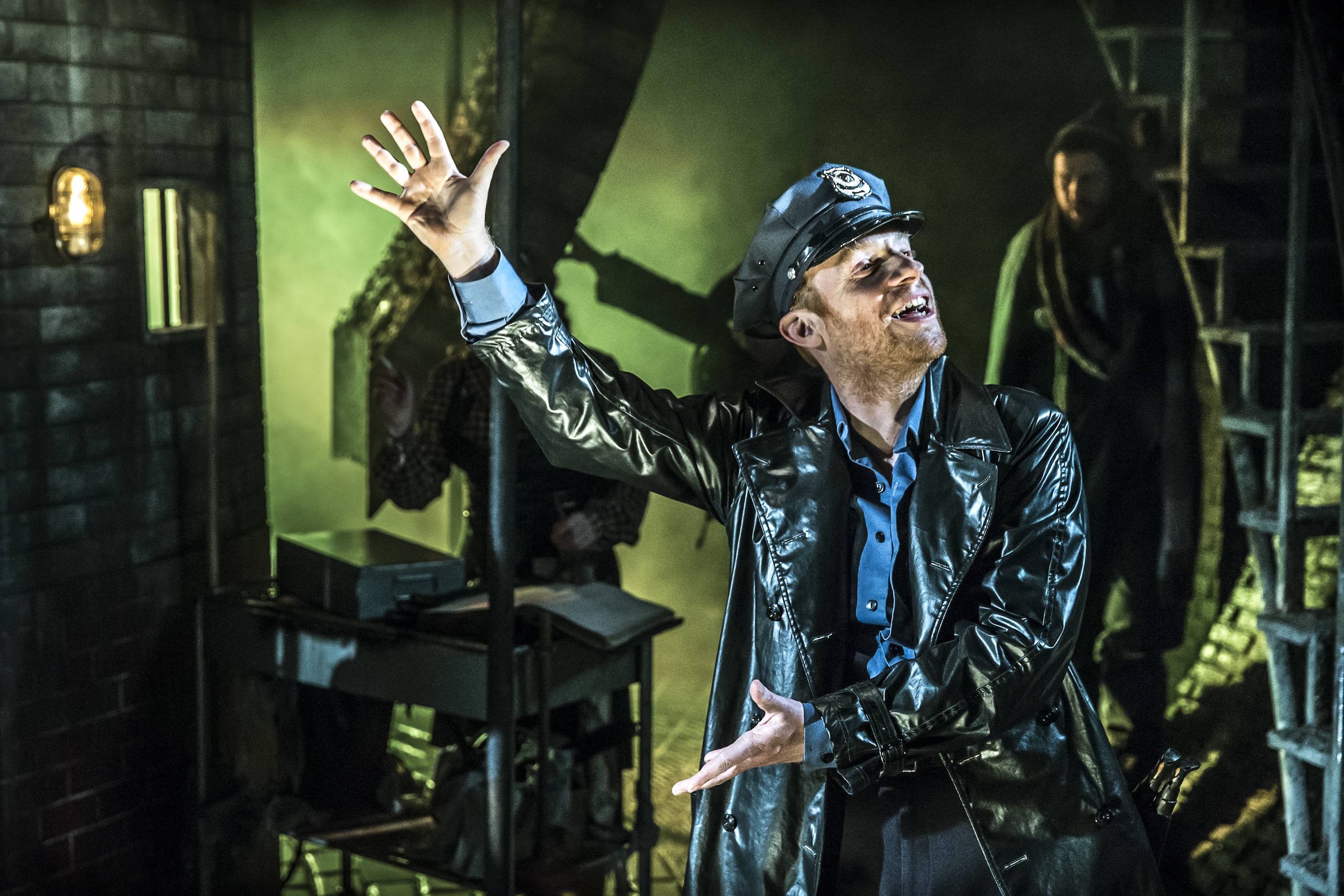
The National Theatre of Scotland are paying a visit to London, to the Royal Court, with their warmly received production, Let the right one in. A superb adaptation by Jack Thorne, of the novel by John Ajvide Lindqvist, made famous by two successful film versions, it deserves unreserved praise for its eminent theatricality. It’s a vampire story with a brain, as well as the usual suspense, and the twist is that this is a story about children.

On stage, we have Martin Quinn as young Oscar, doing a marvellous job at convincing us he is on the brink of puberty. He’s horribly bullied at school, from a broken home and has issues that are only suggested to us (like Oscar, we can’t quite work them out). The supporting roles of school children, mum and dad, are confidently performed and Quinn captivates as the kid in the class we all recognise.

But Oscar’s issues are nothing compared to those of his new friend Eli. She only plays at night, sleeps in a box and lives off blood procured by a creepy father-figure who murders people in the nearby woods. Oscar and Eli’s innocent relationship is… complicated. Rebecca Benson, taking the lead role, gives a luminous performance. Just the right side of ethereal, she injects humour and tension with a physicality that stuns.

All the potent ingredients of vampire mythology that make the genre so popular (and commentators so profuse) are present. There’s no shortage of spine tingling and no skimping on blood capsules. But even better, each encounter between the youngsters increases in tension. The characters are complex, and even Eli’s butchering guardian, played so well by Ewan Stewart, is someone you want to learn more about.

Director John Tiffany’s work ensures the show is not only far more than your average teenage tale but also (and critics always love this one) more than a film on stage. Every aspect of the production emphasises the theatrical: its inventive, high-spec set by Christine Jones, and fantastic sound design, lighting and especially movement that adds immeasurably to the powerful emotions and gives the show an odd beauty.

The grace of the performances, often in scenes of violence, is accompanied by a rousing electronic soundtrack by Ólafur Arnalds – the best music I’ve heard for theatre in a long time. A gory vampire story might make an odd Christmas trip for the family, but this is one that teens might actually like – and that everyone should be impressed with.

Until 21 December 2013

www.royalcourttheatre.com 

Written 6 December 2013 for The London Magazine

“Once A Catholic” at the Tricycle Theatre

A friend of mine used to describe himself as a ‘recovering’ Catholic. Indeed, the impact of the religion on those educated within the faith is well known. A revival of Mary J. O’Malley’s 1976 play, Once A Catholic, set in a convent school close to the Tricycle Theatre – where it opened last night – reminds us what fertile ground for comedy the subject is.

With director Kathy Burke in charge it’s no surprise that it’s all fantastic fun. The simple design has the feel of a sketch show, but Burke holds the drama together and gets the most out of her performers.

Three little maids are the focus. Amy Morgan and Katherine Rose Morley play two Marys, girls having a pretty good time. Their love interests, a Protestant teddy boy and a distinctly noncelibate upper-class toff who wants to be a priest, make great roles for Calum Callaghan and Oliver Coopersmith. Molly Logan playing, you guessed it, another Mary, heads the youngsters. Hopelessly naïve, her innocent questions, such as the nature of the sin of Sodom, disturb the teachers riotously.

The school staff are the best thing. There’s a dotty music teacher, played superbly by Richard Bremmer, and a thoroughly Irish priest, a role taken by Sean Campion. Both live up to every caricature and exploit them to the full. But really stealing the show are the nuns: another trio played by Clare Cathcart, Kate Lock and the scene-stealing Cecilia Noble.

Rich in nostalgia, Once A Catholic is set in 1957 and trades heavily on the innocence of the times to get laughs. The girls’ naivety makes it seem like ancient history and this distance also serves to lighten the casual racism and sexism of the times, sliding over some pretty seedy stuff. Humour is prioritised and Burke excels at this.

There’s little depth to the show, though it’s clear that ignorance is the thing to battle against. It’s a point the play makes well – with its educational setting and poor Mary’s dangerous unworldliness. But with all the fun, there’s little fight in the play; its sacrilegious lines don’t outrage and it lacks a good punch line. There are a lot of laughs to be had though. If it’s comedy you’re after, your prayers will be answered.

Until 18 January 2014

www.tricycle.co.uk

Written 28 November 2013 for The London Magazine

“In the next room, or the vibrator play” at the St James Theatre

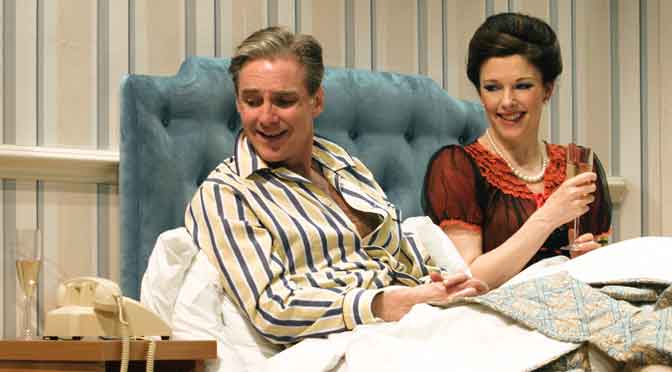
Sarah Ruhl‘s In the Next Room, or The Vibrator Play received its London premiere at the St. James theatre last night. A clever take on the drawing room comedy, it doubles as an intelligent peek at love and sex, medicine and gender.

Set in the late 19th century, its saucy starting point is the historic practice of using electrical, ahem, instruments ‘down there’ to induce what were termed ‘paroxysms’. It’s guaranteed to generate giggles, but showing how medical discourse generated its own clientele (the procedure was to resolve the complaint of hysteria), a deeper discussion about relationships between the sexes comes to the fore.

This is another production to arrive at St James from the Ustinov Theatre in Bath. It confirms both venues as exciting locations. Directed with care by Laurence Boswell, the design from Simon Kenny focuses attention on that glorious new discovery – electricity – which revolutionised work and home. For the Givings, the couple at the centre of the play, the two are combined: the Doctor’s surgery is ‘the next room’ in his house, in which patients are satisfied in a manner denied to his wife.

In the lead roles, Natalie Casey and Jason Hughes give fine performances as a man of science and his wife, driven to desperation mostly, it would seem, through sexual frustration. The doctor’s patient, Mrs Daldry, has a similar complaint, depicted with great fun by Flora Montgomery. And lest we should suspect Ruhl is simply recasting a Victorian malady, suggesting sex is a cure-all, there are the deep pains and joys of childhood to consider. The better-off woman’s fears and anxieties are brought into sharp relief by the employment of a wet nurse whose own child has just died. Madeline Appiah does wonders with this small role.

This is a chance for London audiences to see the work of a new, much feted American writer. Well constructed, with a light touch underlined by some deep thinking, it has possibly too many twists; including what happens when there is a power cut and the arrival of a male patient (now that’s got you thinking). Some predictable touches commenting on a battle of the sexes fail to satisfy. The play is impressive for its commercial potential as much as a sense of integrity. Ruhl may try to tackle a little too much but the laughs are uproarious and the romantic ending a delight.

Until 4 January 2014

www.stjamestheatre.co.uk

Photo by Johan-Persson

Written 22 November 2013

“Strangers on a train” at the Gielgud Theatre

Most people know Strangers on a train because of Alfred Hitchcock’s 1951 film. As with the director’s earlier work, Rope, it was based on a novel by Patricia Highsmith. Hitchcock must have been a fan, and it would be nice to think he would approve of writer Craig Walker adapting the book, rather than the movie, for the stage.

Presenting Highsmith’s take on the ‘perfect murder’, with two strangers killing for one another, thereby securing alibis and depriving investigators of motive, it’s a disturbing journey worth taking.

It’s a shame that director Robert Allan Ackerman’s production contains so many frustrations. After a bold move away from the screen, continual projections make us feel we are watching a movie and some frankly hammy music sets a period feel in the worst possible way, being both clichéd and melodramatic.

The first act is taken at a disconcertingly swift pace: this is Highsmith on a high-speed train. It’s all so quick that the performances disappoint a little. Laurence Fox and Jack Huston are the strangers, Haines and Bruno, who kill an unwanted wife and a father holding back a legacy. Fox’s accent slips as he rushes the lines and there are times it is difficult to hear Huston. The possibility of homoeroticism, so potent in Highsmith’s work, is also an issue. These are remarkably sexless performances (was this a conscious decision?). Of the secondary characters, only Imogen Stubbs, who plays Bruno’s mother with a knowing nod to Blanche DuBois, giving us an impression of what Marilyn Monroe might have become, stands out.

Everything improves greatly in the second part – ironically as the steam runs out, and the pace slows. Now we have the psychological outcome of the murders, the realisation of how dangerous Bruno is and Haine’s descent into instability. Fox and Huston have the chance to show themselves as fine actors, the tension is higher and the finale surprising.

Throughout, the show looks stunning. The revolving design from Tim Goodchild is worked for all it’s worth and the impressive number of sets is remarkable. A monochrome palette is deployed, with superb costumes from Dona Granata, making the show lavish. It would have been great if the suspense matched the style. But Highsmith’s ideas and the sheer power of her storytelling go a long way and Warner has done well to bring so much of this forward.

Until 22 February 2014

Photo by Brinkhoff and Mogenburg

Written 21 November 2013 for The London Magazine