All posts by Edward Lukes

“A Haunting” at the Vault Festival

There’s a great starting point for Nathan Lucky Wood’s play. A young boy’s online discussion with an older man quickly includes sexual content and turns out to be even creepier than we imagine. With brilliant twists too good to spoil, Wood explores current concerns about the internet in an original and unsettling way. It’s challenging and uncomfortable, as well as providing a great role for Roly Botha as a teenager running a gamut of emotions: he’s smart enough to see he is being blackmailed, but not entirely unwilling to meet his “friend” in the woods.

The scenes with Botha onstage alone are gripping, so it is a shame the play falls off so quickly. The actions of the boy’s mother (Izabella Urbanowicz), who we’ve already seen in a couple of short and unconvincing scenes, beggar belief. The meeting with our online villain has potential, and director Jennifer Davis adds some nice touches, while Jake Curran works well in the role. But encounters between all three characters strain credulity further and a disappointing final scene only emphasises how much the steam has run out. After such a promising start, it’s disappointing, as Wood can clearly do so much more.

Until 19 February 2017

www.vaultfestival.com

“Villain” at the King’s Head Theatre

This is a great little show. With plenty of issues and just one performer, writer and director Martin Murphy creates a tense and moving story that puts hearts in mouths while injecting some strong comedy. The character of Rachel, a successful saleswoman turned social worker, is likeable from the start. When she becomes publicly demonised after a case goes horribly wrong, sympathy mounts. Flitting back and forth to her former job provides some light relief and exposes her flaws. Making his heroine realistic and modulating a tone of confession with camaraderie is Murphy’s key achievement and it reaps big dividends.

Maddie Rice takes the part. Her performance is superb. Portraying fear while hounded by the press, claustrophobia and panic are all well done. But it’s filling out the portrait that is the point: looking behind the headlines and trolling tweets. With stories of her work life, riotous nights out and colleagues both “coping” and “cracking”, Rice shows her grade-A comic skills. An enthusiasm for life and doing good, along with the character’s selfishness and brutal honesty, endear her further, all balanced with a degree of unfulfilled loneliness skilfully evoked. This is a performance to treasure that complements satisfyingly strong writing.

Until 4 March 2017

www.kingsheadtheatrepub.co.uk

“This Must Be The Place” at the Vault Festival

I’ve waited a while to see another play by Brad Birch, and this piece, co-written with Kenneth Emson and presented by Poleroid Theatre, shows a writing team with strong ears, observant eyes and independent minds. Firmly rooted in the experience of young lives today, this story of family and friendship is full of recognisable stuff, even if most of us would fail to articulate it with such style.

Two couples, linked by the theme of home, weave a poetic dialogue full of wit. There are laughs, but a sense of anxiety is always present. Technology and the “shared, liked, commented on” of social media becomes a pressuring mantra. The everyman here, Adam, debates having a child with his girlfriend and tackles the legacy of an estranged father. Meanwhile, two friends, endearingly hapless desperadoes, are on the move to London. All four roles are well acted. James Cooney and Molly Roberts play struggling lovers: distant from one another in more ways than one, yet still emotionally attached. Feliks Mathur and Hamish Rush play mates with a fantastic chemistry – surely aided by both being recent graduates from the same college – and top-notch banter.

This Must Be The Place isn’t making revelatory statements. If you’re not on Facebook, after a feeling of smug self-righteousness, the relief you feel will only confirm a lot that’s expressed here. Barbs against hipsters, well, who is going to argue with that? Modern angst isn’t that original a topic and the sources Birch and Emson point towards are no surprise. But it’s all presented very well indeed, using the language of tech and a dissonance with “actual life” brilliantly. Writing this lyrical easily carries the show.

Until 12 February 2017

www.vaultfestival.com

Photo by Mathew Foster

“The White Devil” at the Sam Wanamaker Playhouse

John Webster’s play is a textbook Jacobean revenge tragedy, circling around an adultery that engenders murders in Italian courts riven with plots and poison. It’s a play about rage and, with emotions boiling (it’s lust not love on offer), needs the strong hand provided here to create a rollicking evening that should satisfy any bloodlust while providing plenty to think about.

Director Annie Ryan shows no qualms about dealing with Webster’s text. Tidying up, with the help of Michael West, the poetry is retained while twists and turns in the plot are treated with ruthless efficiency during a swift two- and-a-half hours. There’s no sweetening the disgusting misogyny. With ahistorical steam punk touches to a scene of sorcery (“quaintly done”, indeed), there’s the warning that prejudice and violence are a perennial threat.

It’s satisfying that a policy of balanced gender casting works so seamlessly. Kate Stanley-Brennan shines in her starring role of Vittoria, particularly in the scene of her murder trial, a riveting combination of indignation and cunning. And it’s good to see Shanaya Rafaat doing well as the servant Zanche, with a writhing physicality that terrifies. Also gratifying is the part of Vittoria’s young stepson, which cleverly uses the skills of Mollie Lambert.

Jamie Ballard as Bracciano

Perhaps Ryan’s embrace of Webster’s black humour is her biggest achievement. Incredulous moments are made funny – we’re going to laugh anyway – with the instant calls for revenge dealt with superbly by Jamie Ballard’s manic Bracciano. This adulterous, murdering Duke isn’t the only engaging villain on offer. Indeed, even the single sympathetic character, Vittoria’s “virtuous” brother Marcello (a good turn from Jamael Westman) falls victim to his own impetuous anger. His fate provides a pause for thought and pace, with the play’s one moment of compassion boldly handled.

Ahead of the plotting gentry and papacy (a great role here for Garry Cooper as a suave clergyman) is Flamineo, delivered with spectacular charisma by Joseph Timms, whose energy and impeccable delivery garner laughs and excitement. Timms makes his pandering and posturing crook the arch evil in a play with no shortage of demons. There are devils all around, a bewilderingly “catalogue of knaves”, and Ryan deals with them all brilliantly. Her patience with the play is truly saintly.

Until 16 April 2017

www.shakespearesglobe.com

Photos by Marc Brenner

“Worlds” at the Vault Festival

A set of strangers together in an isolated guest house might normally be associated with a murder mystery story, and there are puzzles in Martin Murphy’s new play, which he also directs. But his series of intimate glimpses into multiple lives is gentler than even a Miss Marple. Storytelling seem to be the purpose here – fair enough – but, while scenes are set up and acted well, they don’t develop far.

The odd building, converted into a hotel, is said to have had “many guises”. There’s a mish-mash of visitors, including a middle-aged couple having an affair and two youngsters starting a family, and a few too many metaphors to allow a comfortable stay. Themes of union and dissolution almost manage to link the stories but they’re a bit too open. And there’s a Brexit analogy that strikes a very odd note. The vignettes each have potential, but presenting only tasters is quite unsatisfying. It’s a tribute to the several characters that you want to see more and, as a way of showing Murphy’s versatility, the play succeeds.

Two actors, taking on all the roles, with just minimal costume changes, are impressive. Andrew Macklin’s popstar character is a hit and he has a good go at playing a young boy with cancer. Naomi Sheldon’s swaps include an intriguing dominatrix and a nice delineation of two older characters: a grandmother and the adorable landlady Briony. It’s these “many guises” that really drive the play.

Until 29 January 2017

www.vaultfestival.com

“BU21” at the Trafalgar Studios

Stuart Slade’s new play, which has transferred from Theatre 503, imagines the aftermath of a passenger jet shot down over Fulham. Forget the how and why – details given only feed our fears ­– instead this is a long hard look at the effect of trauma on a personal and national level, as a group of survivors meet for therapy sessions and press reporting of events looms large. Frank monologues addressed to the audience contain a brutal, often startling, humour.

When it comes to thinking about our reaction to big events, Slade’s cynicism is refreshing and the lack of sentiment is a worthwhile corrective. The only patriotism here is sham: an opportunist happy with 15 minutes of fame that Graham O’Mara plays and manages to make intriguing despite objectionable arguments. Nobody really recovers from their trauma, a fact that makes three well-written roles for women (with hugely impressive performances from Florence Roberts, Roxana Lupu and Isabella Laughland) all the more moving. Admissions of selfishness bring us close to them. The language of the corporate meeting and the counselling session are both cleverly manipulated for laughs.

Less successfully are the audience’s motives questioned and our prejudices challenged. Why would we watch this ‘misery-porn’? And do we assume a Muslim character (played by Clive Keene, in fine form) is guilty? Bearing the burden here is Alexander Forsyth’s character, a particular obnoxious banker who breaks the fourth wall, haranguing us for buying a ticket in an appropriately overblown manner. Director Dan Pick obliges the pushy aspects of Slade’s writing with lots of raised lights to make sure there’s nowhere for the audience to hide. But the desire to be confrontational creates unconvincing moments. Too many assumptions are made about the audience and twists don’t have the impact wished for.

A lot of BU21 is tough and the manner harsh. Using laughter as the cure for trauma means the jokes are close to the bone. Such humour is revelled in, in keeping with the confrontational spirit of the piece and, while I can’t imagine this would bother Slade, it approaches a word seldom used – tasteless. But for all the flashiness, the combination of calculated insight with strong characters, impeccably performed, makes this a hot and cold affair that intrigues and stimulates.

Until 18 February 2017

www.atgtickets.com

Photo by David Monteith-Hodge

“The Doppel Gang” at the Tristan Bates Theatre

What a good idea. A failing theatre troupe, finding unperformed scripts by the Marx Brothers, decides to masquerade as the comedy greats… for one night only. Suspending disbelief is part of the fun. Seeing the character’s troubles and rehearsals provides behind-the-scenes mayhem and, with accomplished comedy writing, the whole thing is hugely entertaining.

There are some problems, the most obvious coming from the production. Terence Mann’s direction is slow, with time often wasted moving things around between scenes. Mann seems enamoured of background music and, even worse, recorded dialogue that sucks the life out of scenes painfully quickly.

Jordan Moore and Peter Stone

With my sympathies, the cast mime their lines well. But they are a lot better when they speak out loud. Jake Urry makes a credible spiv impresario, despite the role really needing more mature casting, while Rachel Hartley makes you want to see more of her character. As the tired comedy duo forced to take over the show, Peter Stone and Jordan Moore have a great chemistry – both can boast a natural stage presence – and Moore deserves special praise for bravely taking on the iconic figure of Groucho Marx with such care.

Playwright Dominic Hedges, with nerves of steel, replicates the Marx material well. But the real story here is backstage and this could have been elaborated on much more. The material has potential, as do the characters who all beg to be fleshed out further. Two examples: it wouldn’t hurt to know earlier on where and when the play was set, and a romantic subplot suffers from too little development too late.

If this sounds like a lot of criticism, many points are relatively easy to implement. The cast can clearly deliver and the creatives produce a good story. With a few tweaks and some extra polish, this play could have a very bright future. As it stands, The Doppel Gang is still well worth seeing.

Until 11 February 2017

www.tristanbatestheatre.co.uk

Promotional photo by Tom Barker. Production photograph by Mitchell Reeve

“Promises Promises” at the Southwark Playhouse

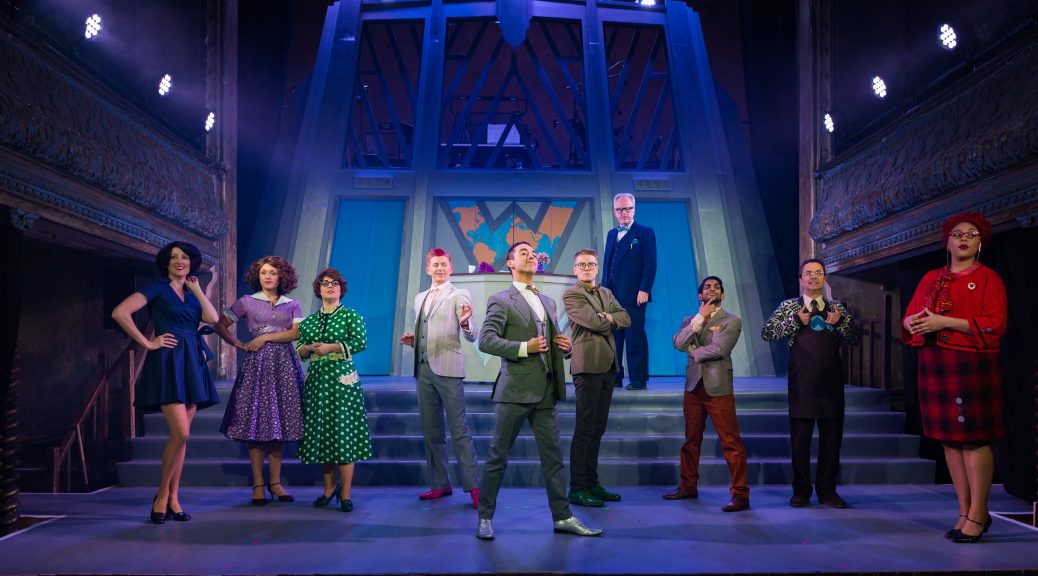
The credentials for this musical are impeccable: a book by Neil Simon, with music and lyrics fromBurt Bacharach and Hal David. That should be enough to get you booking tickets. The endearing, nostalgic piece follows the adventures of New Yorker Chuck, who lends his flat to his bosses for their extra-marital affairs, while his own love life flounders.

Adapted from the 1960 movie The Apartment, it’s the script that dominates. There’s a lot of Simon here – no bad thing – playing with cynicism, packing in jolly touches and good plotting. If the songs don’t fuse into a score in the manner that makes some musicals heavenly, they are great numbers, with a trip to the back catalogue sublimely incorporated as an extra treat.

Paul Robinson
Paul Robinson

The smooth sounds are well performed and Bronagh Lagan’s direction has a calm pace that’s appropriate – disguising how much work her dozen cast members are doing – so the show feels like relaxed fun. There’s swinging going on (it’s the Sixties, after all) but, despite the Mad Men vibe, evoked especially well by Paul Robinson as the arch philanderer Sheldrake, the tones are pastel and the atmosphere oh-so cool.

Gabriel Vick and Alex Young

Darker shades are present and handled well by leading lady Daisy Maywood, whose character Fran is driven to attempt suicide. The sobering moments are a little jarring and stem from the sexism within Promises Promises itself. Women are, literally, backing singers, playing secretaries and ‘pick ups’ (providing a blissful cameo for Alex Young). And the office Christmas party would give an HR department a fit. Lagan deals cleverly with the unsavoury middle-aged executives, presenting a collection of more sad than mad men that we can laugh at. It’s a sensible move, and the cast makes it work for them.

The saving grace is our heroine, at times displaying an emotional depth that overwhelms the show – welcome nonetheless – and Maywood’s acting is as strong as her powerful voice. The equally impressive Gabriel Vick, playing Chuck, joins her. Ostensibly, this is his character’s story. He’s a “puny” figure that Vick makes winning with perfectly pitched direct addresses to the audience. Fantasy conversations only endear us to him further. It’s the two leads who make the show, culminating in a gorgeous duet that is the fulfilment of all the talent on offer.

Until 18 February 2017

www.southwarkplayhouse.co.uk

Photos by Claire Bilyard

“Wish List” at the Royal Court

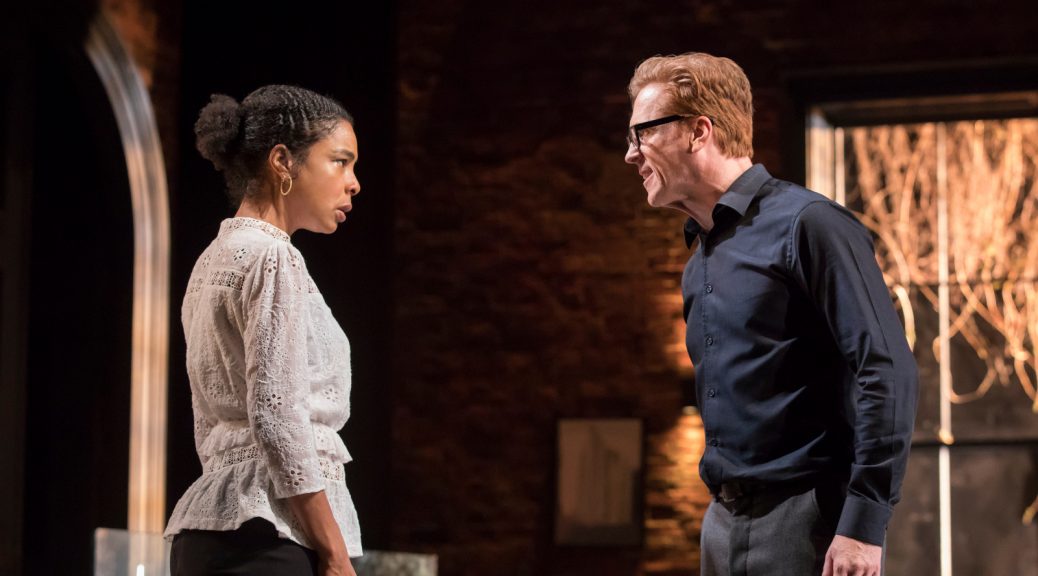
Katherine Soper’s play tackles modish concerns about mental health and the world of work, as two siblings struggle against the benefits system and a menial job on a zero-hours contract. A joint production with Manchester’s Royal Exchange, the play is at home at the Royal Court; there isn’t just a kitchen sink, there’s a bathroom one as well. But suspicions should be suspended: Soper has written a play with real heart, a well deserving winner of the Bruntwood Prize for Playwriting.

For all the monotony in the characters’ lives, Roper covers a gamut of emotions, while Matthew Xia’s direction, with strong sound design from Giles Thomas, nurtures her considerable skills.

The stress in Tamsin’s life, brilliantly portrayed by Erin Doherty, is well depicted and instantly recognisable. Reduced to tears more than once, Tamsin’s own wishes are balanced with responsibilities to her sick brother, combining care and understandable frustration.

With the siblings’ crippling obsessive behaviour, Soper brings insight into a condition increasingly depicted on stage and adds tension. Rendered with almost unbearable intensity by Joseph Quinn, this young man becomes a danger to himself and a fascinating figure with Christ-like connotations from his self-inflicted injuries.

Soper appreciates we can only stand so much doom and gloom and deftly introduces some sweet comedy. Doherty takes us touchingly close to her character’s hopes and gives us the giggles with a rendition of a Meat Loaf song, part of a budding romance with a younger colleague made all the more appealing by a performance from Shaquille Ali-Yebuah: any actor who can make a role this charming is sure to have a bright future.

There are lighter moments also from the mild satire against big business. In the packing factory, neither Tamsin nor her potential boyfriend falls for the inspirational slogans, despite their desperation for a job. But cleverly, the awful working conditions are depicted dispassionately, with an intelligent role for Aleksandar Mikic as their manager.

Digs against faceless organisations come alongside camaraderie. Small acts of kindness in the face of big problems are part of Wish List’s most effective passages – which focus on hope. A lit candle, shared cigarette or high five, take on the significance of communion that is simply beautiful. Soper wants this look at vulnerable lives to be dignified. Her play wins respect as a result.

Until 11 February 2017

www.royalcourttheatre.com

Photo by Jonathan Keenan

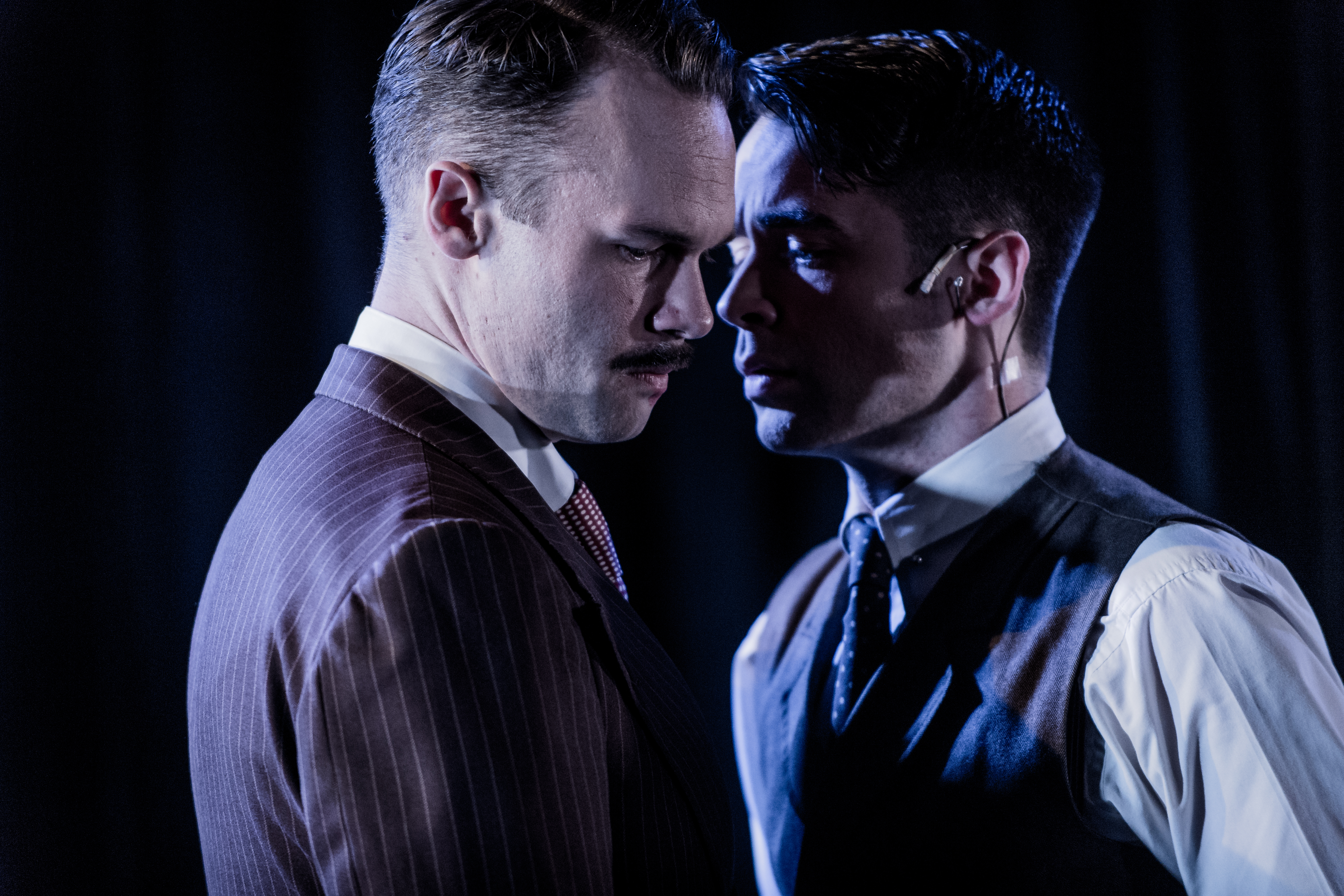
“Abigail” at The Bunker Theatre

This spiky, provocative tale, written by Fiona Doyle, chops back and forth through the one-year relationship between a damaged woman and the man who becomes her unwitting victim. A psychological thriller, imbued with the spirit of a nasty fairy tale, it packs a good deal into just an hour and cannot fail to impress.

Joshua McTaggart directs with appropriate efficiency. We see the couples’ first meeting, holidays and arguments, circling around their sole anniversary. The short scenes are tensely interspaced and the quick changes in chronology a credit to the superb actors. Mark Rose makes his unnamed character satisfyingly rounded, an affable presence, he gives a performance of great technical skill when it comes to depicting physical injury. Tia Bannon tackles even more violent shifts just as admirably, being charming one minute, spooky and scary the next. Stories about a traumatised past are especially well delivered, with too much sympathy carefully avoided.

McTaggart and Doyle don’t dally over their efforts, giving less than the bare minimum to pin a lot down. Avoiding details makes the writing admirably crisp – I look forward to more work from this team – but it doesn’t aid clarity. While creating a sense of mystery is all very well, at times the intrigue becomes frustrating. Since Doyle is enamoured of withholding information, only partly as a technique for suspense, it would be churlish to give too much away. The clue is in the title (thanks, Wikipedia) as Abigail is usually associated with the role of handmaid. Suffice to say subservience here has a dangerous edge. The twists are great and this world of poison, graves and glass splinters is evocative. But it could benefit from elaboration.

Until 4 February 2017

www.bunkertheatre.com

Photo by Anton Belmonté for 176 Flamingo Lane