All posts by Edward Lukes

“Evita” at the London Palladium

Star director Jamie Lloyd has provided many golden theatrical moments, from a brutal production of Oscar Wilde’s Salome many years ago to his work on Harold Pinter’s plays. And he is an expert at musicals, with brave productions of Stephen Sondheim’s work and an exciting appreciation of Andrew Lloyd Webber, including a smash-hit production of Sunset Boulevard. Lloyd’s productions are always daring, with a ‘takeaway’ to remember after the show. But this time, with the balcony scene in this latest revival of Lloyd Webber’s Eva Peron musical, Lloyd tops them all.

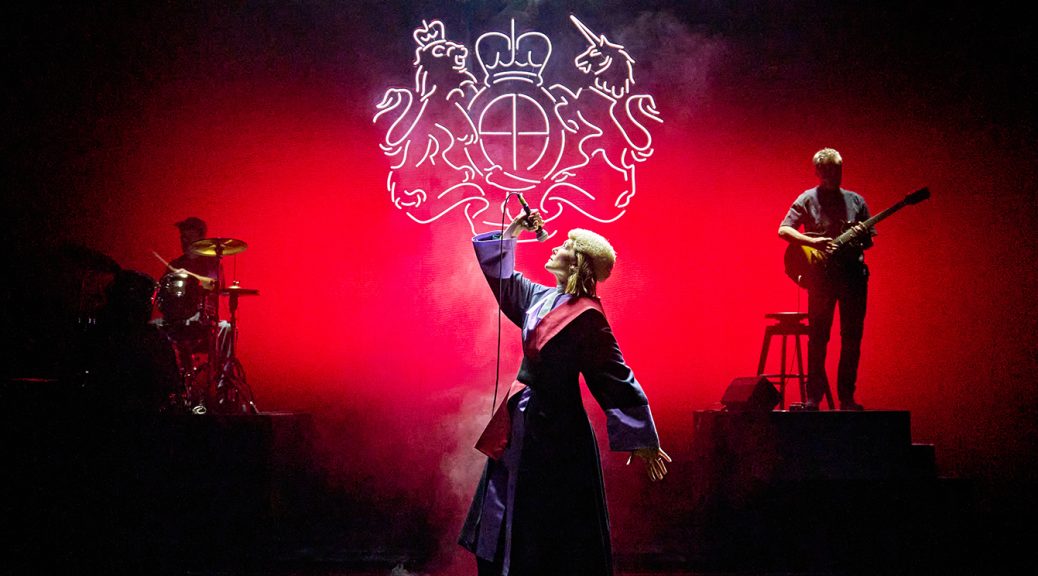
The rendition of ‘Don’t Cry For Me Argentina’, staged outside the auditorium and relayed to those watching inside, is a great stunt as crowds show up to watch it at nine each night. It’s also brilliant – goosebump brilliant. Lloyd has staged the show before, a superb production at Regent’s Park, but this grand venue works even better. It’s not a question of pimping up the production – the staging is still minimal, although Jon Clark’s lighting design is advanced. It’s the effort to bring out the politics of the show that is, arguably, more urgent than ever – a genuine rage about social divides that provides a vital, angry feel.

“screw the middle classes”

The passion is projected by Lloyd’s star, Rachel Zeigler, who takes the title role in her West End debut. I’d suggest it’s this spirit that makes her performance so great, even though she sings superbly. When she screams “screw the middle classes” it’s the only time Zeigler’s voice isn’t beautiful. She has identified the kernel to her character and does not let go. There’s a vicious sense of humour to this Evita. She is bored by weakness, ambitious, unscrupulous and not very nice! Her powerful voice, which is also remarkably clear, sounds strangely old-fashioned and is utterly compelling. 

Evita at the London Palladium

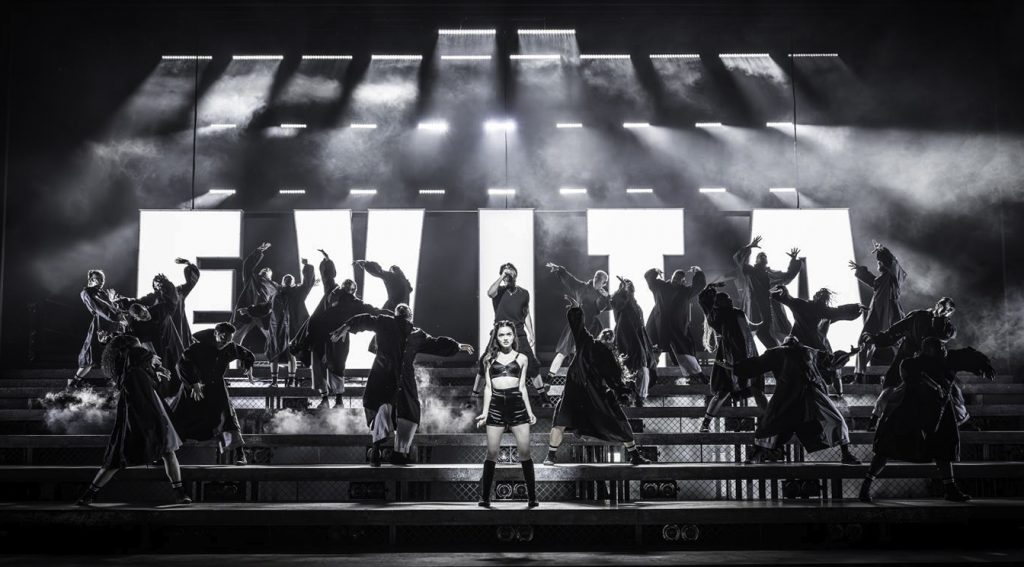
Zeigler is also, like a lot of Lloyd’s leads, a big star. It’s perfect casting and cleverly leaned into. Much of the show feels like a pop concert, with Evita as the performer, her name, literally, written large. The response is fanatical (especially to ‘Buenos Aires’). Fabian Aloises work as choreographer and the amazing cast come to the fore. The dancing is terrific. Filled with humour and danger, acrobatic and at times otherworldly, many movements are robotic, or should that be puppet like? Because what sympathy we have for Evita is about the chances she didn’t have, how she had to exploit others to avoid being exploited. The moving moments in the show feed into the anger that powers it.

“star quality”

Aloise and Lloyd show such rigid control that it could cause problems. Take the interactions between characters. For most of the time, the cast looks out towards the audience, rather than at each other: Evita always has her eye on public perception, on her legacy. There’s only one person she is really interested in; the show also belongs to Che Guevara, and it brings us to yet another stellar performance.

Evita-Andres-Rodriguez-as-Che-credit-Marc-Brenner
Diego Andres Rodriguez

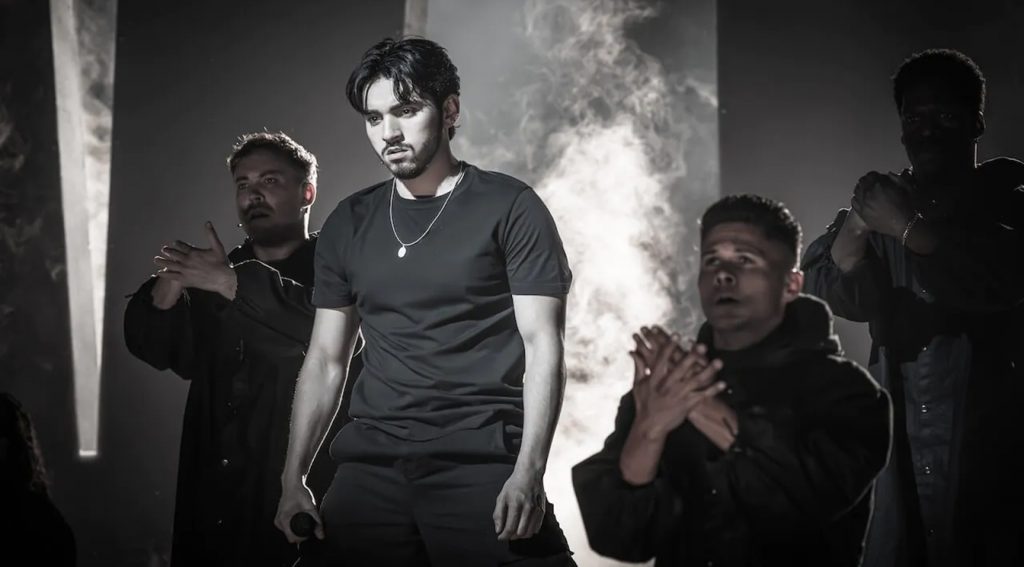
Diego Andres Rodriguez, who takes the role as the Communist rebel, is fantastic. His voice is flexible, his physicality astounding, and to say he is a match for Zeigler is to award the highest praise. Again, he makes the politics of the piece clear – a rebel filled with rage. Rodriguez is another West End debut we feel very lucky to see – in a production so full of “star quality” that it could well go down in history. 

Until 6 September 2025

www.evitathemusical.com

Photos by Marc Brenner

“This Bitter Earth” at the Soho Theatre

Harrison David Rivers’ play sees an interracial couple react to the Black Lives Matter movement. The twist is that Waspy Neil is the activist. The tension is that his African American boyfriend, Jesse, is accused of apathy. There’s intelligence and detail here, both emphasised by director Billy Porter. But there’s also disappointment, as the topic isn’t explored in depth and the romance doesn’t move as much as it might.

There are a lot of references, many of them American, showing Rivers’ careful research, which situates his play firmly in a time and place. From the title, based on a song by Dinah Washington, to the poet Essex Hemphill (who I confess I’m keen to learn more about), the quotes, songs and people mentioned don’t necessarily have to be explained. But might the references be elaborated on? In a short play (less than 90 minutes), ideas bombard the audience and the work is weighed down by its erudition rather than the substance of what is being said.

Neil and Jesse speak in hashtags and slogans. I don’t doubt this is accurate and, again, the dialogue situates us in a specific context well. But do people talk like this all the time? The little bit of flirting we see is sweet, but much of the everyday is lost in talk of privilege and activism. So, the play’s tragic conclusion isn’t as emotional as it should be. Rivers’ efforts to tug at heartstrings come across as forced. More seriously – surely in opposition to his aims – there isn’t enough debate. Argument is lost among signalling. That’s a shame and it leaves the play feeling… not bad, but thin.

The structure of the piece, though, is exciting. Action goes back and forth, with conversations repeated to good effect. Big moments in the relationship are shown out of sync. Some scenes are very short, punctuated by robust sound and lighting design, from Julian Starr and Lee Curran respectively, and aided by the video work so integral to Morgan Large’s efficient set. Porter and the cast deal with all this impeccably, not only avoiding potential confusion but creating an energy that matches the script. For all that, the action, while thought-provoking, contributes to a distance from the characters. Rivers treats growth and development of the men and his story in a novel manner. I just don’t think it works.

Despite these reservations, the performances from Omari Douglas and Alexander Lincoln are an undoubted success. Their accents are superb, the chemistry between them fantastic and they bring out the script’s sexiness and humour wonderfully. Douglas makes the super-smart, if self-obsessed, Jesse appealing, showing a self-knowledge that is inspiring. Moments of explosive rage or grief are compelling. Lincoln allows Neil’s wealthy background to be a genuine cause of concern – and his guilt is contagious. Clearly, the cast, and Porter, see a lot in This Bitter Earth and it is their conviction that carries the day.

Until 26 July 2025

www.sohotheatre.com

Photo by Tristram Kenton

“Pop Off, Michelangelo!” at the Underbelly Boulevard Soho

As success at last year’s Edinburgh Festival, and an eight-week run in London shows, Dylan MarcAurele’s musical is a solid fringe hit. It’s a high-camp romp about Renaissance artists Michelangelo and Leonardo, with a lot of laughs, catchy songs and plenty of fun.

Reframing the Renaissance has been fashionable for a long time, with contemporary references and viewpoints adding an edge. It’s easy to think of connections to Six, and the opening number here enforces that impression. But Pop Off, Michelangelo! is aimed at an adult crowd. And, it seems fair to say, a crowd of gay men. So many of the references are about (one kind of) gay culture that the show starts to parody itself. Jokes about RuPaul’s Drag Race and ‘internet boyfriends’ abound. But MarcAurele knows his market and delivers… or should that be slays?

There is a message, or rather a statement, about how painful homophobia can be. Our heroes, played by Max Eade and Aidan MacColl, meet when they’re young and scared about being gay. Their sexuality threatens their lives and careers. What passes as a plot is their plan of working for the Pope and then persuading him to save them from hell. Written down, it’s sad as well as silly. So, credit to director Joe McNeice and his cast for keeping the energy and the atmosphere up, up, up.

There are reservations around the show. It’s not that the jokes are rude, but that that they don’t all land. Nor are the songs and lyrics bad, but the quality is inconsistent. MarcAurele appreciates the need for a good villain and gives us Sixtus, Savonarola and Machiavelli. But despite the efforts of Michael Marouli, Laura Sillett and Sev Keoshgerian, who all work very hard, these baddies need more time and more depth.

More heartfelt moments make a neat contrast with all the foolery. Leonardo’s romance with a fellow pupil at the Platonic Academy (a role Kurran Dhand gets a lot from) is sweet, and there’s good song for the two of them. Putting an emphasis on friendship, rather than romance, gives the show potential standout. Eade and MacColl make their characters endearing and have good chemistry.

There are crazy touches, too, often welcome in a musical, including Leonardo’s vision of Marisa Tomei (leading to number that allows Maiya Quansah-Breed to shine). Surprises sustain the madcap energy but, at just over an hour long, it’s hard not to find it all a bit slight (short musicals are a tough ask). Maybe the show should be viewed as part of a bigger night out – something that sets the mood for fun? Pop Off, Michelangelo! returns to Edinburgh this year, and could well be around again soon.

Until 13 July 2025

www.popoffmichelangelo.com

“Intimate Apparel” at the Donmar Warehouse

Nothing written by Lynn Nottage should be missed. Director Lynette Linton’s revival of the playwright’s 2003 piece, last seen at the Park Theatre, is splendid. This story of a seamstress at the turn of the 20th century is well constructed, dramatically engaging, full of poetry and contains great insight. And what a heroine! Esther’s hard work, good heart and bad luck all prove compelling as she looks to better herself and find love. While the show is more than a romance, it is easy to fall in love with her.

The lead role is a triumph for Emmy award-winner Samira Wiley. Barely off the stage, she holds the audience’s attention with ease, although the role could be played with more restraint. There’s a balance between Esther’s determination to fulfil her dreams and her disbelief when some of them appear to be coming true that Wiley doesn’t quite pin down. But the emotion displayed is sincere and always moving.

While Esther overly dominates the play, there is excellent support from three women who are her friends, played by Nicola Hughes, Claudia Jolly and Faith Omole. These accomplished performers share Nottage’s skill in making their roles more than foils. There’s a case for claiming that Intimate Apparel is a play about female friendship.

intimate-apparel-Kadiff Kirwan-credit-Helen-Murray
Kadiff Kirwan

Kadiff Kirwan is George, whose epistolary romance with Esther very results in their marriage. His wonderful letters convince – until their nuptial night. The cloth merchant Mr Marks is a tougher role for Alex Waldmann. The chemistry with Wiley is good, but there’s not enough conflict surrounding this potential romance. And Waldmann should display the material he sells (and praises so beautifully) with more care.

A long-term collaborator of Nottage, Linton is a justifiably confident director. Which makes some fussy touches in the show’s design (by Alex Berry) a surprise. The video work feels unnecessary. But the production’s intensity is a marvel – full of frustration, passion and drama. It’s sexy, too, with innuendos about fabric and Esther’s fantasies given weight. The humour shines out and there are gasps over plot points. None of this is surprising, given the strength of the script, but it’s a still an achievement and a theatrical thrill.

Until 9 August 2025

www.donmarwarehouse.com

Photos by Helen Murray

“Who is Claude Cahun?” at the Southwark Playhouse

The titular artist who is the subject of DR Hill’s play has only received attention relatively recently. Speculation about Claude Cahun’s sexuality and gender has appeal for academics, while her life makes for an interesting story. From Paris in the 1930s to resistance work in occupied Jersey during World War II, this is a story worth telling. It is a great shame that here, despite a lot of effort, that it is not told well.

Rivkah Bunker, who takes the title role, and Amelia Armande, who plays Cahun’s partner Marcel Moore, are hampered by a script that is both worthy and wooden. Maybe Hill has read the anti-war messages his subjects wrote as a form of protest too often – there were posters and banners, as well as writing secreted in magazines and even on cigarette papers. But surely, Cahun and Moore didn’t speak like that in real life. The problem is compounded by an eye on theory – the word ‘identity’ is used far too often – which takes us out of the world of the play. Nearly all the dialogue is poor. Lines such as “open up, it’s the Gestapo” are close to embarrassing. 

There is no shortage of ideas in the piece. Juliette Demoulin’s set is effective and the video design by Jeffrey Choy uses Cahun’s artwork well. Director David Furlong highlights movement a lot and manages to create some intriguing moments, inspired by Cahun’s performance work, expressing intimacy and emotion. But there is a reliance on presenting Cahun as a troubled genius. Too much background information is taken for granted, with a difficult childhood and time in a chauvinistic Paris presented in short scenes that are hard to digest. The trio that makes up the remaining cast – Gethin Alderman, Ben Bela Böhm and Sharon Drain – are overworked and the results unpleasant. There are a lot of accents and poor attempts at establishing weakly written characters.

Things improve… a little. As the Resistance work becomes riskier, causing concern to the paranoid Germans, Cahun and Moore are captured and undergo interrogation, imprisonment and almost execution. At times it is hard to believe they were taken so seriously (the “Soldier with no name” Cahun took as her identity was presumed to be German and part of a whole terrorist cell). But it really is a compelling story and that Cahun’s confession was not believed a fine touch.

Again, though, the delivery isn’t strong enough. Bringing out farcical moments is a good idea. Like the art Cahun left behind in Paris, you might say the situation was surreal. But the comedy lacks bite and detracts from the tension. Furlong tries to keep up a pace, but the effect is clumsy. There’s a final twist that is strong. In the search for who Cahun is, do we forget the identity of their companion? It’s Moore’s photography that has made Cahun memorable, yet her name is even less well known. Such insight into the perils of biography is admirable, but not enough to compensate for so many mistakes.

Until 12 July 2025

www.southwarkplayhouse.co.uk

Photo by Paddy Gormley

“Stereophonic” at the Duke of York’s Theatre 

As the most Tony Award-nominated play ever, and the biggest winner in 2024, David Adjmi’s smash hit is compulsory viewing. Set in music recording studios in the late 1970s as a band work on an album, there are vivid characters, rigorously directed by Daniel Aukin, to enjoy. As the highs and lows of making music are recounted in depth, ‘detailed’ is a generous description. It turns out there’s a lot of repetition to making an album… and a surprisingly amount of silence. So, while Adjmi’s script is carefully crafted, it might try your patience.

The pressures and problems of artists aren’t my favourite genre. No matter how troubled, the characters here are talented and successful, so sympathy is a bigger ask than it might be. And I’ll admit the period and type of rock group the show is about (roughly, Fleetwood Mac) has little appeal. Nonetheless, the focus brought to the project is admirable. The claustrophobia recounted is compelling and, considering how little action there is, this long show has tension that Aukin sculpts with skill.

Stereophonic-Eli-Gelb-and-Andrew-R.-Butler-credit-Marc-Brenner
Eli Gelb and Andrew R. Butler

Does Adjmi open up his play so that mere mortals who aren’t ‘artistes’ have something to relate to? Yes. But not successfully. The band’s two engineers, Grover and Charlie, are a device here. Eli Gelb and Andrew R. Butler are strong in the roles, but the characters are still stuck in their milieu. They become lackeys to Peter, the band’s self-appointed creative lead, whose tortured performance from Jack Riddiford makes his deep insecurities clear. There’s plenty to observe about the (male) ego – a bigger topic than the music business – although not much of it is new.

Stereophonic-Chris-Stack-credit-Marc-Brenner
Chris Stack

There is an admirable restraint when it comes to the machinations of showbusiness. Simon, who both the band’s manager and its drummer, could be a more sinister figure, but Chris Stack’s careful portrayal makes us warm to the man. Addiction is a big subject, too. But the band’s bag of cocaine is, literally, too large – it causes more laughs than it should. Bass player Reg, played by Zachary Hart, is a role that suffers, as his drunken and drugged stumbling just gets giggles. Even when he gets clean, Reg is just ridiculous. 

Stereophonic-Nia-Towle-and-Lucy-Karczewski-credit-Marc-Brenner
Nia Towle and Lucy Karczewski

It’s with romantic relations that the play excels. With two married couples in the band, the sexual dynamics are interesting, and the balance Diana and Holly must strike between being wives and artists means that Lucy Karczewski and Nia Towle have meaty roles. Both are fantastic, their characters complex, quick to connect with and easy to become invested in. As Diana fights not to cut verses of her song, it is the only instance when Adjmi’s interests are a hit emotionally.

The songs written for the play, by Will Butler, will be a further attraction for many audience members. But because the show is consciously not a musical, they come close to being a distraction. It’s nice to hear what the band are working on, and it all sounds great, but it also makes the whole show too long. As with everything here, the music and its performance are of a high standard. But, while you can see why Stereophonic got so many awards, it is hard to be inspired by it.

Until 11 October 2025

www.stereophonicplay.com

Photos by Marc Brenner

“STOREHOUSE” at Deptford Storehouse

Secrecy can be exciting, and this project from new arts production company Sage & Jester uses that fact well. “Truth lies here” is the smart tagline, immersive theatre is the promise and, given how diverse that scene is, what you are going to get is hard to anticipate. That the show is big is obvious enough – the former paper depot that serves as the venue is 9,000 square metres.

Without giving too much away, there’s a sci-fi scenario that the audience is guided through a little too strictly. The story isn’t complicated – all the world’s digital information, since the internet started in 1983, has been secretly stored in this very location – but it is hampered by a lot of jargon. The scientists who founded the project (at the height of post-modernism, no less) were aiming for an ultimate truth via algorithm. A mission that has, not surprisingly, failed.

The show’s founder and concept creator, Liana Patarkatsishvili, has the laudable aim of provoking us into thinking about information and control. But the issues aren’t new and it’s all a bit worthy. We learn that online media is often biased and that it brings out the worst in people. Hopefully, that isn’t a revelation to many. Exploring the cultish overtones to a faith in the algorithm is more interesting but comes with yet more cant.

STOREHOUSE-Nina-Smith-credit-to-Helen-Murray
Nina Smith

While those founders are voiced by an impressive cast in recordings, it is the bookbinders, stackers and caretakers (each with an oath) that we meet. These characters are a touch too bizarre. And attempts at humour fail. But Nat Kennedy, Zachary Pang and Nina Smith, who I saw perform, dealt very well with the audience participation, which is encouraged but isn’t heavy handed – the cast won’t bother you if you aren’t keen (guilty). The questions are rather elevated, or at least abstract, which gives the show some standout.

There was a ‘Writers’ room’ at work here. And while there is lots of talent credited (Tristan Bernays, Sonali Bhattacharyya, Kathryn Bond, Katie Lyons, Caro Murphy and Rhik Samadder, with the story “produced” by Donnacadh O’Briain) the result is disappointing. The vocabulary is, frankly, naff and the dialogue clunky, partly because of too many slogans. Yes, we are meant to question all these mantras. But that doesn’t make them any easier to listen to. A bigger problem is that we don’t get to know our guides. They have a back story, but not enough time is taken over it, so there is no emotional connection.

There’s a twist when it comes to the end, with a nod to conspiracy theories that might surprise. After all, when it comes to “shaping narratives”, theatre makers are experts! It’s never a bad thing check how gullible you might be. I’m just not sure that insight is commensurate with the effort here.

Thankfully, there can be no reservations about the set itself – that is impressive. Production designer Alice Helps’ work is big and beautiful. It’s clever not to lean too far into scary, and the details, including the smells, tick the immersive box. The lighting from Ben Donoghue and the sound design from James Bulley are both suitably ethereal. For the finale, there’s a great touch incorporating the crowd, as well as music by Anna Meredith and more abstracts, as we are asked about the future and what gives us hope. This final scene might even give you goosebumps, though that’s mainly down to the staging and set.

Until 20 September 2025

www.sageandjester.com/storehouse/

Photos by Helen Murray

“The Fifth Step” at the Soho Place Theatre

David Ireland’s new play, a hit for the National Theatre of Scotland at last year’s Edinburgh International Festival, is a vague affair. The scenario, discussions between an alcoholic and his sponsor, is promising enough, a good idea. But scenes talking about sex, abuse and addiction are joined by the topic of religion, and nothing is addressed in detail. Like much recent writing, masculinity might be the subject matter – but even this topic feels tackled by default.

There’s also Alcoholics Anonymous itself, whose course of treatment provides the play’s title. How much do you need to know about the organisation to enjoy the play? The Fifth Step isn’t about A.A., as such, criticism about the process is implied, but not investigated. It’s frustrating that we don’t learn more through the play. Is the target talking therapies in general? Or the quasi-religious system of “fellowship” that has a fascinating history?

As a two-hander, the piece is, understandably, character driven and these are meaty rolls that have a clear attraction for performers. Jack Lowden reprises his part as Luka while Martin Freeman joins as an older sponsor, called James. Both men are interesting to watch, and the dynamics of their relationship provides the drama, carefully nurtured by director Finn Den Hertog. Still, Luka is too much a tick-box of toxic masculinity: his opening line is that he is an incel, while his homophobia, misogyny and ignorance push credulity just a little too far. Likewise, James’ sensitivity and hypocrisy don’t quite work – it’s just a little too clear that things aren’t as rosy as he makes out. But when he gets nasty, it doesn’t ring true either.

The performances are top-notch. Fans of Freeman and Lowden will enjoy themselves. And their talents are clear, given how both deal so expertly with Ireland’s humour. The Fifth Step tries hard to be funny. At times it’s a little too close to sketches for stand-up comedy routine, where seeing the punchline coming is part of the fun. Both cast members are great at landing the lines. But despite their efforts, which are considered and considerable, the characters end up as bores. It’s a shame that, with such emotive topics discussed – from adultery to atheism – it is hard to feel for either man or wish to journey any further with them.

Until 26 July 2025

www.thefifthstop.co.uk

Photo by Johan Persson

“Shucked” at Regent’s Park Open Air Theatre

Well, this one is fun! Brandy Clark and Shane McAnally’s new musical, fresh from Broadway, is full of laughs and chipper songs. The story of an isolated community having trouble with its crops juggles sentimentality and cynicism with gusto. Strong performances from a cast that seems to be loving every moment make it easy to enjoy. 

The inhabitants of Cob County, who all appear to be related, are great figures of fun. There are lots of country bumpkin jokes and colourful characters (Keith Ramsay is particularly strong). Every kind of gag gets a go – dad jokes, dirty jokes and some awful puns. They’re delivered thick and fast and almost always land. 

Keith Ramsay in Shucked at Regents Park Open Air Theatre
Keith Ramsay

While giving us plenty to laugh at, the characters have admirable qualities, focusing on loyalty and community, that the show extols. And it feels very contemporary that their suspicion of the outside world might be warranted. Our heroine, Maizy, may not be too bright but she has the courage to travel to the big city – Tampa, Florida – to seek help with the harvest and Sophie McShera makes her character’s mini journey of self-discovery appealing.

Of course, Maizy is conned. By a not very good conman posing as a chiropodist (a great role for Matthew Seadon-Young). And her adventure complicates her love life, too, as she’s left her beau, who is called Beau, behind. But don’t worry – it’ll all work out. And along the way there are strong numbers for Georgina Onuorah and Ben Joyce, who both sound fantastic. Robert Horn’s book for the show is admittedly slim, but it is romantic without being sickly sweet.

Monique Ashe-Parmler and Steven Webb in Shucked
Monique Ashe-Palmer and Steven Webb

The music itself is pastiche, but strong. The silly songs are great and there’s enough heart to make you fall in love with everyone (one of the strongest numbers is about female friendship). And there’s a nice twist with two ‘story tellers’, played by Monique Ashe-Palmer and Steven Webb with fantastic energy. They provide many of knowing glances that help the show and a reassure us that we’re all here for fun. Of course, it’s corny – that joke is set up from the start – but such enthusiasm is delicious. 

Until 14 June 2025

www.openairtheatre.com

Photos by Pamela Raith

“The Frogs” at the Southwark Playhouse

Fans of Stephen Sondheim – and I’m one – are lucky right now. His last work, Here We Are, is playing at the National Theatre while this show has been revived in spirited style by director Georgie Rankcom. There’s fun to be had with comparisons or, to be frank, shared problems. But this is another part of the canon it is wonderful to get the chance to see. And fan or not, The Frogs is smart, fun and well-executed.

Like all Sondheim’s work, The Frogs is inspired by… a lot. There’s the play by Aristophanes, adapted “freely” by Burt Shevelove, then “even more freely” by Nathan Lane, and at each stage given Sondheim’s spin. And it’s a show with a long, somewhat convoluted genesis. Rather brilliantly, as it involves a journey on the River Styx, it starts in a swimming pool!

The-Frogs-Dan-Buckley-and-Kevin-McHale-credit-Pamela-Raith
Dan Buckley and Kevin McHale

A lot depends on the leads Dionysos and his slave Xanthias, who journey to Hades to save the world through art. The plan, to bring George Bernard Shaw back to Earth, is suitably kooky. Dan Buckley and Kevin McHale, who take the parts, are up to the job, sounding great and making an excellent comedy duo. The metatheatricality and the message in the show are generally overdone, but with these two the touch is, thankfully, light.

The-Frogs-Shaw-credit-Pamela-Raith
Martha Pothen as George Bernard Shaw

Their adventures are accompanied by a talented ensemble who also double as extra characters. Joaquin Pedro Valdes stands out as Herakles and Martha Pothen as Shaw. The structure is simple enough, but the pace slows too often. Thankfully, the music is a delight. From the jolly refrain ‘I Love To Travel’, to a melancholic number, ‘It’s Only A Play’, the songs are Sondheim quality, and you can’t give higher praise than that.

Still, given Sondheim’s back catalogue, there’s some disappointment. The Frogs feels heavy-handed. Even the lyrics, although always smart, are a little blunt. And a final contest (apparently agon is the term) between Shaw and Shakespeare is far too lengthy. The point is interesting enough: do we need Shavian “great abstractions” or the bard’s poetry? Pothen and Bart Lambert (as Will) do well. But the outcome is predictable (who really wants an “orgy of Georgie”?) and preachy.

The-Frogs-Victoria-Scone--credit-Pamela-Raith
Victoria Scone stars as Pluto

There is a strong sense of musical revue about the show (it started out at Yale) that suits the venue and that Rankcom cleverly leans into. Dance numbers, difficult in such a small space, showcase choreographer Matt Nicholson’s talents and add energy – the “web-footed debauchery” of the titular amphibians is a hoot. And having a special guest as Pluto is a great idea (until 31 May it’s Victoria Scone and very good she is, too).

The variety of the score and the broad humour are all embraced, with lots of good gags based around Greek myths (apparently Viagra is the god of perseverance). It’s on a wider level, with Sondheim reviewing the state of the world, that problems arise. A touch of the classroom carries the potential to defeat the argument and instruction that we should all get angry and act. Maybe it’s more generous to say that the show’s sense of urgency overwhelms it? At least there is fun as well as conviction here.

Until 28 June 2025

www.southwarkplayhouse.co.uk

Photos by Pamela Raith