"You Stupid Darkness!" at the Southwark Playhouse

Super smart and far from monochrome, this transfer from Plymouth of Sam Steiner’s play proves to be the first must-see London show of 2020. It’s funny and moving, while quietly bold touches guide a sense of purpose delivered with impressive confidence.

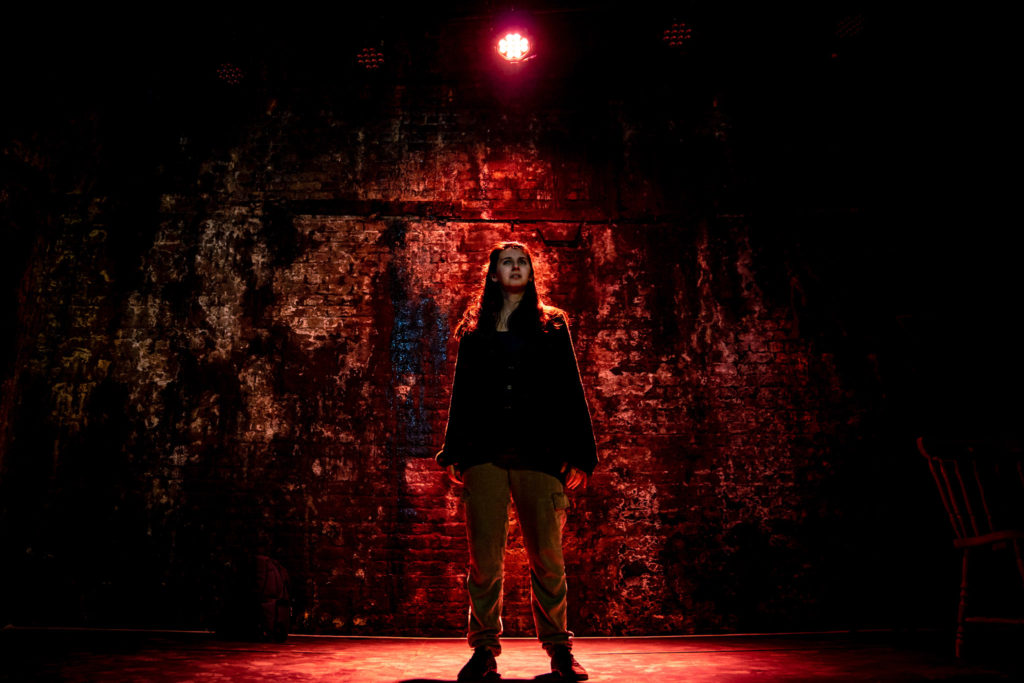
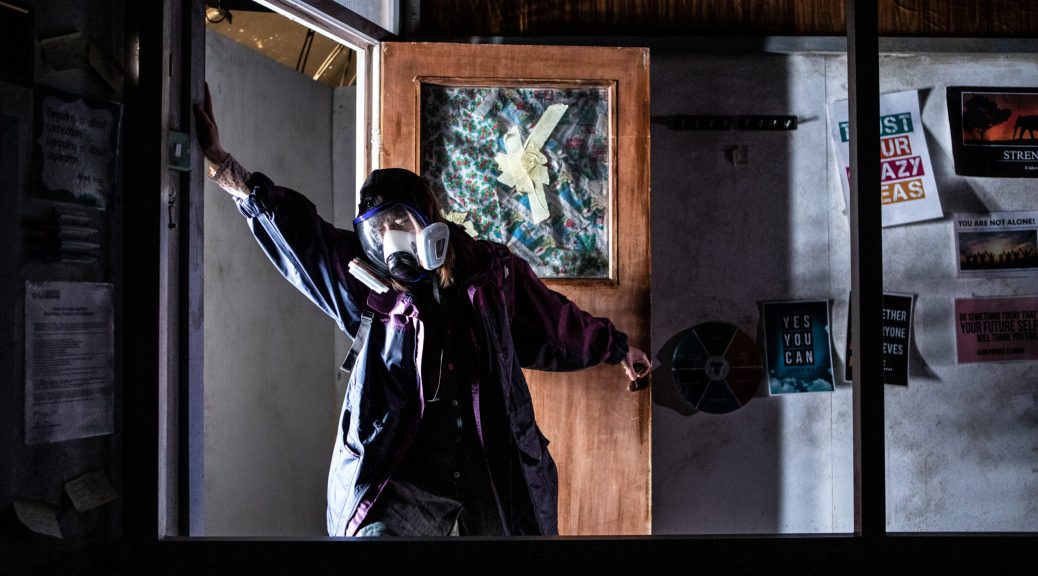
Set in a helpline call centre in catastrophic times, you don’t need to have worked as a Samaritan to suspect the staff on stage are dubiously qualified. But, while this odd bunch might be amusingly ill-suited to deliver the care they offer, the hugely talented Steiner is an excellent listener. His ear for dialogue results in fantastic conversations, many one-sided, that are both comedic and emotional – a combination that makes the piece both delightful and intriguing.

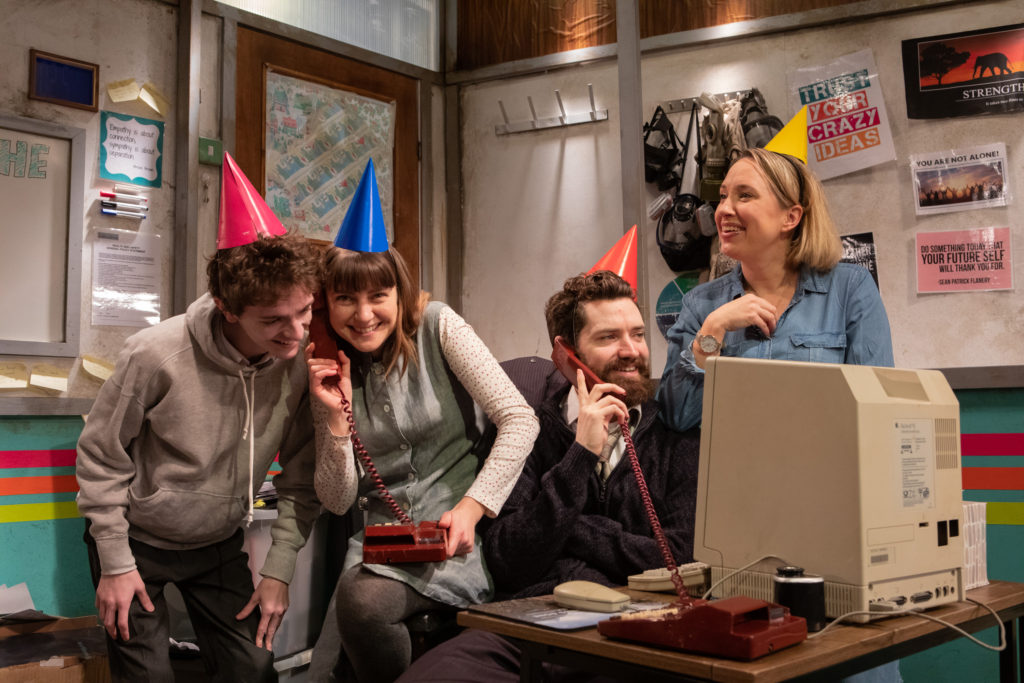
Andrew Finnigan Lydia Larson Andy Rush and Jenni Maitland in You Stupid Darkness Credit Ali Wright
Andrew Finnigan, Lydia Larson, Andy Rush and Jenni Maitland

The recognisable characters, with well-developed personalities and problems, play a big part in the piece’s success. The performances do the writing justice. The group is run by Frances, as irrepressibly perky as she is heavily pregnant, beautifully depicted by Jenni Maitland. Chatty Angie first appears to be a comedy foil, but Lydia Larson ensures considerable emotional impact from her. A well-written teenage role that Andrew Finnigan is perfect for, and a depressed older man that Andy Rush makes appealing, complete a quartet who are eminently easy to watch. From traumatic calls to simple pleasures from a story-telling caller named Merlin, moments of tension and relaxation are magically sculpted with fantastic talent.

We could be in a superior sitcom were it not for the dark surround Steiner crafts. Our heroes face big problems – that they always carry gas masks tells you that much! This is not just a charity on its last legs, but a society facing its demise. Yet, in a daring move, we never know the specifics of the apocalypse being faced. Of course, it’s hard not to presume an environmental disaster, but that’s never stated. Maybe it’s an interesting, naturalistic, observation? But sparing details can frustrate viewers – it takes guts. The focus is everyday lives: the way Steiner understates this dystopia keeps the audience on its toes.

You Stupid Darkness! goes well beyond your average dark comedy to become a play about hope. Director James Grieve does an excellent job of giving the script room to develop. Time is needed for hope to show itself – now we see why insisting that the odds faced remain unknown is important. The final scene of keeping calm and carrying on is profoundly moving by embodying those very qualities; the play gets quieter and more controlled as conditions worsen. Motivating the skill this takes, and surely the key to what makes the play so winning, reveals the humble realisation from a playwright who has written a five-star banger of a play – that listening to stories might be just as important as telling them.

Until 22 February 2020

www.southwarkplayhouse.co.uk

Photos by Ali Wright

“Fix” at the Pleasance Theatre

In her psychological thriller, Julie Tsang uses Chinese mythology, ghost stories and fairy tales to intriguing effect. When an unsuspecting repairman is called to an isolated house in the woods, his unusual client and an exploration into his past, combined with some psychedelic touches, are sure to hold your attention.

Tsang’s script benefits from careful direction by Jen Tan, along with fine performances from Mikey Anthony-Howe and Tina Chiang. Both luxuriate in Tsang’s poetic imagery, which makes the presence of a surrounding forest feel palpable. Ali Hunter’s lighting design goes a long way to add atmosphere – it deserves special praise as the piece could easily be one for radio (which is fine for Tsang’s future career but vaguely frustrating in a theatre).

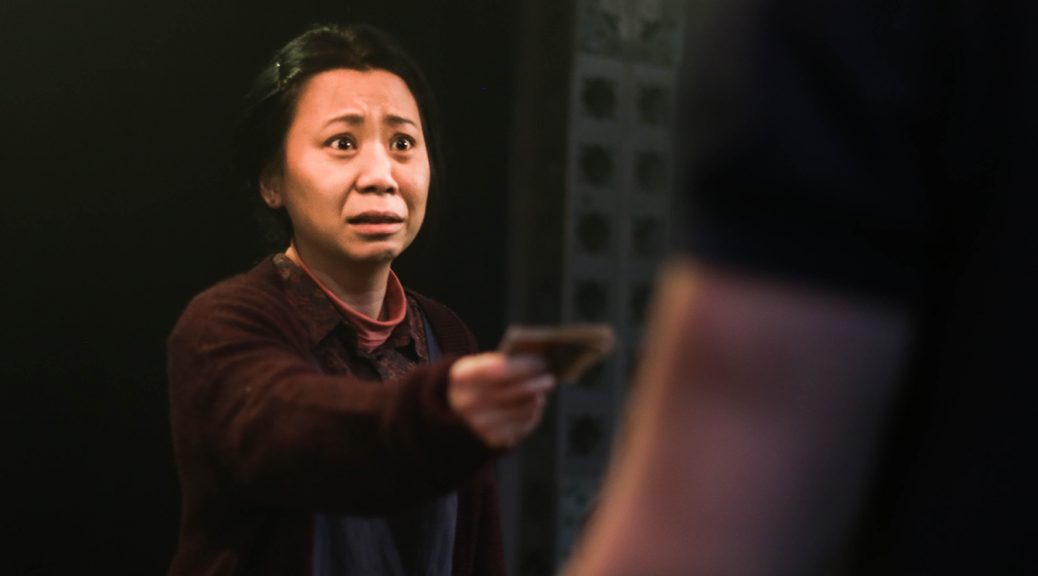
Mikey Anthony-Howe in 'Fix' at the Pleasance Theatre
Mikey Anthony-Howe

Anthony-Howe does a good job of rooting us in the here and now as no-nonsense Kevin, whose past comes to be revealed bit by bit. But it’s Chiang’s portrayal of Li Na that’s the main point of interest. This is strangely ambiguous figure – her intentions, even her age, are deliberately confusing – and Chiang does a great job to convey all this. She moves from a frightened creature to one in control, even command. Capable of being physically threatening and then caring for Kevin, Li Na is mercurial enough that, with some creepy touches and plenty of imagination, the play’s rougher edges are smoothed over nicely.

Although the denouement may be too briefly handled, and the loose ends perhaps too plentiful, this high-quality storytelling is both entertaining and absorbing.

Until 1 February 2020

www.pleasance.co.uk

Photos by Nicole Latchana

"Beckett Triple Bill" at the Jermyn Street Theatre

It’s easy to see why this programme of short plays by Samuel Beckett is already a sell-out hit. A superb cast and direction from none other than Trevor Nunn make it a very special treat. The chance to see a famous piece – and two that deserve to be better known – makes it perfect for Beckett fans and newbies. Check out the theatre’s gala performance on the 30 January if you’re flush, or its 5@5 day tickets if you’re youthful, and here’s hoping for a transfer!

First up, the most famous piece, Krapp’s Last Tape is presented is with taut precision. As its titular hero listens to a recording he made in the past, the idea that we become very different people during the course of our lives is palpable. James Hayes takes the role and gives a performance of remarkable variety – not a nuance of Krapp’s interaction with his past voice is missed. It really is theatrical perfection.

Niall Buggy at the Jermyn Street Theatre credit Robert Workman
Niall Buggy

For me, the big thrill comes next with Eh Joe, which has Niall Buggy listening to another recording, this time an imagined voice from his past. Buggy gives a tremendously focused performance – he doesn’t say a word – but his character disintegrates as his memories haunt him. In a nod to its origin as a piece for television, his face is filmed, adding to a sense of paranoia. The accusing ghost from his past is a voiceover performed by Lisa Dwan. Reminding him of affairs and failings, it becomes truly terrifying. While Joe tries “throttling the dead in his head” he also needs them – when the voices end so will his life – the past defines us and the only escape is death.

Niall Buggy and David Threlfall at the Jermyn Street Theatre credit Robert Workman
Niall Buggy and David Threlfall

It might be a bit of a relief to end the programme on a lighter note. While The Old Tune continues the themes of memory and old age the tone is very different. Buggy makes another appearance, joined by David Threlfall, as two old acquaintances reminisce. Or at least try to… Beckett mixes up stories and dates as the two become confused to surprisingly gentle comic effect. A melancholy is still prevalent, and both performers effectively maintain this.

It’s not in curating the selection that makes this a great offering from Nunn; there’s no overstating connections between the plays and the direction shows a discipline and precision that makes the most of the brevity of each. Working with some long-standing contributors and clearly revelling in the intimacy of the venue, the approach to all three matches Beckett’s own confidence and vision for them.

Until 8 February 2020

www.jermynstreetheatre.co.uk

Photos by Robert Workman

"Antigone" at the New Diorama Theatre

My theatre year is off to a great start with a new company – Holy What – and a challenging version of Sophocles’ tragedy from Lulu Raczka. Interrogating the Greek classic, while using it as a source of inspiration, results in a piece full of ideas and surprises.

The obvious difference is that we see only Antigone – the one who defies the law to bury her brother and is executed as a result – with her sister. In this two-hander, the performers mimic other characters and, in some sense, act as their own chorus. But for me the bigger twist is that both are presented as youthful enough to still be playing games of make-believe. While turning them into wannabe clubbers and throwing in a Beyoncé track might be slightly predictable, making them so vulnerable is emotionally effective and raises plenty of questions about autonomy and responsibility.

Annabel Baldwin takes the title role with a tomboyish streak that makes you wonder about her motivations: how self-conscious is her rebellion? Might it even come close to a tantrum? Yet ‘Tig’ is an appealing figure through Baldwin’s energy, full of passion as well as pondering moral questions. Director Ali Pidsley takes the cue of focusing on the fantasies the sisters act out – imaginary trips to bars and pretend love affairs. These colour the distinctions between words and action that run through the text, as well as the heart-breaking questions of whether or not Antigone should act, and then what she should do next.

Pidsley keeps focus throughout: with Lizzy Leech’s circular stage, part play pit, part burial ground, and lighting from Tim Kelly making the action and ideas consistently guided. And there’s more. Raczka looks just as much at Antigone’s sister – prizes for the remembering the name – Ismene. Creating a brilliant role, in which Rachel Hosker excels, Antigone becomes just as much Ismene’s play, providing a new perspective. And it’s a view Raczka ensures we relate to. A long coda to the piece about Ismene’s future life shows how Sophocles has been used as a springboard to great effect.

Until 1 February 2020

www.newdiorama.com

Photo by Ali Wright

“A Taste of Honey” at the Trafalgar Studios

More than 60 years after the play’s premiere, and three years since he first directed it at the National Theatre, Bijan Sheibani’s new revival continues to show that Shelagh Delaney’s superb play is as fresh as you could wish.

Sheibani adds a sophisticated flourish to the production with an on-stage three-piece band and music from Benjamin Kwasi Burrell. Popular songs provide introductions to characters and ease the play’s episodic structure. Although sometimes elegiac, the music adds an energy to the show that, despite my admiration for the text, is admittedly needed.

Gemma Dobson and Jodie Prenger in 'A Taste of Honey'
Gemma Dobson and Jodie Prenger

As well as putting some soul into Salford, Sheibani’s close knowledge of the piece has led to sharp performances that do justice to Delaney’s wonderful characters. Jodie Prenger is great as the wicked mother Helen: razer sharp and brutally honest, she’s funny and smart even if you wouldn’t want her as a family member. Gemma Dobson plays her daughter Jo with bold intelligence. Refusing to make the character too sympathetic, she’s a brittle teenager who is frequently unappealing. The bickering matches between the two women are a highlight but the humour is controlled; A Taste of Honey isn’t a comedy no matter how funny both women are. Moments of hope, fear and pain are all regularly glimpsed and then hidden with frightening speed.

Durone Stokes and Gemma Dobson in "A Taste of Honey" credit Marc Brenner
Durone Stokes and Gemma Dobson

Performances from the men in both women’s lives are just as good. Durone Stokes makes a dashing love interest for Jo, while Tom Varey plays Helen’s new husband just the right side of villain. Stuart Thompson may have the trickiest role as Geof – Delaney’s precocity gets the better of her characterisation here, it’s amazing to think she wrote the play at 19 – but his performance is still one to be proud of.

That the play is concerned with Northern working-class lives still feels unusual. Treating its central female characters as intelligent and complicated remains depressingly rare. While rooted in its time and place, Sheibani’s production shows a play that’s still for today; a piece he makes it easy to relate to, while never compromising on Delaney’s distinctive voice.

Until 29 February 2020

nationaltheatre.org.uk

Photos by Marc Brenner

"Curtains" at Wyndham’s Theatre

Although this musical comedy by Kander and Ebb – creators of Cabaret and Chicago – is never going to be regarded as their best work it’s still a credible piece, being clever, funny and always entertaining. It’s a spoof of musical theatre itself and of the detective genre, which means there’s a lot going on. Unfortunately, at the unhappy performance I attended, it feels that the content is simply too much for this company to tackle.

Jason Manford and Leah Barbara West

At an out-of-town run for a turkey of show called Robbin Hood, the drunken star is killed while taking an underserved bow. And since that death might be the best thing for those onstage and off, the suspects are plentiful. In a nice twist, our detective, Frank Cioffi, is a theatre lover who sets about saving the show as well as solving the crime. Jason Manford takes the sleuthing role and acquits himself well. It’s a shame that there’s too little chemistry with his love interest Niki (played by Leah Barbara West). These are well-written roles that feel neglected by director Paul Foster, who plumps instead for the eye-catching director and producer characters who provide comedy highlights via the performances of Samuel Holmes and Rebecca Lock.

Samuel Holmes in 'Curtain' at Wyndhams Theatre
Samuel Holmes

Kander and Ebb don’t make things easy for themselves (or anyone) as Robbin Hood is reworked, and improved before our eyes. It’s an interesting idea for lovers of the genre but needs more pace and more signposting than Foster provides. As Noises Off just down the road shows, when you pretend to be bad you really have to be very good. A delay at the start of my showing created suspicions of problems, then a real scenery malfunction created very much the wrong atmosphere.

Curtains The Musical credit The Other Richard
Alan Burkitt

Of course, this is just one performance in a long run, and such things happen. But there are other disappointments. Having only seen the show in a fringe production before, I should have found a large-scale version more exciting. Foster doesn’t infuse enough ambition into the piece and the stage seems sparsely populated. Alistair David’s choreography does not help; the dance seems laboured – no matter how well delivered by Alan Burkitt and Emma Caffrey, who do well with their roles as Bobby Pepper and Bambi Bernet – an awful lot of effort for little result. Worse still, Curtains should be a lot funnier: Rupert Holmes’ book builds expertly and the lyrics are smart. For some reason, the composers of the show within the show seem instructed not to even try for a laugh, which means that performances from Andy Coxon and Carley Stenson may sound great but end up – like the production as a whole – flat and disappointing.

Until 11 January 2020

curtainsmusical.com

Photos by Richard Davenport

"Teenage Dick" at the Donmar Warehouse

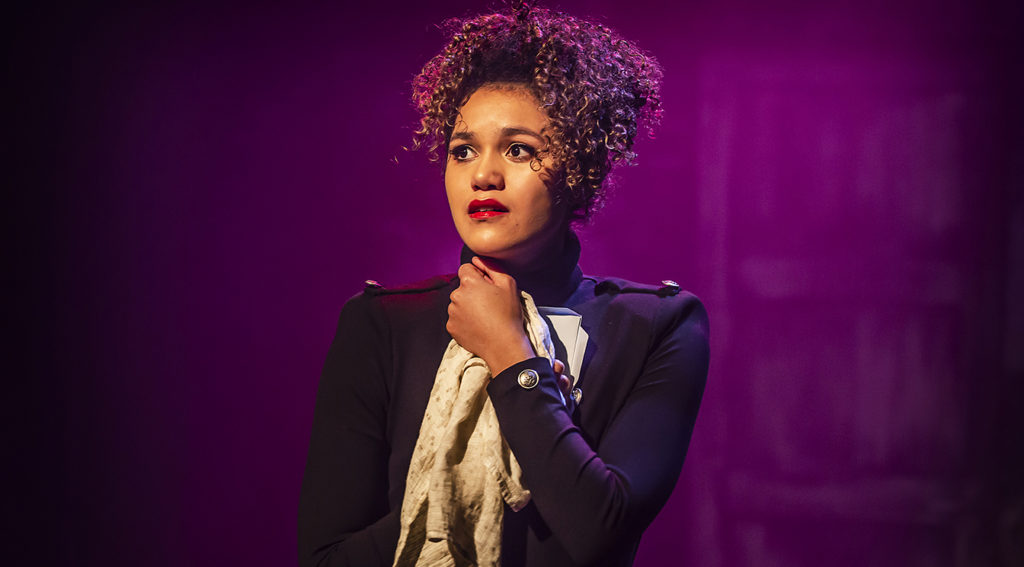
Joining a slew of strong American plays to reach London this year, the work of Mike Lew receives a British premiere under the energetic direction of Michael Longhurst. Along with its provoking title, this reimagining of Shakespeare’s Richard III as a high-school drama ends up somewhat burdened by its concept. But it is more than just a smart exercise: insisting a disabled actor plays theatre’s most famous disabled character provides a superb vehicle for Daniel Monks, who takes the title role, and brings issues surrounding disability powerfully to the fore.

So, at Rosewood High the war that student Richard Gloucester starts is one for class presidency. He’s unwittingly aided by his friend ‘Buck’ and his teacher Mrs York (great performances from Ruth Madeley and Susan Wokoma) while his rivals are football star Eddie and over-achiever Clarissa (less satisfactory roles that Callum Adams and Alice Hewkin still do well with).

Daniel Monks, Ruth Madeley, Callum Adams and Alice Hewkin in 'Teenage Dick' at the Donmar Warehouse
Daniel Monks, Ruth Madeley, Callum Adams and Alice Hewkin

Such moves are not unfamiliar (Lucy Monroe will tell you about them in the programme) and Lew manages well enough. There are some amusing references to the play, and the meta-textuality (which even the worst of this genre shows) is plentiful. Openly acknowledging Richard’s arcane language (in itself interesting and impeccably delivered) – and how it contrasts with the other characters’ speech – is fun. Trouble is, this game can get tiring quickly.

Siena Kelly and Daniel Monks in 'Teenage Dick' at the Donmar Warehouse
Siena Kelly and Daniel Monks

Thankfully, Lew knows he has to be more than just playful. Both Richard and his love interest, Anne Margaret – who it’s acknowledged deserves a play of her own – provide emotional weight as the play grows. Focusing on Anne Margaret (played brilliantly by Siena Kelly) shows Lew’s strong writing – including a particularly harrowing scene that needs a warning – and the role goes some way to grounding the play.

That Monks is hemiplegic undoubtedly makes a difference to the story we know and leads to powerful scenes of Richard dancing and debating. Disability is stated as the reason for the character’s unpopularity – a stark suggestion – and from this comes his platform to change the “order of things” in school society. Unfortunately, whether his pledge is for the better or just for power gets a little lost.

Throughout, Lew plays with our expectations of Richard the character and of people with a disability. The layering effect seems less interesting than the mix of pity, hate and fear that the contemporary teen experiences. That’s the bit we’ve not seen before, while the Shakespeare seems a distraction. Lew’s exploration is seldom subtle – but it’s frequently effective. The challenge, that the audience assumes Richard can’t be the hero – and so must be the villain – raises problems too frequently ignored.

Until 1 February 2020

www.donmarwarehouse.com

Photos by Marc Brenner

"The Boy Friend" at the Menier Chocolate Factory

Sandy Wilson’s light-as-a-feather-boa musical was a legendary hit in the 1950s. Superb work from Matthew White, assisted with direction by his choreographer Bill Deamer, show us why.

It’s hard to imagine a show more fantastically escapist. Inspired by work from the 1920s, please remember The Boy Friend was nostalgic nonsense from its inception. The romantic adventures of rich kids and their elders on the French Riviera are deliberately low stakes. White appreciates the piece needs to appear effortless and banishes worries from the stage.

Tiffany Graves in 'The Boyfriend' at the Menier Chocolate Factory
Tiffany Graves as Hortense

The characters are flat-as-cardboard cut-outs and a marvellous cast understand the humour this can generate. There’s a wonderful sweetness to our leading lovers, Polly and Tony, given a fresh feel by Amara Okereke and Dylan Mason, who both sound fantastic. A star-turn from Janie Dee, as a head teacher with a past, is just as delightful. Dee allows you to laugh at the character while believing she’s sophisticated (and that’s hard). Meanwhile her maid, Hortense, is a brilliant vehicle for Tiffany Graves, who embodies the comedic tone. Within a minute of coming on stage she’s given us an accent Vicki Michelle would be proud of and crossed her legs like Cupid Stunt. It’s clear, very quickly, you need to relax and enjoy yourself.

Jack Butterworth and Gabrielle Lewis-Dodson in 'The Boyfriend' at the Menier Chocolate Factory
Jack Butterworth and Gabrielle Lewis-Dodson

Talking of legs, there’s plenty of them in The Boy Friend. Deamer’s work as choreographer foregrounds the piece’s potential as a dance show and the limbs of the cast deliver. There’s the Charleston, tap, tango and the show’s very own ‘Riviera’. Winning the high-kicking competition is Gabrielle Lewis-Dodson as “mad-cap Maisie” whose dances with her beau Bobby (Jack Butterworth) are a dream. On a relatively small stage, there are moments when the show feels cramped – transfer anyone? – but the dancing consistently impresses with its wit and sense of ease, just the qualities needed here.

Wilson’s cynicism is of the gentlest kind – which White is strict in preserving – and the result is frothy from first to last. But don’t be fooled; this easy fun has work behind it. The score is a perfect combination of comedy numbers, catchy tunes and sentimental ballads. The lyrics are consistently smart and very funny. This is a show constructed to make you clap – nearly every number has a reprise – it is literally built to please.

Rejoicing in pink lighting from designer Paul Anderson for that vie en rose touch and gorgeous costumes from Paul Farnsworth that got a round of applause the night I attended (I can’t remember the last time that happened in the theatre), White and his team create a bubble of happiness. It’s all smiles, romance and charm, with every performer seeming to enjoy themselves. Why not, when there’s so much love in the air? The Boy Friend is a show to simply adore.

Until 7 March 2020

www.menierchocolatefactory.com

Photos by Manuel Harlan

"Snowflake" at the Kiln Theatre

Even if you think Christmas plays aren’t for you, Mike Bartlett might change your mind. Here’s a show that, thankfully, doesn’t expect us to switch off our brains during December. And in this look at contemporary family life there’s not a trace of the nostalgia that consumes the festive season. At the same time, Snowflake ends a long way from doom and division: Bartlett gives us a heart-warming and clear lesson that’s feelgood enough to teach any Scrooge.

Starting with a 40-minute monologue from Elliot Levey, as Andy waiting to see his daughter for the first time in three years, the first pleasure here is a brilliant performance. And maybe a cheeky streak? How much is Bartlett playing with the fact that this middle-aged, middle-class man – given such a massive role – is just the person we hear too much from in the theatre?

Depending on your age, you might find Andy patronising to the point of being insufferable…or maybe just lame. At first the generation gap is gently prodded; the humour is pretty standard. But there’s real pain behind the Dad jokes. Andy doesn’t know why he is estranged from his daughter Maya. He is still grieving for his wife. And he feels his age, comparing himself to an Anglo-Saxon dummy on display at his local museum. Bartlett’s skill is to give us a midlife crisis that’s interesting (for once) and Levey does a brilliant job with it.

It’s pretty obvious that a confrontation with Andy’s daughter will occur. But Bartlett handles this well, too, and I wouldn’t want to spoil the surprise. Suffice to say that, with the aid of Clare Lizzimore’s sure-handed direction, not one but two younger voices get to be heard. Amber James’ character, Natalie, provides a welcome, energising hit, bringing fine challenges to Andy’s views and more humour to the piece. Ellen Robertson takes the part of Maya. Of course, in reference to that distasteful description of the millennial generation, she is the snowflake of the title – but Robertson makes Maya a formidable character and effectively ups the emotional stakes.

Again and again, Bartlett predicts the different responses his audience might have, twisting arguments and emotions to answer prejudices and predispositions. The result is a play with an agility that’s in keeping with the message that we all need to take more time to listen to one another better. And that maybe now is the time of year to do so. If that sounds pat, then clearly you really don’t like Christmas, let alone Christmas plays. Admittedly, there’s a sentimental streak to the show. But, since it’s partly Bartlett’s point that the season of good will should be extended to all – even those who voted for Brexit – it’s only fair to make allowances for a writer with Yuletide in mind.

Until 25 January 2020

www.kilntheatre.com

Photo by Manuel Harlan

“A Kind of People” at the Royal Court

Set around a group of former school friends, this stimulating new play has a tender romance at its core. Intelligently written by Gurpreet Kaur Bhatti and confidently directed by Michael Buffong, the piece is a slice-of-life polemic of considerable dramatic power.

A long-devoted couple, Gary and Nicky, are working-class heroes the like of which are still too seldom seen on stage. Their struggles highlight issues around race and class in contemporary urban Britain. The toll taken by prejudice has a profound personal impact on the lovers and the questions raised are important.

Amy Morgan in "A Kind of People" at the Royal Court
Amy Morgan

You might argue that Gary’s objectionable white boss, Victoria, whom Bhatti uses as her starting point for looking at racism, is too much of a straw figure. Not because people don’t hold such views – or that Amy Morgan is at all lacking in the role – it’s just that most people hide their prejudice better. But, following scenes that ignite the audience against Victoria, there’s the suggestion that, when accused of racism, the character uses her sex as a defence: a bold move by Bhatti that makes the atmosphere in the theatre electric. 

Manjinder Virk in "A Kind of People" at the Royal Court
Manjinder Virk

It’s clear how smart – and provocative – this writing is. A second incident of prejudice comes from a Muslim mouth. Focusing on class, taking in the metropolitan obsession about schools, it is Anjum, a likeable Muslim mother, who uses that loaded phrase “people like you” against her white friend Nicky. The moment is made all the more shocking by the fact that this is a character, with a performance expertly crafted by Manjinder Virk, who has made us laugh and whom we admire.

Petra Letang in "A Kind of People" at the Royal Court
Petra Letang

Although each of the wonderfully observed characters we meet provides a take on race or class, Bhatti’s skill makes sure none of them feels like a device from a playwright. There is considerable nuance in A Kind of People, and it reflects complex lives and problems. There are strong performances too from Thomas Coombes, Asif Kahn and especially Petra Letang, whose character Karen injects a fantastic no-nonsense humour. But the play belongs to its central roles, which are developed superbly. Gary has a troubled emotional journey, becoming a man “drowning in anger”, plotted by Richie Campbell with impressive understatement. Claire-Louise Cordwell’s depiction of Nicky follows a different trajectory – she is a rock that crumbles with frightening suddenness in a performance that does justice to the blunt force contained within this sophisticated play.

Until 18 January 2020

www.royalcourttheatre.com

Photos by Manuel Harlan