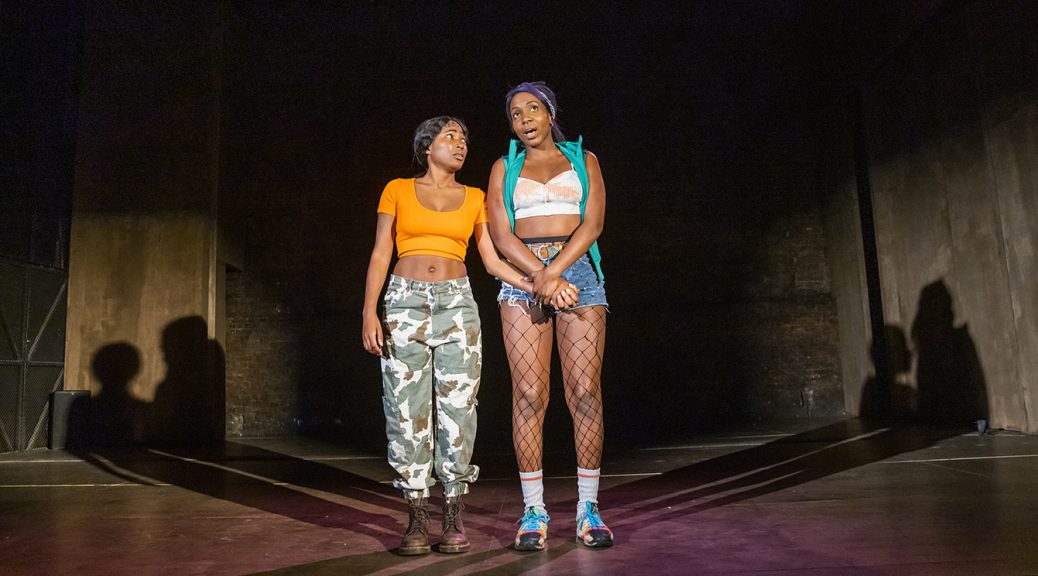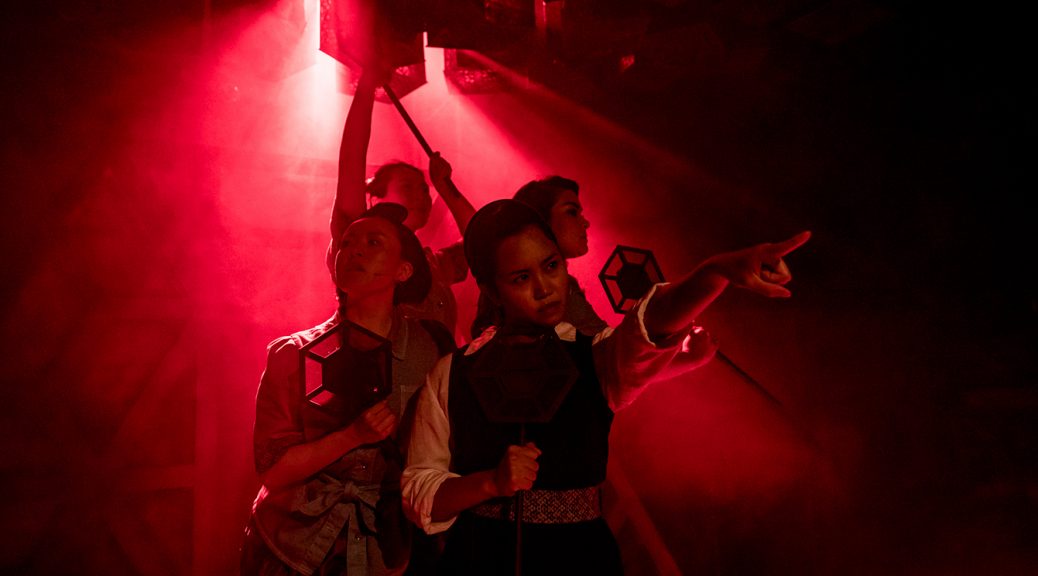
“Tokyo Rose” at the Southwark Playhouse

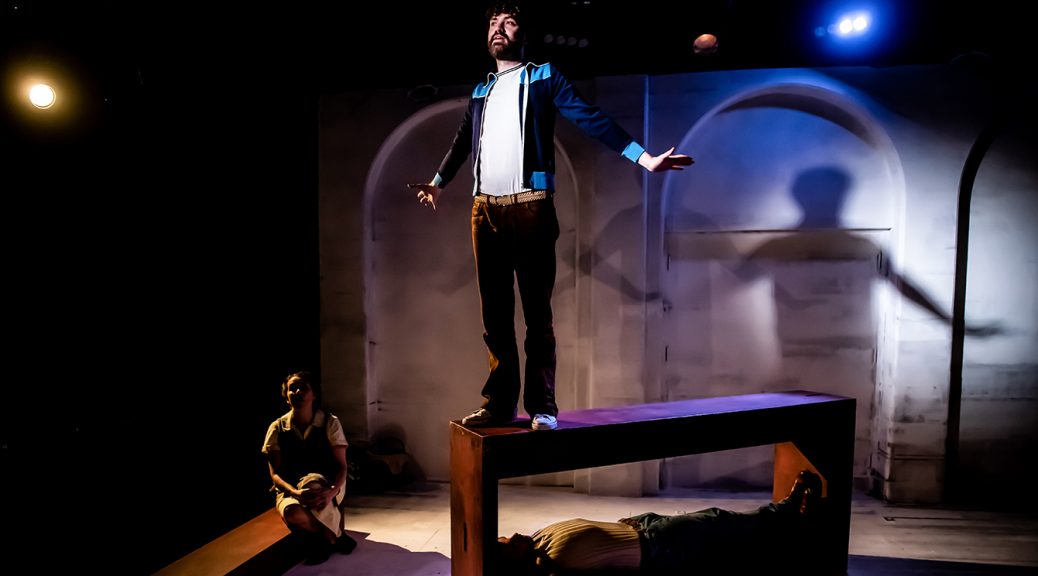
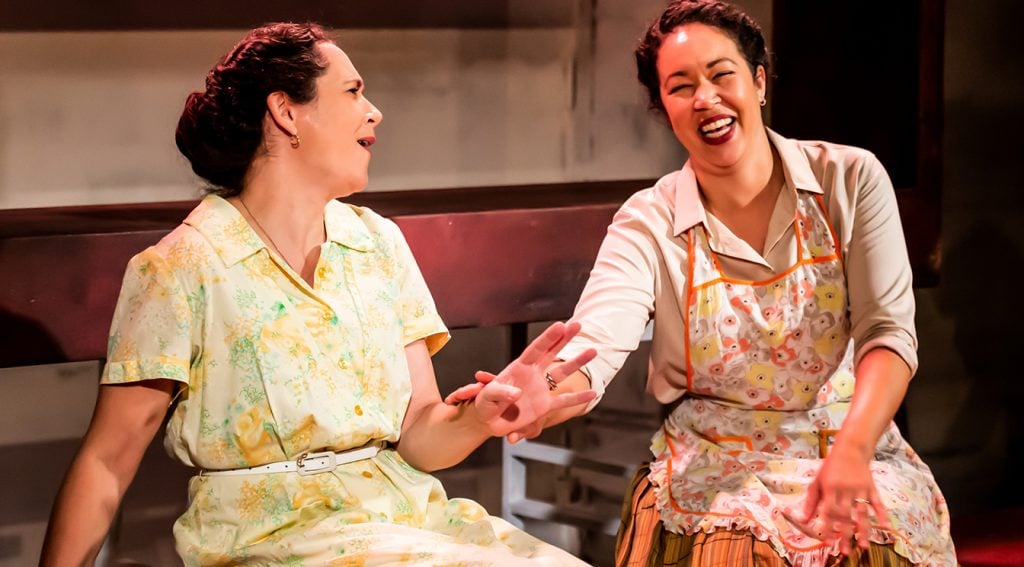
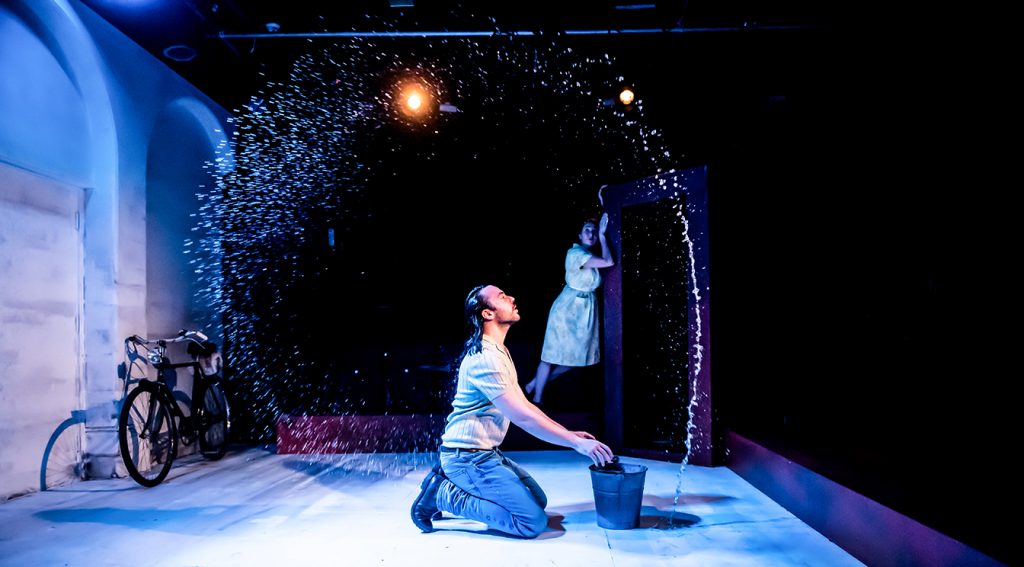
Maryhee Yoon and Cara Baldwin have a strong true story for their new musical. Framed around the trial of Iva Toguri, accused of treason for broadcasting Japanese propaganda during World War II, Tokyo Rose has plenty of potential. Regrettably, the telling of the tale has too many problems.

Maya Britto makes an appealing lead in the title role. Yoon and Baldwin do well with the character and the dilemma of an American stranded in Japan, trying to hold on to her identity. A mixture of naivety and conviction makes Toguri endearing and Britto has a strong voice.

There’s the fascinating idea that, with her prisoner of war colleague Major Cousens, the radio show Toguri presents will subvert propaganda. Humour will be used to fight a war from inside Japan. But the radio show we hear too little of just isn’t funny.
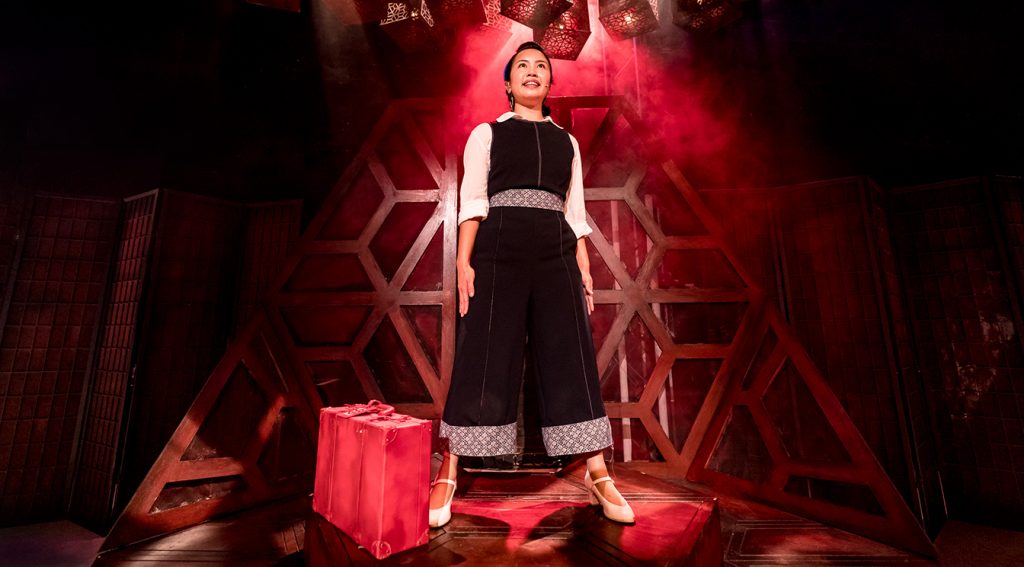
Maya Britto in Tokyo Rose
Maya Britto

The idea gets lost in a dense biography. The central scenes of the trial are good. But the show’s book (with additional work from William Patrick Harrison, Hannah Benson and Jonathan Man) makes the plot cumbersome. As director, Benson’s efforts to make the show speedy add a nervous energy.

There are more serious issues. Harrison’s music has dramatic moments and drives action well enough. The score is admirably diverse. But too many sentimental songs are a drag. And the music is consistently upstaged by poor lyrics – clumsy and frequently clichéd.

A hard-working cast does its best, although its work as a chorus needs tightening. Performers impress by taking on lots of roles. Lucy Park is a highlight in several male parts: she gets to inject some humour and has a strong scene after America drops the atom bomb. Credit to all for tackling Benson and Amelia Kinu Muus’ ambitious choreography, even if success is mixed.

As a final disappointment, Toguri’s long struggle for justice results in Tokyo Rose wilting. There’s a fiery spirit to the show with the suggestion that America, rather than the unfairly-treated Toguri, should be on trial. But this is abandoned for a bland end. Letters get delivered in a rush and Britto struggles to portray her character ageing. There’s little sense of triumph or achievement for our heroine – or the show.

Until 16 October 2021

www.southwarkplayhouse.co.uk

Photos by Steve Gregson
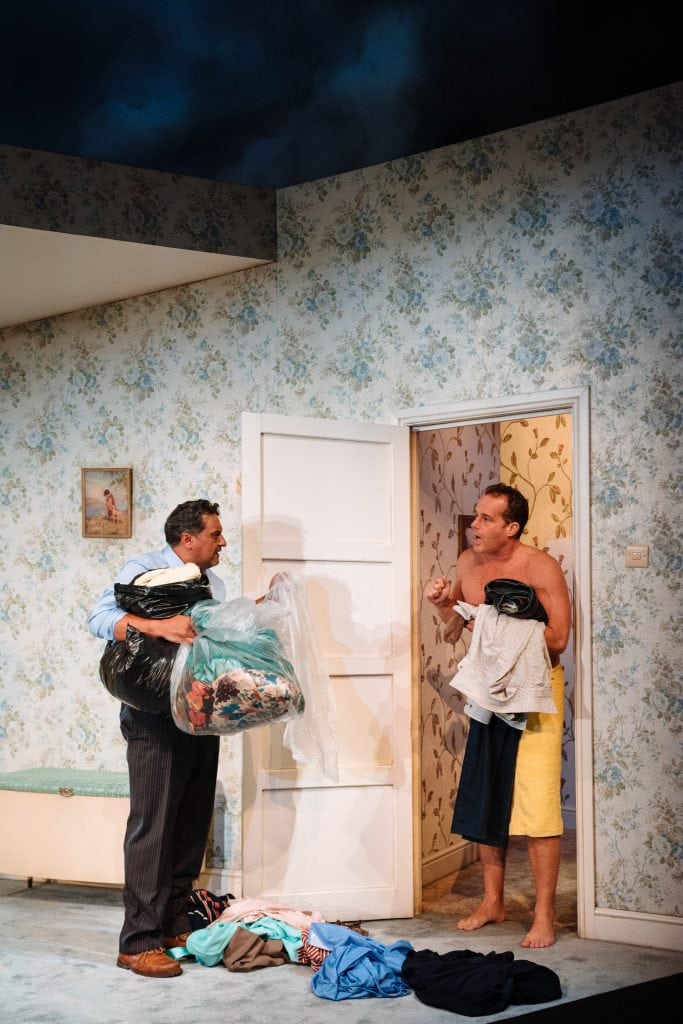
“Relatively Speaking” at the Jermyn Street Theatre

Director Robin Herford’s revival of Alan Ayckbourn’s classic is a well-crafted and high-quality affair. Much like the play itself.

Young Greg and Ginny, who we meet first, become rapidly engaged despite his suspicions and her worries. Taking the roles, Christopher Bonwell and Lianne Harvey convince and intrigue as young things in love… if warily so. Random gifts and phone calls cause confusion.

An older married couple, Philip and Sheila, come next. The relationship is equally well observed, with long-standing power struggles exquisitely performed by Rachel Fielding and James Simmons. Philip’s affair with Ginny is the cause of her anxiety and a dilemma: she wants it over with and he doesn’t.

When the couples meet, confusion ensues and the comedy really gets going.

A slow start, then (and a pace Herford doesn’t rush), but one that builds to a farce that is original and quietly subversive. As an early Ayckbourn, from 1967, some social mores need to be recalled: confusion about Ginny’s illegitimacy isn’t going to get many laughs nowadays. But it’s still clear how bracing the satire is intended to be. And it should be noted that the two roles for women are excellent, their empathy for one another moving. Our sympathies firmly lie with the naive Greg and the long-suffering Sheila – a fact Cromwell and Fielding exploit well.

Ginny is complex and Philip a clear villain. With both roles, you might suggest Ayckbourn wants to question how funny a comedy about adultery should be? The dramatic irony, ridiculous coincidences and assumptions mount up. But these laughs have a queasy edge. After all, there are incestuous implications and an attempt at blackmail. There’s more to Relatively Speaking than meets the eye (or the genre), which makes the play fascinating as well as funny.

www.jermynstreettheatre.co.uk

Until 9 October 2021

“Blithe Spirit” at the Harold Pinter Theatre

Richard Eyre’s revival of Noël Coward’s supernatural comedy has bells and whistles as well mentioning smells. Funny, polished and proficient, it is enjoyable”. But despite the star casting of Jennifer Saunders, the production doesn’t quite manage to sparkle.

There is plenty to impress. Anthony Ward’s grand set and illusions by Paul Kieve emphasise the spooky as Charles and Ruth are haunted by his dead wife Elvira. There are bangs, flashes and smoke. And some strange music.

As for the smells, Jennifer Saunders gives us a flatulent Madame Arcati! As the spiritualist whose séance coincides with the return of Elvira, this key role gets the over-the-top performance it deserves. And some big eyebrows. You don’t need to be a psychic to predict Saunders will do well: she proves value for money with an impressive physicality that energises the character.

While other performances are accomplished, they are less inspiring. Geoffrey Streatfeild is surprisingly flat as novelist Charles Condomine. It’s easy to see his character as a stand in for Coward himself, but there’s little sense of complexity to the part. It comes as a surprise when either wife gets vicious – he just seems amiable and there should be more.

Both wives are more interesting than Charles. There’s no shortage of stage presence. But Eyre’s direction curbs the performances: Madeleine Mantock spends nearly all her time as Elvira on tiptoes while Lisa Dillon’s Ruth makes silly noises to get laughs. Delivery of the lines is very fast. And while this is impressive technically, it means Coward’s wit is poorly served. There are jokes that are just abandoned for the sake of speed.

Rose Wardlaw in Blithe Spirit
Rose Wardlaw

Thankfully, the production isn’t just the Jennifer Saunders show. However loved, focusing on one performer doesn’t make for good theatre. Rose Wardlaw’s turn as the Condomine’s maid, Edith, is a real crowd-pleaser. Again, the comedy is physical and there’s a great spooky moment for her. Saunders and Wardlaw make the show fun if not quite as fantastic as it should be.

Until 6 November 2021

www.atgtickets.com

Photos by Nobby Clark

“Leopoldstadt” at Wyndham’s Theatre

Start your play with a Jewish family in turn of the century Vienna and an audience is sure to have expectations. Tom Stoppard knows this, of course, there’s little Tom Stoppard doesn’t know. But the craft behind his new history play is a marvel. And the emotional power of Leopoldstadt every bit as strong as you’d imagine.

Starting in 1899, things are convivial and a little confusing. We’re introduced to Hermann Merz and an extended family that – like the cast – is huge. As we see them grow up, and the family grow, it’s tough to keep track. Thankfully, Aidan Mcardle and Faye Castelow take the lead as Mr and Mrs Merz, with marital troubles and his conversion to Christianity, to focus on.

Faye Castelow in LEOPOLDSTADT photo credit Marc Brenner
Faye Castelow

The discussions are fascinating and highbrow – after all, this is Vienna and they are Jewish! Identity, mostly, but all manner of politics and culture. There’s a sense of excitement and pride about the city that roots the play. Stoppard sets out issues clearly – it’s a great lesson in intellectual history – but also makes debates feel alive as the characters live them.

Admiration for the cast grows as their characters age. Mcardle and Castelow triumph as Stoppard takes us to the end of their characters’ lives. Jenna Augen’s Rosa, an American relation, is also a highlight with a performance that goes from strength to strength. And it is a thrill to see relatively small roles so fully developed. Sam Hoare is just one example as a British journalist who marries into the family. Director Patrick Marber has neglected nothing, like Brigitte Reiffenstuel’s exquisite costumes, the attention to detail is winning. A sense of grandeur and respect appropriate to the subject infuses the show.

If there are slower moments, the dramatic point behind the depth and detail brought to Leopoldstadt becomes clear as history progresses. A family encounter with Nazi’s is difficult to watch. Seeing the characters, we have so deftly been made to respect and admire, cowered and humiliated is painful. What happens feels unbelievable. Shocking. And that’s quite an achievement when we all know the awful history.

Arty Froushan, Jenna Augen and Sebastian Armesto

Stoppard gives us the space to think about history. A scene set in 1955 focuses on the encounter between a younger generation: Leo, who escaped to Britain, and Nathon, who has survived a concentration camp. If Sebastian Armesto and Arty Frouhsan play the roles broadly, they match the peculiar underlying tension to the scene which compliments the extremes of their experience. As Leo learns the fates of his family from Augen (who makes Rosa’s suffering palpable) we are made aware of how close we’ve become to them all leading to a conclusion of intense theatrical power.

Until 30 October 2021

www.leooldstadtplay.com

Photos by Marc Brenner

“Small Change” at the Omnibus Theatre

Peter Gill’s exceptional play isn’t easy. But, with the aid of this excellent revival from Both Barrels Theatre, it is an experience worth every effort. 

Even at its simplest Small Change is a play about memory as much as about the particular memories of a young man called Gerard. His life story shows us working-class Cardiff from the 1950s and 1970s that is interesting enough. But it is the telling of the tale that makes mind-blowing theatre.

Gill’s dense, poetic writing is beautiful, if demanding. This is a long play, but at times I wanted it to pause to appreciate the language more. As Gerard, Andy Rush’s delivery of the script – verse, really – is a marvel. The linguistic acrobatics are matched by a fantastic physicality to the whole production.

Gill’s subject is memory in general

As well as Gerard, we have his mother, his neighbour, her son Vincent, and their memories, too. Gill’s detail is so great – and the performances so good –that you might argue that the play is about any one of them.

Small-Change-at-the-Omnibus-Theatre
Sioned Jones and Tameka Mortimer

Certainly, Gerard’s relationship with his mother is extraordinary and leads to a magnificent performance from Sioned Jones. For all her frustrations about her “swine of a kid”, their closeness shines through. From supportive to claustrophobic, the changing dynamics are riveting. 

The next-door neighbour’s mental health problems are explored by Gill with sensitivity and depth: qualities reflected in the performance from Tameka Mortimer. Small Change‘s angle on the lives of working-class women is authentic and inspiring.

Small-Change-at-the-Omnibus-Theatre
Toby Gordon

Meanwhile Gerard’s best friend Vincent is as fully formed a character you could wish for. Toby Gordon’s wonderful depiction brings out a fascinating intelligence and independence. 

So maybe I’ve got it wrong? Small Change is about so much more that Gerard’s soul-searching reminiscences.  Because the memories recounted are brilliantly interwoven and seen from many angles. The life choices and trauma of each character are revealed from individual perspectives. 

The scraps of memories, conversations, observations (from different times of life) flow with dizzying speed. Wrongs and sufferings are circular as the give and take of personal relationships creates a web that’s powerful, but let’s be frank – hard to follow. Gerard is the vector of the “hard slog” of memory: working out the past and how it impacts the future isn’t easy for him or the audience.

“The hard slog”


Director George Richmond-Scott revels in the play’s complexity and his work is, as a result, bold and brave. It’s easy to imagine how static Small Change could be (it’s one of those plays that you want to read). But Richmond-Scott injects an energy into the production that matches the verse. Rush is eye-catching, but I became obsessed with the way Jones used her cardigan to show her character ageing. Wonderful stuff.

There’s guidance about what is going from Lex Kosanke’s excellent sound design. But it is the sculptural set from Liam Bunster that proves a revelation. The rust-coloured benches and a box look as if Donald Judd’s artwork has found a practical application. The set becomes a beach and a playground as well as a door or a window. Thanks to movement director Rachel Wise, it’s creatively negotiated around, jumped and balanced on, with images vivid enough to match the script. And, with this script, you can’t praise higher than that.

Until 2 October 2021

www.omnibus-clapham.org

Photos by Lidia Crisafulli

“Deciphering” at the New Diorama Theatre

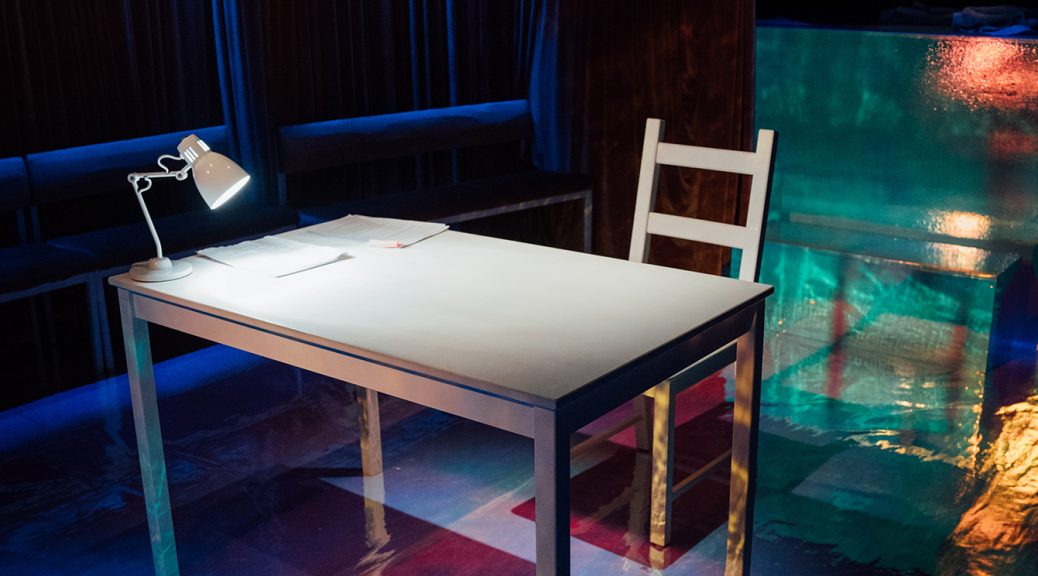
It’s easy to appreciate that theatre company curious directive’s show is the most technically ambitious staged at this super venue. The New Diorama is tiny and what Zoë Hurwitz’s set achieves is remarkable. Regrettably, for all director Jack Lowe’s efforts at making sure the show actually works, the piece itself achieves little.

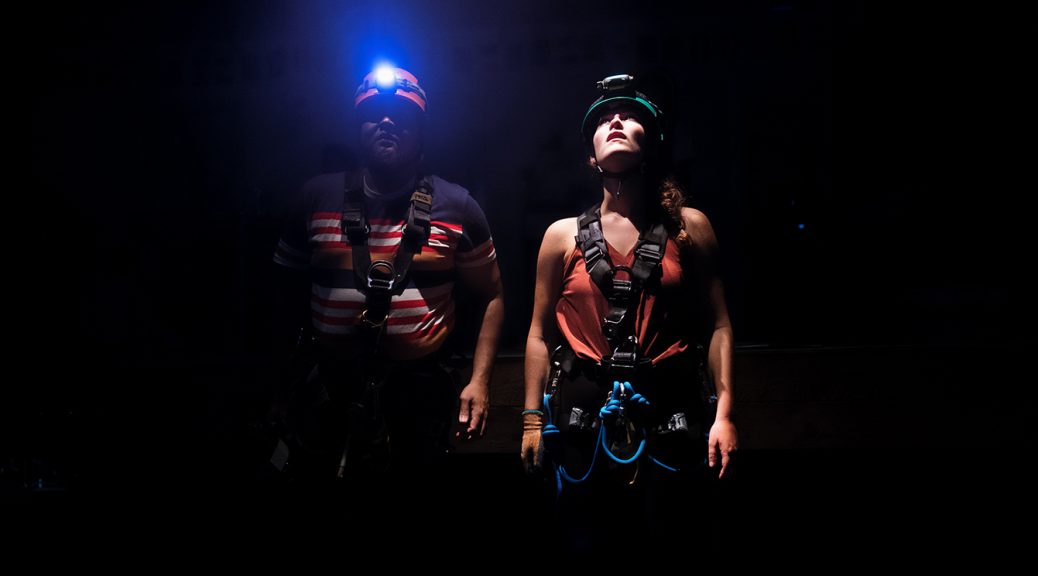
Abseiling actors are just the start. With performers above and below a stage full of surprises, as well as projections and headphones to hear the show through, we are taken backwards and forwards through time. The story follows one woman, Elise, at different stages of life and takes us exploring in an Indonesian cave full of prehistoric symbols.

Lowe manages this time travelling well. A clear performance from Stephanie Street anchors the show and there is a particularly challenging role for a child (well done to Asha Sylvestre at the performance I attended). That the personal relations in Elise’s life are slim is a relatively small problem.

What Deciphering does with its ambition – its scope as well as execution – is disappointing. There’s an exploration of creativity and communication (in a classroom as well as a cave). But the thinking is woolly. On top of this, an investigation into time shows us different paths Elise could have taken in life. The ambition to visualize time on stage is impressive. But we end up with Sarita Gabony (our third Elise) dropping down on a rope and asking us what we want to be when we grow up. Identity seems to be all about your job as Elise suggests that instead of being a paleo-archaeologist, different “versions” of herself could be all manner of equally interesting and prestigious professions. Isn’t she lucky.

A very earnest young teacher, which Lewis Mackinnon can do little with but play, well…earnestly, and an irritable academic (great work from Amanda Hadingue) are the professionals who shape Elise’s life. But both characters are forced too close to cliché as they have to help or hinder Elise. There’s a strong sense of wonder when it comes to the symbols in the cave, which I suspect was the inspiration for the show: with Hurwitz’s help, the scene is a highlight. But Deciphering descends into platitudes. The show desperately wants to be profound. Forcing in personal growth for Elise, we conclude with the weak advice that “if you are brave you cannot fail”. I beg to differ.

Until 2 October 2021

www.newdiorama.com

Photo by Alex Brenner

“Is God Is” at the Royal Court Theatre

Whether young, middle-aged or old, the women in Aleshea Harris’ play are tired. Traumatised, abused, abandoned – or all three – what drives them is anger. Revenge and rage take their toll, but for the 90-minute duration of Is God Is they create an exhilarating piece – it’s the characters and not the audience who are exhausted.

A hit in New York, the play is a good fit for the Royal Court, where we expect to see the engaging of big themes and explorations of dialogue and theatrical form. And we’re used to a dark sense of humour, which this play takes to an extreme. Is God Is succeeds all round and stands out as original.

Harris’ use of dialect and characters’ deliberate inarticulacy is sophisticated. There are influences from hip-hop and Afropunk (excuse my ignorance – I’m trusting the back of the script on that). But the blunt statements and a new level of deadpan understatement make this murderous revenge story very funny.

As for form, the road trip that twins Racine and Anaia embark on engages with movies as much as the theatre. It’s an Americana tour from the “dirty South” to a not-so-wild West that ends with a showdown. The acceptance of a circle of violence is seldom questioned – as in a movie – which is surprisingly unsettling on stage. In her mad mash-up of Cain and Abel with an inverted sacrifice of Isaac, Harris isn’t scared to create a satire of biblical proportions.

Serious subjects? The title is hardly subtle. The twins’ long-missing mother is immediately and inexplicably identified as God. And ‘She’ issues the mission of murdering their father! Harris makes sure we question free will and plays with plenty of excuses for all kinds of inexcusable behaviour. Messages and morals are skilfully slippery, and audience complicity in blood lust manipulated. For all that praise, the larger motives behind Is God Is get lost.

Firstly, some especially vivid characters prove distracting. This isn’t an even-handed issue. With the men in the show the best we get is Mark Monero’s crisp father (who only appears in the penultimate scene). But the women in the play are – in every sense – fantastic. Both Cecilia Noble and Vivienne Acheampong, two very different kinds of mothers, have great roles that they develop marvellously. More of Acheampong’s Angie would be welcome: this bored housewife, who has her own plans, adds to the mix immeasurably. As for the leads – Tamara Lawrance and Adelayo Adedayo – are barely off the stage and don’t so much hold attention as grab and throttle it: “hard end” Racine and the emotional Anaia are a consistent, entertaining and invigorating pair.

Despite the bizarre premise and having its tongue firmly in its cheek (it really is funny) Is God Is triumphs with its plotting. How old fashioned! Ola Ince’s direction, and a set full of fun and signposts from Chloe Lamford, make this bloody journey breakneck. No matter how crazy, the story is driven impeccably. Gory and tense as well as sometimes silly makes for a fascinating and memorable production.

Until 23 October 2021

www.royalcourttheatre.com

Photos by Tristram Kenton

“Catching Comets” at the Pleasance Theatre

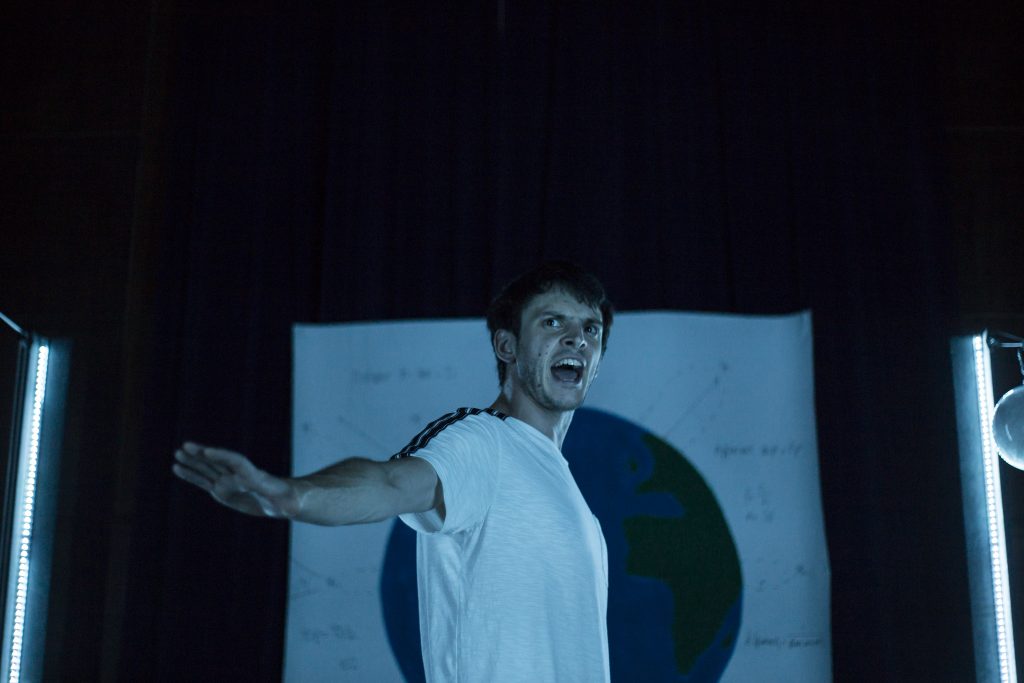
Piers Black’s monologue provides a look at modern masculinity and movies through the character of Toby – an apprehensive astronomer, who, bless him, is far more diffident than he should be. Toby’s love life is combined with a fantasy about saving the world, inspired by action films. As Toby imagines the man he wants to be – as compensation for feeling small, stupid, and scared – a tale unfolds that is slim but sweet.

It’s hard not to see Catching Comets in relation to lots of men that theatre-makers have shown us lately. Toby is a good bloke – surprisingly, annoyingly so: apologetic to a fault and deliberately far from toxic. But, despite the recognition that many models of masculinity are just silly, what to replace them with is a bigger question. There’s a strange preoccupation here that apologising is a failing. And there’s an anger in the character that Black could explore more. Regrettably, the woman Toby loves (his “magical time-melting girl” – nice phrase) is a shadowy figure. As with “the best friend” Emma, Black’s women are too indulgent and a touch saintly.

It’s possible that discussing toxic masculinity brings about the kind of ‘A-Level’ analysis that annoys Toby. After all, Catching Comets is a comedy. The humour is a mixed bag, though. Toby’s insecurities are – regrettably – predictable and repetitive. It’s hard to laugh too hard at a character you feel sorry for. The jokes around the spoof action film in Toby’s head are much better. With clever parallels to the character’s ‘real’ life, appearing at moments of stress, the Bond-style hero is shown as truly ridiculous. The details are great (I loved his coat, described as “newly polished Jaguar fur”).

There’s no doubt Catching Comets is a great showcase for performer Alastair Michael. With help from Black’s direction (as well as Chi-San Howard as movement director) Michael’s physicality is impressive. He does well with the contrast between Toby’s timidity and his action hero alter ego, as well as cameo characters. Best of all, Michael sets up a great rapport with the audience. Oh, and his comedy Dutch accent is brilliant.

Not surprisingly, resolution is a lot to ask from Black. We know how action movies end… and, disappointingly, it isn’t much of a spoiler to mention the conclusion of Catching Comets.

Catching Comets at the Pleasance Theatre

Having criticised Hollywood heroes, Black has backed himself into a corner – and ends up leaving Toby hanging. But denying us a happy ending feels a let-down, especially when there have been plenty of laughs. It’s a testament to Toby winning us over that is seems a shame he can’t sort out what kind of hero he might really be. At least there’s plenty of room for a sequel.

Until 19 September 2021

www.pleasance.co.uk

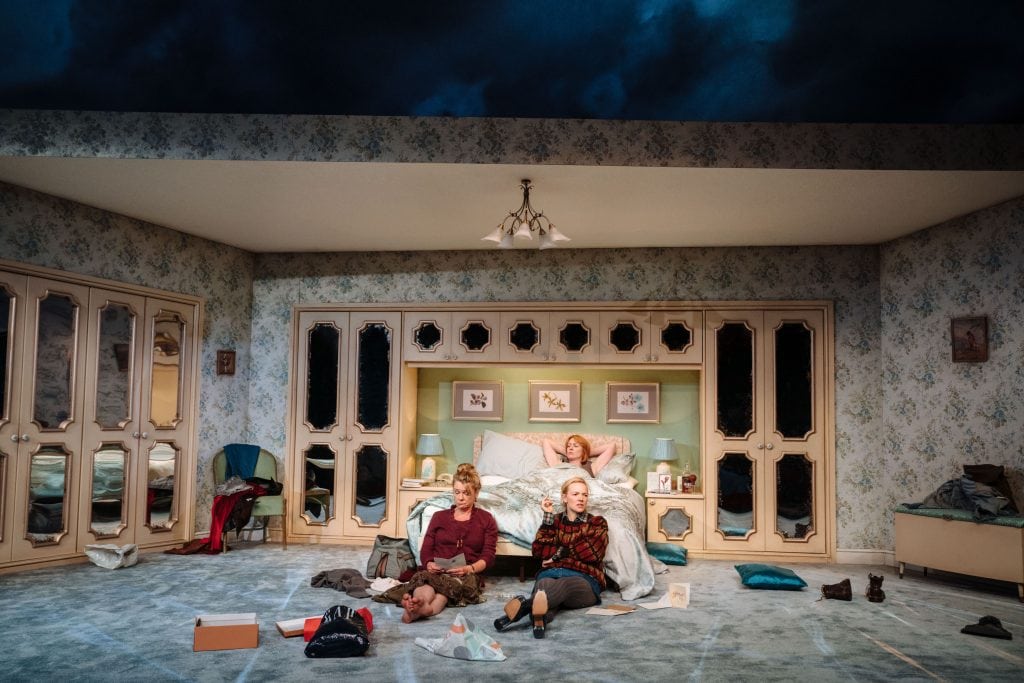
“The Memory of Water” at the Hampstead Theatre

As part of the “Hampstead Originals” season, celebrating significant pieces that started off at the venue, this new production reminds us why Shelagh Stephenson’s 1996 play is popular. A satisfying comedy drama and a gift to performers, The Memory of Water has plenty to please.

Within the scenario of three sisters together before their mother’s funeral, Stephenson injects a surprising amount of comedy with a superb ear for dialogue and strong characters. Take your pick from doctor Mary, health food entrepreneur Teresa or the troubled, younger, Catherine. Each has an appeal. And there are three top notch performances to enjoy – from Laura Rogers, Lucy Black and Carolina Main – each a careful detailed study.

The Memory of Water at the Hampstead Theatre
Lucy Black, Carolina Main and Laura Rogers

There are good jokes, inappropriate reactions and a down to earth humour that is great fun. Stephenson examines sibling relations with confidence and risqué insight. Meanwhile the theme of memory proves stimulating (if not particularly subtle when it comes to Mary’s research into amnesia) as the sisters’ recollections of their past, and their mother, diverge.

After the interval, The Memory of Water gets bolder and darker. Painful truths and shocking secrets are revealed. The grief within the play becomes multi-layered. And we start to take Catherine’s health problems more seriously. Harsh words are spoken and the action is frequently gripping.

It is with quieter moments that director Alice Hamilton’s command of the play is clearest. While the comedy is strong (with Catherine’s tantrums, Teresa’s neurosis and Mary’s deadpan lines) it’s the pacing of more dramatic scenes that really impresses. Ever alert to the space the text needs, and aided by Johanna Town’s lighting design, Hamilton guides the audience magnificently. Given Sam Yates’ success with the venue’s previous show, Hampstead Theatre is clearly a home for directing talent.

The Memory of Water at the Hampstead Theatre
Kulvinder Ghir and Adam James

While there’s no doubt that The Memory of Water is a play focused on women, and their relationships with one another, Stephenson deals just as well with the men we meet. Indeed, even the girls’ father, long dead, is a vivid presence. Again, there are great roles for Teresa’s husband and Mary’s married lover that Kulvinder Ghir and Adam James do well with.

A final strength with The Memory of Water comes from the ghostly role of the girls’ mother, Vi. Played by Lizzy McInnerny, with a particularly fine study of her character’s accent, her interactions with Rogers were my favourite scenes. Vi is far more than a foil for her daughter: gifted her own voice, showing us a previous generation, and adding a twist to what we have seen. Vi is funny and hurt while her maternal legacy and suffering from Alzheimer’s takes us to the heart of the play’s theme. Stephenson’s description of the cruel disease, that Vi feels “broken into islands”, is brilliant and moving. As Vi’s influence on her daughters becomes clearer, McInnerny becomes magisterial. Despite Mary’s request, Vi is “never” really going to leave her daughter; like the play, she is a woman to remember.

Until 16 October 2021

www.hampsteadtheatre.com

Photos by Helen Murray

“Dear Elizabeth” at Theatro Technis

Theatregoers get used to professionalism and perfection. This blog is full of questions about choices and quibbles about generally (very) good shows. So the idea of a production with the cast coming cold to the script – with different performers every night – has a peculiar appeal. A deliberate move away from polish is novel and oddly exciting.

Visiting North London from the Gate Theatre, Dear Elizabeth is a presentation of letters between American poets Elizabeth Bishop and Robert Lowell. It is love story, of sorts, that takes the decades and complexities of an original romance in its stride. But the performers don’t know what the letters contain or what the ending will be. The result is a sense of adventure – and fun.

Game for the challenge the night I attended were performers Martins Imhangbe and Roberta Livingston. The run will pair an established actor with a recent graduate – a nice idea. But I suspect the readings will generally remind those of us who hate the idea of speaking aloud that actors – through their training – are a different breed! Imhangbe and Livingston were both assured and charismatic, and showing how much they were enjoying themselves proved contagious. Receiving packages of letters – including instructions – and props throughout, they always had the audience on their side.

Of course, there were more stumbles over words than usual. But with beautiful speaking voices and some magical ability to inject emotion into phrases off the bat, we almost need reminding that Imhangbe and Livingston hadn’t seen the text before. And here is where the skill behind the show comes in – that spontaneity is cleverly controlled.

Only the cast is unprepared! The carefully constructed script by Sarah Ruhl bring us close to the poets’ lives and love affairs with ease. All kinds of topics – focusing on health and work – are skilfully covered, providing considerable insight. And Ruhl has a careful eye on the ethical implications of her project with a brilliant section that has Bishop criticising Lowell for using another person’s biography in his art. 

Director Ellen McDougall, with the aid of designers Moi Tran, Jessica Hung Han Yun and Jon Nicholls (set, lighting and sound, respectively) retains a surprising degree of control. Paying special attention to the pace of the performance, factoring in time for the actors to work out what the hell they do next, without pausing the action, is brilliantly done. 

The performers and audience are together in taking cues at the same time – the music and lighting point us towards responses simultaneously. The concept behind Dear Elizabeth only goes part of the way to ensure the evening is a success. But making theatre so immediate – so in the moment – is especially timely after we’ve missed the stage for so long. The show also reminds us how varied the talents behind any production are. And I hope all involved take this blog as a kind of thank-you letter.

Until 18 September 2021

www.gatetheatre.co.uk