All posts by Edward Lukes

“Rosencrantz And Guildenstern Are Dead” at the Theatre Royal Haymarket

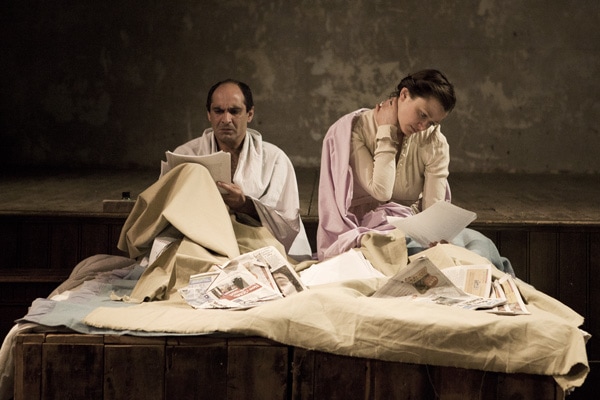
Having to write about a play can spoil watching it. Many a schoolchild has been put off Hamlet, trying to fathom out what happens, conscious they will be examined on it. It’s a relief to find that in Tom Stoppard’s Rosencrantz and Guildenstern Are Dead, the characters are in the same situation; baffled by the unfolding plot and their role in it, their predicament creates a special affinity with the audience.

Tom Stoppard, of course, knows exactly what is going on, in his hands we never feel too scared – just highly entertained. Stoppard’s first masterpiece, from 1965, Rosencrantz And Guildenstern Are Dead, doesn’t feel dated in the slightest – its intelligent humour shines forth. Seeing the events in Hamlet unfold via once minor, now major characters, we are introduced to the theme of free will, with speculation on aesthetics, and dazzling verbal badinage.

Stoppard’s dexterous writing is well served in director Trevor Nunn’s superb production. Having missed out on the chance to direct the plays premiere, Nunn relishes the opportunity now. There is an appropriate exuberance in his direction that does him credit.

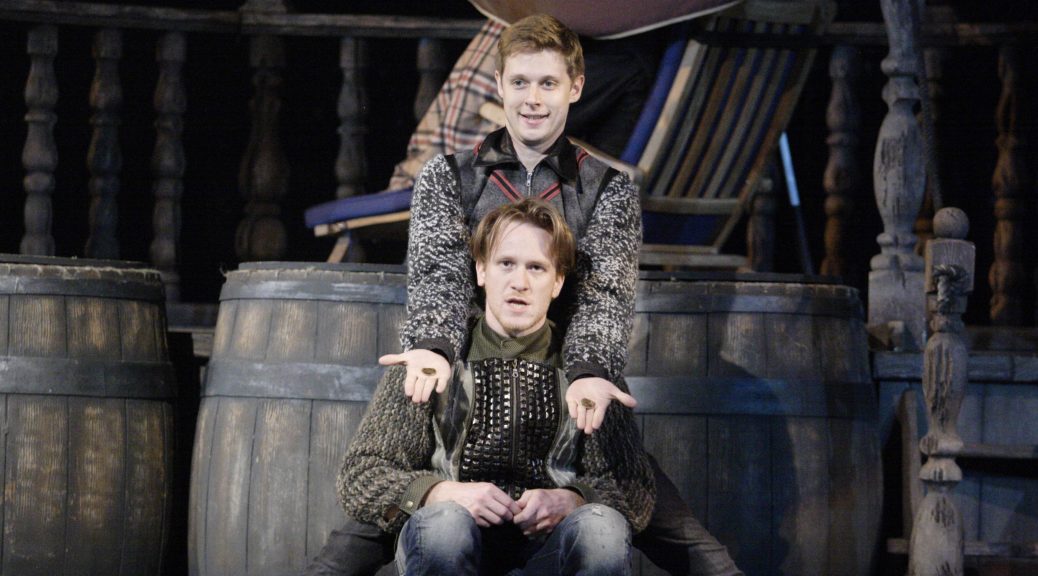
Arriving from the Chichester Festival the production is already polished. The Players that Rosencrantz and Guildenstern encounter make a convincing ensemble of tatterdemalions. Times are tough for performers, they will “stoop to anything” to entertain, and as their leader Chris Andrew Mellon conquers, hilariously guiding our heroes around the artifice of the world they are trapped in.

In the lead roles, Samuel Barnett and Jamie Parker, the one-time History Boys, are reunited, and this duo needs no lessons in comedy. Parker explains their predicament marvellously: seeking logic and justice in the theatre, fate means they are condemned to “death followed by eternity”, with their roles puzzled over forever more. But Barnett literally runs rings around his colleague, getting every laugh going and showing that Rosencrantz And Guildenstern Are Dead is a very lively affair indeed.

Until 20 August 2011

www.trh.co.uk

Photo by Catherine Ashmore

Written 22 June 2011 for The London Magazine
“The Seagull” at the Arcola Theatre

Dalston’s an unlikely place for a dacha. But Joseph Blatchley’s fine new production of The Seagull at the Arcola Theatre takes us to the Russian countryside in a fresh and exciting way. Working with Charlotte Pyke and John Kerr on a new translation, Chekhov’s text seems funnier and more dramatic than ever.

The new adaptation takes the young writer Konstantin’s advice to heart, creating a script that “flows freely”; full of naturalism, with judicious use of modern idioms, it is clear and pacey. In a play so crowded with art and performance, the histrionics and famous Russian gloom take on a comic twist – yet when sincerity comes forth it packs a punch.

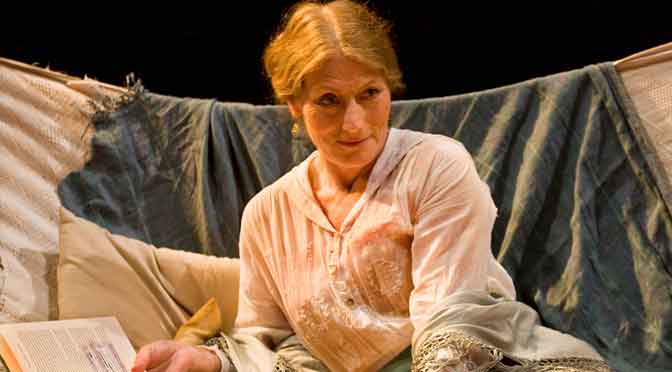
“So much anguish, everyone in love” announces Roger Lloyd Pack’s excellent Dr. Dorn: mostly to himself since Chekhov’s characters are solipsistic despite their self-awareness. Their selfishness is played for humour by the ensemble cast. In the star role of Arkadina, the successful actress who can’t stand the spotlight being on anyone else, Geraldine James is wonderfully intense.

Arkadina’s battles are tremendous set pieces, none more so than her confrontations with her son Konstantin. Al Weaver takes the part, funny as a petulant artist, and then deeply moving as he becomes a tortured young man.

Konstantin’s love for Nina, the girl next door who wants to become an actress, is so convincing it gives the whole production a romantic air. Yolanda Kettle, in a professional debut to be proud of, plays the role charmingly, making her character’s demise all the more moving.
Nina’s downfall comes via Trigorin, in Blatchley’s version a more than usually fascinating character. Played expertly by Matt Wilkinson, the startling accusation he has been “grooming” Nina adds considerable tension, making her seduction relevant to a modern audience, and preparing the ground for a traumatic conclusion that becomes as appropriately tormented as the good doctor predicted.

Until 16 July 2011

www.arcolatheatre.com

Photo by Simon Annand

Written 16 June 2011 for The London Magazine
“Butley” at the Duchess Theatre

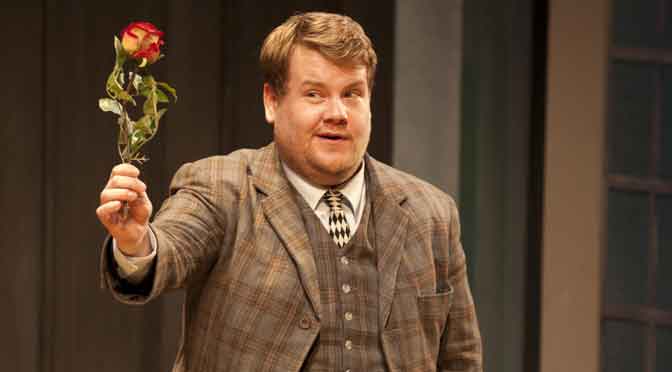
Butley is in trouble. The eponymous anti-hero of Simon Gray’s play has left his wife, is being deserted by his friends, and his career as a university lecturer is full of petty politics and pesky students. Lindsey Posner’s impeccably directed production of this comedy classic is the West End’s funniest play. To use a critical cliché, the English tutor would no doubt condemn – it’s unmissable.

Butley has an egalitarian edge that makes him likeable – he’s nasty to everyone. His dowdy colleague Edna (the wonderful Penny Downie) has her high ideals about collegiate life mocked mercilessly. Anyone who has ever hated work will understand Butley’s boredom; his desperation makes him a mid-life everyman and his wit makes him adorable. He deserves to be punched – but you know he’d come back with a killer line.

Butley’s passion for his “creepy” prodigy and now colleague, Joseph, played with intelligent nuance by Martin Hutson, is flirtatiously ambiguous. It’s unconvincing that someone as brutally honest as Butley would be a repressed homosexual (text excised from performance makes this explicit) but love is at the heart of this couple’s relationship. As moving as it is entertaining, it makes Butley an original examination of male friendship.

Being friends with Butley is worth it. Manic, indolent, fey and mendacious, the title role is performed mercurially by Dominic West – this is a landmark performance for him. Gray’s creation is an Ambrose Bierce of the stage, yet West does him justice with a comic ability that makes the shocks, spills and laughter flow, just like the whisky Butley downs. Performance and play are something to celebrate – I’ll drink to them both.

Until 27 August 2011

www.butleylondon.com

Photo by Tristram Kenton

Written 13 June 2011 for The London Magazine
“Chicken Soup with Barley” at the Royal Court Theatre

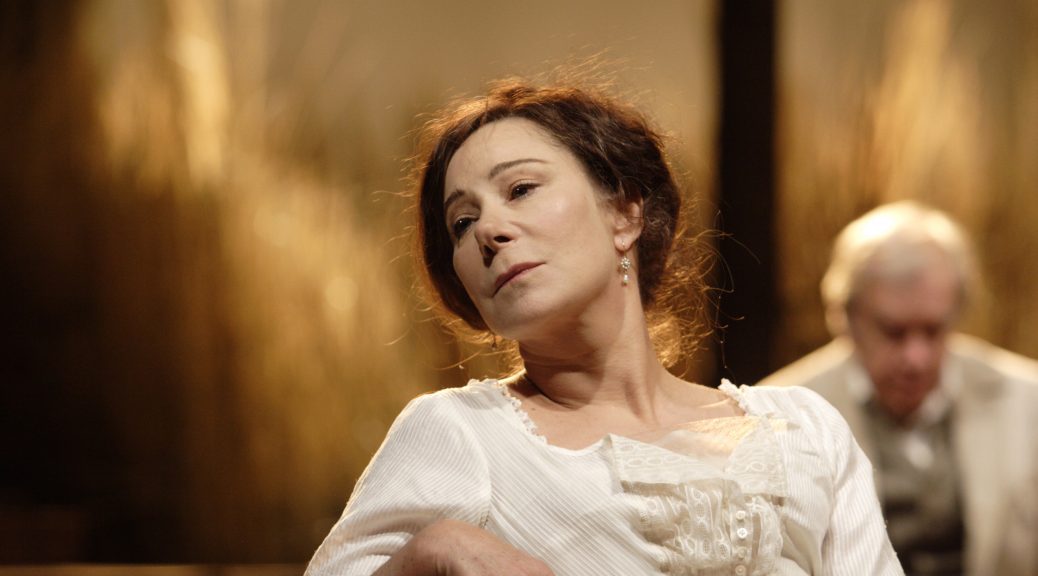
First performed at the Royal Court in 1958, Arnold Wesker’s Chicken Soup with Barley is the story of Sarah Kahn, a dedicated East End communist, and her struggle against capitalism. Director Dominic Cooke’s revival of this state-of-the-nation period piece does justice to Wesker’s ability to unite the political with the personal.

The play opens on the day of the Battle of Cable Street, on 4 October 1936, and the characters’ enthusiasm for rioting seems strangely quaint. When Sarah reaches for the rolling pin it gets a laugh and handing a Communist flag to her husband, telling him to “do something useful,” takes on a delicious irony.

Chicken Soup with Barley is a convincing family drama. Sarah’s husband Harry’s lack of political involvement is only the start of their marital problems. In these roles, Samantha Spiro and Danny Webb give tremendous performances. As the story spans three decades, the actors have plenty of opportunity to show off their technical prowess (Spiro has done this before – she seems capable of playing any age). But what really impresses is the close emotional bond one can sense, despite their cruelty to one another.

The arguments between the couple, including the fight for a socialist future, take their toll on their children. Here are two fine professional debuts, with Jenna Augen as Ada establishing her character’s complexity with impressive speed, and Tom Rosenthal as Ronnie providing a moving and astute performance.

Hindsight might make rebellion against their mother’s ideas seem predictable, but it is Cooke’s masterstroke to open up this division and make it so emotional. In a production that often feels rushed, time is taken to remind us of Ada’s absence, while Ronnie’s rejection of the ‘Party’ has apathy at its core. And that makes the themes in Chicken Soup with Barley seem relevant today. Londoners still protest, but our riots are reactionary not revolutionary. Fortunately for Cooke, the heart of Wesker’s political comment is engagement and a repeated desire to debate and act that becomes not just compelling drama but an important message that is clear and loud.

Until 16 July 2011

www.royalcourttheatre.com

Photo by  Johan Persson

Written 13 June 2011 for The London Magazine

“Into thy hands” at Wilton’s Music Hall

Politics and prayer seem to have been much more interesting 400 years ago, at least if Jonathan Holmes’ new play at Wilton’s Music Hall is to be believed. Set in 1611, Into thy hands is a story of sex and death, religion and science, with the life of poet and preacher John Donne as its catalyst.

Holmes is a scholar as well as the production’s writer and director. He has staged a Jacobean court masque as well as recovering some of Donne’s songs and both become valuable additions to his play. So Into thy hands doesn’t wear its learning lightly, it’s too ambitious for that. There’s even a nod to verbatim theatre (another of Renaissance man Holmes’ interests). You have to be on your toes for this one.

Part of the challenge is the inspiration taken from Donne’s poetry. Complex and full of conceits, you could never call it an easy read. Rewarding certainly, but characters discussing theology in this manner is hard work. Donne’s very name is a case in point, dripping with puns and prophecy – he can be finished, satiated, but also downcast, undone. Donne’s role in public life adds another level: he becomes trapped as a symbol himself, forced into the church as a reformed soul. For Holmes, the early seventeenth century was a period when a new world of science and religion saw “words move” while reactionaries fought to pin everything “in place”.

Donne’s position in this struggle is never less than compelling. He wants to be “a voice not a text”, arguing for fluidity and a sensuality that is shockingly modern. Zubin Varla plays the lead and delivers his verbose lines with remarkable fluidity, convincing us of the man’s passion and originality. But Donne shouldn’t just be unconventional and Varla’s occasional rants make him unconvincing – a flaw in a man so famous for his sermons.

Listening to the debate is Donne’s circle of allies and adversaries. It is a strength of Holmes’ text that he attempts to give a voice to the strong women of the period. Donne’s wife Ann is a fascinating character, played articulately by Jess Murphy. There are also strong performances from Helen Masters as Lady Danvers and Stephanie Langton as the Countess of Bedford. The latter has to deal with some explicit scenes concerning her character’s sexuality and manages to create an emotionally rounded performance.

Nothing about Into thy hands is easy. Even the humour is a sophisticated kind of bawdy. But any trip to Wilton’s music hall is worth taking and Holmes deals well with the building’s fantastic acoustics. This ‘hidden gem’ of a stage, derelict for so many years and London’s last surviving music hall, is at risk because the Heritage Lottery has refused a grant for its redevelopment. This makes a visit more important than ever – and with a play that has a preacher as its hero, surely a donation is called for?

Until 2 July 2011

www.wiltons.org.uk

Written 3 June 2011 for The London Magazine
“Lord of the Flies” at Regent’s Park Open Air Theatre

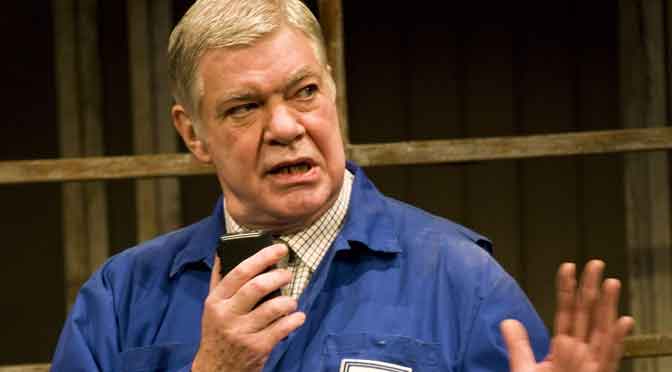
An airplane has crash-landed in Regent’s Park Open Air Theatre. With an engine planted amongst the audience and luggage hanging from the trees, designer Jon Bausor’s Lost-inspired set immediately establishes the extremity of the situation. The dismantling of the British flag of the tailfin – to make a temporary shelter for the schoolboys who have survived the crash – succinctly reflects the theme of the decline of civilisation that courses though Golding’s original narrative.

Everybody’s favourite text from school days, the 1954 book, is expertly brought to the stage by Nigel Williams. Adapting it [for the RSC in 1995] must have been a daunting task – not simply because of its fame, but because Golding’s authorial voice is so strong, his work so filled with symbolism and so marked by a scarcity of dialogue. Williams neutralises the 1950s schoolboy chat that could cause laughter: the whole production is vague about period, a move that avoids distraction in these ephebiphobic times. Better still, the script makes many of Golding’s concerns, such as the dynamics of society and the struggle between good and evil, only too clear.

Timothy Sheader’s direction is remarkable. Working with a young cast, he has fostered a collection of impressive professional debuts – London hasn’t seen the like since The History Boys. Treating the stage as a playground, then a hunting ground, the boys move with frightening agility, undertake extended fight scenes convincingly and viscerally embody the savagery they descend into.

Alistair Toovey is wonderful as Ralph, the group’s first chief, engaged in a power struggle with Jack (James Clay), a choirboy-turned-hunter who leads the boys in a very different kind of song and dance. Clay bristles with adolescent awakening. There are also stand-out performances from George Bukhari as Piggy, a moving voice of reason in the wilderness, and Joshua Williams as Simon, whose discovery of the truth about the ‘Beastie’ scaring the children has brutal consequences.

Clay does especially well in playing out Jack’s manipulation of the weaker boys through fear. As night descends on Regent’s Park, and the hunt to kill Ralph begins, the boys become the “solid mass of menace” Golding describes. Sheader makes the escalation of violence theatrically plausible but, more remarkably, his pacing and use of slow motion give the audience time to think through what is going on. This is the same privileged position Golding gives his readers, making the production a true compliment to a terrifying modern classic.

Until 18 June 2011

www.openairtheatre.org

Photo by Johan Persson

Written 27 May 2011 for The London Magazine

“One Man, Two Guvnors” at the National Theatre

Richard Bean’s adaptation of Carlo Goldoni’s commedia dell’arte play, One Man, Two Guvnors, is a story of lovers, disguise and an overworked servant, set in 1960s Brighton. The decade is a great excuse for a nostalgic design, rock ’n’ roll songs, and plenty of saucy jokes that some sensitive souls might frown at. And the seaside is an appropriate location for the silly stuff we see on stage – it’s picture postcard time at the National Theatre, with plenty of slap and tickle to enjoy.

The humour couldn’t be less sophisticated, and the gags as old as they come (“men will do anything to get you into bed. Lie, cheat, buy you a bed”). We are offered some theory as an excuse. Commedia dell’arte deals with stock characters and director Nicholas Hynter makes sure his cast delivers the broadest of performances. None of this stops the play from being funny – predictability is part of the joke, but it does make delivery the most important thing. Here, One Man, Two Guvnors does very well indeed.

The lovers we encounter include Pauline Clench (Claire Lams) and her RADA-trained fiancé Alan Dangle (Daniel Rigby) whose postured emoting gets more laughs than his lines. Their marriage is endangered by Rachel Crabbe (the excellent Jemima Rooper) disguised as her brother, who has been killed by her lover Stanley Stubbers, played effortlessly by Oliver Chris, the nice-but-dim public school boy who, taking inspiration from the street, disguises himself as Dustin Pubsign. His is the star turn of the night.

Chris steals the show, which might surprise some, since One Man, Two Guvnors seems rather unashamedly designed as a vehicle for James Corden. As the servant who takes on two jobs, he rarely leaves the stage and his energy is fantastic. The physical comedy poses no problems for Corden and he deals playfully with his colleagues, especially his own love interest Dolly (sassily portrayed by Suzie Toase), but his character is supposed to be more hapless than devious and – whisper it – Corden doesn’t possess quite enough charm to hold the role.

And yet Corden’s star appeal overpowers any deficiencies in his performance. His confidence is enough to entertain and he’s undoubtedly a crowd pleaser. If audience participation strikes you as a little tawdry, then stay away. But, as they say on the X Factor, the audience is the judge, and the level of near hysteria following Corden’s every move makes for an electric atmosphere.

www.nationaltheatre.org.uk

Photo by Johan Persson

Written 26 May 2011 for The London Magazine

“The Cherry Orchard” at the National Theatre

Director Howard Davies is well known for his work on Russian classics. Last year, his production of The White Guard did phenomenally well at the Olivier Awards. His new production of The Cherry Orchard is a quality affair from a director who doesn’t rest on his laurels.

Davies is working again with designer Bunny Christie. Her set offers the first glimpse that this is something different: there’s no trace of quaint dacha here and not a samovar in sight (for that, you have to nip into the National’s bookshop for a particularly twee display), a set is a huge barn of a place, that really is dilapidated, whose owners are in dire financial straits.

Andrew Upton joins the team again with a text that is wilfully modern. Every effort has been made to make Chekhov’s story of the landowning Ranyevskaya seem contemporary. It will certainly jar on some ears. Maybe in our credit- crunched times her poverty rings a chord, but Ranyevskaya isn’t a member of the squeezed middle. She’s a frightful snob, yet her obstinate refusal to recognise the reality of her situation is conveyed with charm by Zoe Wanamaker.

There is little sense of Ranyevskaya’s journey in this production. Like her brother Gaev (James Laurenson) she seems little aware of the times she is living in. A sense of history that Chekov certainly saw as a theme of his work is diluted, the production seems more immediate and less didactic, but it’s a trade off that is debateable.

Wanamaker’s performance is generous, allowing the other characters to shine out: stories of lovers of different ages and status, all given equal weight, bring out the plays rich complexity. Kenneth Cranham is a truly revolting Firs, playing with Emily Taaffe’s Dunyasha with great cruelty. Mark Bonnar is convincing as Petya Tromfimov, one of those scholastic characters Russian dramatists love that are so difficult to perform; his impassioned relationship with Anya (Charity Wakefield) is a highlight of the evening.

Lopakhin, the merchant whose capitalism is so much at the core of The Cherry Orchard’s historic concerns, is played by Conleth Hill with passion. Hill is perfectly farouche and, if not quite believable as the businessman who could save the estate, his fragility makes his the most moving performance of the night.

All the casts’ performances are mobile, running around in a play that is usually static. The party scene is particularly raucous. These Russians know how to live it up but, of course, not how to live. The pain as they all try to find a place for themselves in their changing world easily transcends historical circumstance. Davies preserves the philosophical dilemma at the heart of The Cherry Orchard while presenting it with fresh eyes.

Until 13 August 2011

www.nationaltheatre.org.uk

Photo by Catherine Ashmore

Written 18 May 2011 for The London Magazine

“A Delicate Balance”at the Almeida Theatre

Edward Albee’s A Delicate Balance is the story of an elderly couple whose twilight years are disturbed by an alcoholic sister-in-law, a daughter’s failed marriage, and their best friends’ nervous breakdowns. A thought-provoking meditation on the duties of family and friendship, as well as an examination of the American dream, this is a fantastic piece of writing that’s ambitiously broad, but so intelligent and challenging that it is always absorbing.

Albee’s observations are inspired. Often more startling than sure-footed, they can jolt an audience to attention. Agnes and Tobias, the elderly couple in whose house we, and all the characters in the play come to stay in, form the focus of observations on age and gender. Agnes fears that she will come “adrift” in senility and claims her husband’s life has been easier than hers – all men have to worry about is “making ends meet until they meet the end”.

Unfortunately, the writing here is far stronger than the production. Albee has created a stifling social world of guarded conversations, full of innuendo, but director James Macdonald does it little justice. Desperation is conveyed too quickly, with no sense of the slide into apathy.

This fault matters less with characters clearly on the edge. Harry and Edna are the best friends who seek refuge due to their inexplicable fear. Diana Hardcastle’s panic is conveyed superbly, likewise her battle to stay and claim the ‘rights’ of her friendship with Agnes. Imelda Staunton plays Clare, the alcoholic sister-in-law, with wit and perspicacity.

But the production falters with its central characters and the talented cast never satisfactorily deals with Albee’s articulacy. Penelope Wilton’s Agnes is too magisterial and Tim Pigott-Smith’s Tobias always so close to a breakdown it is hard to imagine him as the conventional man he has always seemed to be.

The skeletons in this family’s closet are so easily exposed you wonder if the wardrobe door was ever closed. Macdonald’s indelicate production destroys Albee’s cleverly constructed rhythm – too much weight is given to calls to activism and not enough to either the humour or humanity of the piece.

Until 2 July 2011

www.almeida.co.uk

Photo by Hugo Glendinning

Written 13 May 2011 for The London Magazine

“Sign of the Times” at the Duchess Theatre

Humour and sentiment can be an uncomfortable mix. The secret of Tim Firth’s successful career, from Neville’s Island to the recent Calendar Girls, is that he combines them so well. Sign of the Times shows off this talent on an intimate scale – its heartwarming stuff with plenty of laughs.

Matthew Kelly plays Frank, Director of Installations at a sign manufacturer who is given the added responsibility of looking after Alan (Gerard Kearn) who is on work experience. Like many an intern, Alan is getting a raw deal here – he wanted work experience on the set of Emmerdale but instead is stuck on top of an office roof with a bore.

This is a comedy about a generation gap with the age-old twist of who is actually learning most from whom. Young Alan’s creativity strikes a chord with the older man, who is a frustrated writer. No matter how bad the spy thrillers he dictates during breaks are, we are touched by the sincerity of his efforts – he has a “burning burn” to write and who can argue with that! And the inspiration to do more with his life comes at the perfect time – the sign they are currently erecting spells out the end of his career.

Three years later, the roles are reversed. Alan is now the eager Trainee Assistant Deputy Manager explaining Frank’s new job to him with corporate mnemonics ripe for satire. It’s Frank’s turn to inspire and remind the youth of the courage he once had, saving him from electrocution along the way.

Sign of the Times started as a one-act play and there are moments when Firth’s extension seems contrived. Frank’s story reminds us that postponing retirement age entails problems, but that isn’t where the strength of the story really lies.

Firth writes great characters and in Sign of the Times they get the performances they deserve. Kelly is fully in control of the stage, charming even when pompous and endearing in his enthusiasm, and Kearns (who may be recognised from Shameless) makes a great West End debut. Both actors are spot on with their comic timing and make Sign of the Times well worth seeing.

Until 28 May 2011

www.nimaxtheatres.com

Photo by Simon Annand

Written 14 March 2011 for The London Magazine