“Rockets and Blue Lights” at the National Theatre

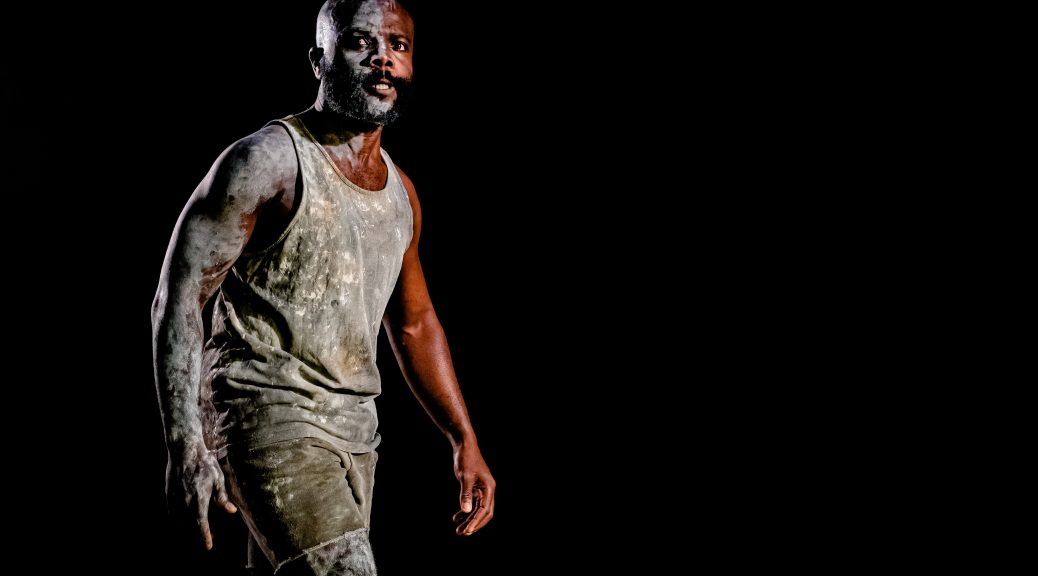
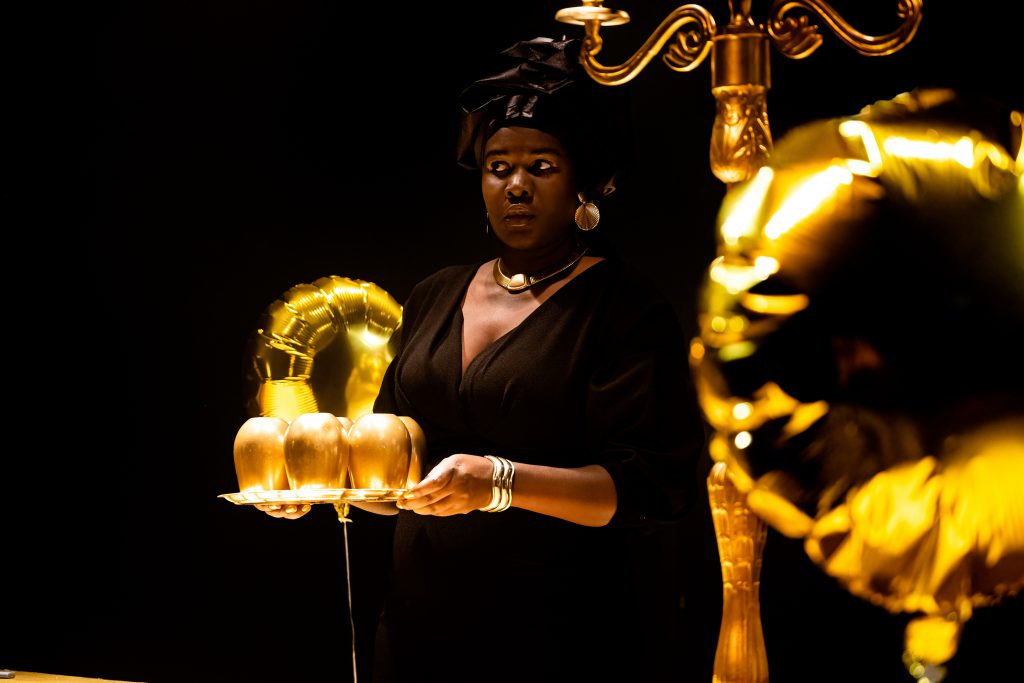
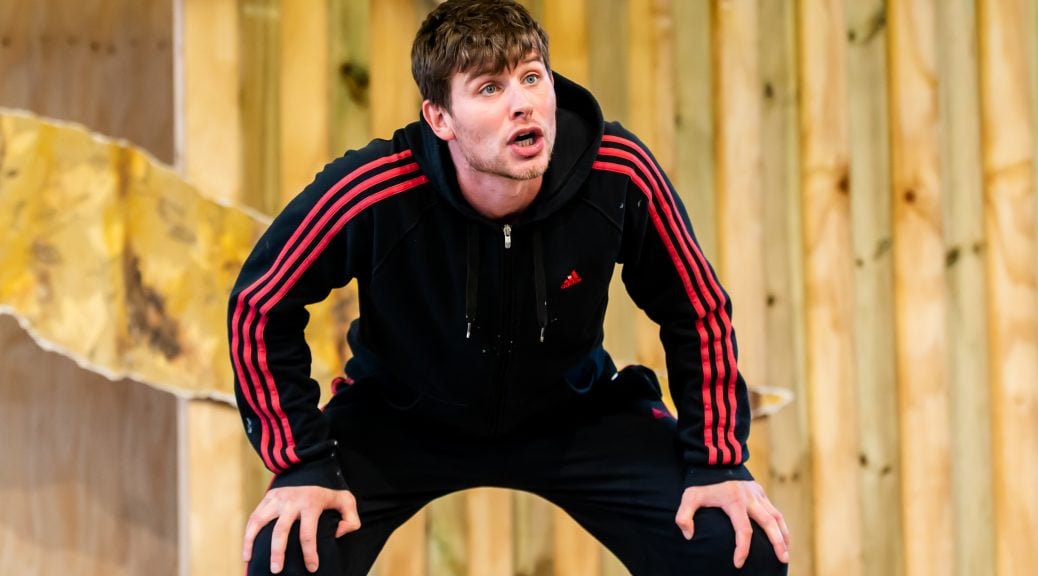
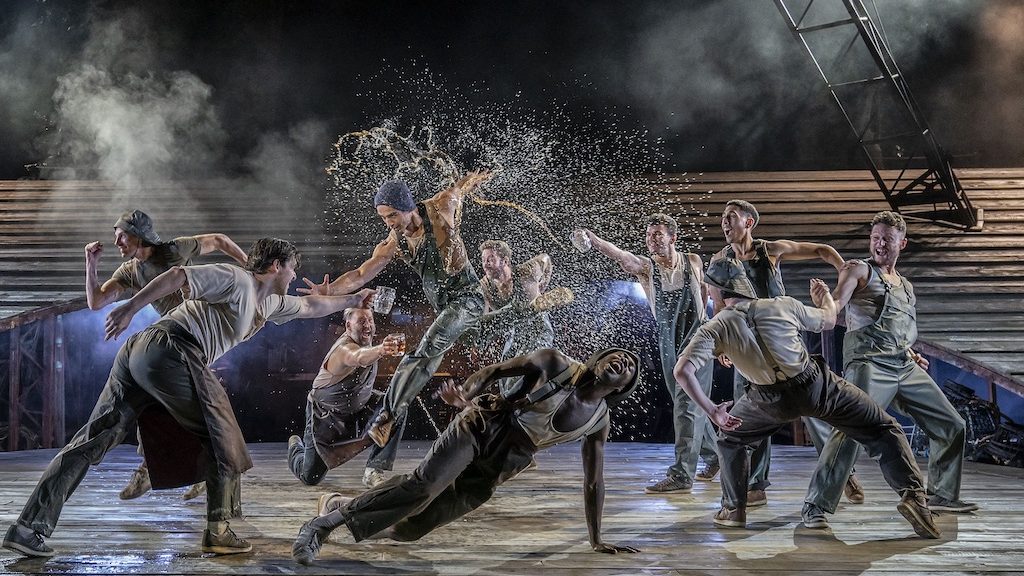
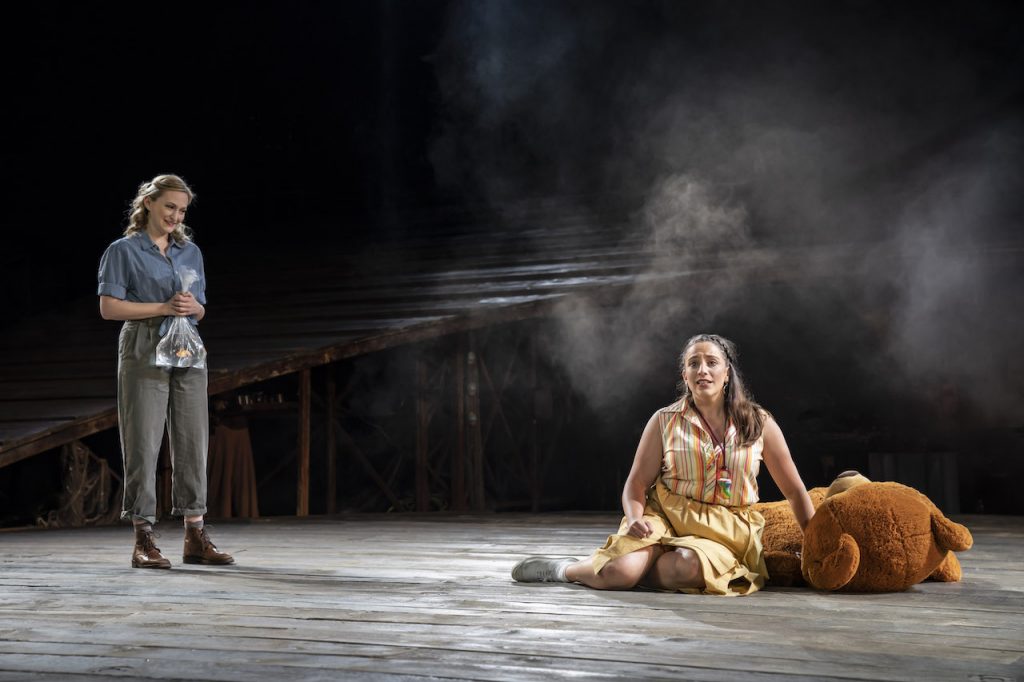
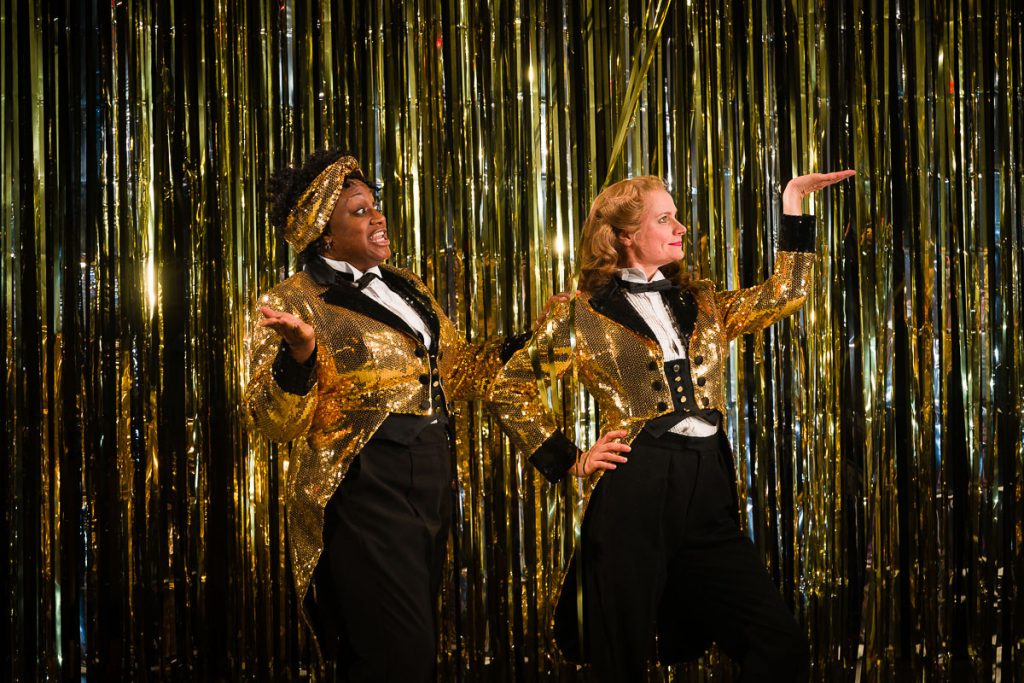
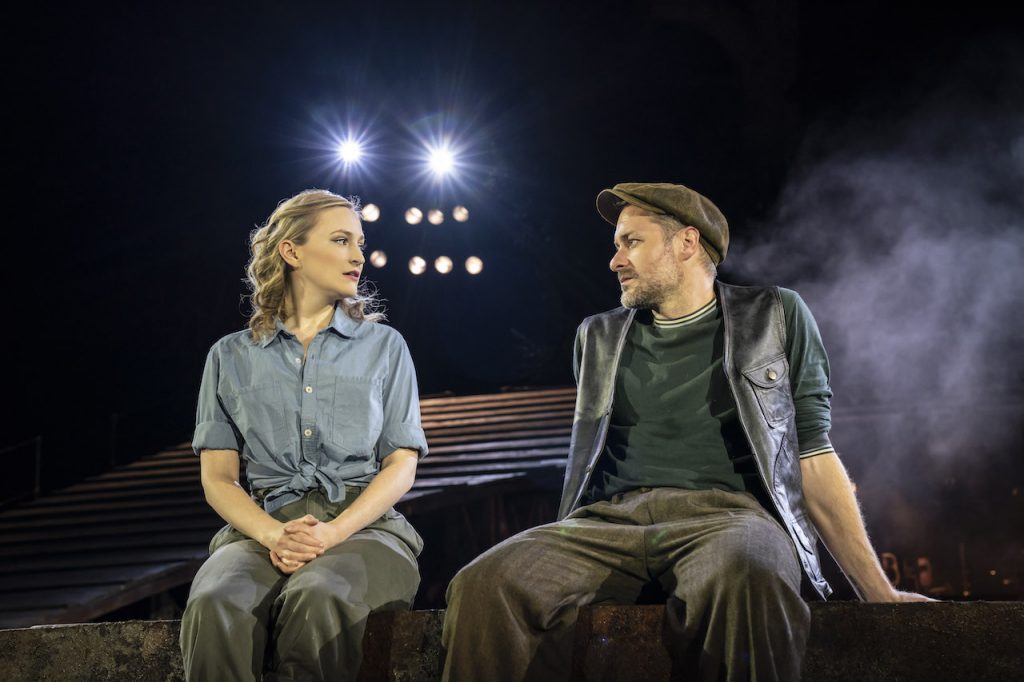
Winsome Pinnock’s play tackles the subjects of race and history with ambition and ability. Splitting the action between the 19th century and the present day, we see JMW Turner painting and contemporary creatives at work on a film about him. As both sets of artists engage with the issue of slavery, Pinnock’s dialogue with history becomes vivid and urgent.

There’s trouble among the filmmakers as a director and his star, Lou – a particularly grand role for Kiza Deen – argue over artistic integrity. Meanwhile, the story of a young artist and his inspiring teacher (characters you immediately get behind, carefully portrayed by Anthony Aje and Rochelle Rose) brings another level to the debate about the role of art and education. The commentary on creativity and society is intelligent and provocative.

Such vivid questioning of whether art can only “bear witness” or whether it can do more make the historical part of the play pale slightly. It’s a shame. The plot is strong: an adventure for Turner and a tragedy for a black sailor called Thomas make compelling stories. The latter includes a love story especially well portrayed by Karl Collins and Rose. But the politics Pinnock wants to explore sound hollow in her well-drawn characters’ mouths.

It isn’t that people didn’t question slavery or race during this period – it’s just the effort to state these debates in our terms. Maybe how the 19th century would phrase the argument is too unpalatable or, more likely, incomprehensible. Pinnock makes the debate smart and relatable. It’s good to credit the past with intelligence while interrogating it. But we can’t pretend that the dialogue doesn’t jar now and again.

Any reservations disappear after the interval as Rockets and Blue Lights really takes off: increasingly ambitious, full of surprises and even more political. Bringing together periods in time is well done – with dance and ghostly visitations. The use of music, composed and directed by Femi Temowo, is inspired. Arguments about the legacy of slavery, and injustices both past and present, lead to strong imagery from Pinnock.

Having the cast double up between the historical periods ensures impressive performances – and suggests connections between characters that make the mind boggle. Director Miranda Cromwell’s staging is strong, switching effortlessly between the time periods and handling distressing scenes with power and tact. This fine balance is particularly impressive – there is none of the “torture porn” that Lou fears might appear in the film she is working on. Considerable sophistication is the undercurrent for the whole show.

Until 9 October 2021

www.nationaltheatre.org.uk

Photo by Brinkoff / Moegenburg
“Salomé” at the Southwark Playhouse

Lazarus Theatre Company’s exemplary production of Oscar Wilde’s infamous play benefits from Ricky Dukes’ forceful directorial vision and strong performances from a committed cast.

The production is exemplary in the sense that it suggests how to deal with a difficult text. More like a poem than a play, Salomé is hard work. Even nowadays we can see why Wilde’s morbid, exaggerated language was once thought unhealthy…it’s kind of, well, sickly. The production makes the action as clear and concise as possible. Mostly doing justice to the poetry (with the exception of added expletives) there’s even a sense of humour, which the text itself notably lacks.

Salome, Lazarus - Pauline Babula
Pauline Babula

Further credit for Dukes comes with efforts to recreate the sense of scandal the play once engendered. Young Salomé’s bargain with her step-father is made explicitly erotic with sexual tension and exploitation equally highlighted. This is achieved in sophisticated fashion thanks in part to the casting of Herod and his wife (Jamie O’Neill and Pauline Babula) who give subtle performances suggesting the power play between them as well as their characters’ individual lust for sex or power.

Games play a big part. The famous dance becomes a creepy parody of childhood fun – a brilliant move – with tag and hide-and-seek making it queasy to watch. Desire is consistently identified as dangerous – creating tension and getting to the heart of Wilde’s obsessions.

Salome, Lazarus - Fred Thomas
Fred Thomas

Further provocation comes with the casting of the leads, surely deliberately removed from the ‘blind’ casting we usually applaud. There’s a charge – and a challenge – from having a Prince Salome and a Jokanaan, explicitly praised for the whiteness of his skin, performed by a black man. The expectations of the audience (and author) are questioned. That said, what really gives the production power are the detailed and skilled performances. In the title role, Fred Thomas mixes arrogance and fear with desperation, managing to make this murderer surprisingly sympathetic.

Riveting as Thomas is, especially in the harrowing finale, eyes should really be on Prince Plockey who takes the part of the Baptist. Plockey brings a power to the prophet that makes you understand why he is feared. A continual stately procession around the table that is Sorcha Corcoran’s clever set design mounts in power. The focus Plockey brings to this pacing is fantastic and each announcement from the doomed figure creates a sense of dread fitting to the text’s doom-laden tone. Salomé is Jokanaan and Plockey’s show which, despite the title, is exactly as it should be.

Until 11 September 2021

www.southwarkplayhouse.co.uk

Photos by Adam Trigg

“When Darkness Falls” at the Park Theatre

The promise of a spine-chilling ghost story is always welcome, and this show has not one but five spooky tales, which surely counts as good value.

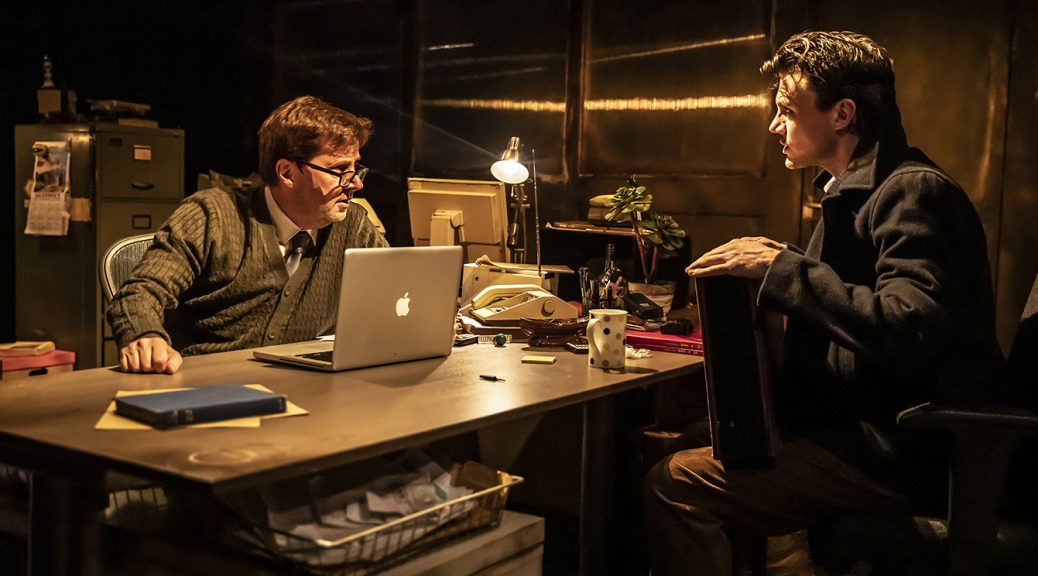
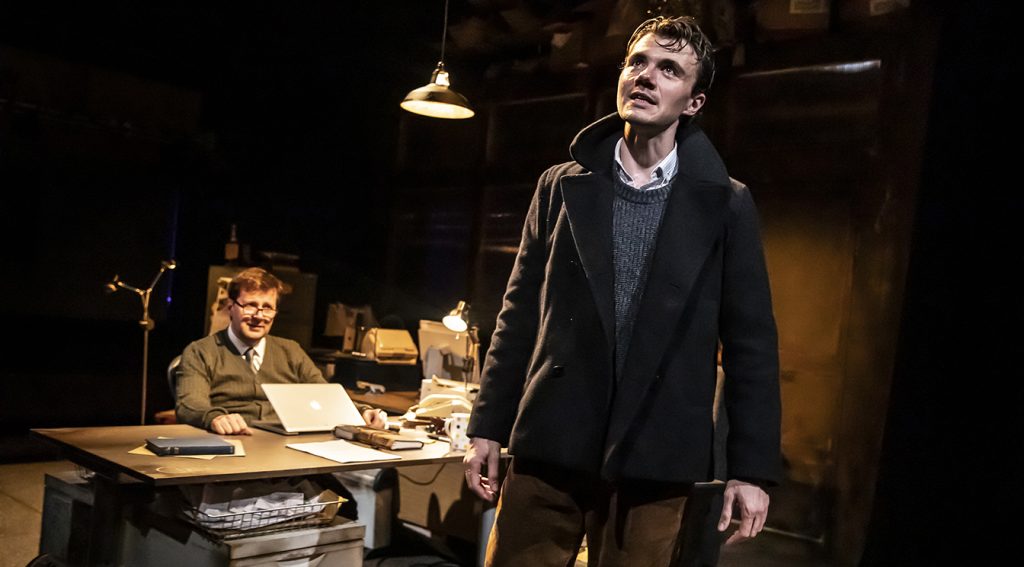
The spectres range from the 17th century to the present day, framed within the device of a local Guernsey historian, one John Blondel, vlogging. There’s a lot of history – including witch hunts and pirates – that will have you Googling background stories afterwards. The carefully constructed script, from Paul Morrissey and James Milton, plays with setting up connections between the stories well.

Morrissey and Milton want just the right amount of sensation to distinguish the narrator, Blondel’s vlog guest, from your average journalist. They have their reasons. A newspaper’s approach to ghost stories is said to be “short, cheap, generic, repetitive” – avoiding all that creates a script that is a solid, traditional affair. If the dialogue isn’t shy of clichés, they are justified in adding to the atmosphere.

In short, the tales are good. And the telling is even better. These aren’t easy roles. Blondel is presented, at first, as a too-predictable sceptic. Attempts to lighten the mood are a misstep on Morrissey and Milton’s part. And a potential plot spoiler…

When-Darkness-Falls-credit-Pamela-Raith
Will Barton and Alex Phelps

‘The Speaker’ is a little too obviously otherworldly. This isn’t really hidden (should it be?). Don’t worry, as there are more than enough twists to come.

While the characters aren’t perfect, the performances are. Will Barton works hard as Blondel suggesting an underlying fear with great skill. Participating in the stories – as a character as well as a commentator – impresses further. As The Speaker, Alex Phelps mixes vulnerability with a delicious sense of menace, and manages to vary a performance that could all too easily be static. Above all, Phelps is a great storyteller.

Further aiding effectiveness is Morrissey’s direction and some particularly strong sound design from Daniel Higgott. Wind, whistles and screaming might not be particularly original, but they work. Even better, Higgott appreciates the power of silence and uses it to create tension very well indeed. Excitement and interest are present throughout this quality show. Chilling spines is harder but, if When Darkness Falls doesn’t quite manage that, it is still sure to entertain.

Until 4 September 2021

www.parktheatre.co.uk

Photos by Pamela Raith

“Scab” at the Arcola Theatre

Theatregoers continue to be spoilt for monologues, but in a crowded field this script by Luke Stapleton is credible and safe to recommend: Scab is thought-provoking and entertaining, with an exceptional performance from Conor Lowson that should not be missed.

The young man we meet, who Lowson makes engaging throughout, is an unwilling Samaritan to Keith, an injured old man who is suffering from dementia. Coming to know Keith’s estranged daughter Carla and helping with the construction of a boat, establishes themes of family, aging and trauma that Stapleton makes intriguing.

Despite the broad Northern accents there might be less sense of place than intended. The plentiful details in the script focus on food – these are good (and having sold ice creams I can confirm Solero’s are for a sophisticated clientele). But more diversity would be welcome to locate Scab in place and time.

More seriously, if you like your writing neat, there are loose ends here. We learn about Keith’s past but are still in doubt as to the motivation and pain of others. Stapleton has created characters we want to know more about – well done – but it’s disappointing that mystery remains despite a strong finale.

Nonetheless, there’s an impressive imagination behind the script. And some vivid imagery that mixes the mundane and the magical in a distinctive fashion. The performance of the text, with crudity and invitations to marvel at beauty, is hugely impressive…if not always for the best reasons.

Director Jamie Biddle appreciates speed is important to Stapleton’s work. A rapid delivery shows a stream of consciousness and brings naturalism, aiding conversations between characters. Lowson delivers all this very well – for sheer speed he cannot fail to impress. But I wonder if, rather than waiting for the audience to accustom themselves to the pace, it could be slower at first? That said, reservations about the breakneck speed fade when taking into account performance conditions.

While the main theatre is closed for renovations, the Arcola’s outdoor tent proves an unforgiving venue. It may be Covid Safe but it is far from soundproof. With a queue for the local roof top bar going past the theatre, and partygoers drinking while they wait, it felt like Lowson was pretty much acting in the street. All the more credit for such a committed performance – a nuanced delivery with fantastic energy. Lowson didn’t flinch despite conditions – both he and Scab won my admiration as a result.

Until 21 August 2021

www.arcolatheatre.com

“Carousel” at Regent’s Park Open Air Theatre

The joy of theatre is that it changes all the time – it’s alive. And most can agree that Rodgers and Hammerstein’s classic musical, wonderful as it is, needs some changes. The show’s lead, wife-beating fairground attendant Billy Bigelow, is a tough sell for our times. And the too casual acceptance of his violence, including that from Mrs B, means that the romance leaves a nasty taste, despite the sublime score. Boldly attempting a new kind of Carousel, director Timothy Sheader can be applauded – the aim is admirable – even if the production doesn’t quite succeed.

Tom Scutt’s bare design is an indication that this Carousel isn’t going to be pretty or charming. Any nostalgia about the New England setting is replaced with British regional accents that manage to bring an air of working-class realism surprisingly well. And Drew McOnie’s excellent choreography shows us a world of work and violence. The only sheer delight is a wonderful Carrie Pipperidge, where Christina Modestou’s lilting Welsh voice made me wonder how she would deal with all manner of show tune standards.

Carly Bawden and Christina Modestou in Carousel at Regents Park
Carly Bawden and Christina Modestou

Women come to the fore in Sheader’s vision for the show. To be fair to Rodgers and Hammerstein, that isn’t hard. Carly Bawden’s Julie – the lead with bad taste in men – intrigues; she has an otherworldly quality to go with her out-of-this-world voice. Joanna Riding’s matriarchal Nettie is convincing, while the carousel owner Mrs Mullin is made a forceful presence by Jo Eaton-Kent. The ensemble provides memorable moments, confronting the audience and Billy about his crimes.

Carly Bawden and Declan Bennett

As for our kind of hero, Declan Bennett’s Billy has none of the usual charisma… fair enough. Billie is a weak, feckless character (too easily swayed by Sam Mackay’s somewhat pantomime villain, Jigger) and Bennett does this well. But Billy being boring makes the love story at the heart of the show unbelievable. We know Julie is a fool to fall for him, but if the audience doesn’t fall as well – just a little – the show becomes robbed of emotion.

A chilly Carousel then, but that isn’t the biggest problem here. While Sheader’s vision can be respected – it’s clever and clear – changes to the score are less successful, and updating the music is a riskier affair. Again, the approach is bold: a classic American score has hints of Americana (with surprisingly modern touches), but seemingly at random. The additions will keep you guessing – they entertain – but hampered by excessive amplification the sound is sometimes cheap and tinny. Overpowering the singers more than once, the music is almost unpleasant. And that can’t be the kind of new ride Sheader intended.

Until 25 September 2021

www.openairtheatre.com

Photos by Johan Persson

“Bagdad Café” at the Old Vic

Nobody brings film to the stage like director Emma Rice. Following hits such as Brief Encounter and Romantics Anonymous it’s now the turn of Percy and Eleonore Adlon’s 1987 movie. The story of an unlikely friendship between two women – Brenda and Jasmin, estranged from their partners in the remote titular location – has a quirky appeal. While the adaptation fails to move beyond appealing eccentricity, a drop in standards for Rice is still a show worth seeing.

As a Rice fan, I’d argue the problem lies with the source material. I’m puzzled by the choice. There’s a fairy-tale charm in the story of a German tourist and a hassled coffee shop owner… but little else. The women’s quirks, as well as those of Brenda’s family and clientele, replace plot. Maybe this was the attraction – Bagdad Café is novel and Rice is one of the most original theatre makers around – but, frankly, too little happens.

It is a collection of characters to enjoy. Much is made of former “songbird” Brenda and her current sorry state struggling to run a business. Sandra Marvin takes the part and is believable. But it’s her husband, performed by Le Gateau Chocolat, who complains about how hard she works – it’s not clear why we should share that problem. The show’s heroine Jasmin, who walks out on her husband in a scene with no dialogue, is a touch too mysterious. Patrycja Kujawska portrays the character’s quiet power well as she changes the lives of those she ends up living with. But she encounters oddities rather than odds, as conflict and tension are absent. Even learning magic tricks comes suspiciously easily. With little backstory, secondary characters are pleasant to watch but suffer a similar complaint: there are lovely turns from Gareth Snook and Sam Archer as a couple of misfit hippies, but you can’t help wondering how they ended up in the story and what they are there for.

The music for the show, ably directed by Nadine Lee, consists of too few tunes (the show relies heavily on Bob Telson’s hit, Calling You). And the numbers are truncated. There’s a defence for this – Bagdad Café isn’t trying to be a conventional musical. But the show’s originality ends up frustrating. It’s down to the theatricality of the production to hold our interest. Rice and her cast attempt this admirably. There are lovely touches with puppetry and movement (credit here for John Leader, Sarah Wright and Etta Murfitt) that make for plenty of memorable moments – it’s almost enough.

Bagdad Cafe at the Old Vic
Sandra Marvin and Patrycja Kujawska

A world is vividly created. And even if it puzzles too much to entirely suspend disbelief, it is enchanting. There’s not much to Bagdad Café apart from atmosphere. But what an atmosphere! A finale where Brenda and Jasmine put on a show gave me goosebumps. The show’s feelgood simplicity coalesces to make sure we leave the theatre happy. And an encore, showing an accompanying digital project for the production, further confirms a striving for originality that wins admiration. The conjuring here is more than tricks that Jasmine enjoys on stage, it’s theatrical magic of the kind Rice excels at.

Until 21 August 2021

www.oldvictheatre.com

Photo by Steve Tanner

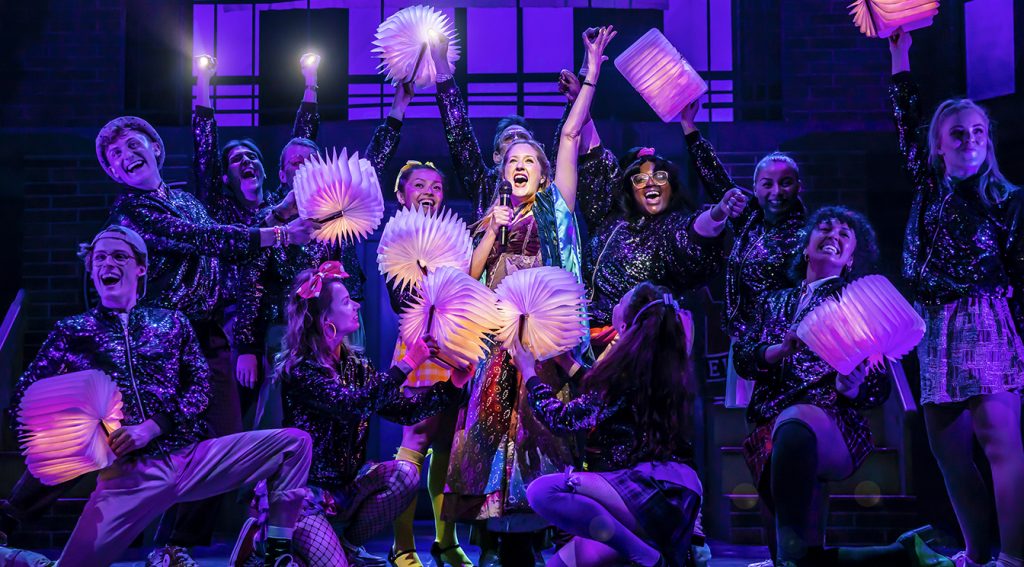
“Heathers – The Musical” at the Theatre Royal Haymarket

Like the 1989 film on which it is based, Kevin Murphy and Laurence O’Keefe’s musical aims for cult status. Given a brief West End run that is well worth catching, the show can make a claim for that status: the production, directed by Andy Fickman, keeps popping up and fans are as enthusiastic as the energetic performances on offer. 

Heathers has its quirks – not all of them work – but there’s a striving for originality that is admirable. The show enjoys a twisted sensibility that, in truth, has limited shock value. And you can question how the topics of teenage suicide and mass killing are handled. What, no trigger warning? Nonetheless, the show is well above average.

Twists on high-school dramas are as predictable as high-school dramas themselves. But the titular characters here, popular girls who share the same first name, are impressively repulsive. Led by Jodie Steele, who makes her role fool-proof with its brashness, the trio are fun. Our actual heroes are the real psychopaths, with roles that aren’t much more convincing, even if Christina Bennington and Jordan Luke Gage give their very best.

The music is good. This is a fine collection of rock/pop songs on the right side of late 1980s pastiche. If there aren’t enough stand-out numbers, collectively the score and lyrics are impressive. And all the numbers demand powerful vocals provided by everyone on stage. It’s rousing stuff, often funny and occasionally original. The choreography, from Gary Lloyd (also associate director), with mirroring moves to show the Heathers’ influence on others, is also strong. The production is almost entertaining enough to ignore what is actually going on.

Lauren Ward Heathers The Musical credit Pamela Raith
Lauren Ward

In common with lots of teen dramas, the adults in the piece are awful (even with the excellent Lauren Ward putting in a star turn as a hippy teacher). It might be better to excise them altogether. And while strong female characters are welcome, might balance help? I think every named male character is either a potential rapist, a closeted homosexual or a serial killer!

Following the movie closely makes the plot cumbersome on stage. Murphy and O’Keefe’s tweaks are good – especially having victims appear as ghosts, not least because we get to see more of Steele – but they only add to a plot that starts to become unwieldy. And we do have to address the very serious subject matter. Not because musicals can’t tackle such subjects, or that humour shouldn’t be used to examine them, but because Heathers doesn’t deal with violence well. In a long show, questions of motive and morality are shoehorned in or glossed over. A too speedy resolution and homespun wisdom tacked on don’t do the subject – or the show – justice.

Until 11 September 2021

www.heathermusical.com

Photos by Pamela Raith

“Destiny” at the Pleasance Theatre

Over the next five weeks, Londoners have the chance to see shows from all over the country just five minutes from Caledonian Road Tube. Five shows, supported by different theatres, will visit as part of the Pleasance’s National Partnership Awards. If this first offering, from Florence Espeut-Nickless and supported by Bristol Old Vic Ferment, is anything to go by there are real treats in store.

Nobody disagrees that in theatre’s drive for inclusivity white working-class women’s voices need to be heard. As the story of a girl called Destiny from a council estate, this monologue fits that brief. But that the setting is rural Wiltshire is also important. This voice, this accent – literally – isn’t one that we hear on stage. I’m reasonably eclectic in my theatre trips but, apart from Shakespearean rustics, I don’t recall hearing it before.

While important, inclusivity in itself doesn’t make the show worth seeing. It must be good theatre, too! Thankfully, Destiny stands on its own merits and is easy to recommend.

As an autobiographical show, Espeut-Nickless’ writing has a sincere and authentic tone. There’s a clear structure and motivation behind a monologue that provides insight and drama, with careful control aided by director and dramaturg Jesse Jones. And there is a real conviction behind Espeut-Nickless’ performance that wins further admiration.

As for what happens to Destiny, as Espeut-Nickless’ said while thanking the audience after deserved applause, the play isn’t enjoyable as such. There’s a depressing inevitability to the way the character is used by men and poorly treated by those we expect to help her. Destiny’s encounters with the legal profession and social services are truly awful, making the piece grim but powerful.

What might make the story predictable is cleverly used. The fact that the audience can see what is coming next still creates tension. And there is an impressive subtlety to our heroine. Destiny has charm – mostly from her irrepressible optimism – to match her rough edges. Poor decisions abound… but what choices does Destiny really have? How can this lonely teen deal with the traumatic situations she faces? Understandably naïve (and poorly educated) Destiny’s ignorance becomes a powerful challenge to the audience.

The run for Destiny is short… try to catch it this weekend or look out for a promised digital on-demand performance to be announced soon. Other shows are supported by the Pitlochry Festival Theatre, Leicester’s Curve Theatre, Manchester’s HOME and the Theatre Royal Plymouth, with the diverse programme running until 11 September.

Until 7 August 2021

www.pleasancetheatre.co.uk

Photo by Chelsey Cliff

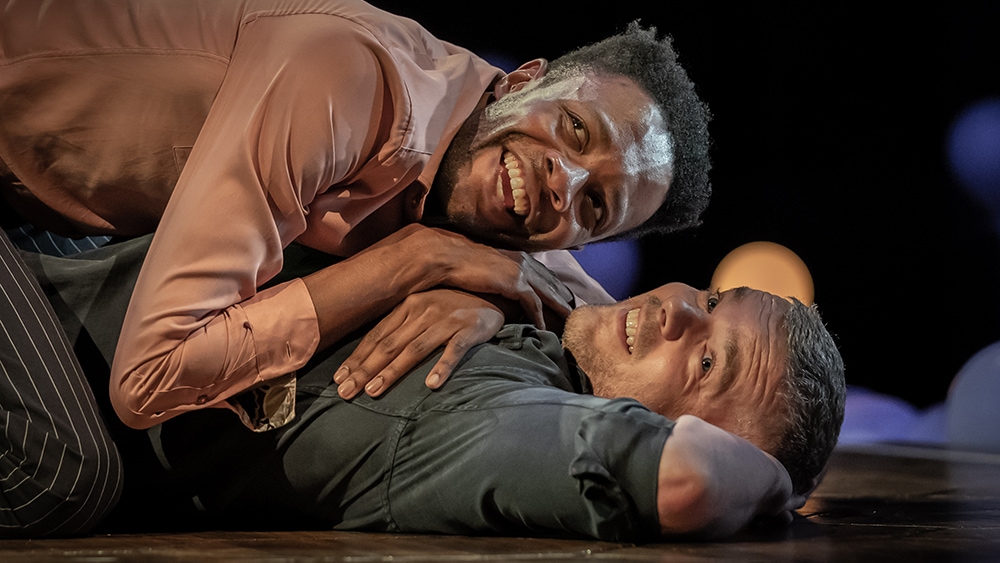
“Constellations” at the Vaudeville Theatre

I’ve loved Nick Payne’s play for a long time – since its première upstairs at the Royal Court in 2012. This exceptional two-hander, using the idea of multiverses from theoretical physics, presents diverse possibilities within one relationship. Deservedly a huge hit, Constellations is a must-see that is getting better with age. I wonder in what universe we can start calling it a modern masterpiece?

With this revival of Michael Longhurst’s production, also seen in the West End and on tour, the headline news is that four groups of performers will tackle the fantastic roles. Take your pick from Sheila Atim and Ivanno Jeremiah, Peter Capaldi and Zoë Wanamaker, or Anna Maxwell Martin and Chris O’Dowd. The exciting possibilities reflect the different outcomes within the text – a very smart idea.

A fourth option intrigued me more than the other talented combinations – Omari Douglas and Russell Tovey. Constellations wasn’t written with a gay couple in mind. Would the play or text change? As it happens, tweaks are minimal and the play isn’t altered a jot: it’s just as funny and moving as before. And both performers have taken every advantage of the opportunities within Payne’s script.

It’s not quite fair to say that Tovey supplies the laughs and Omari the tears. The roles point towards this, but both performers embrace the short scenes with different outcomes and swiftly altering emotions that the play features. But Tovey’s comedy skills really are excellent – there are proper belly laughs in the play. And Omari is heart-breaking as Payne develops his theme of mortality with fantastic skill.

The text isn’t just rewarding for performers. If you’re new to it Constellationswill stay with you a long time. Pulling out universals from the multiverses we encounter makes for powerful stuff. Or, appropriately enough, if you have seen the play before, your reactions might change. For me, Longhurst brings home how clear Payne’s text is: for complex ideas about science and free will the exposition is excellent. And maybe it’s my own age, but the play is much more moving than I recall. 

While I remember being moved to tears all those years ago, I cried even more this time around. And I wasn’t alone. A sell-out show with no social distancing, the production received a fantastic reception from the audience. A keenness to talk as soon as the lights come up is, like the show itself, a thrill to experience. Nearly ten years on, there’s still a fantastic buzz about – in my universe anyway – this modern masterpiece.

Until 12 September 2021

www.nimaxtheatres.com

Photo by Marc Brenner

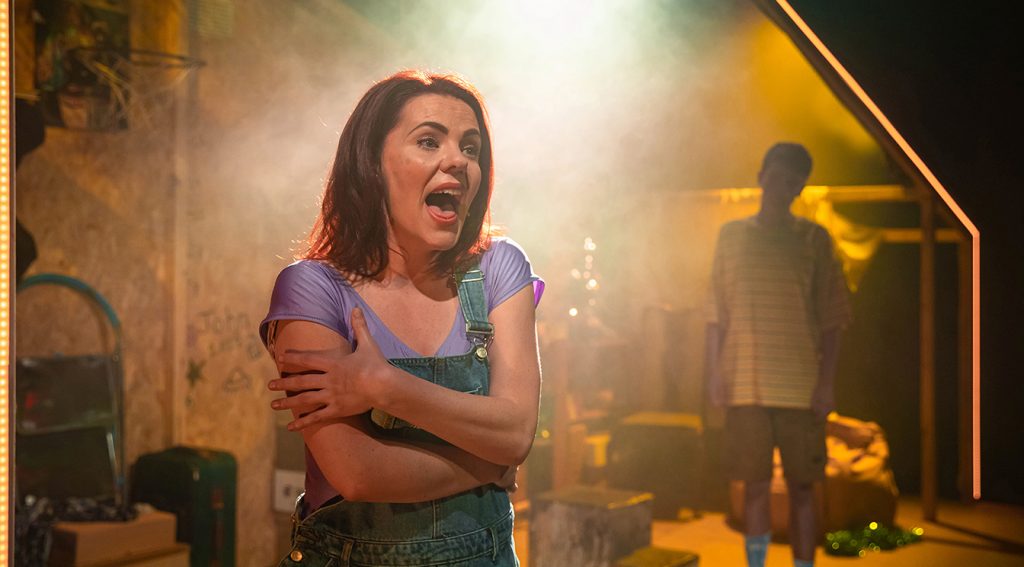
“John & Jen” at the Southwark Playhouse

Deceptively simple and slow burning, the cumulative power of Andrew Lippa and Tom Greenwald’s musical benefits from Guy Retallack’s direction in this strong revival. The production is clear about the show’s complexity and the performances, from Rachel Tucker and Lewis Cornay, are full of fire.

John & Jen is a family drama with a novel structure – the second act is a nice twist if you are new to the piece. Suffice to say that we follow characters through different ages and stages of their relationships. It’s a gift for Tucker and Cornay, who portray their roles from toddlers to teens and adults to remarkable effect, and not least with their singing. To express such different ages while always sounding great is a very special skill.

Lewis Cornay in John & Jen Photo Danny Kaan
Lewis Cornay

Greenwald and Lippa’s book tackles plenty. There’s the usual coming-of-age angle as well as politics that point to cultural divides, domestic abuse and toxic masculinity. It should be too much. But Retallack’s strategy is a light touch that makes interpretation surprisingly open. Picking a major concern is deliberately tricky – down to each member of the audience. The clever juggling act seems grown up to me – again, aided by Tucker and Cornay’s acting talent. 

Smart stuff, then, but sometimes cold? Though you warm to the characters, and the short scenes showing changes in their relationship ring true, the show is tricky to love. The level of accomplished professionalism – clear in Lippa’s score and Greenwald’s lyrics – lacks inspiration. There’s a hint of careful manipulation, albeit effectively employed, with refrains that come back to haunt or lines repeated with a sting. And there’s a saccharine streak that two or three funny numbers do not balance out. Tucker and Cornay are strong comedians, too – I really can’t praise them enough – but, despite a few laughs, the overall effect is soppy. 

Rachel Tucker in Jonh & Jen Photo Danny Kaan
Rachel Tucker

While there is plenty of detailed Americana, a sense of specific place is lacking. Presumably, Lippa and Greenwald wanted to make the show resonate with a large audience. But for British viewers I’m betting the attraction for this production will come with the performances.  Seeing West End stars Tucker and Cornay in the small space at Southwark is a huge treat. Both add an impressive weight to the score with powerful voices that intoxicate (the singing is sometimes more impressive than the songs). Along with superb musical direction from Chris Ma, the show sounds simply fantastic. Five-star performances in a four-star musical but, without doubt, a show to see.

Until 21 August 2021

www.southwarkplayhouse.co.uk

Photos by Danny Kaan