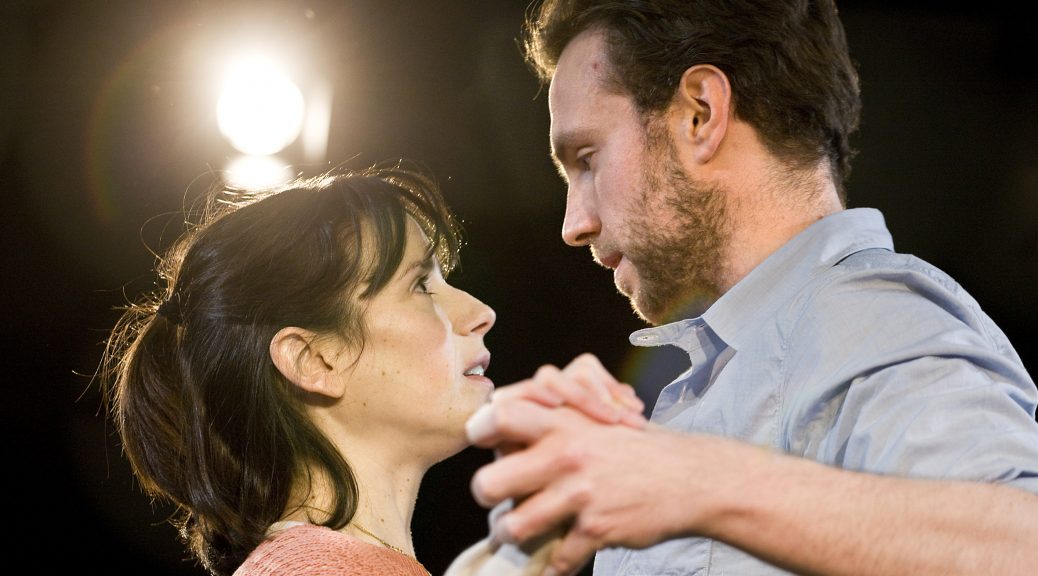
“Mathematics of the Heart” at Theatre 503

There’s a lot of common sense in Kefi Chadwick’s play The Mathematics of the Heart, now running at Theatre 503 in Battersea. Paul, a middle-aged maths professor, loves order and seeks to predict what will happen. Chadwick reminds us that the world isn’t like that.

Disrupted by his father’s death and the arrival of an odd bequest – a pre-packed sailing boat – Paul’s relationships with his new student, his errant brother and his long suffering fiancée come adrift. Fortunately, Chadwick and the cast are thoroughly in control.

Bella Heesom is arresting as the young student and Isabel Pollen gives a stunning performance as the fiancée constantly in waiting. Pollen’s character is a cold fish, which makes her well-observed and emotional performance all the more remarkable.

But the heart of the play is a fascinating sibling relationship. Mark Healy is terrific in the lead and Mark Cameron is given a superb role as his brother Chancer. The ego-driven, self-appointed moniker is indicative of this obnoxious but funny, free spirit (there’s a touch of Gloria Swanson about him – the many rock groups he has joined haven’t sacked him, “I always leave first!”). Chancer and Paul are diametrically opposed, artfully described as double pendulums: starting out together but now swinging at different velocities and, frighteningly for Paul, at unpredictable speeds.

Chadwick doesn’t plumb the depths of a connection between maths and art – for academic simply read emotionally dysfunctional. Director Donnacadh O’Briain provides a nice take on the mechanics of theatre, though, with the cast making open demands on the sound and lighting and some very sweet audience participation. It is a shame that O’Briain allows Theatre 503’s intimacy to become a problem, with far too much action occurring in the aisle. Take care to sit at the back and away from the steps as it would be a pity to miss anything about this well crafted, accessible and appealingly modest play.

www.theatre503.com

Until 3 March 2012

Photo by Simon Kane

Written 10 February 2012 for The London Magazine
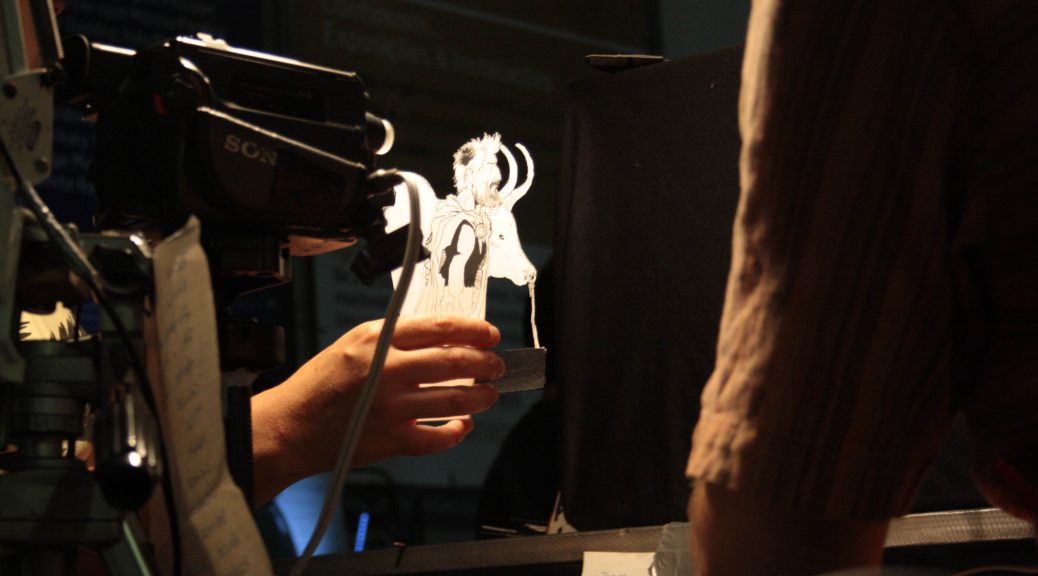
The Paper Cinema&’s “Odyssey” at the Battersea Arts Centre

Performance has always played a role in the story of Odysseus. The tale of Homer’s wandering hero was recited long before it was recorded on paper and the telling has never stopped. The Paper Cinema introduces its own special brand of theatricality by producing a live animation in the form of a film, with pen and ink wash drawings and cut-out paper puppets projected on to a screen.

Apart from an onomatopoeic ‘splash’, words are stubbornly excluded from this retelling, and this focuses our attention all the more on the artistry of both Nic Beard’s wonderful drawings and Ed Dowie’s fantastic accompanying music.

Images and sounds play on a sense of wit and invention that delights, particularly as the puppeteers and musicians sit in front of the screen so that we can watch them making it all happen. It’s fascinating and inculcates a growing sense of respect for their controlled teamwork.

With a seemingly lo-fi approach, one appreciates their care, attention and humour all the more: the overlapping images are perfect for conveying the memories of the characters, and there’s a playful sense of scale and a good few visual jokes (the Cyclops’ dad-and-trident tattoo is a lovely touch).

This journey is hypnotic and heart-warming. It is possible to see a drawback to its charms – it turns The Odyssey into something of a fairy tale. But you’d have to be a real purist to object. The Paper Cinema has such skill in tapping into the magical thrill behind all good puppetry that seeing the strings doesn’t break, but extends, the spell.

Until 25 February 2012

www.thepapercinema.com

Photo by Perrine Desproges

Written 7 February 2012 for The London Magazine
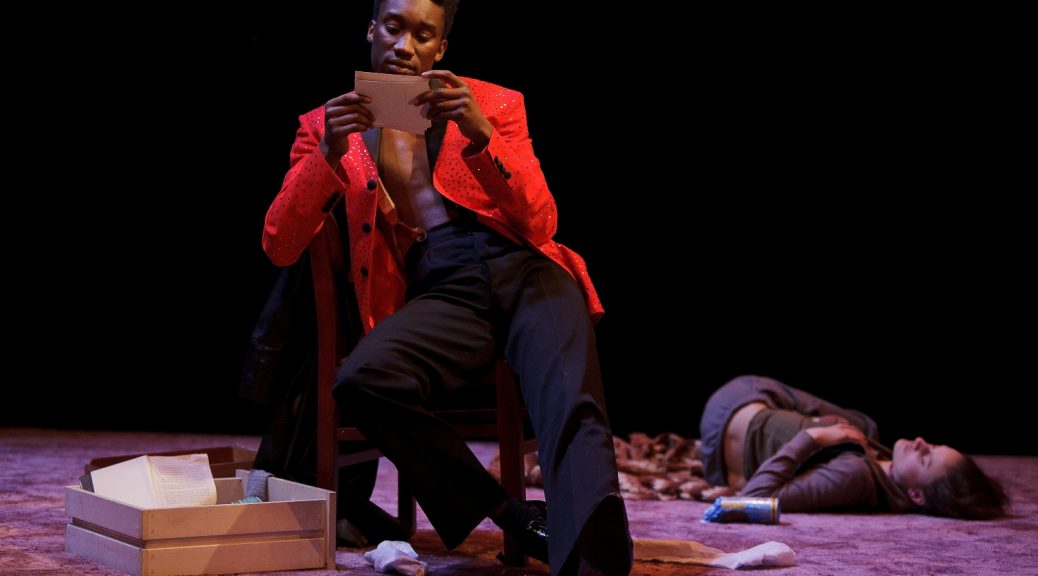
“The Pitchfork Disney” at the Arcola Theatre

The Arcola’s new production of Philip Ridley’s The Pitchfork Disney marks the play’s 21st anniversary. It’s a study in terror, which might lead us to speculate whether our collective fears have changed in texture over the last two decades. Ultimately Ridley deals with such basic, and base, themes that his work remains alarming and powerful.

Under Edward Dick’s faultless direction, Chris New and Mariah Gale are remarkable as Presley and Haley – pill-popping, chocolate gorging twins with a psychotic bent. Agoraphobics who wallow in their piteous existence, they tell stories to each other not just for escapism but to perpetuate their trauma.

And what stories, hypnotically poetic, ruthlessly insightful and grotesquely overblown as they are. The cast revel in the telling, with New especially adept in bringing out the morbid, humorous edge. His Presley peeps through the letterbox, looking at the real world but describing his imagined apocalypse.

When the door to this disgusting flat is opened, inviting in a “pretty boy and a foreigner”, we start to see connections between their fantasies and what really exists. Cosmo Disney has a thought-provoking story of his own, and Nathan Stewart-Jarrett’s performance in the role is captivating. He damns the twins as “ancient children” and mocks mankind’s desire for a “daily dose of disgust”, making his dissecting analysis more like a vivisection.

Disney is a performer and Stewart-Jarrett preens to perfection, with a cabaret trick of eating cockroaches. But The Pitchfork Disney doesn’t just curl toes – it surprises. When Disney’s fellow performer Pitchfork arrives, it is into a bizarre, spooky and fantastic scene that doesn’t deserve a plot spoiler. Presley’s nightmare starts to come to life and they play’s conclusion is truly desperate.

If people such as these exist, they surely don’t get this weird without something happening to them. Ridley never offers us a specific reason and his play is so full of themes that the mind boggles. In this way, he leaves us to examine our own fears of “freak accidents and freaks” – and that of course, is truly scary.

Until 17 March 2012

www.arcolatheatre.com

Written 2 February 2012 for The London Magazine
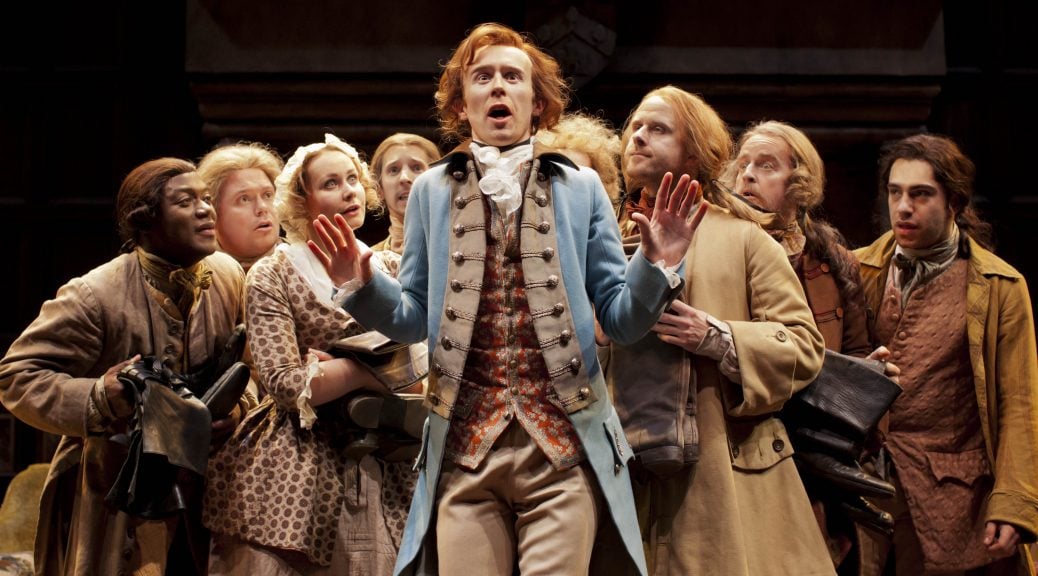
“She stoops to conquer’ at the National Theatre

Any production of a comedy at the National Theatre is likely to be compared to the venue’s most recent success, One Man, Two Guvnors. As Richard Bean’s updating of Goldoni’s play moves to Broadway, and opens with a new cast in the West End, the National’s newest attempt to make us merry is a traditional version of another 18th-century classic, Oliver Goldsmith’s She Stoops to Conquer. Remarkably, the National has succeeded again – this is a delightful production with guaranteed belly laughs.

Our hero Marlow is sent to visit his prospective bride Kate, played commendably by Harry Hadden-Paton and Katherine Kelly. But while Marlow can banter with barmaids he is impotent when flirting with women of his own class. A practical joke by Kate’s half-brother Tony Lumpkin (a superb comic creation in the hands of David Fynn) leads Marlow to believe the home of his future father-in-law is the local inn. Exploiting the confusion, Kate joins in the deception, bawdily stooping in class to conquer her diffident suitor.

Another pair of lovers, Constance (the appealing Cush Jumbo) and Hastings, joins the fun, planning to elope under the nose of the former’s guardian, the pretentious and avaricious Mrs Hardcastle. Sophie Thompson is superb in the role, her deliciously exaggerated performance making her one of the most endearing characters of the piece. But it’s John Heffernan as the foppish Hastings who takes the evening’s comic laurels delivering a master class in buffoonery and raillery.

It’s a relief that director Jamie Lloyd doesn’t try anything tricksy with the play. She stoops to conquer is “old-fashioned trumpery” that doesn’t need a modern take. Lloyd has the confidence to play it straight, knowing he just has to control the action, and the laughs will follow. Mark Thompson’s design provides the doors to slam – the text doesn’t really call for them but they add a reassuringly farcical touch. And the music – all pots and pans and trolololing, provided by Ben & Max Ringham, directed and arranged by David Shrubsole, adds immeasurably to the production. You have to see the ensemble perform it to believe how funny it is – that’s if you can hear it above the laughter.

Until 28 March 2012

www.nationaltheatre.org.uk

Photo by Johan Persson

Written 1 February 2012 for The London Magazine
“The Sea Plays” at the Old Vic Tunnels

Filing through the Old Vic Tunnels to your seat for The Sea Plays you pass a tableau of a ship’s boiler room. The scene has an energy that continues into the first thing we see on stage – a storm at sea with the crew struggling against the elements. It’s an exciting piece of theatre that stirs the blood.

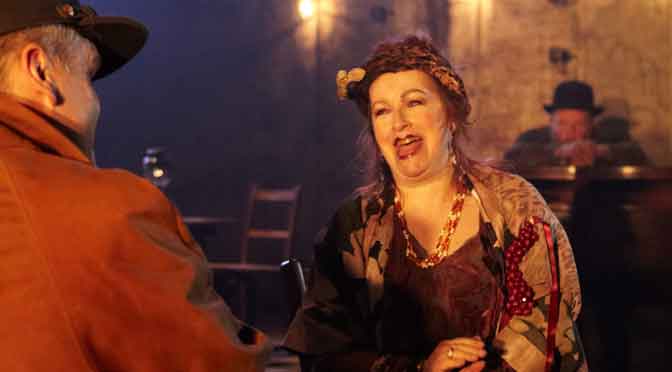
Unfortunately, matters go downhill as soon as The Sea Plays properly start. Eugene O’Neill’s three sketches show an injured crewman facing his death, a sailor subjected to the espionage-fuelled paranoia of his shipmates and finally a tavern scene with a criminal landlord exploiting those just off the boat. It’s honest of director Kenneth Hoyt not to make more of these pieces than they deserve; they are short and sharp but have little point. Critics often like brevity, but most audience members should beware if they are in search of a satisfyingly full night of theatre.

The cast sometimes struggle with roles only outlined and seldom developed. Matthew Trevannion gets the best bargain, in all three plays playing a character named Driscoll, a fiery Irishman he portrays with appropriate vigour. There are also good performances from Raymond M Sage and Amanda Boxer as a sailor with a dream and an elderly prostitute who helps swindle him. Van Santvoord’s set and Alex Baranowski’s music and sound design cleverly use the space of the tunnels, but creating these fascinating male-dominated environments is a tough ask and the swaggering machismo of the cast often falls short.

The Sea Plays are interesting for O’Neill fans but they are difficult to be passionate about. The scenarios are powerful enough and Hoyt’s direction taut and strong – he is clearly convinced of the trilogy’s power. But these vignettes are so short, and the writing often surprisingly melodramatic, despite O’Neill’s naturalist credentials, that the evening is more a matter of squalls than storms.

Until 18 February 2012

Written 27 January 2012 for The London Magazine
“The Madness of George III” at the Apollo Theatre

It seems we love the Royals right now. What with last year’s wedding and the forthcoming jubilee, there’s a feelgood factor about pageantry that our first family is riding high on. It’s well known that the Windors aren’t big theatregoers, which is a shame since they will probably miss this new production of The Madness of George III.

Alan Bennett’s 1991 textbook play, dealing with one of George III’s periods of mental breakdown (probably from the hereditary condition of porphyria), has aged superbly. Progressing from the Theatre Royal Bath, this production is highly polished. Against the backdrop of Janet Bird’s intelligent design, Christopher Luscombe’s direction is clear and pacey. While lacking satirical bite, the politics of the period are presented well, with fine performances from Nicholas Rowe and Gary Oliver as Parliamentary rivals William Pitt and Charles James Fox using the Royal family as pawns to gain power.

And Bennett’s gags about the parlous state of 18th-century medicine still shine. Peter Pacey plays the King’s first doctor with suitable sycophancy. Clive Francis is commendable as the radical physician Dr Willis whose techniques reveal the ridiculous dangers of court protocol (such as not being allowed to question the King directly) and who gets the play’s best line: “the state of monarchy and the state of lunacy share a frontier.”

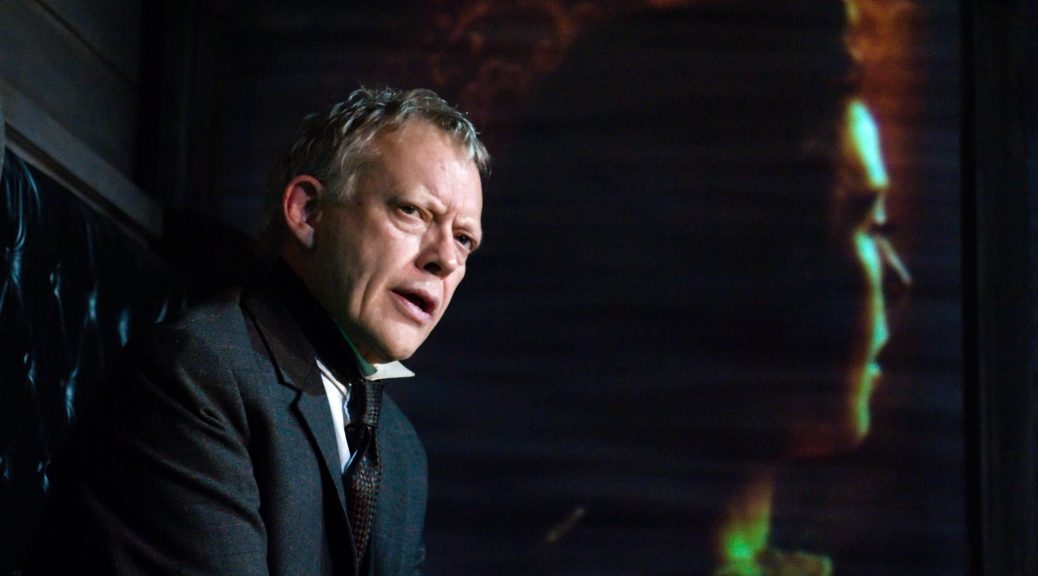
The role of George III is a dream for any leading man. David Haig lustily rises to the challenge of bettering Nigel Hawthorne’s much loved representation in the 1994 film. Haig is best at showing us the King as a likeable character: the benevolent ‘farmer’ George whose “indirect and infinite curiosity” annoys his equerries but charms the audience.

Often, if you are rich, you aren’t mad – just eccentric. So Haig works hard to convince us that George losing his mind isn’t just quaint but something painful. His performance forces this point home. We can smile when the King says he would rather go to Japan than Kew, but portraying George as an intelligent man, aware of his own tragedy is Haig’s main achievement, making this a more moving evening than you might expect.

Until 31 March 2012

www.nimaxtheatres.com

Photo by Robert Day

Written 24 January 2012 for The London Magazine
“Constellations” at the Royal Court Theatre

Constellations, a new play by Nick Payne at the Royal Court, applies the theory that there are multiple universes onto one couple. “Everything you’ve ever and never done” is played out in different ‘multiverses’ creating many stories. In a series of short scenes the relationship on stage is presented in parallel narratives – from friendship to marriage, in sickness and in health, rejection to reconciliation. These multiple realities make Constellations a truly wonderful play.

By turn hilarious, with sharp comic observations, then dealing with tragic events, there’s an ironic eye to this multiverse idea that makes Constellations a playful affair. The decisions any playwright faces when making a drama mirror those we face in life: Payne wants to show all these choices with a virtuoso display that runs his actors and audience through the gamut of possibilities.

Repeated dialogue and stops and starts that occur on entering each new universe are handled skilfully by director Michael Longhurst. And the repetition of lines allows Sally Hawkins and Rafe Spall to give stellar performances as they modulate their delivery of the same conversations in different contexts. Spall’s comic ability and incontrovertible charm are perfect for the likeable character he plays, while the moments of vulnerability show his sensitivity.

Both actors have to turn on a dime, as they switch from universe to universe, and they excel at this. Sally Hawkins is truly remarkable not only at getting laughs, but at exploring the play’s darker moments. Whenever she despairs it is deeply moving, all the more so since only a second before she was making us giggle. Seldom have I laughed and cried in such close proximity.

Constellations marks a development in Payne’s writing not to be missed. It’s an ambitious, confident piece which retains his warm wit yet has a bleak edge. The work is also beautifully poetic – the revisited phrases are not only a comic device, but wrought to create a hypnotic symphony of feelings.

If this sounds pretentious then think again: Payne works in another universe where experimentation like this isn’t pompous. There’s no intellectual posturing here and, while the ideas are a challenge, this is a practical play extolling experience, embracing our condition and offering consolation not with philosophy but physics.

Until 11 February 2012

www.royalcourttheatre.com

Photo by Simon Annand

Written 20 January 2012 for The London Magazine
“Travelling Light” at the National Theatre

Cinema and theatre have always had a close symbiosis. The relationship is often fruitful but, for those who love live arts more, Nicholas Wright’s new play, Travelling Light, about the fascinating early days of the motion picture, is an opportunity to convey emotions and ideas with an intimacy that stage, rather than screen, promotes.

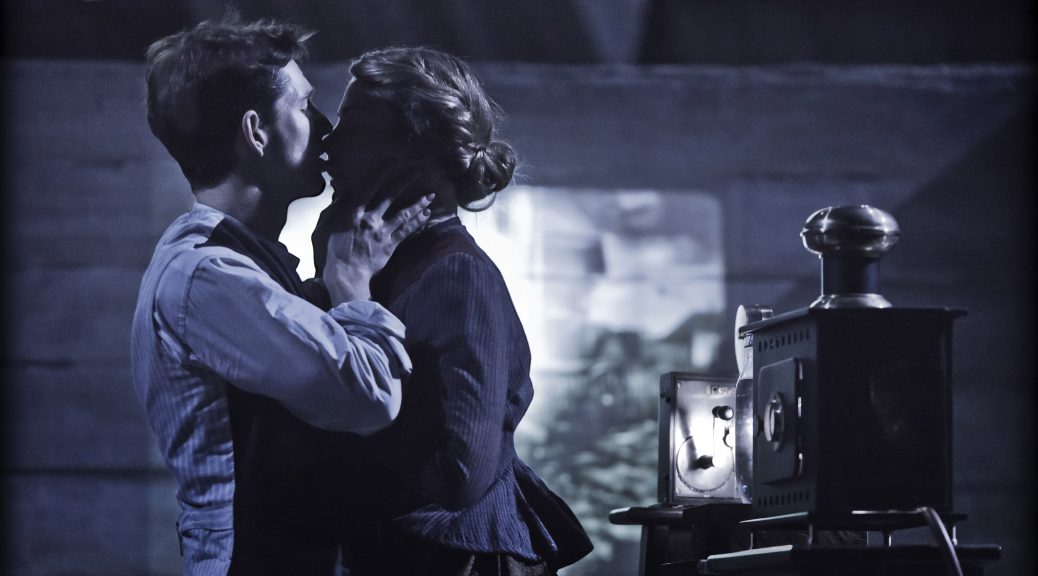
There are moments when Travelling Light uses the power theatre has to grab your attention like nothing else. It’s the tale of Motl Mendl, a Russian Jew, falling in love with the new medium of film and a girl who acts in his first picture. Punctuated with witty observations on the nature of art (a scene of the first focus group for a movie is delightful) and nostalgically interspaced with reflections from Mendl in later life, it’s an interesting story, well told – unfortunately there never seems very much at stake.

Damien Molony and Paul Jesson are both commendable as the flawed hero Mendl and there is a strong performance from Lauren O’Neil as his love interest. But the core of the play is Mendl’s relationship with his first ‘producer’, the rough and ready mill-owner of his hometown performed by Antony Sher. Clearly loving being back on stage at the National, Sher gives a robust, heart-warming performance in a difficult role that could easily turn into parody.

Unfortunately, Sher’s performance is the only thing that makes Travelling Light really compelling. Nicholas Hytner’s direction is clear and concise but the projection of film on to Bob Crowley’s design seems to have missed a trick or two.

Wright’s text seldom rises above the level of entertainment, and that isn’t much of a fault, but we often expect more from theatre, don’t we? It’s a double standard, of course, but Travelling Light is a little too light and this story of moving pictures not moving enough.

Until 6 March 2012

www.nationaltheatre.org.uk

Photo by Johan Persson

Written 19 January 2012 for The London Magazine

“The Kreutzer Sonata” at the Gate Theatre

Having broken box office records a couple of years ago, the Kreutzer Sonata’s return to the Gate Theatre gives us the chance to take an extraordinary journey once again. Designer Chloe Lamford transforms the auditorium of the Gate Theatre into the inside of a railway carriage, her clever set further condensing an already intimate space. We are about to travel with a quiet unassuming man sitting in the carriage corner.

The man is Pozdnyshev, who will reveal to us the story of his marriage and how he came to murder his wife. While hardly charming, his frankness endears him to us – he seems honest, albeit disturbed. As his jealousy and the play’s tension mount, his irrational fears begin to seem understandable – trapped in a loveless relationship, his musical wife is attracted to a violinist. Pozdnyshev becomes the victim of his own rage but believes his actions to be entirely understandable.

Pozdnyshev’s unsettling position is grippingly portrayed in Hilton McRae’s quietly nuanced performance. Considered and philosophical, what really pains him is what he views as the inevitability of events. Most impressively, McRae has the stage presence to hold our attention during this 85-minute monologue. His wife and her lover, played by Sophie Scott and Tobias Beer, make music and appear through screens on the carriage doors.

Nancy Harris handles the adaptation and translation of this short story from Tolstoy with great skill. Highlighting the narrative increases the drama and does away with the (to be frank) rather madder elements of Tolstoy’s philosophy. The misogyny is still present but just more believable – a question of character development rather than political creed.

A live performance of parts of the sonata accompanies the piece, focusing attention on the relationship between music and passion: a preoccupation for Tolstoy as an aesthetician. It also serves as a potent dramatic device, as the musicians present directly to the audience the turmoil of emotions that haunt Pozdnyshev. It’s stirring stuff. In fact, this is a train not to be missed, so get your ticket soon as I suspect many who have already seen it will be buying a return ticket.

Until 18 February 2012

www.gatetheatre.co.uk

Photo by Simon Kane

Written 12 January 2012 for The London Magazine

“Pippin” at the Menier Chocolate Factory

As its history of transfers to the West End and Broadway demonstrates, The Menier Chocolate Factory has an enviable reputation when it comes to musical theatre. This is a team that knows what it’s doing and their new production of Pippin confirms just that. If ‘updating’ a story about the son of ninth century Holy Roman Emperor Charlemagne into the computer game era sounds mad, fair enough. But it works to perfection.

The 1972 piece by Stephen Schwartz, now famous for his success with Wicked, follows the eponymous hero’s quest for a meaning in life. Pippin’s efforts to lose himself in fighting, sex or politics, are presented as levels in a computer game. Along the way he is accompanied by the sinister ‘Leading Player’, constantly nodding at a metanarrative that sits happily with the new production’s conceit.

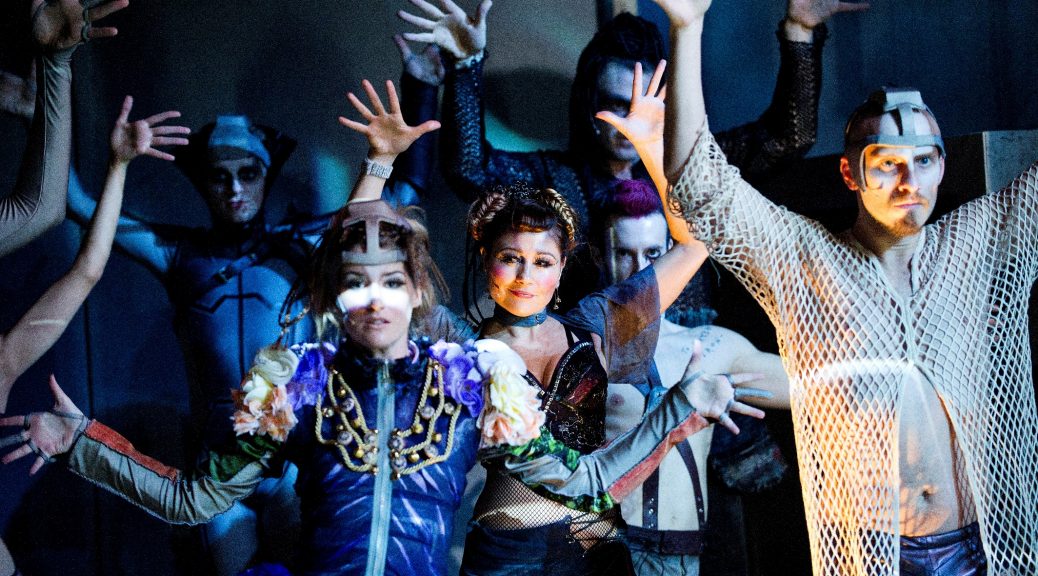
Credit goes to Director Mitch Sebastian’s confidence and determination to follow the idea through. From the zapping noises that greet the audience upon arrival, to the faces of texting monks lit up in the gloom, there’s such attention to detail you can’t help be impressed. Best of all is Sebastian’s decision to base his choreography on the original work by the legendary Bob Fosse. It is the core of the show: bold, articulate and wonderful to watch.

Using computer games to add a ‘boys own’ feel to the show allows designer Timothy Bird’s imagination to run riot with projections as witty as they are dazzling. Similarly, Jean-Marc Puissant’s crazy costumes – part Visigoth, part Tron – are something you won’t forget in a hurry. This is a sexed-up Pippin with an intelligent eye for the crass aesthetics of adolescence.

Harry Hepple’s performance as the lead is commendable. With more than a touch of self-pity Pippin’s search to stop feeling “empty and vacant” often seems indulgent but Hepple manages to retain our sympathy and his voice is great. Hepple doesn’t even get a break in the interval as he continues to play his computer game in the corridor as the audience files past. Frances Rufelle’s rendition of Spread of Little Sunshine is revelatory and there is an outstanding performance from Louise Gold as Pippin’s “still attractive” grandmother that is a genuine crowd pleaser.

Pippin is very much a musical lovers’ musical. You need to be able to laugh at lines like, “it’s better in a song”, as well as adoring catsuits and jazzhands. While Schwartz can write a good tune and a serviceable lyric, providing plenty to hum on the way home, much of Pippin is so firmly rooted in the 70s it can be painful. Unusually it is Sebastian and his cast that should get the credit, transforming a musical that could be damned with faint praise into a fantastic night out.

Until 25 February 2012

www.menierchocolatefactory.com

Photo by Tristram Kenton

Written 8 December 2011 for The London Magazine