Tag Archives: Hampstead Theatre

“Wonderland” from #HampsteadTheatreAtHome

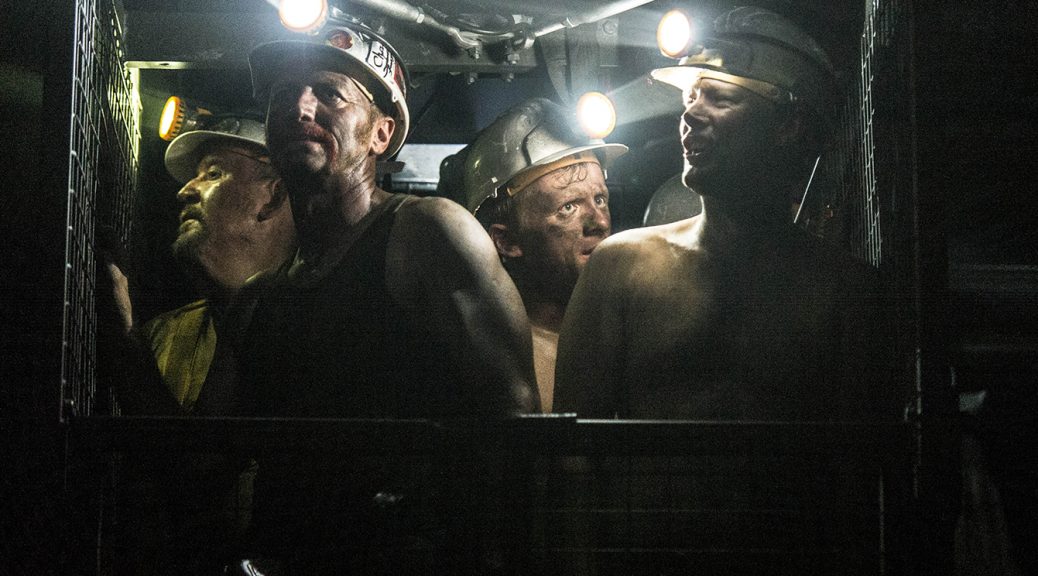
This second online offering from Hampstead Theatre shows Britain in a different kind of crisis than the coronavirus we currently face – The Miners’ Strike of 1983. Although it’s always clear where the show’s heart rests, presenting events from the perspective of both workers and government creates problems. But playwright Beth Steel’s achievement is to convey a sense of those times as epoch making, giving the history a palpable urgency in a play full of passion.

There’s real heart in Steel’s depictions of the miners and it makes the story engrossing. Starting off slow, showing work underground, during the strike both tension and emotion build well. Performances from Paul Brennen as the ‘Colonel’ of a mine and a pitman who disagrees with the strike, played by Gunnar Cauthery, are highlights. If the roles of two young apprentices, Jimmy and Malcolm, seem less secured, with their motivations and characters more confused, there are further strong performances from Ben-Ryan Davies and David Moorst. Steel is strong at showing a blend of comradery, with humour and machismo, alongside revealing the craft behind the graft. It makes Wonderland powerful stuff.

When it comes to the politicians and businessmen on the other side of the strike, what is mined is conspiracy rather than character. The result is a selection of stark portrayals that, even if they are accurate, mean performances struggle. Michael Cochrane has a good go as Ian ‘Butcher’ MacGregor, Chairman of the Coal Board, which is an interesting role, surely written as too naïve. The parts for Transport Secretary Nicholas Ridley and that of David Hart, whose role in events is understandably confusing, are too villainous (likewise any police shown). It’s left to the ‘wet’ Energy Secretary Peter Walker to present any kind of balance and, while Andrew Havill, who takes the part, does a good job, he isn’t given enough to work with.

There are moments when director Edward Hall could help more: a scene of political debate disappears into the pit as it’s getting interesting and a tragic finale, which enforces the dangers of mining and has some of Steel’s finest writing, is sacrificed for the sake of action. Yet Hall deals with all the incident Steel crams in – and it’s a lot – with commendable efficiently. The set from Ashley Martin Davis, mining lifts and all, is excellent and well used. There’s valuable support from lighting designer Peter Mumford and composer Simon Slater, whose ‘theme tune’ for the miners is highly effective. The commitment behind the show shines out as the injustice of “proud working men treated like dogs”, victims of ideology and political machination, are exposed with conviction.

www.hampsteadtheatre.com

Available until 12 April 2020

Photos by Manuel Harlan

“Wild” from #HampsteadTheatreAtHome

The first of three free streamed recordings on offer, Mike Bartlett’s 2016 play takes inspiration from Edward Snowden and revelations of government spying on its citizens. This superb play shows Bartlett’s characteristically calculated skill and cool intelligence.

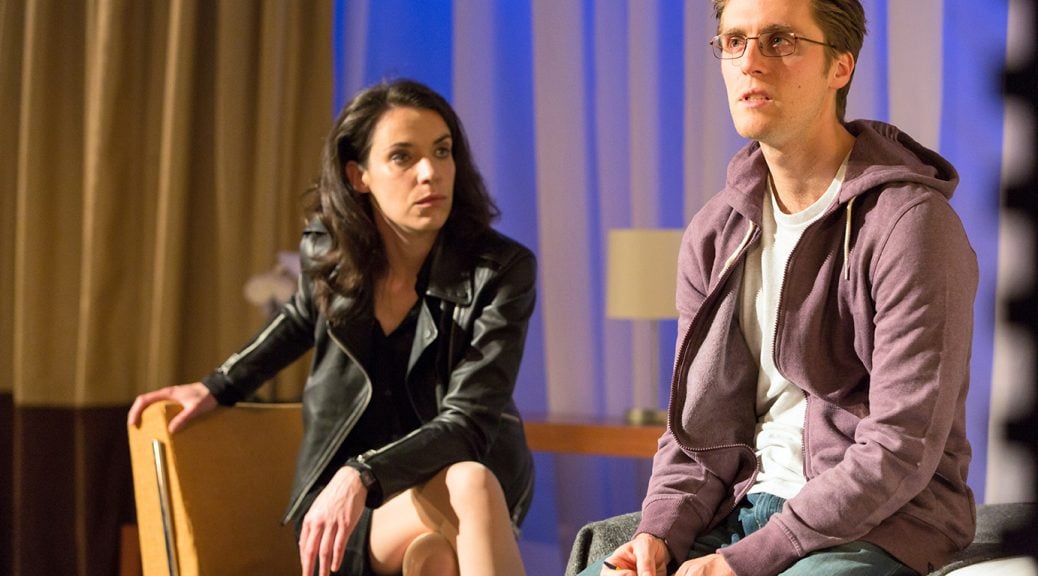
Handled impeccably by director James Macdonald, for a while, Wild looks like a modest two-hander. The Snowden character, renamed Andrew, meets his contact from what we assume is WikiLeaks in a Russian hotel room. What happens to a man right after he becomes the world’s biggest ever whistleblower? It’s a smart little twist and what follows is often clever, and funny, provoking plenty to debate.

The next move is to make ‘George’, sent to represent Julian Assange, quite bonkers. Andrew’s rescuer arrives in tottering high heels and with plenty of provisos, making a great role for Caolifhionn Dunne, who gets a lot of laughs. If the performance seems a bit broad on a screen, it’s clear it would inject energy on a static stage.

Questioning Andrew’s actions and motivations, playing with the espionage surrounding the situation (which also introduces considerable threat) continues when another George appears. This time played by John Mackay, whose dour presentation is just as good as Dunne’s mania. The play takes on a surreal paranoia with simple effectiveness. 

In the role of Andrew, Jack Farthing’s response shows how carefully his performance has been prepared; increasing the panic nicely and adding an intriguing depth to the role. Yet the play still has an economy to it that’s impressive. Only later does extravagance arrive.

Bartlett is not a playwright shy of exaggeration and this comes into its own in Wild. Conspiracy theories pile up, moving tantalisingly close to spiralling out of control, and, as the arguments become more abstract, Bartlett’s tone turns impassioned and aggressive. Both of the Georges become demonic figures, whose power is undoubted, while Farthing makes his character’s lot lamentable. 

For final praise, there’s a plot spoiler. Designer Miriam Buether (with a consulting illusionist, Ben Hart, also credited) provides a set with a surprise – it collapses and the floor rotates 90 degrees. As a literal metaphor for Andrew’s disorientation it may not be subtle – but it’s brilliant theatre and leaves a stunning impression.

www.hampsteadtheatre.com

Available until 5 April 2020

Photos by Stephen Cummiskey

"I and You" at the Hampstead Theatre via Instagram

While not being able to visit the theatre, or blog about it, is low on the list of most people’s problems right now, any glimpse at a big part of my normal life is welcome. I’m grateful to Hampstead Theatre for streaming this play, first seen on its stage last October, and a chance to get as close to theatre as is currently possible.

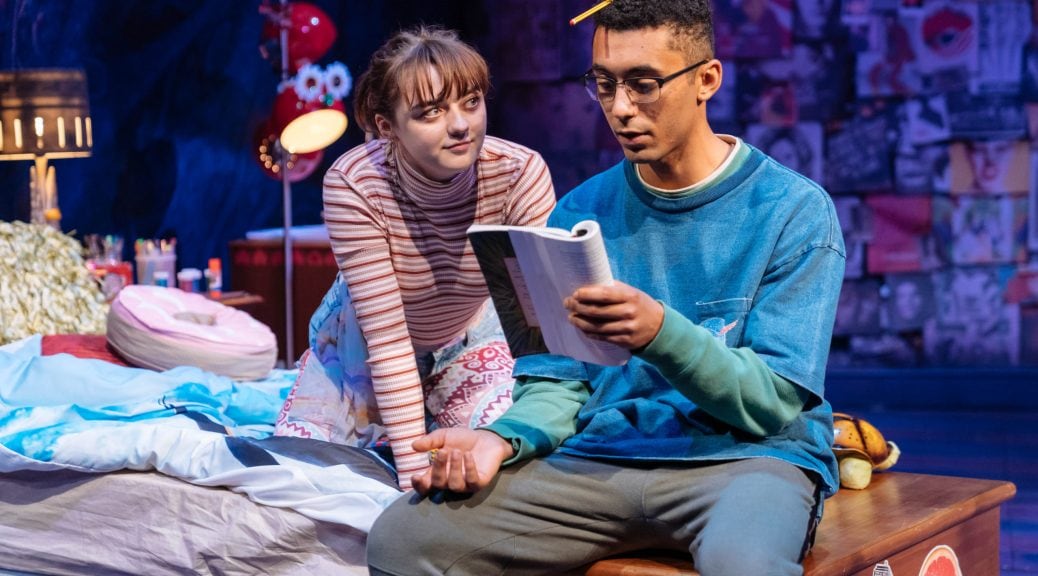
Lauren Gunderson’s two-hander has its teenage characters occupied with death and art. Caroline is waiting for a liver transplant, trapped in her room for health reasons, while Anthony from her school is assigned to work on a poetry project with her. It’s serious stuff, but not as heavy as it sounds. Gunderson has a nice way of lightening the themes with some surprisingly gentle comedy. 

The performers, Maisie Williams and Zach Wyatt, are good with the jokes and Gunderson’s strong characters are a gift to them. Williams makes Caroline’s self-definition as “small and mighty” believable – the character is abrasive and obnoxious, but above all appealingly honest. It’s no small achievement to see past the illness to get a well-rounded role: her hatred of the “kittens and winky faces” people send her on social media, as well as her obvious intelligence, come through. And surely you have to admire someone who names their cat Bitter. Wyatt has a harder job but also does well: Anthony’s enthusiasm for the poetry of Walt Whitman feels forced, but it’s easy to see how it would have worked better on a stage than on a screen. For a lot of the piece, there’s too much of the teacher about him for someone who is supposed to be Caroline’s peer.

There are other problems, although all are mitigated by Edward Hall’s skilful direction. Claiming I and You is too shouty might be subjective, but there are clunky touches around sudden love and pain. We can pass over Caroline’s knowledge of a poem she supposedly hasn’t read, but her enthusiasm waxes and wanes too abruptly. And, while the budding friendship between the two youngsters is mostly touching, a potential romance feels superfluous. The play’s twist, which has potential, arrives a little too late and feels underexplored.

Nonetheless, this is a work of focus and skill. Gunderson has a strong ear for speech. The kids’ project is on pronouns, and proves thought-provoking, while Caroline’s dialogue, with its “prefaces” and “postscripts”, is fascinating. While there’s plenty of talk of collages, and how strange they can be, Gunderson’s work is far from bricolage and all the better for it. Caroline’s artwork focuses on close-up photography – the beauty that most of us miss – a quality shared with detailed moments in the text. I look forward to seeing Gunderson’s work live at some point and promise I’ll attend whatever show she, or Hampstead Theatre, has on as soon as I can.

Available @hampstead_theatre on Instagram until Sunday 20 March 2020

Photo by Manual Harlan

“The Phlebotomist” at the Hampstead Theatre

There is a great excitement around playwright Ella Road and her first impressive play. After a sell-out premiere last year and a transfer from the venue’s studio space into the main house – with an Olivier nomination under its belt – congratulations are in order. Road’s ear for dialogue is sure and the production strong. It’s a shame that control of the subject matter is lost in this sci-fi romance. Ultimately, the genre ends up manipulating the writer, rather than the other way around.

The scenario is that a system of genetic ratings based on blood tests changes our not-too-distant future. Road has no shortage of ideas, and a series of films crowds the show with news reports or fake adverts. But none of this is particularly novel or hard to foresee, so the play as a whole becomes predictable. While the testing is initially to assist in healthcare, its application in jobs, dating and then eugenics appears quickly. Each could be the focus of a play in its own right but, crammed together, the topics feel thinly explored. There are too many questions and some silly inconsistencies, while tacking on environmental concerns doesn’t help either. There’s a reason sci-fi has so much detail – without the geeky touches, the future world we find ourselves in fails to convince.

Road escalates outrage at a steady rate but with little change of pace in the structure of her scenes, so the show feels slow. By the time we’ve got the legalisation of “post-natal abortion”, attempts to challenge the audience feel more than desperate – they are naïve. Tasteless or provocative? That might depend on your view of human nature. But it seems fair to suggest it’s a dramatic own goal to curtail a plot about the fight again “rateism” so quickly. Only one figure (and a couple of news snippets) attempts to challenge this nightmarish system. A subplot about dealing in blood is carefully contained as a matter of financial corruption. The characters are worryingly lacking in morality or even agency.

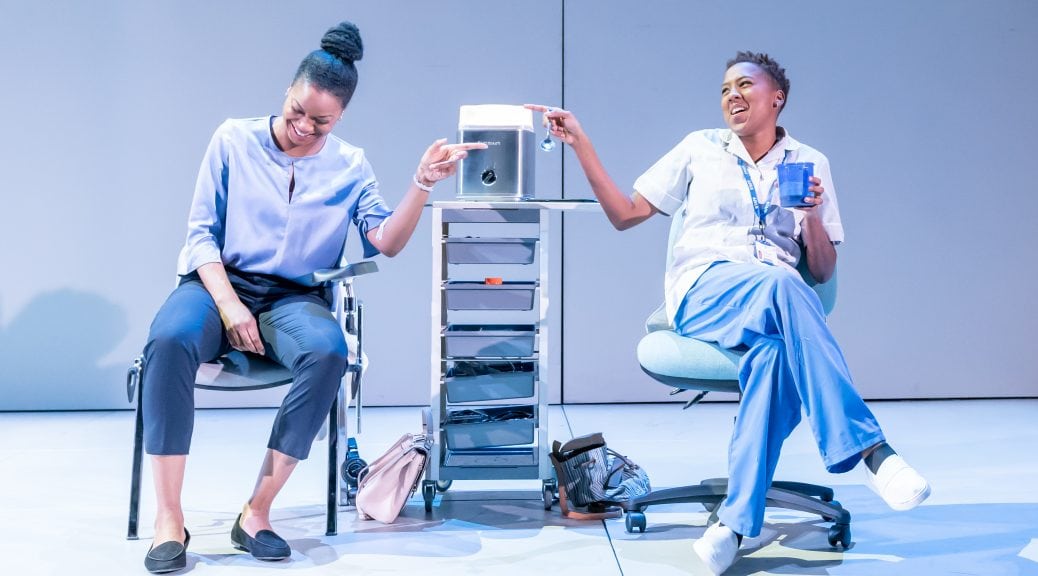
For all the problems with the plot, the production is good. Road benefits from ambitious direction from Sam Yates and a superb cast that laps up her well-written lines. Mark Lambert makes for an intriguing impartial observer in his role as a hospital porter. Kiza Deen does sterling work as a protestor who develops Hodgkin disease during the course of the play. The Phlebotomist is essentially a love story between Angus – played by Rory Fleck Byrne, who reveals his character marvellously – and Bea. She holds the occupation that gives the play its title, and the role shows Road’s strengths. A brilliant performance from Jade Anouka – who demands both our sympathy and revulsion – makes her the highlight of the night.

Until 20 April 2019

www.hampsteadtheatre.com

Photo by Marc Brenner

“Cost of Living” at the Hampstead Theatre

Edward Hall’s venue has a strong reputation for bringing American plays to our shore. Taking directorial charge of this one is clever move, as is getting Martyna Majok’s play over here so quickly – it only won the Pulitzer Prize for Drama last year – because the piece hits the jackpot. It’s the kind of play you really want to win big.

As a story focusing on people with disabilities, Cost of Living answers an urgent need for diversity and representation on the stage. Nobody should knock that, but Hall also knows a fundamentally strong play when he sees one. Following John and Ani, who both need constant care, it is true that some issues raised about the health system and class are more relevant to an American audience… one hopes. But this is a play so full of life, of pain and of love, that it is impossible not to get caught up in.

Jack Hunter and Emily Barber

First taking John, a wealthy grad student, performed superbly by Jack Hunter, and his carer Jess, their scenes are full of wit and tension with the non-disabled Jess as the focus. Her poverty and personality are conveyed with great skill by Emily Barber, who clearly appreciates how Majok is guiding the audience.

An even more complex relationship is that between Eddie (Adrian Lester) and his ex-wife Ani, who was injured in a car crash. The story of her death prologues the play, with a moving meditation on grief that could stand alone as a brilliant monologue. The balance between “glum” events and the play’s humour shows Majok’s skills further. The dialogue throughout is stunning in its naturalism. For a conclusion, both Lester and Barber excel again as the hope that the play never ceases to include is allowed as a final note.

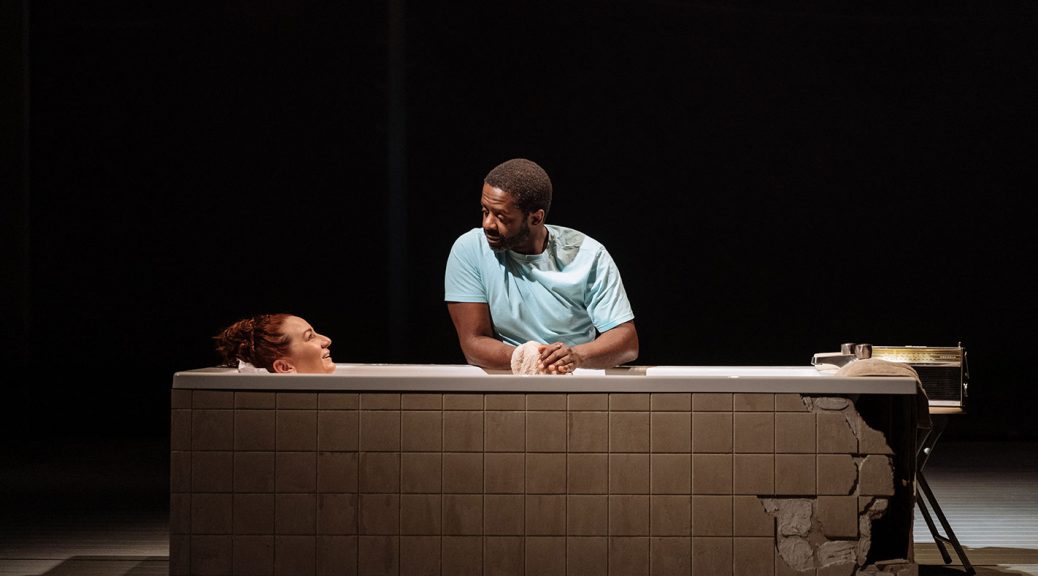
The central scene, which I’d put money on as being the germ of the piece, is something else. Ani (played marvellously by Katy Sullivan) is being bathed by Eddie. Starting with an intense intimacy, this is a sex scene the likes of which you’ve probably never witnessed before on stage. The tenderness is moving, the atmosphere electric and the insight profound. To embody her theme that the smallest mistakes can change – and end – lives, Majok then produces a shocker. Truly, I’ve never heard such gasps from an audience. An unforgettable moment of theatre is what gets you awards, and it makes Cost of Living a priceless play.

Until 9 March 2019

www.hampsteadtheatre.com

Photo by Manuel Harlan

“Caroline, Or Change” at the Hampstead Theatre

Well done to Edward Hall for bringing this Chichester Festival production to London. Director Michael Longhurst’s modest treatment of this major musical, about racism in the American south, has an intimacy that increases its intensity. The talents of Tony Kushner and Jeanine Tesori are awe inspiring, and this work ground breaking. The piece is sung throughout, so there’s a case for calling it an opera, but the genre doesn’t matter – this is simply something everyone should see.

Caroline, Or Change is at heart a “small domestic tragedy” about a middle-aged black maid, her children, and the family she works for. It’s a given that Sharon D Clarke would be good in the title role, but it’s a thrill to see just how great: her voice gives goose bumps and she portrays Caroline’s tough life, and harsher attitude, unflinchingly. Making Caroline heroic is interesting in itself, and seeing her through the eyes of Noah, the young boy she works for, is a brilliant device. She is not a wholly sympathetic character and Clark’s triumph is to balance the dramatic tension that results from this.

Following Caroline’s day, the washing machine, dryer, radio and bus she travels on all get songs. That might sound like Disney, but the music is for grown-ups and powerfully performed by Me’sha Bryan and Ako Mitchell, while T’Shan Williams, Sharon Rose and Carole Stennett make up a 60s-style singing trio. When allowed to keep coins Noah leaves in his laundry, Caroline’s struggles to take the child’s money. And all is played against the backdrop of the Civil Rights movement. So there’s change, big and small, with a heroine so poorly equipped to deal with either it becomes heart-breaking.

Kushner is a big ideas man, and there’s plenty of challenging thinking here. But these lyrics must count as some of the most extraordinary written. Along with propelling the plot, extending the family dramas and explicating historical events, the complexity of emotions expressed is remarkable. There’s wit, which makes many lines laugh out loud funny, and breath-taking imagery. Much of the text is pure poetry.

Matching Kushner’s skill with words comes the music of Jeanine Tesori. It’s a huge achievement that these lyrics never feel compromised: always clear, not a word out of place. The musical references have to be various, there’s a clash of cultures to evoke alongside a period feel. With gospel and blues comes Jewish folk music, the American anthem and Christmas carols. Weaved into all of these, with massive intelligence, are motifs for characters that provoke huge emotional impact.

Kushner and Tersori are smart and know great works require originality. Caroline, Or Change isn’t quite like anything else. It’s not just a matter of quirks – although it has delightful surprises – or contrariness. The audience goes home on a high (as it should). But Caroline’s fate is realistic, and any feelgood comes from the legacy of her children: led by her daughter Emmie, who wants to embrace the new and is given a suitably inspirational depiction by Abiona Omonua. Caroline herself can’t change. Given her life, could you? But putting such a fallible figure against dramas big and small is an important triumph of its own.

Until 21 April 2018

www.hampsteadtheatre.com

Photo by Marc Brenner

“Ken” at the Bunker Theatre

This tribute piece to the multi-talented Ken Campbell, who died ten years ago, comes from the pen of his old friend the playwright Terry Johnson. Campbell is clearly much missed and this celebratory evening explains why: originality, intelligence and independence made him a presence in the theatre, while a maverick sense of humour made his company appealing.

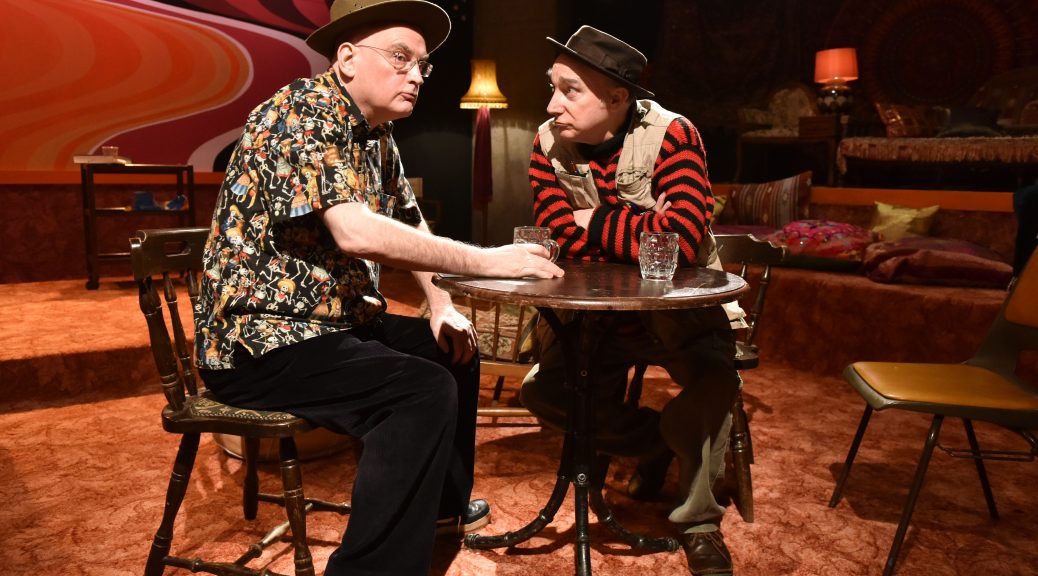
A skilled impersonator, Jeremy Stockwell takes the title role, and the show is very much for those who will recognise his Ken straight away. But as he strides through the audience, with Tim Shortall’s design recreating late 1970s hippydom, his confidence and enthusiasm are highly entertaining. And there’s a touch of insanity: old-fashioned smut alongside experimental avant-garde makes for an edgy combination that could have been elaborated on. Campbell’s theatre was a long time before ‘safe spaces’, of course, but questioning some of his actions might make the show feel less cliquey. Instead, the atmosphere is convivial-clubby, if you are being harsh. Stockwell knows how to work a crowd, but I am just not sure how you’d feel if Ken’s wasn’t a club you wanted to belong to.

Johnson takes to the stage as himself, showing a modesty and honesty as impressive as his erudition. The finale, recounting Campbell’s funeral, is vividly written. The impact Campbell had on Johnson’s life, imbued with a confessional air and a great deal of humour, is moving and intensely personal. This isn’t your standard biography. Described as a “seeker” with a perpetually open mind, it’s Campbell’s antics, the kind of shows he put on, and the tricks he played that make him memorable. Indeed, some of it is so far-fetched that a writer wouldn’t dare to make it up. And it’s interesting to journey back to a time when theatre was so different: especially in an exciting venue that’s announced such a forward-thinking season for 2018. After all, who doesn’t want to learn about the holder of the world record for the longest ever play, or the man who took it upon himself to rename the RSC? This “Essex estuary incarnation of Pan” gets a fond farewell that is suitably idiosyncratic.

Until 24 February 2018

www.bunkertheatre.com

Photo by Robert Day

“Cell Mates” at the Hampstead Theatre

Edward Hall always puts on a classy show. His direction for this first revival of Simon Gray’s 1995 play is, typically, clear and careful. And Hall always gets great performances from a cast: here Geoffrey Streatfield plays the spy George Blake, alongside Emmet Byrne as Sean Bourke, who “sprung” him from prison, and both are superb. Joined by Philip Bird, Cara Horgan and Danny Lee Wynter, who play different characters aiding and abetting the criminals in the UK and then Russia, it’s as fine an ensemble as you could wish for. The production also boasts an impressive set from Michael Pavelka that feels ready and waiting for a West End transfer.

The only problem is that this is a disappointing play that Hall has an unjustified faith in.

While Cell Mates is based on a thrilling real-life story, complete with Blake’s extraordinary break-out from Wormwood Scrubs prison and subsequent life in Russia, the play steers away from a documentary feel or political commentary. Fair enough. But for a piece rammed with spies and the Cold War, it seems perverse to include so little tension. A scene in Blake’s safe house shows Gray’s strength for farce, expertly executed here, while making the KGB officers we meet funny is fine (Wynter is especially good at this), the play isn’t really a comedy either. The focus is Blake and Bourke’s relationship: why the latter helped the former, and why he was subsequently betrayed and imprisoned when visiting Blake in Moscow. Unfortunately, the duo’s friendship isn’t made interesting enough.

Blake and Bourke’s first meeting is gnomic, if intriguing. Scene II starts to reveal some idea of why Bourke might be around – he wants to be a writer and senses “a story to tell and a story to sell”. While this motif is taken up as both men work on books when in exile it does not settle the question of their bond or provide motivation for what they go through together. Talk of a “country of the future” and ideologies is given the briefest lip service. Streatfield and Byrne depict the stress of imprisonment in an accomplished way but the question of their attachment becomes an overwhelming puzzle. Their friendship may well be inexplicable, but Gray doesn’t speculate or explore it in depth and the void created makes the play a pointless struggle.

Until 20 January 2017

www.hampsteadtheatre.com

Photo by Marc Brenner

“iHo” at the Hampstead Theatre

To give Tony Kushner’s play its full title – The Intelligent Homosexual’s Guide to Capitalism and Socialism with a Key to the Scriptures – is to sell it short. This is a history of left-wing politics and activism in the US that sweeps across the whole of the 20th century. And it’s also a family drama of parodic contemporary complexity that turns into a meditation on death. Thanks for the abbreviation, but it’s “iHo, iHo and off to work we go” with such a dauntingly demanding piece.

It can be hard to connect with characters taking abstract ideals so seriously, but Kushner makes Communist Party member Gus convincing, and asks us to question why the values he has lived by might feel alien. A kind of leftist Willy Loman, Gus is a superb role in which David Calder excels. The declaration that he is soon to take his own life sends his family into a spin and adds mounting emotion to the text. Dividing the house among his children, each of whom make King Lear’s kids look positively benign, brings secrets out of the woodwork, adding further tension.

Gus’s sons Pill (Richard Clothier) and Vito (Lex Shrapnel) are joined by Tamsin Greig, who plays his daughter. She’s the favoured child, heir to all that theory, and, as the play grows, her increasing concern with mortality sees her performance gain in strength. Along the way the sibling dynamics provide a lot of humour. I-Ho is very funny. The younger generation’s complex personal lives (let’s just mention Pill’s affair with a prostitute, confirming Kushner’s obsession with commodification) and their academic partners provide a lot of laughs, with outrageous narcissism and jargon-laden chat. I’ve a theory they’re all imprisoned by identity politics: a trend that’s ripe for exploration.

The part of Aunt Clio provides such a blast for Sara Kestelman that it’s a real highlight. Once a nun, then a Maoist and now moving on to Christian Science, she’s described as addicted to the “metaphysical crack pipe”. With characters like her it’s hard not to love the play. But a warning is needed: nothing about i-Ho is easy. More than one scene has the large cast talking over one another. It’s masterfully handled by director Michael Boyd but proved too much for some audience members. It feels as if Kushner is cramming more than one play into the night. Each of the three acts here would have been satisfying. Cumulatively, by the end of three hours, if you managed to keep up you definitely deserve a certificate.

Until 26 November 2016

www.hampsteadtheatre.com

Photo by Manuel Harlan

“Rabbit Hole” at Hampstead Theatre

When it comes to sensitive subject matter, a family’s grief at the death of a child is a particularly brave topic to tackle. But the sensitivity and intelligence that playwright David Lindsay-Abaire brings to his play will make you glad to have seen a work that feels so truthful.

The marriage of Becca and Howie is placed under pressure after the accidental death of their son. Claire Skinner and Tom Goodman-Hill are tremendous as this unfortunate couple. Following their ups as well as downs, seeing the differences in how they manage their bereavement, their strengths and weaknesses are revealed. Skinner is especially strong in the single scene where she breaks down. Restraint is the key to her character and the whole play – emotions are palpable but skilfully held in check in a rich text full of suggestions and suspicions, which explores grief but never feels exploitative.

Georgina Rich and Penny Downie

Such is Lindsay-Abaire’s skill that, remarkably, this is a play with plenty of laughs despite the subject. Much of the humour comes from clever observations of social class in America. This is a family split demographically, with Becca’s mother and sister having a little of the “Jerry Springer” about them. Impeccably performed by Georgina Rich and Penny Downie, both are fully realised, appealing, characters and could easily have a play of their own. The point is that neither the play, nor its characters are paralysed by grief. After all, in the real world, you can’t be.

Sean Delaney
Sean Delaney

Becca and Howie are the focus but they come to fear “the face” from others who can’t deal with their tragedy – in particular, Jason, the driver of the car involved in the accident, who looks to find his own closure. In three short scenes, Sean Delaney makes his mark in the role. Becca’s willingness and Howie’s reluctance to meet him provide the play’s most heartfelt moments. Fittingly, Jason provides hope in the play, providing a scientific theory of parallel universes that Becca can take solace from (she movingly speculates that her present shows only “the sad version of us”).

Rabbit Hole is the second play by Lindsay-Abaire to be performed at Hampstead. Previously, Good People was a theatrical highlight of 2013 and a West End transfer that it’s to be hoped sets a trend. It’s a fruitful association for the venue and director Ed Hall, who shows a through appreciation of the writing and an ability to empower the cast to face the comedy in the piece. I can’t wait to see more from the combination.

Until 5 March 2016

www.hampsteadtheatre.com

Photos by Manuel Harlan