Category Archives: 2025

“(This Is Not A) Happy Room” at the King’s Head Theatre

While Rosie Day’s new play might suit a screen more than a stage it is entertaining and well-acted. As the dysfunctional Henderson family meets for a super stressful wedding, we get to enjoy larger-than-life characters, most of whom are successfully drawn, which a talented cast gets the most out of. The play has just enough good jokes, many propelled to laugh-out-loud level by the performers.

There are three siblings here, all of whom are damaged. The very funny Andrea Valls plays control freak Laura, Jonny Weldon’s Simon is an accomplished hypochondriac, while Day herself takes the role of Elle, a young and successful actress she is a bit hard on. A nostalgia for the late 1990s is shot through the play, which narrows its potential audience, as does the class of the characters, but Day clearly knows her stuff and the observations are decent if not surprising.

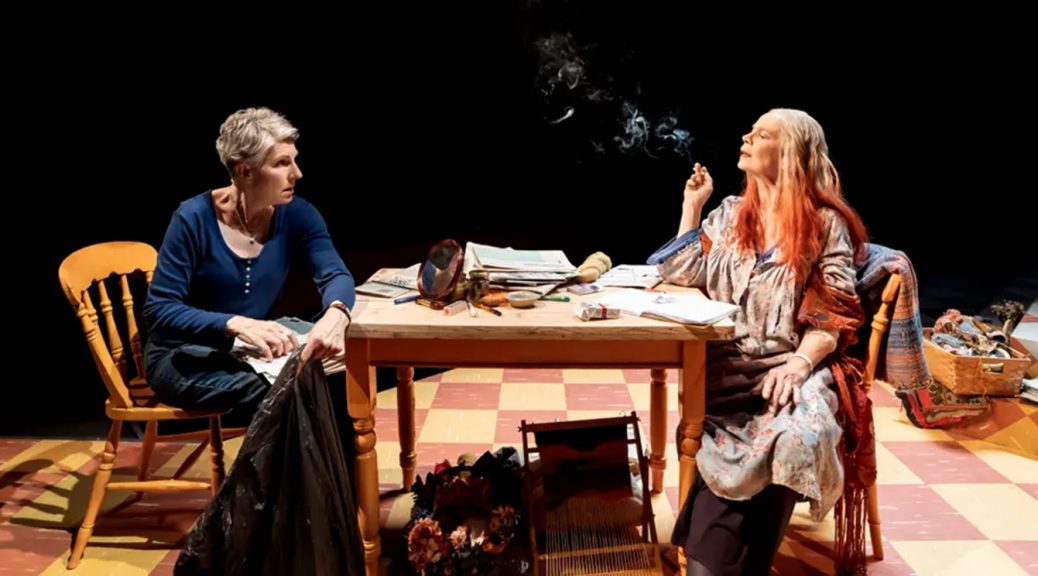
Amanda Abbington in "(This is not a) Happy Room"
Amanda Abbington

A trio of secondary roles are less successful (husband, demented aunt and psychologist) despite the efforts of Tom Kanji, Alison Linley and Jazz Jenkins. These parts also get laughs but, as we spend less time with them, they feel flatter. All three are balanced by another late arrival – Amanda Abbington, as the magnificent mother, who excels with her Waspish stiff upper lip. Abbington makes every one of her lines land.

There are flashes of profundity to the script that raise interest but struggle to convince as they lack consistency and, being scattered around, provoke a rambling feel. A similar problem comes with several big plot twists. While it’s impressive that these change the comedic feel less than they might (the jokes carry on) the gags aren’t quite as good. Revelations come a little too thick and fast, adding to the sense of a script that’s a tad out of control. It’s still far more celebration than commiseration but, like the events in the play itself, a bit more planning might have been beneficial.

Until 27 April 2025

www.kingsheadtheare.com

“MJ” at the Prince Edward Theatre

Trying to be more than a tribute act, yet still pleasing fans, makes for an interesting conflict within this hit show about the King of Pop, Michael Jackson. A biography of Jackson’s life up to the fabled Dangerous tour of 1991, there’s a lot of material, expertly handled by director Christopher Wheeldon, leading to numerous hits peppering the action. If you want the songs, you’ll get them… but there’s something more interesting struggling to emerge. The ambition here is bigger and that is to be applauded, even if that ambition isn’t quite fulfilled.

The smart move is getting acclaimed playwright Lynn Nottage on board to make a characteristically clear and sensible contribution. Of course, there’s Jackson’s early life and speculation on how that affected him. The story of juvenile stardom ends up moving. It’s true that we never question Jackson’s genius, even if we see him as stubborn to the extent that he frustrates everyone and bankrupts himself. And the show is easy on mad moments and scandal. Instead, Nottage gives us a celebration of the artist’s imagination, a journey into his creativity. And that’s actually more interesting.

The songs are broken down, experimented with, by David Holcenberg and Jason Michael Webb, who are responsible for the interesting orchestrations and arrangements. Extravagant sets and costume design (Derek McLane and Paul Tazewell) are called for and delivered. And for Wheeldon, who is also the show’s choreographer, it is Michael Jackson and dance that come to the fore. There’s a potted history of those who inspired him: the music and the movement always go together and this is some of the best dancing you can see in the West End.

It’s a shame, and an irony not lost on anyone involved, that Jackson’s biography, well, gets in the way. The device of a journalist (a neat role for Philippa Stefani) sums it up: while sympathetic, she can’t help trying to find a scoop. The character points out that Jackson’s trauma trumps his art. But a similar thing happens to MJ as well. The show itself tries to use personal pain (linking the song ‘Thriller’ to his father is spectacular). But the approach isn’t consistent, and too much of the time songs are crammed in. We’re told this is what Jackson wanted – for his songs to come first – but it means the musical becomes one just for his admirers.

In the end, the success of the show comes down to the performances, which everyone can enjoy. A strong ensemble dances magnificently and an excellent supporting cast includes Ashley Zhangazha, who plays Jackson’s father and tour director brilliantly. And there are three Michaels, each fantastic. A child performer is sure to win applause, while Mitchell Zhangazha takes on early hits with fantastic skill. The star is the Jackson of the Dangerous era, played by Jamaal Fields Green, who is stunning. It isn’t a question of impersonation. These performers must share the power of one of the most charismatic performers ever. That Fields Green, who has also performed the role on Brodway and the US national tour, so fully convinces is an incredible achievement.

Until 21 June 2025

www.mjthemusical.com

Photo by Matthew Murphy

“Retrograde” at the Apollo Theatre

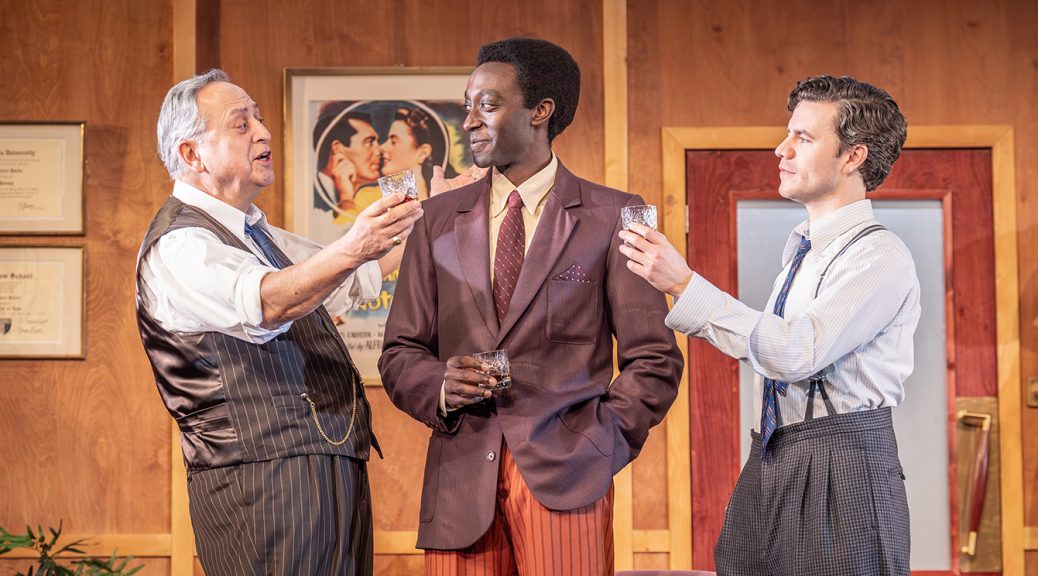
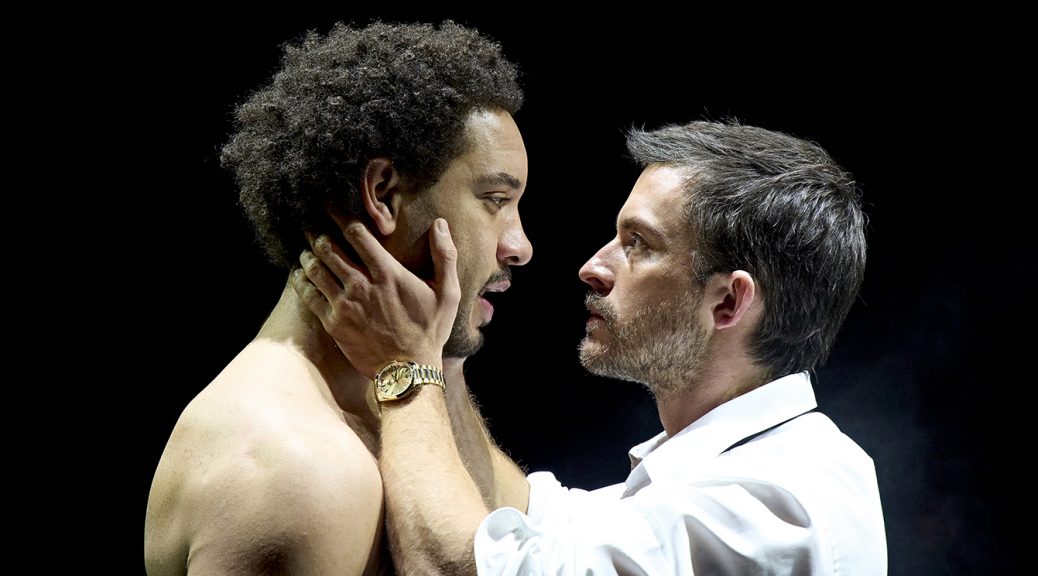
Even with five-star reviews from its premiere at the Kiln Theatre, a West End transfer for a play about Sidney Poitier was never guaranteed. Considering the ‘action’ is three people in one room talking about two pieces of paper, it could be considered a tough sell. But Ryan Calais Cameron’s new play is wonderfully rich. Looking at “trailblazer, activist, icon” Poitier at the start of his career in such a sophisticated and provocative style would surely have made its subject proud.

On the eve of signing a contract with a TV station, Poitier finds himself caught up in Senator McCarthy’s “red scare”, potentially ending his career before it begins. While the subject feels topical – it’s hard not to draw parallels with current events – Cameron doesn’t sacrifice historical context (younger members of the audience seemed a little puzzled, if enthusiastic). This is a solid period drama that makes its points with a firm understanding of the past while allowing us to think about the present day.

Amit Sharma’s confident direction helps. It’s clear he appreciates the strength of the script and he paces it wonderfully. It’s the characters who are the key, and the cast also rises to this quality material. Ivanno Jeremiah does justice to Poitier with a commanding performance. As his character’s admiration for Paul Robeson indicates, it’s good to have a hero. And, like the best heroes, this one has complexity. The will-he-won’t-he signing of a “loyalty oath” is accompanied by moving, tearful anguish from Jeremiah, and his dialect work, with Poitier’s accent slipping at times of stress, is accomplished.

Retrograde is also strong when it considers the industry it is set in. The issues are bigger than TV and Hollywood but wider implications aren’t overplayed. OK, nods to representation aren’t subtle… but they are convincing enough to answer critics who might regard them as a solely contemporary concern. Cameron doesn’t have to work hard to make us believe in the mendacity of the movie business but still does a grand job. And it’s neat that there’s a great role for a writer, the passionate but ineffectual Bobby, whose project Poitier is connected to. A good man but with flaws, and subject to temptation, the performance from Oliver Johnstone brings his qualities out perfectly. 

Cameron also knows how a play can benefit from a great villain. And it’s here that he has excelled himself in the form of the play’s lawyer. Stanley Townsend’s Mr Parks comes close to stealing the show, which in itself is a brave move. Parks talks some sense but, as Poitier points out, he is greedy and afraid. He’s easy to hate but we’re allowed to admire him too, since he brings out the joys of a script crammed with brilliant insults. Many are uncomfortably racist, sexist and scatological. But even more are very funny. “As stupid as a soup sandwich” is my favourite, but invective of this standard is a treat. Retrograde, like its subject, is a class act, so well-written and performed that the West End is lucky to have it.

Until 14 June 2025

www.apollotheatre.co.uk

Photo by Marc Brenner

“The Mosinee Project” at the New Diorama Theatre

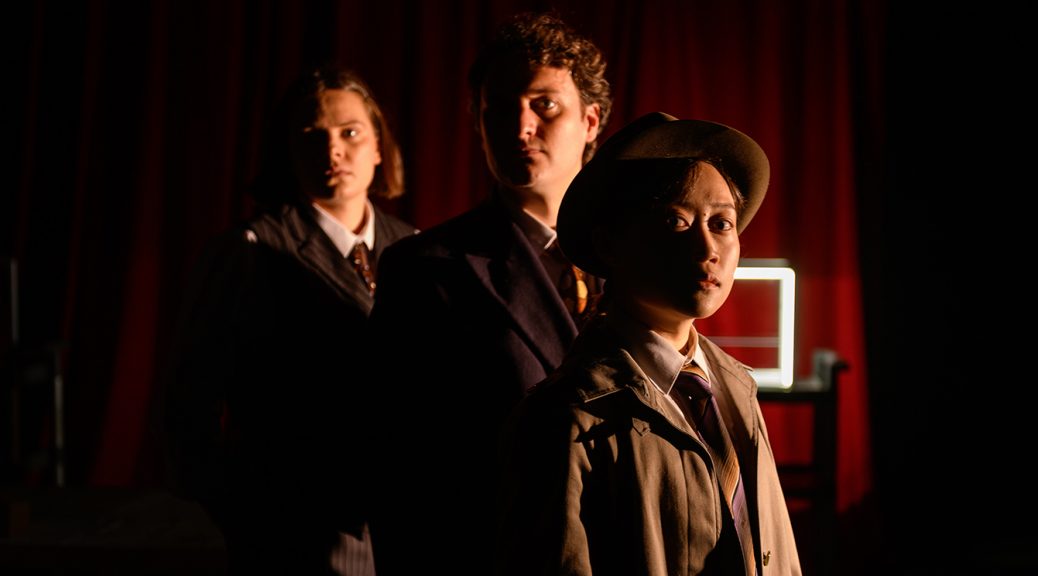
Writer and director Nikhil Vyas has found a great subject for this new short play. Along with original co-creator and dramaturg Aaron Kilercioglu, he presents an odd slice of history: 1 May 1950, when a small town in Wisconsin was taken over by Communism.

Of course you’re intrigued! And the fact that the event was only staged actually adds to the show’s theatrical potential. Vyas and his team (additional material is credited to Breffni Holahan, Jessica Layde, Jonathan Oldfield, Martha Watson Allpress and Millicent Wong) handle the topic with almost too much restraint. But the facts are fascinating. 

In the midst of McCarthyism, The American League, a veterans organisation, masterminded proceedings to highlight the threat of the “red menace”. Showing us the build-up to the day might be more exciting. Did nobody object? Could plans have got out of hand? But is this fair criticism? The show is presented as a documentary, a little like a lecture, so the painstaking efforts separating verbatim and imagined scenes are important in themselves. There are plenty of addresses to the audience, news photos and recordings as well as video work aimed at suggesting the real-life location. 

The-Mosinee-Project-2-credit-David-Monteith-Hodge

It’s a shame, though, that more isn’t revealed. Especially about the impact of the event. The three strong cast – Camilla Anvar, Jonathan Oldfield, Martha Watson Allpress – all impress, slipping in and out of their roles effortlessly and serving as trustworthy documentarians. But they also take on smaller roles as the town’s residents and this section could have easily been expanded.

The focus becomes an argument about whether the project is just a propaganda piece or something genuinely educational, embodied in a conflict between two of its organisers who, in a bizarre twist, were former Communists themselves. The tension between the two men doesn’t quite come through. And an extra debate about what stories really scare us isn’t elaborated on satisfactorily by Vyas. But for sheer ambition and interest The Mosinee Project is admirable. I didn’t quite learn as much as I wanted, but leaving intrigued and wanting more isn’t a bad outcome.

Until 22 March 2025

www.newdiorama.com

Photo by David Monteith-Hodge

“Alterations” at the National Theatre

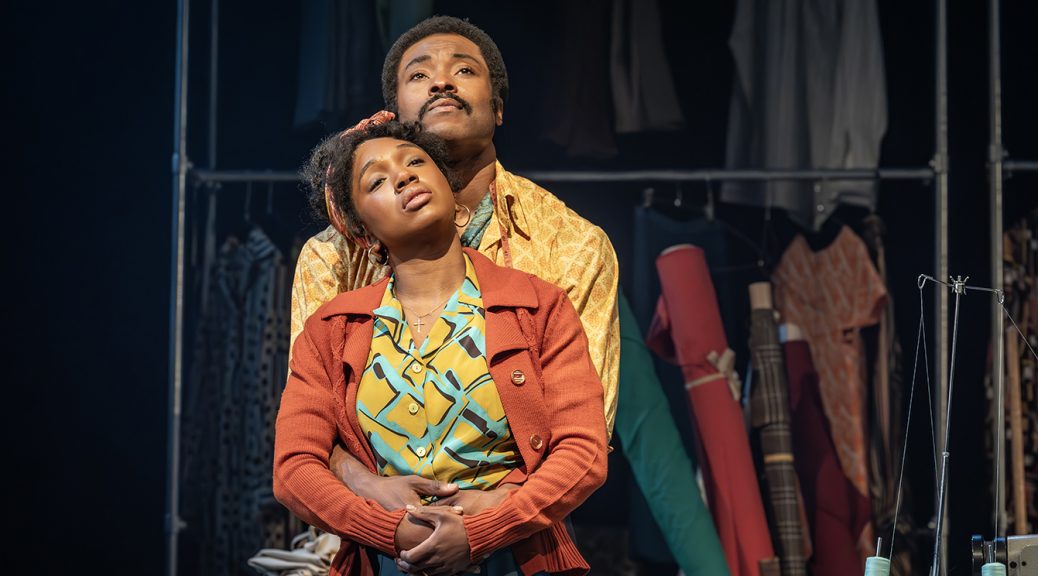
Michael Abbensetts’ play, revived via the Black Plays Archive project for the first time since its 1978 premiere, is easy to commend. The script, with additional material by Trish Cooke, is neat. Abbensetts has important things to say and says them well. The action is tight, following West Indian immigrant Walker Holt over the course of his “make or break day” as he works to secure his own tailoring business.  

This is an ‘issues’ play, reportedly inspired by the Kitchen Sink school, with plenty of detail about the racism that Holt and his friends face. Abbensetts’writing is nuanced, with a love triangle subplot that provides an impressively strong female perspective. Its thorough, well-rounded characters are impossible not to care about. 

With such a strong base, it’s no surprise, yet still an achievement, that the acting is superb: sure-footed, impassioned and enjoyable. Led by Arinzé Kene as Holt, who is a commanding presence, his character’s employees, played by Gershwyn Eustache Jnr and Karl Collins, are superb as they tackle their difficult boss and reveal complex dynamics. Cherrelle Skeete is excellent as Holt’s long-suffering wife, a powerful role that manages to challenge his dominance. All the cast bring out the considerable humour in the piece.

Gershwyn-Eustache-Jnr-Raphel-Famotibe-and-Karl-Collins-in-Alterations-at-the-National-Theatre-credit-Marc-Brenner
Gershwyn Eustache Jnr, Raphel Famotibe and Karl Collins

There’s plenty to like and caveats are small. Some movement (credited to Shelley Maxwell) could be sharper and – take your pick – more naturalistic or more stylised. Here, we have an in-between that’s occasionally messy. The set and costume design from Frankie Bradshaw is undoubtedly accomplished. But I wasn’t sure if the garments rising and falling were connected to Holt’s daydreams and working it out was distracting. And the revolving stage feels unnecessary as the action is set solely in a Carnaby Street workshop. Too much time is taken trying expand the play. This includes a contemporary figure who makes random appearances and feels a forced effort to give the work relevance since Abbensetts already provides a youthful perspective with the character of Courtney, depicted skilfully by Raphel Famotibe. 

There is a sense that Lynette Linton’s usually excellent direction is effortful, excessive. The script doesn’t need the help the production thinks it does as the play opens up by itself. As well as racism, Abbensetts targets capitalism. The price to pay for Holt’s hard work is the loss of love. His happiness is sacrificed in a search for security. That Holt is warned off his ambitions (by another immigrant, Mr Nat, played by Colin Mace) and seems to recognise his mistakes makes the play a tragedy. The changes referenced in the title must start with the personal – a strong idea that doesn’t need overplaying.

Until 5 April 2025

www.nationaltheatre.org.uk

Photos by Marc Brenner

“The Seagull” at the Barbican Theatre

In their new adaptation, Thomas Ostermeier and Duncan Macmillan revel in the metatheatrical potential of Chekhov’s masterpiece. It isn’t hard to see the opportunities in a play with so many actors and so much talk about writing. But the fun had here makes the night entertaining and brings out its humour in a fresh and exciting, way.

The updated touches in the script feel light under Ostermeier’s direction. You might expect vaping and VR headsets to appear, but credit where it’s due – Billy Brag songs and bingo weren’t on my card, and a Bella Freud-inspired T-shirt is an excellent touch (Marg Horwell’s costumes are terrific).

The stand-up microphones on stage throughout, used by characters to address the audience and emphasise lines, might be used too much. But the idea is effective. It’s clear everyone is ‘performing’ their roles and there’s a brilliant moment when amplification is removed. Combined with a thrust added to the Barbican’s stage we see a lot of action in The Seagull as contrived – which is often funny and also moving.

If this were all, I’d be happy. The Seagull is a legendary text and to have left a mark on it is an achievement. But it gets better, as some of the most memorable characters in theatre are brought to life with a stellar cast of players who do each role proud. 

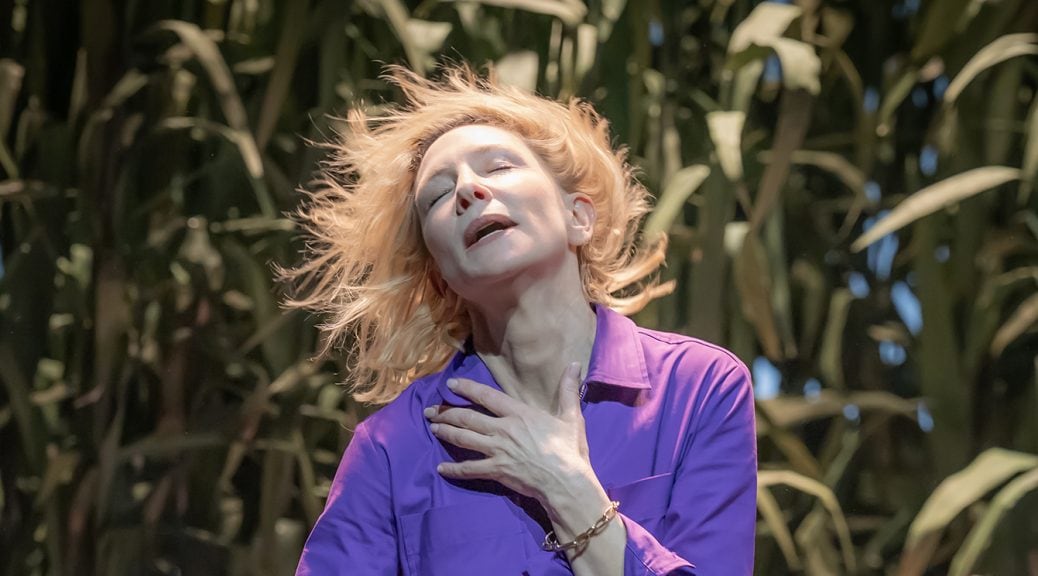
Megastar Cate Blanchett does not disappoint as the famous actress Irina Arkádina, matching Ostermeier in balancing the comic and tragic. All eyes are on her, of course, which is appropriate for the role, and that’s a fact Blanchett uses intelligently. Irina’s counterpoint is the writer, her lover, Trigorin. The reserved performance from Tom Burke is in danger of fading into the background, but this is deliberate, and Burke uses great skill to prevent it happening. A more sympathetic and tormented figure than you might expect, his watching – which sets him at a remove – is worth watching. 

Tom-Burke-and-Emma-Corrin-credit-Marc-Brenner
Tom Burke and Emma Corrin

The whole cast is superb, and the stories of frustrated lives and loves are evenly handled. Jason Watkins is a particularly touching Peter, the retired civil servant who fears he will die before he has lived, while Paul Bazely, Priyanga Burford and Paul Higgins are strong enough to make you reconsider the middle-aged love triangle with Doctor Dorn and the Shamrayevs. Which is all part of the production being especially strong when highlighting the generational divides in the play. This is a credit to all, of course, but the younger characters truly shine. 

Zachary-Hart-and-Tanya-Reynolds-credit-Marc-Brenner
Zachary Hart and Tanya Reynolds

There are raw performances from Tanya Reynolds and Zackary Hart as Masha and Medvedenko (now a factory worker rather than a teacher) making the theme of unrequited love heartbreaking. Emma Corrin’s Nina is distressingly vulnerable, an admirable departure for the actor. And it is a thrill seeing Kodi Smit-McPhee as Konstantin. Like his fellow author, there is a deal of restraint here that is impressive and allows us to wonder about Irina’s cruel observations on Konstantin’s immature works, his “immersive Cirque du Soleil”. It’s the first time I’ve considered that maybe Konstantin’s art isn’t very good.

Jason-Watkins-and-Kodi-Smit-McPhee-credit-Marc-Brenner
Jason Watkins and Kodi Smit-McPhee

It’s not just their clothes (praise again for Horwell) or nods to nepo-babies that make these Gen Z figures topical – there’s also a sense of impending doom that fits Chekhov well. The frustration is more urgent than the original (current affairs get a mention), which might remind audience members of Ostermeier’s politically engaged An Enemy of the People early last year. Such forced contemporaneity can be a turnoff. But together with the strong comedy and careful attention to all characters, even purists should be pleased with this tremendous show.

Until 5 April 2024

www.barbican.org.uk

 Photos by Marc Brenner

“One Day When We Were Young” at the Park Theatre

Director James Haddrell can be proud of this fine first revival for Nick Payne’s 2011 play, “refreshed” by the playwright himself. I’m happy to boast about being a fan long before his breakthrough play ConstellationsWhile it’s interesting to see connections with Payne’s mega hit, let’s be clear that One Day When We Were Young stands on its own and is strong work. 

We see Leonard and Violet at three points in their life: as a young couple the night before he is conscripted to fight in World War II, a little after his return from a POW camp when Violet has married someone else, and then much later, towards the end their lives. These are snapshots, but it is a marvel how much we learn from these complex and relatable characters.

Leonard and Violet are tremendous, if challenging roles. While showing the breadth of Payne’s skill, it’s a lot for the performers to pull off. Thankfully, Cassie Bradley and Barney White, who take the roles, are marvellous. Getting them to fuss around with a set, clever as Pollyanna Elston’s design is, probably isn’t worth it. And if there’s a little struggle with the final scene as very old people, both bring out the romance and sadness in each timescale, appreciating the nuances of the script and its underlying melancholy. 

This is a quiet play. If you said slow, I wouldn’t argue. But the pace shows confidence. A small, simple story about ordinary people is surprisingly rare. Class is a topic handled carefully (Leonard is a butcher’s boy while Violet’s parents own a shop) and Payne’s observations are keen but never pressured. 

It’s the dialogue that really makes One Day When We Were Young work. Payne’s humour is delicate (might it have been encouraged more?) and there’s a naturalness to these conversations, regardless of the tense situations and emotions, that is powerful. Aspirations, hesitations, reservations are all carefully explored in a show that is a well-crafted treasure.

Until 22 March 2025

www.parktheatre.co.uk

Photo by Danny Kaan

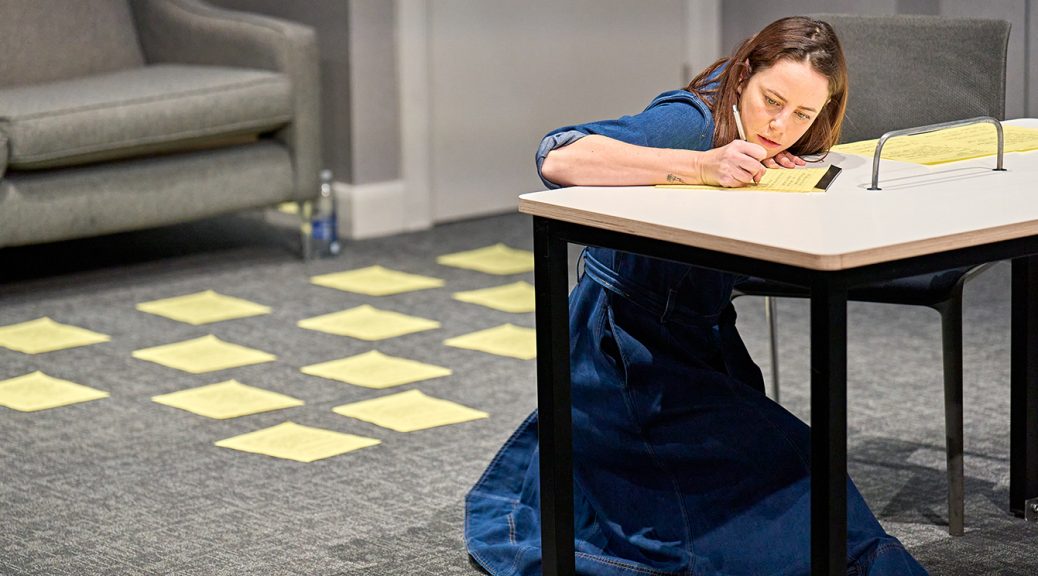
“Backstroke” at the Donmar Warehouse

This new play, written and directed by Anna Mackmin, works hard but comes too close to being hard work. Performances from superstars Celia Imrie and Tamsin Greig make it a must-see, but it’s hard to escape the idea that without them patience would run short.

Looking back at the relationship of mother and daughter, Beth and Bo, after the former has a stroke, is a powerful story. But then, why wouldn’t it be? Much of the action is set on a deathbed.

Mackmin tries to avoid sentimentality, but her writing, like the subject, is heavy. The production isn’t helped by unnecessary filmed vignettes that accompany the action, a kind of internal dialogue for Bo that includes her own troubled daughter (and lots of screaming).

These are strong characters, interesting and well-performed, but are they a touch too eccentric to believe? This old hippy and her ambitious daughter have a complicated relationship. It’s revealed that Beth’s mental health has always been a problem and Bo has suffered as a result. Be warned: some jokes come close to the bone.

Beth also suffers from dementia and Mackmin’s depiction of this is more poetic than realistic. Credit to Imrie for the delivery, which must be extremely difficult. A loss of inhibition, mood swings and anger are all ticked off. But I’m not so sure about the malapropisms. Bo still makes sense a lot of the time, her repetition is haunting, but her search for words comes too close to funny.

Mackmin’s topic of motherhood is clear enough. If you’re in doubt, Bo’s adoption of Skylar brings the theme home (we only see this other damaged character on screen until the very end). Bo is finding parenting so hard that she admits she wants to give her daughter back. It’s a brave confession that needs more exploring to convince.

Backstroke-at-the-Donmar
Anita Reynolds, Lucy Briers and Georgina Rich

There are problems, too, when it comes to the hospital staff, a trio that are well-performed but close to stereotyped. From Georgina Rich’s aloof consultant to two very different nurses (Lucy Briers and Anita Reynolds), we are prepared for a debate about end-of-life care that doesn’t really take off.

Nonetheless, going back and forth in time is a boon for the performers, who really do impress. The focus shifts to the question of “how to die” and, if the swimming metaphor is laboured, the films become better, and our perception of Beth is cleverly modulated. It’s still too long, though, and a memorial speech by Bo pushes us into weepy territory. I’m not sure, given this subject matter, that reducing your audience to tears is really a big achievement.

Until 12 April 2025

www.donmarwarehouse.com

Photograph by Johan Persson

“East is South” at the Hampstead Theatre

It’s an old trope in science fiction that, when asked if there is a God, a supercomputer replies: “There is now”. Playwright Beau Willimon’s riff on the idea of AI and divinity is intelligent and a refusal not to simplify such a complex topic is admirable. If too many ideas are mentioned then left unpacked, it probably isn’t a surprise. But this mix of modern concerns and religion benefits from director Ellen McDougall’s impressive infusion of dramatic tension and some fine performances.

The play is a series of interrogation scenes, set around an accident in an AI lab. So, there’s little action and an awful lot of talking. It works (just about) mostly through the efforts of Nathalie Armin, whose character is investigating the security breach. Her character is a psychologist, there’s the threat of terrorism, and Armin manages to make the role likeable, at the same time generating suspicion.

Luke-Treadaway-in-East-is-South-credit-Manuel-Harlan
Luke Treadaway

Willimon is too smart to give us good guys and bad guys, but the two programmers, Lena and Sasha, who have taken the dangerous step of “releasing” the AI programme might be a little more complex. Kaya Scodelario and Luke Treadaway both do well with the roles, but snippets of their relationship don’t add much (nor does an unnecessary Russian accent). The performers are strong enough to make us care for this young couple, who might even be in love, but, again, Willimon crams in detail that could be left aside.

It isn’t much of a spoiler to say Lena’s religious beliefs shape events – it’s easy to see the twist that she’s the mastermind and even to guess her eventual fate. Nonetheless, any mentions of blind faith are highlights, as is Willimon’s ability to reconcile contradictions (like those the play takes its title from). You might expect a little more scepticism, but sections connecting art and myth are well written and aided by David Ridley’s musical direction and some video design by Zakk Hein.

There are more problems with characters, though, and two really hamper things. A very standard Federal Agent (that Alec Newman manages to save) seems to belong in a different play. It’s odd that a government oversees the programme at all (and ironic most of us would feel reassured by that). Far worse is Lena and Sasha’s boss, a former academic so clichéd he could have been written by… no, I won’t say it. His insufferable word soup is dire and its delivery, by Cliff Curtis, is poor. The role is key, surely intended to help the audience out. But the character is a bad teacher, and the play suffers horribly as a result.

Until 15 March 2025

www.hampsteadtheatre.com

Photos by Manuel Harlan

“Richard II” at the Bridge Theatre

After the tremendous, nearly two year long run of Guys and Dolls, Nicholas Hytner’s Tower Bridge venue has another hit on its hands. OK, it’s more star casting, with Jonathan Bailey taking the lead as Shakespeare’s deposed monarch. But there’s a lot more to this production; Hytner is too experienced a director to be swayed by a star and this is solid work through and through. 

Breathe easy, Bailey is very good. Richard’s complexity is tackled well; Bailey can do frantic and philosophical and he “sports” – his Richard is a wit and gets laughs. The performance is smart enough to use Bailey’s reputation as a heartthrob to lean into Richard’s vanity and suggest a parallel between the divine right of Kings and celebrity. If it is a depiction to respect rather than inspire, it is impossible not to admire it.

Bailey is also a generous performer; like Hytner, fully aware the text isn’t just about Richard. Every role is given its due with a tremendous attention to detail so that the whole ensemble shine. You might easily end up awarding the laurels to Royce Pierreson who plays the usurping Bullingbrook, brilliantly reflecting how the man’s ambition conflicts with a grudging respect for Richard. The future Henry IV is a schemer, of course, but the sense of events out of his control, and Pierreson reacting to them, is wonderfully dynamic.

Richard-II-Vinnie-Heaven-credit-Manuel-Harlan
Vinnie Heaven

There are further fine performances, from relatively small roles that are easy to ignore in most productions: Badria Timimi does well as the Bishop of Carlisle, providing an important religious context to the argument. Michael Simkins, Amanda Root and Vinnie Heaven are all superb as the family York torn apart by the conflict they find themselves in. Hytner and his cast convey how fraught capturing the crown is for these people, how tense this time in British history was, and the drama gains in tension as a result.

Richard-II-Amanda-Root-and-Michael-Simkins-credit-Manuel-Harlan
Amanda Root and Michael Simkins

Hytner uses Bob Crowley’s set marvellously, with minimal props appearing from the floor to effectively create scenes. It all looks stylish and, despite a long running time, the action is swift. If there’s a flaw, Grant Olding’s score for the show is cumbersome, imposing on events rather than complimenting them. But it’s hard to find fault in work that’s accomplished all around – a team, and a star, at the top of their game.

Until 10 May 2025

www.bridgetheatre.co.uk

Photos by Manuel Harlan