All posts by Edward Lukes

“Keep Watching” at the New Diorama Theatre

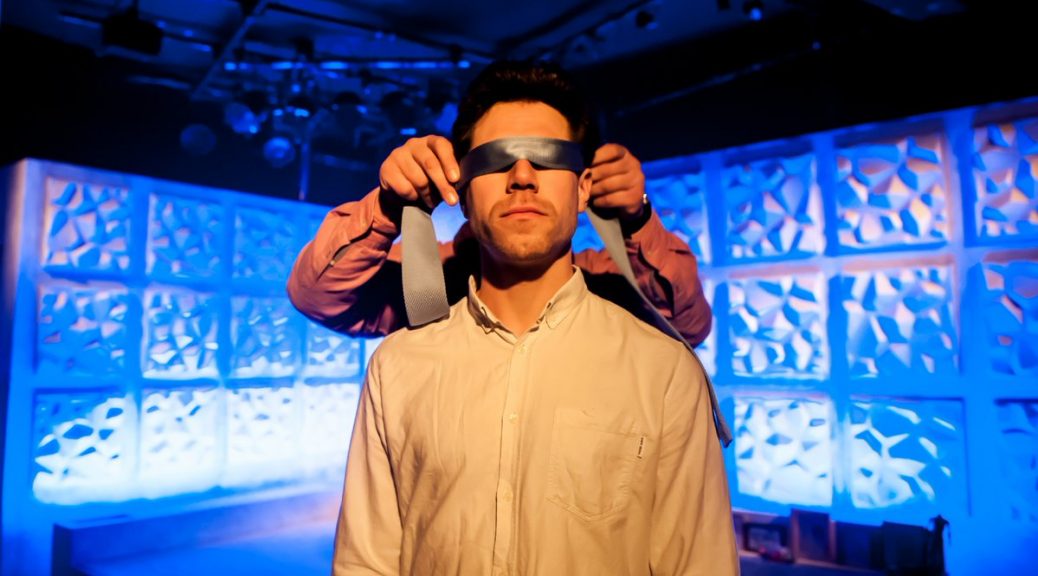
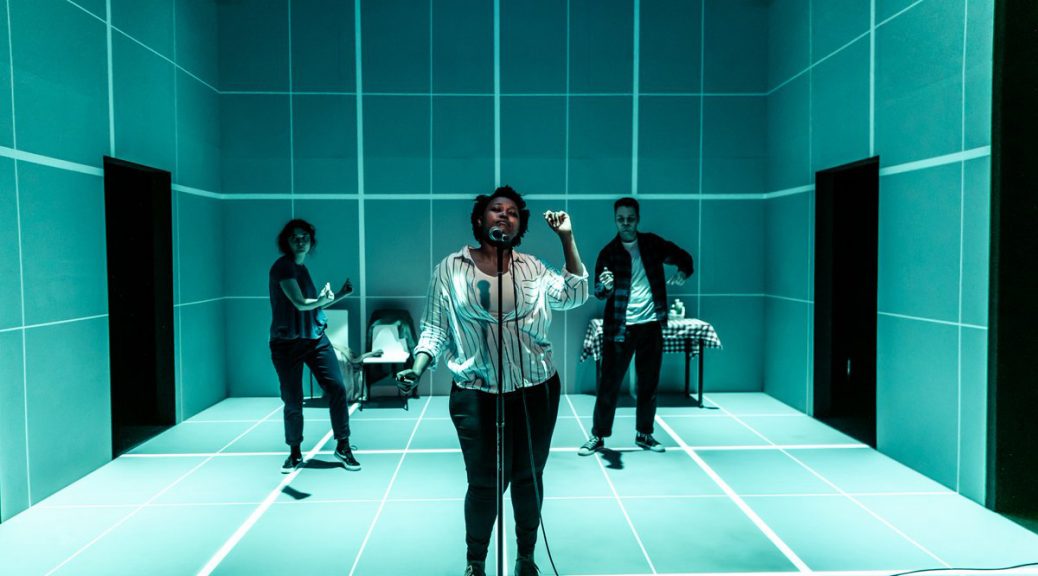
A company that’s well worth following, Engineer Theatre Collective’s new show is notable for its stylish looks and clever invention. The chosen subject matter is rich – our increasingly surveyed lives – and there’s no lack of ideas about depicting the contemporary condition. The cameras that surround us, the devices that are with us, and a sense of exhaustion are all impressively incorporated into the action. But the story itself is poor. And if you like your theatre with a strong narrative, this becomes a weakness on the part of a strong team. 

What little plot the play has is far too predictable. Arguments for or against technology – based on a balance between invading privacy and providing safety – are thin. The show ends up as a vague jeremiad on modern life in terms of a fear of being “swallowed up”, powerfully conveyed but with little outcome. There are far too many ideas set in motion and left unresolved. Engineer is a collective, remember? Maybe writer and dramaturg Jesse Fox has not been listened to quite enough? Simon Lyshon’s direction is tight from scene to scene, but there’s a lack of detail in favour of a general atmosphere.

Nonetheless, the execution is excellent. There are three strong performers. The action focuses on Luyanda Unati Lewis-Nyawo, who plays a surveillance operative who inveigles herself into the life of Kat, an emotionally fragile nurse played by Beatrice Scirocchi. Wonders are worked with underdeveloped roles by both actors. Meanwhile, George Evans holds his own as a brother in trouble, who also makes a great deal out of little. And this is a real ensemble piece as the performers take over the scene changes and leap into extra roles. More highlights come with excellent sound and lighting design, from Dom Kennedy and Bethany Gupwell, respectively. It’s exciting to see so much creativity, and that much of it is so simple and low-tech impresses all the more. It’s the company rather than this piece that deserves continued observation.

Until 4 May 2019

www.newdiorama.com

Until 4 May 2019

“9 to 5” at the Savoy Theatre

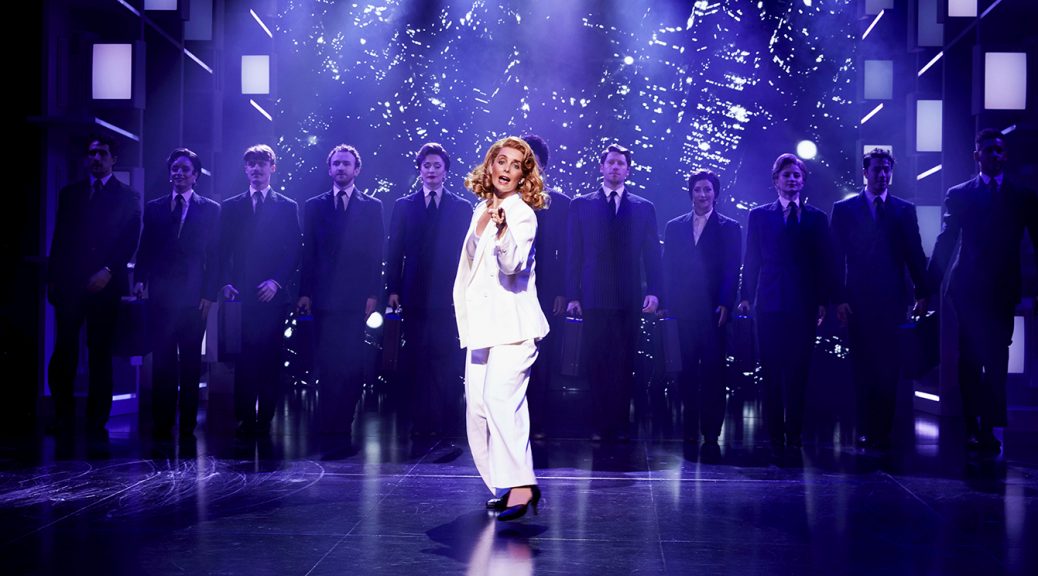
The legendary Dolly Parton’s first musical, based on the 1980 film that she starred in, does everything it can to entertain. The songs are good, of course, not just the back catalogue used but numbers written for the show. And the additional lyrics to that famous title number are frequently smart. Unfortunately, despite a large crew of orchestrators and arrangers, the production does not service Parton’s music well; it all sound tinny and simplistic. The show is feelgood for most of the time, but the fun is forced. Atmosphere is fought for with gritted teeth and forced smiles, which ends up self-defeating.

Many of the flaws come from the book by Patricia Resnick, who adapts her original screenplay – about secretaries taking over from their tyrannical boss – far too faithfully. Not enough attention is paid to the fact that this is a period piece (Tom Rogers’ design could help a bit more) with the uncomfortable result that the sexism the show condemns makes up most of its humour. In what’s supposed to be a comedy, the jokes become an increasing problem. Unfortunately, our trio of career women struggle too much to land the pretty poor material. Again, the shadow of the film – with three talented comedians – overshadows the stage show. 

Louise Redknapp plays Violet (until 29 June, in case you’re interested), the competent businesswoman passed over for men she has trained. Redknapp has stage presence and is a personality you want to like. But seeing how hard she is trying becomes uncomfortable. She can sing and does well with a big glam number that really isn’t much cop, but she is not an actor and her accent is painful. Amber Davies plays the recently divorced Judy (inexplicably recast as a young woman) and doesn’t seem to try with the accent at all. When she’s not sobbing loudly, she sounds shrill. Natalie McQueen takes a different tack with Doralee, the Dolly Parton role, and ends up leading the show (which isn’t quite the idea). Presented as a caricature of the great woman herself, she’s nice and cheeky and at least looks as if she’s having fun. Director Jeff Calhoun seems to have left each performer to their own devices and the result is a mess.

For the rest of the laughs, Brian Conley plays the infamous boss Franklin Hart Jr and manages to get some pretty moronic jokes literally off the ground. But note, he isn’t in a character at all and murders the songs, not because he can’t sing, but because he’s playing everything so cheaply. Thank heavens for Bonnie Langford who plays office termagant Roz to camp perfection; her lust for Hart is hilarious and Langford hams it up to the heavens while looking as if she’s barely breaking a sweat. Langford gauges the tenor of the show, leaving everyone else behind. She even takes a bow better than the rest of this workaday crew.

Until 31 August 2019

9to5themusical.co.uk

Photo by Simon Turtle

“The Last Will and Testament of Henry Van Dyke” at the Tabard Theatre

This meta-theatrical sketch makes a neat and sweet debut for its writer Karrim Jalali. Along the way you might think it’s about friendship, documenting the bromance between two young men. Or that it concerns creativity, with a debate about art and the sacrifices it requires. But the text itself is adamant: it’s simply two mates talking about making a play and retelling events that have just happened. One guy thinks he’s had a genius idea. The other wants to set him straight. There’s your theatrical conflict and, with the help of two great actors, this clever little notion is handled superbly.

It’s admitted by the performers that there’s no action or plot. And explicit that a story is only being played with. Pointing out potential flaws, along with the suggestion that doing so is a defence for the writer, gets a lot of laughs and brings us closest to Jalali’s aims. The play is full of games, both smart and silly, double bluffs and downright nonsense, that added together with charm make The Last Will and Testament of Henry Van Dyke five-star smart and funny.

There are plenty of plays that reference the theatre and many of them are mentioned here. But what sets Jalali apart is an openness and sincerity that’s especially appealing. It’s nice that he’s done his homework but, more unusually, he’s careful not to show off about it. Much of the affable mood created can be credited to Joy Harrison’s snappy direction – there’s no doubt talk of structure and theory can get dry quickly and she prevents this. But the wonderful intimacy shared between these friends, carefully avoiding any suggestion of a theatrical clique, comes down to the excellent, warm performances of Nathan Wright and Niall Murphy.

That the characters don’t have names is one in joke that annoys – will writers please stop doing this. But this odd couple are completely believable as old friends, their comic timing helps Jalali immeasurably and they become guys you’d want to hang out with. Nathon Wright’s Person 1 is a wonderful mix of enthusiasm and lethargy. Niall Murphy’s Person 2 is full of geeky facts with a healthy suspicion of any urban legend. They are both funny and approachable. Ultimately a lesson is offered, contrasting too narrow a definition of creativity, which Murphy’s character punishes himself over, with Wright’s role showing the way. In art, just trying does count for something; writing any play is an achievement, it’s something brave. There’s an appeal to the audience that’s heartfelt and endearing. Another stab at being critic-proof? Maybe, but I’ll for fall it.

Until 27 April 2019

www.tabardtheatre.co.uk

“Top Girls” at the National Theatre

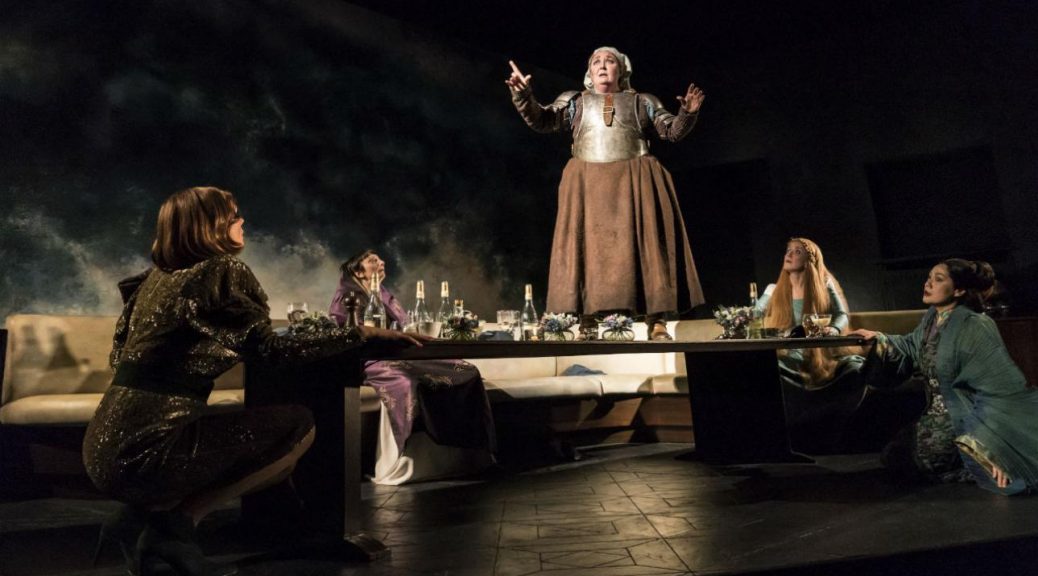
Lyndsey Turner’s revival of Caryl Churchill’s classic play has a reverential air. With such variety in the writing – starting with a fantasy dinner party, turning into a domestic drama and becoming increasingly political – there’s no doubting the text’s importance. But in this staging, the humour in the writing stumbles, the edge is blunted and the production is luxurious to a fault.

The novel, and expensive, move is not to double up roles as most productions of the play do. So performers playing guests at the opening scene, women from different cultures and times, don’t reappear in other roles. Using actors the calibre of Amanda Lawrence, Siobhán Redmond and Ashley McGuire for just one scene seems positively wasteful and it also isolates the brilliantly bizarre prologue scene.

There can be no quibbles about the cast – or Turner’s massive investment in them. The play is capably driven by Katherine Kingsley as the highflying executive whose success we scrutinise. And there are strong performances from Liv Hill and Lucy Black as her estranged family. It’s possible these roles don’t have to have be portrayed as quite so downtrodden – Churchill’s point is still made if they are just ‘normal’ people – but the play’s themes of inequality and individuality are depressingly pertinent.

Ian MacNeil’s design is bold in its variety of spaces – restaurant, office and home are all very different – and the scene changes are impressive. And dealing so well with characters speaking over one another gets more praise for Turner. In short, the production is without question technically accomplished. But is all this sleek professionalism necessary? Or appropriate? Does a dinner party with the long dead or fictional characters need so stylish a setting? Or the shabby world of corporate recruitment have to look so lush? Turner has too much respect for Churchill’s work not to present it impeccably, but the play is strong enough for productions to take a more inventive approach with it. There’s a disappointing lack of energy, or anger, that seems inappropriate: Churchill’s message is there, but the challenge is not.

Until 20 July 2019

www.nationaltheatre.org.uk

Photo by Johan Persson

“Mary’s Babies” at the Jermyn Street Theatre

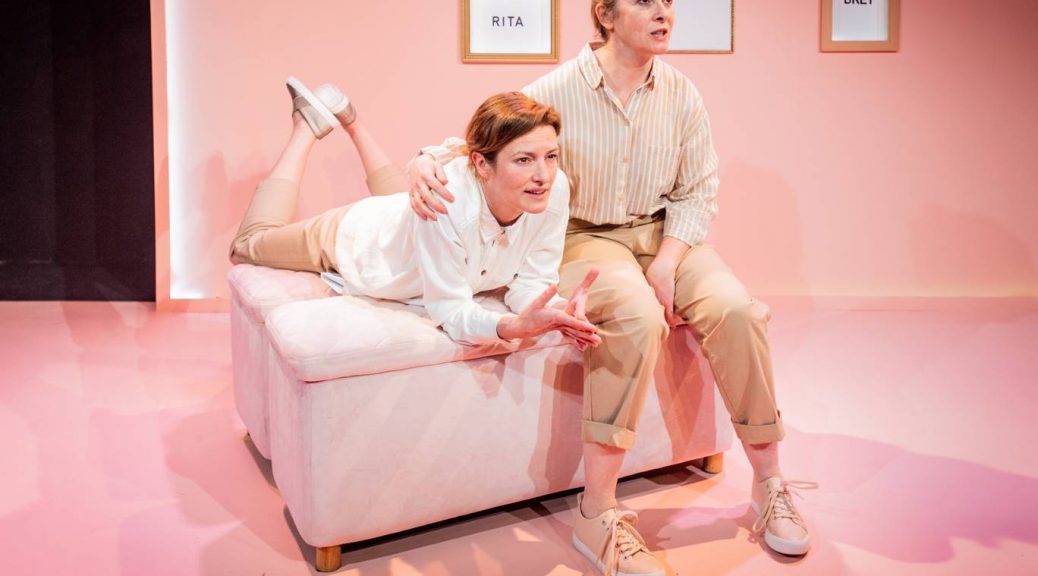
Maud Dromgoole’s play is inspired by the real-life story of ‘Barton’s Brood’, where a fertility clinic run by Mary Barton, with her husband as one of very few sperm donors, resulted in the world’s biggest family. Updating the action to the present day and imagining efforts to reunite a complex network of siblings, some of whom don’t want to know each other, and a couple who have already got too close, provides plenty of plot that this short show manages to explore in surprising depth.

Thirty-one scenes are well-paced, and director Tatty Hennessy does a good job with their variety. Despite the help of Anna Reid’s design, which lights up characters’ names when they are on stage, things are still confusing at times. Sorry to be a bit dim. Some scenes are unnecessarily gnomic, playing with who’s who when the facts are already complicated. And although the play is funny, with Dromgoole handling sensitive issues boldly, not quite enough jokes land. Nonetheless, there’s some excellent characterisation and the dialogue sounds fresh, if not always believable. Two big puzzles come with the only characters not named: a registrar of births, marriages and deaths and, bizarrely, a grieving ventriloquist. The humour here falls flat and the motivation is a real question. Both scenes indicate an overall lack of polish.

While the script is interesting, the performances are superb. This is a play about a large number of people… with only two performers! Emma Fielding and Katy Stephens take on 17 roles each – male and female, of different ages and backgrounds (more credit to Dromgoole for how many issues this raises) and they do so impeccably. The accents do a lot of work, of course, but it’s hugely impressive to see some characters really stand out. Kieran, the “lynchpin” bringing the family together, is skilfully highlighted by Stephens, while Fielding makes a nurse who interacts with several characters a vivid role. In one party scene, nearly everyone appears, providing a heady theatrical moment where the play’s ambition and execution come together in memorable style.

Until 13 April 2019

www.jermynstreettheatre.co.uk

Photo by Robert Workman

“Edward II” at the Sam Wanamaker Playhouse

While few productions at Shakespeare’s Globe lack contemporary touches, it doesn’t seem too reactionary to suggest that the venue’s glorious indoor site needs them the least. Nobody wants theatrical reconstruction – impossible anyway – but seeing a play in a manner close to that experienced by Christopher Marlowe’s original audience is a special thrill. Congratulations to director Nick Bagnall for this surprisingly traditional affair. Ironically, amidst so many interpretations and so much theory in the theatre, it makes for a refreshing change.

While Bagnall presents the story of England’s troubled king and his love affair with lower-class servants simply – making great use of the space, particularly the candlelight, and its unique intimacy – he isn’t enthralled by the text. As a strict editor, he presents a complex plot efficiently and isn’t held captive by it. Doubling – and trebling – of roles by the hardworking cast is expertly handled (special praise for Annette Badland and Sanchia McCormack), making the action clear throughout.

Plot is to the fore – it’s an interesting story, after all. Emotional impact is ensured by strong performances, primarily from Tom Stuart in the lead role, who gives us a man it’s hard not to sympathise with, despite his flaws. There’s charismatic work from Beru Tessema as Edward’s first love, Gaveston, and a superb performance from Colin Ryan as the replacement in the king’s affections, Spencer. Cleverly, there’s little eroticism in the production – the men’s concern is with status more than sexuality – and, arguably, Bagnall takes us closer to Marlowe’s concerns than contemporary ones.

A focus on the action does deprive us on one point, though. While it’s clear an effort has been made to make the role of Edward’s queen central, Katie West struggles with the part. Isabella’s own obsession with Edward, an essential counterpoint that could make her seem just as unstable as her husband, is missing. Even worse, the depths of Isabella’s relationship with the treacherous Mortimer (Jonathan Livingstone) – that they “kiss while they conspire” – are unexplored. The delivery of these fascinating characters is far too flat.

This is a close study of the play, which has resulted in careful insight. Polly Frame’s Kent has a wonderful final scene: as the shock of the character’s execution dawns, her role comes into focus magically. And there’s terrific work from composer Bill Barclay. Bagnall deals superbly with a text that, while containing wonderful poetry – delivered especially well by Stuart and Tessema – also has a lot of narrative detail. Constant direct appeals to the audience (making us Edward’s judges many times) and a remarkable dynamism in the performances all add to a solid, quality production.

Until 20 April 2019

www.shakespearesglobe.com

“Fiddler on the Roof” at the Playhouse Theatre

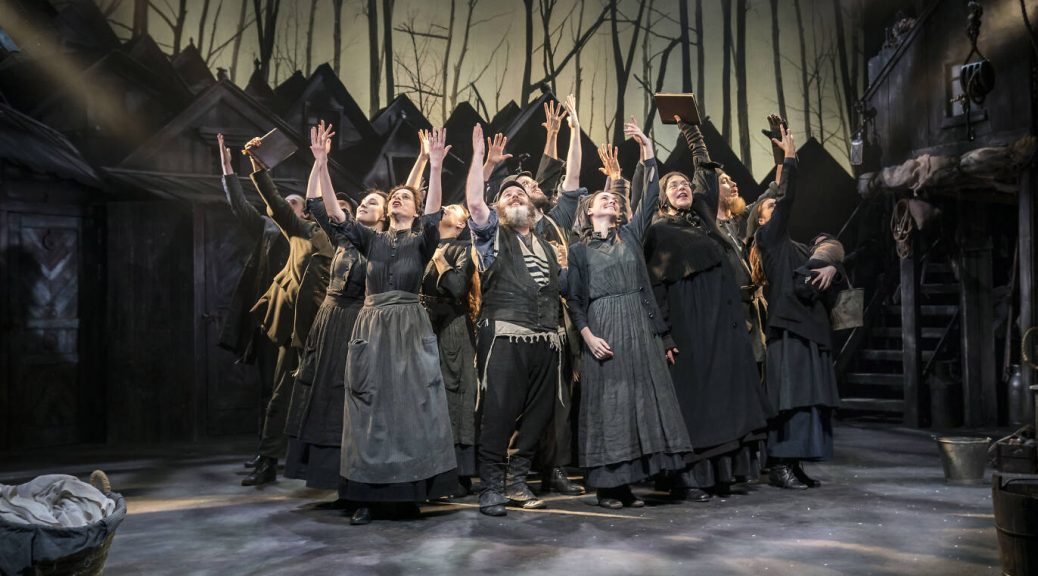
It’s great to see the Menier Chocolate Factory back in the West End. Tickets for this revival of Jerry Bock and Sheldon Harnick’s musical sold out quicker than a Brick Lane beigel for its home run near London Bridge, so a bigger venue means a welcome chance to see this excellent show. One word of warning, though – behave as if you were a rich man and treat yourself to a good seat.

Under Paul Bogaev’s musical direction Bock’s music sounds great, Sheldon’s lyrics are always a treat and director Trevor Nunn has a careful appreciation of Joseph Stein’s book: the structure is kept tight, the characters vivid and the jokes are great. Famously recounting the story of Jewish life in a Russian village just before the revolution, the lead role of Tevye has been career defining before and, taking the part here, Andy Nyman does not disappoint. The poverty-stricken patriarch struggles with his wife (a strong performance from Judy Kuhn) and the marriages of his three eldest daughters. Taking these roles Molly Osborne, Nicola Brown and Harriet Bunton do a fabulous job of injecting youth and energy into the show, and their opening number is a real delight. Each of the troubled romances convinces, mixing sweetness and poignancy with strong songs.

It really is worth splashing out on a posh seat, though. While Robert Jones’s set design – evoking Chagall but with a restrained colour palette appropriate to the piece’s surprisingly somber tone – deserves praise, projecting the stage into stalls causes problems. A lot of seats have been sacrificed (hence the ticket price?) but little account taken of the view from the balcony. Nunn should know better than this. Thankfully Matt Cole’s choreography, based on Jerome Robbins’ original work, is still strong enough to thrill; not just the acrobatics but the way dance is used to illustrate the close community and the struggles with modernity that it faces.

Fiddler on the Roof really fascinates. It’s funny, a simple story, well told, that feels solidly old fashioned. But, while focused on tradition, the theme of the show is actually change. New and old are both present in the 1964 piece itself. Much of the first half seems very Broadway – the format is conservative and almost predictable. But, as a concern for history takes over, the show become bravely dark. As the approaching Cossacks move from a threat to a reality, Tevye shows the limits of his own tolerance (Nyman is an excellent here). There’s a combination of pain, incomprehension and dignity in the characters and the story that the production embraces, moving us from high-class entertainment to a questioning and emotionally turbulent finale.

Until 2 November 2019

www.fiddlerwestend.com

Photo by Johan Persson

“Downstate” at the National Theatre

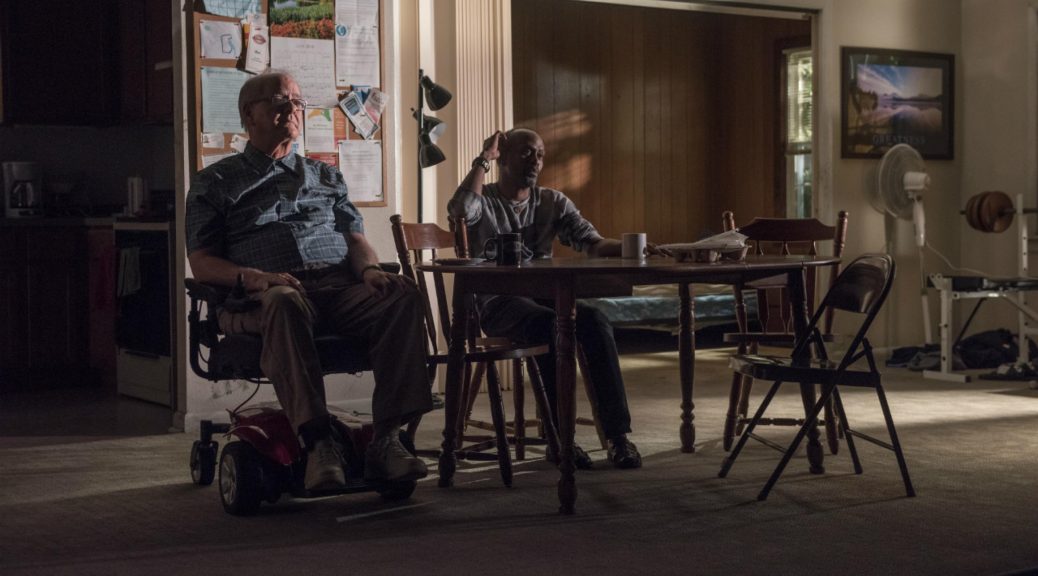
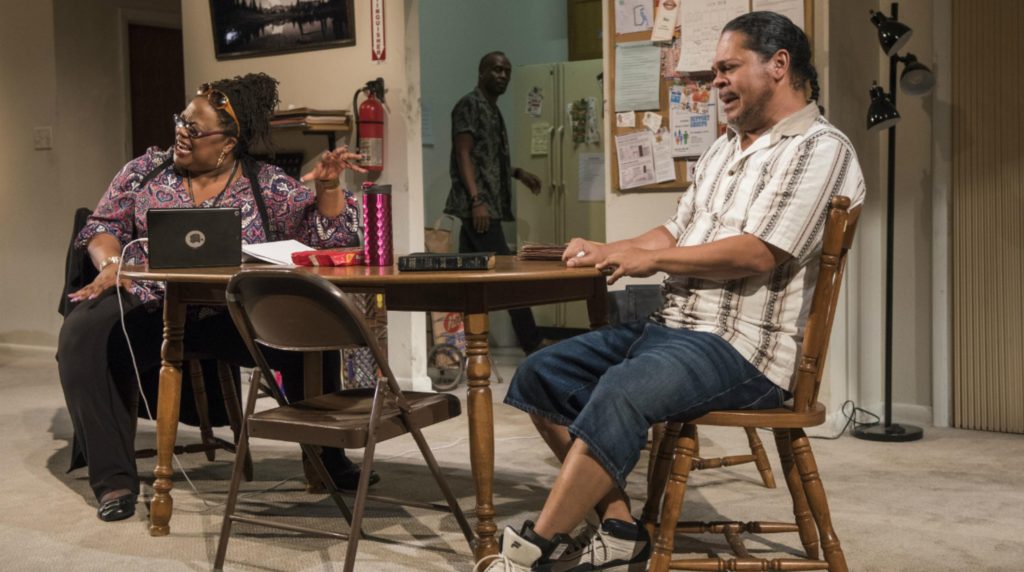
If your life has been even vaguely touched by the tragedy of child abuse, then this new play by Bruce Norris will be difficult to watch. The scenario of four men on the sex offenders register in the US living together on probation is an unpalatable subject matter for most. But theatrically Norris and his team from Chicago’s prestigious Steppenwolf Theatre have achieved the improbable – creating a kind of sympathy for these men and making great drama as a result. The provocative strategy has a further use – creating an empathy for people we find repulsive allows big questions to be asked with challenging clarity.

Justice, with the dichotomy of punishment versus vengeance, is the theme. And it’s complicated by the need to continue to protect children that the men now live near. We see two sides of contrition, in the roles taken by Eddie Torres and Francis Guinan, both equally questionable and powerful. All this might be considered a timeless dilemma. But Norris also addresses a particularly topical concern – ideas about trauma and victimhood particular to our times – with remarkable bravery. Giving a voice to the abusers is a bold move. The reasoned arguments, presented with wit or religion respectively by the characters K Todd Freeman and Glenn Davis so brilliantly portray, are remarkable. The tension with our distrust of these men is wonderfully handled.

Cecilia Noble and Eddie Torres

Along with these personal debates, we encounter the judicial system, represented by probation officer Ivy, brought to the stage so vividly by Cecilia Noble. There are practical touches and legal constraints to Ivy’s generally sympathetic approach to the men, as well as utterly credible touches of exhaustion. But the play’s real originality comes with scenes of a victim confronting his abuser. Andy, played with such care and skill by Tim Hopper, shows a brittle calm presenting rote-learned arguments arrived at via his therapy. It’s almost unbearably tense at times and incredibly sad but, importantly, thought provoking.

The writing is close to flawless, so it’s a shame that one plot twist is over prepared and therefore not quite as shocking as intended. Meanwhile, the performances are perfection and director Pam MacKinnon deals with the actors and the subject matter with utmost care. Without degrading Andy’s trauma, and getting considerable dramatic tension from the idea that we cannot trust these convicted felons, Norris leaves open a judgement as to a statement that victims don’t lie, with the suggestion that there are degrees of trauma that victims as much as the law fail to take into account. It’s a suggestion uncomfortably out of kilter with our times and surely important to raise for that very reason.

Until 27 April 2019

www.nationaltheatre.org.uk

Photos by Michael Brosilow

“Circa” at the Old Red Lion Theatre

As this is his first full-length play, it’s tempting to assume that Tom Ratcliffe is a young man. Regardless, his writing contains prodigious insight. There are so many intelligent observations in Circa that it might be thought of as a wise play, one that stays with you and makes you think. Following one man at three different life stages to explore the theme of loneliness, Ratcliffe seems capable of writing for any age, with dialogue that is consistently strong and often funny. Issues that could have hashtags and heavy debates about heteronormativity are delivered with ease. The neat conceit of covering three decades in its protagonist’s life is ultimately mishandled, and the play ends terribly but, with the aid of director Andrew Twyman, Circa is a particularly impressive failure.

As a young man, our hero encounters sexual violence. In his 30s he tries to settle down, no matter what the compromise. Then in later life he ends up dating online. All this is sensitively performed by Daniel Abelson, Thomas Flynn and Antony Gabriel. And they are ably supported by Joseph Rowe as two very different love interests. Twyman’s efforts to provide space for all this are admirable but there are too many issues touched on too quickly. While the play isn’t without surprises (which includes a fantastic role for the excellent Jenna Fincken), the tone is too insistently melancholic.

The biggest problem is also Ratcliffe’s boldest move – to take us strangely out of time and focus on characters. The isolated emphasis on emotional motivation in the play is sharp, but other considerations are too stripped back. It leads to confusion and a disappointingly hollow feel as a whole. There’s little background for our hero, more but not much for some of his sexual encounters. For all the time we spend with the guy, and the three performer’s efforts to make him appealing, the poor fellow doesn’t even get a name. It’s an interesting point of contrast – many plays with gay characters take obsessive care over the community’s history while here the past seems deliberately avoided. It makes Circa novel but, as the title indicates, it also makes positioning the play in time a frustrating, distracting difficulty. Ratcliffe could argue that it is not his focus – fair enough – but he contradicts himself; with a final scene set in the future in which the piece crashes to a conclusion. The idea that the problem of loneliness is getting (inevitably?) worse is sprung on us with surprising ineptitude. A piece that felt so personal flares out pointlessly and ends up insubstantial. It’s a shock when so much else about the play is admirable.

Until 30 March 2019

www.oldredliontheatre.co.uk

Photo by Lidia Crisafulli.

“The Phlebotomist” at the Hampstead Theatre

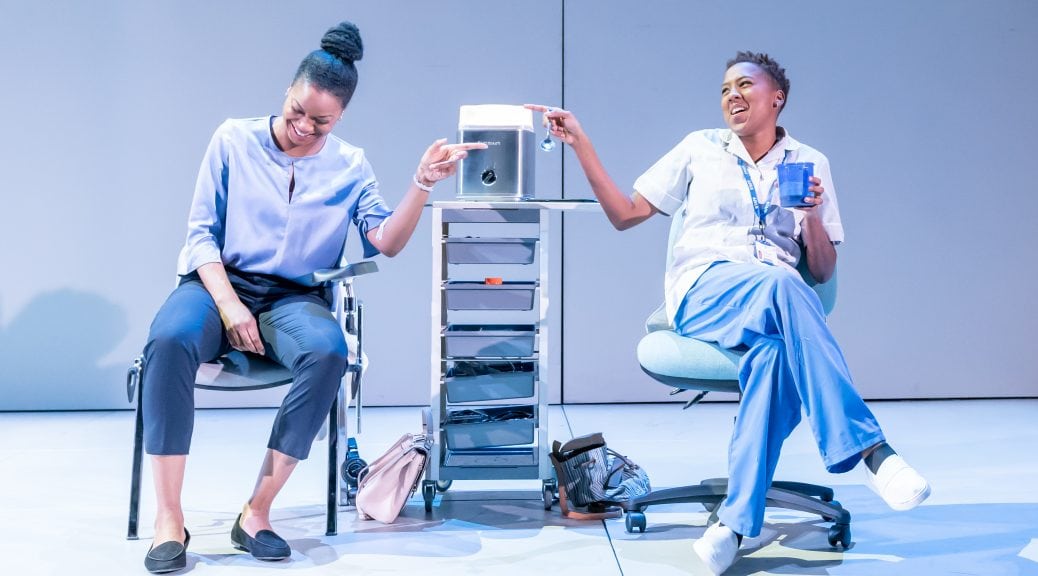
There is a great excitement around playwright Ella Road and her first impressive play. After a sell-out premiere last year and a transfer from the venue’s studio space into the main house – with an Olivier nomination under its belt – congratulations are in order. Road’s ear for dialogue is sure and the production strong. It’s a shame that control of the subject matter is lost in this sci-fi romance. Ultimately, the genre ends up manipulating the writer, rather than the other way around.

The scenario is that a system of genetic ratings based on blood tests changes our not-too-distant future. Road has no shortage of ideas, and a series of films crowds the show with news reports or fake adverts. But none of this is particularly novel or hard to foresee, so the play as a whole becomes predictable. While the testing is initially to assist in healthcare, its application in jobs, dating and then eugenics appears quickly. Each could be the focus of a play in its own right but, crammed together, the topics feel thinly explored. There are too many questions and some silly inconsistencies, while tacking on environmental concerns doesn’t help either. There’s a reason sci-fi has so much detail – without the geeky touches, the future world we find ourselves in fails to convince.

Road escalates outrage at a steady rate but with little change of pace in the structure of her scenes, so the show feels slow. By the time we’ve got the legalisation of “post-natal abortion”, attempts to challenge the audience feel more than desperate – they are naïve. Tasteless or provocative? That might depend on your view of human nature. But it seems fair to suggest it’s a dramatic own goal to curtail a plot about the fight again “rateism” so quickly. Only one figure (and a couple of news snippets) attempts to challenge this nightmarish system. A subplot about dealing in blood is carefully contained as a matter of financial corruption. The characters are worryingly lacking in morality or even agency.

For all the problems with the plot, the production is good. Road benefits from ambitious direction from Sam Yates and a superb cast that laps up her well-written lines. Mark Lambert makes for an intriguing impartial observer in his role as a hospital porter. Kiza Deen does sterling work as a protestor who develops Hodgkin disease during the course of the play. The Phlebotomist is essentially a love story between Angus – played by Rory Fleck Byrne, who reveals his character marvellously – and Bea. She holds the occupation that gives the play its title, and the role shows Road’s strengths. A brilliant performance from Jade Anouka – who demands both our sympathy and revulsion – makes her the highlight of the night.

Until 20 April 2019

www.hampsteadtheatre.com

Photo by Marc Brenner