All posts by Edward Lukes

“Bacchae” at the National Theatre

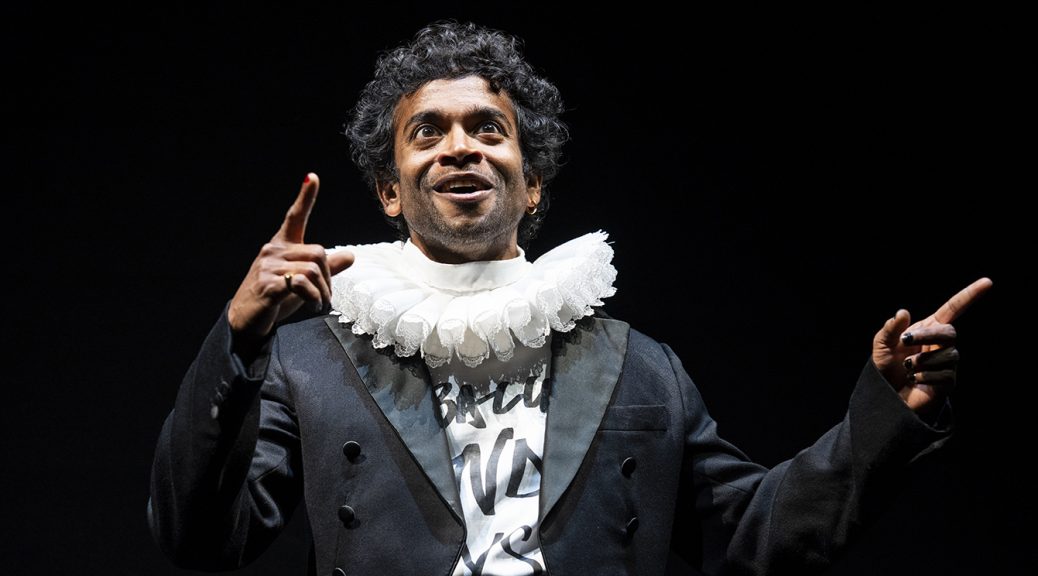
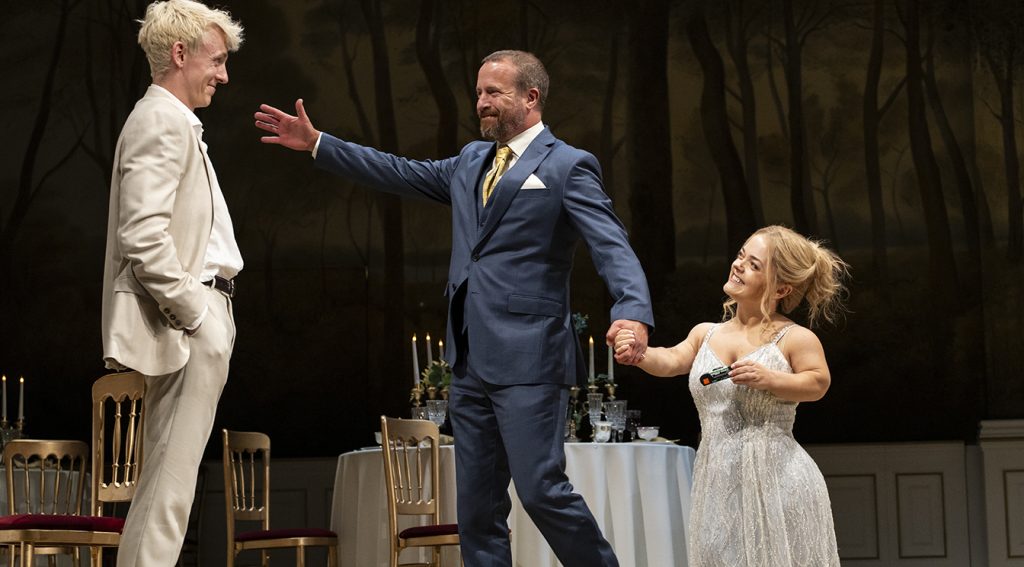
After taking up the toughest role in theatre this spring, Indhu Rubasinghams first show as artistic director of the National Theatre is a production under pressure. There’s a lot of thought behind it – choosing a Greek tragedy is a smart nod to the National’s past and perfect for the Olivier Theatre. Presenting a version – a “new play” – is important, too. There’s much to praise but it’s a shame that, although there are triumphant moments, Bacchae is not a triumph.

From the start, the show looks great, with fantastic puppetry representing a wounded horse. The set and costume design from Robert Jones aid Rubasingham’s clear direction and make the most of the venue. Oliver Fenwick’s lighting is ambitious and, more than once, breathtaking. The fight scenes are great. The music and sound design (DJ Walde and Ben and Max Ringham, respectively) distinctive and atmospheric. Rubasingham is clearly loving her new playground and uses it expertly – who doesn’t love a revolve?

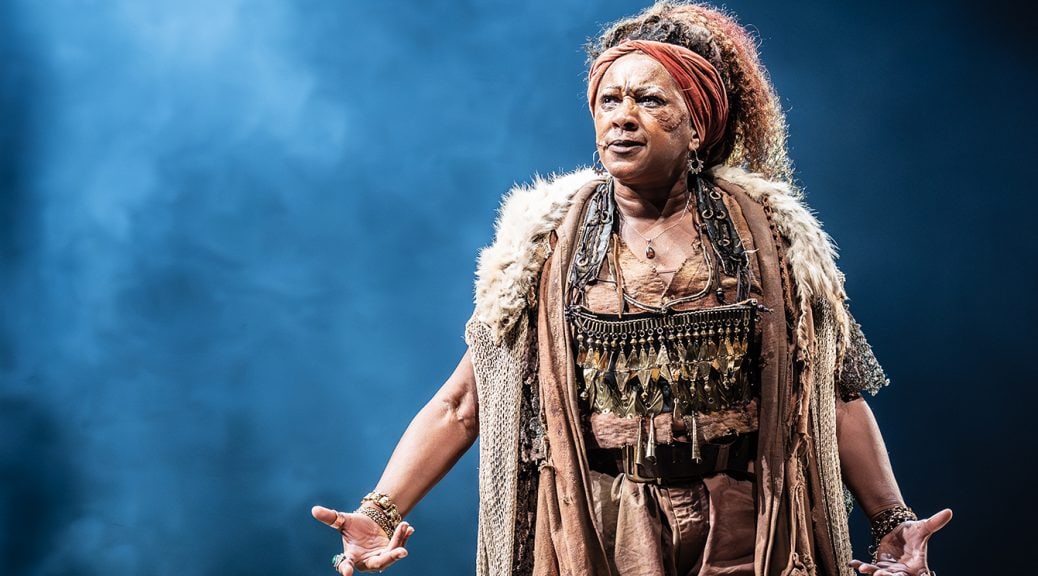
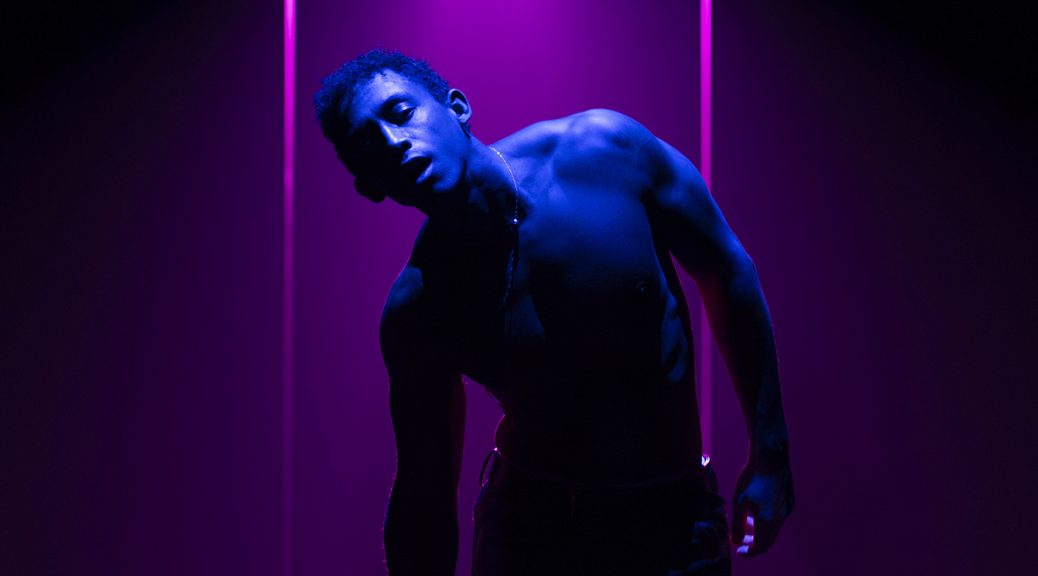
Bacchae is also well acted. There are strong performances from James McArdle and Sharon Small as the doomed Theban royals, showing the script’s savagery and humour. The star of the show is Clare Perkins, who plays Vida, Dionysos’ adopted mother, with ferocious energy and violence while also showing the affection the character has for the man she raised. Perkins is ably supporting by the titular troop who, despite their number, work hard to bring out distinct characters. As the half-God himself, Ukweli Roach brings a lot of bling but runs into problems from the script.

As a first play for Nima Taleghani – and the first time a debut play has been performed at the Olivier – the text impresses but is full of snags. The very different kind of Greek chorus is a strong concept, but the execution is clumsy. Other ideas engage… but don’t quite make sense. Take the play’s exploration of freedom: Dionysian liberty comes at a price, which the Greeks knew, and the play can’t ignore, but Taleghani can’t quite bring himself to warn us about it. His Dionysos is too much of a hero, which dilutes a sense of danger. And there’s the status of the god and his followers – described as immigrants, refugees and terrorists. All very topical, but Dionysos isn’t powerless, or poor… and he comes from Thebes.

As for the Taleghani’s language, that’s a success, although using colloquialism and even rap isn’t particularly new. The play is funny – a nice surprise – yet, oddly, the humour doesn’t work when characters try to make jokes. There’s too much profanity in the sense that it becomes repetitive (“bro” and “fam” are also overused). As Dionysos is the god of theatre, reflections on storytelling are suitably smart, culminating in a finale from Vida that it’s hard not to hear as a statement for the beginning of Rubasingham’s tenure. It’s a strong moment, full of passion and commitment. But how provoking it can be is a problem. It shows one reason why Rubasingham’s job is so hard. Challenging the status quo from the most prestigious stage in the country falls flat. When you’re on it – you are the establishment. 

Until 1 November 2025

www.nationaltheatre.org.uk

Photo by Marc Brenner

“Clarkston” at the Trafalgar Theatre

Samuel D Hunter’s play makes a virtue of being understated in an effort to be profound. It manages to provoke and move – just about – and certainly feels more substantial than its sketchy structure and short running time might suggest. With strong performances, and an intelligent authorial voice, the production safely secures four stars.

The plot is minimal. Jake goes travelling after being diagnosed with a degenerative illness and meets wannabe writer Chris while working in warehouse. The men are very different but start an intense friendship that is intriguing and emotional. Yes, it’s contrived, with touches of sentimentality and miserabilism. But it works hard and there’s a lot to like.

Although Jake and Chris attempt a romantic relationship, that’s not to be. Their differences – one is East Coast, one native to Washington, one rich, one poor, and Jake far more comfortable with his sexuality – are all underplayed. While Jake has the idea of following his ancestor’s pioneering trail to the ocean, opening up ideas about history and politics, Clarkston isn’t a state-of-the-nation play either. Appropriately, that relation of Jake’s is a distant one. Hunter suggests a lot but doesn’t want to be pinned down.

This tentative approach must make it hard for performers, but the cast does the sensitive, detailed characters proud. Joe Locke and Ruaridh Mollica, playing Jake and Chris respectively, build a bond it is easy to believe. How much we like these guys is left nicely open. There are more than a few selfish and silly comments, but Locke and Mollica make you care and bring out the depth of their roles. They are both great at getting the most out of the play’s subtle humour (their “non-sex” scene is brilliant). Sophie Melville joins as Chris’ mother, a recovering addict, in powerful encounters. Her role serves as an interesting foil to the youngsters. We can recognise the generational divide (I won’t list the clichés) but Hunter wants us to look harder and his cast allows it.

The problems all three face are real. It turns out there’s a lot to unpack in such a simple premise and you could argue that none of it is explored in enough depth, in particular Jake’s suicidal ideation, which is skimmed over uncomfortably quickly. But director Jack Serio takes his lead from the text and moves us away from misery into something approaching quiet celebration. As a coming-of-age story, it’s more mature and muted than usual, so easier for all ages to appreciate. I suspect Clarkston is a piece that will linger in the memory. It may be predictable that Jake and Chris get to the ocean. But note, there’s no epiphany here… it’s just the sea and the support of a friend.

Until 22 November 2025

www.clarkstonplay.co.uk

Photo by Marc Brenner

“Entertaining Mr Sloane” at the Young Vic

Revivals of Joe Orton’s plays arrive with concerns. The playwright’s reputation for outrageousness brings baggage. It’s to the credit of director Nadia Fall that this 1963 play is still shocking. It’s a shame that it isn’t as funny as it might be.

Fall tries hard to revel in the extreme and experimental aspects of the text, but the effort is limited because a lot of the humour is neglected. The dialogue isn’t odd just because of its time of writing – the mannered expression and convulsions reflect hypocrisy and twisted desires. Designer Peter McKintosh mirrors this with bric-a-brac, all painted black, suspended above the action like a Cornelia Parker installation. Meanwhile, lighting from Richard Howell includes bold colours and strobes to anachronistically split up scenes. It’s all a risk, as arty touches might alienate some from the play. And Entertaining Mr Sloane – with murder, misogyny and abuse at its core – is fairly hard to get your head around anyway.

Tamzin-Outhwaite-in-Entertaining-Mr-Sloane-at-Young-Vic-credit-Ellie-Kurttz
Tamzin Outhwaite

It isn’t an easy play for the cast either. Orton’s characters are forcefully flat. Motives are transparent, not just for comedy, but to show the audience that everyone here is delusional. But the performances are good. The least successfully written is a father figure, Kemp, capably played by Christopher Fairbank, who manages to inject a good deal of fear into the piece. But the role is too clearly a foil for the other power plays going on. Here, Daniel Cerqueira’s deadpan delivery as Ed gets a little monotonous, though the character is suitably chilling and repressed. Tamsin Outhwaite is a revelation as the sexually frustrated Kath, a woman you might feel sorry for, who Outhwaite makes truly grotesque thereby coming closest to Orton’s humour. As the object of both their affection, the titular lead, Jordan Stephens, has no problem with the charisma his character is said to possess. But Sloane is poorly served by Fall – he is never allowed to be quite threatening or funny enough. There’s a lack of subtlety to moments where the character thinks he has the upper hand because, here, Sloane is never in charge.

There’s a lot of lying. Deceit is often clear, even brazen, as characters are lying to themselves as much as each other. Is this the play’s attraction in 2025? Orton’s world as post-truth! And note, these lies excuse murder and assaults driven by lust and power. We’re a long way from a sex comedy and Fall’s move towards the serious sacrifices a lot. By the end, Sloane is literally tied up by Ed and Kath, as he is to be ‘shared’, so it isn’t subtle. Perhaps the focus is youth and how power held by an older generation is used to exploit? It adds to a creepy feel and gives this already robust play a shot in the arm.

Until 8 November 2025

www.youngvic.org

Photo by Ellie Kurttz

“The Code” at the Southwark Playhouse

Hollywood glamour often has an allure for the stage. And themes of censorship are unfortunately topical. So, a play set in 1950, as the Hays morality code is in full swing for films, ticks boxes. Playwright Michael McKeever pits a gay producer and his protégé against former star, Billy Haines. All three men make the personalities behind the arguments engaging. The play has its problems but is, overall, a good effort, worth seeing.

Like a hit from earlier this year, Retrograde, Tinseltown allows us to examine ethics with a bit of history added. The dilemma here is whether to follow the code of the title, the unspoken rule to tolerate homosexuality as long as it is never mentioned aloud. Producer Henry Willson, depicted with subtle creepiness by Nick Blakeley, plays the game; indeed he uses it to manipulate the impressionable Chad, who wants to become a star. Solomon Davy makes this younger role and the uncomfortable dynamic work well: guessing what Chad will do is a neat puzzle.

Solomon-Davy-and-Nick-Blakeley-credit-Steve-Gregson
Solomon Davy and Nick Blakeley

The moral compass they are both up against is a big part to fill. Haines, who in real life was blacklisted but went on to have a career as an interior designer, is understandably self-righteous. Thankfully, John Partridge, who takes the part, convinces us about his character’s charisma and deals well with some of the weaker humour in the script. Haines is said to inspire both “pity” and “awe”, at least according to Willson. This isn’t accurate – remember who the description comes from – but Partridge manages to show why we could feel sorry, why we might admire, and when neither is the case. It’s a sound device to model the arguments in the piece around. 

Direction, by Christopher Renshaw, is admirably restrained. The Code is a static affair, set in one room, but the claustrophobia is embraced and proves an asset. Yet the script is flawed. Too much talk of “authenticity” drags us out of the period. And a preachy tone from all the characters doesn’t sit well with their high living and streaks of selfishness. A lot of exposition is clunky and for far too much of the time, characters are telling one another what they already know. Chad, as a device to explain why so much ground is covered, becomes increasingly clumsy.

There is a final treat that tips the balance in favour of The Code. The presence of Tallulah Bankhead aids the piece enormously. This is a very strong, and enjoyable, performance from Tracie Bennett. Bankhead is the life and soul of the party, with some great home truths. Arguably, she helps the audience too much. I’m not sure three scenes of direct address are needed, no matter how well Bennett executes them. But Bankhead, and Bennett’s, presence lifts the show, injecting much needed energy and confirming how well-acted the piece is.

Until 11 October 2025

www.southwarkplayhouse.co.uk

Photos by Danny Kaan and Steve-Gregson

“The Producers” at the Garrick Theatre

This first major London revival of Mel Brooks’ hit musical is a blast. The story of theatre financiers who stage a flop to make money contains its own critique. The show is both clever and crass. And – like the reviewers of the musical-within-the-musical – I loved it.

The Producers is, genuinely, laugh a minute. Of course, with most of the jokes based on accents, stereotypes and sexual innuendo not all of them land. But if many of the punchlines are so old you can see – or should that be smell? – them coming, that doesn’t stop them from being funny. 

With its Broadway premiere back in 2001, based on a film from the late Sixties, there might be some caution about how the show has aged (especially gags about the casting couch). Not to forget that in-jokes about musical theatre require some knowledge. But the strategy of offending everyone – as an excuse – is tried and tested. 

The sheer quantity of gags is the key. The audience doesn’t get a break or stand a chance. You will laugh – that’s an order.

At full speed from the start, the show is a demanding one for its cast, some of whom did appear a little breathless on the press night. But all the performances are strong and the leads – Andy Nyman and Marc Antolin, as Bialystock and Bloom respectively – are superb. Their physical comedy is top-notch and I lost count of how many silly accents they use. Joanna Woodward stands up to them in fine style as the “Svedish” secretary/star Ulla, while Harry Morrison’s all-out performance as Hitler’s former valet turned playwright is tremendous. Everyone gets the most out of Brooks’ serviceable music and lyrics for the show, always emphasising the comedy.

It is easy to see that the production started in a smaller venue (the excellent Menier Chocolate Factory). While Scott Pask’s set is impressive, in the Garrick it feels a little shrunk and a few laughs might be lost to those in the Gods. But you can enjoy how settled the cast are. Having a long run before the transfer means their teamwork is superb and gives the sense that they’re also enjoying the show.

Springtime for Hitler, the production Bialystock and Bloom hope will bomb, is always going to be the highlight. Lorin Latarro’s choreography comes into its own here and the segment is a hoot. But director Patrick Marber also pays attention to the underlying theme of friendship between the colleagues that simmers in the background and gets some surprisingly moving moments as a result. Nyman and Antolin’s strengths show again. 

Nobody doubts for a moment how silly this whole thing is. But Marber and Brooks know a touch of sentiment in a musical goes down well and they provide it. The show gives us everything. No wonder it’s a hit.

Until 21 February 2025

www.theproducersmusical.com

Photo by Manuel Harlan

“The Pitchfork Disney” at the King’s Head Theatre

Let’s celebrate that Lidless Theatre, which had great success with Philip Ridley’s Leaves of Glass last year, provides the chance to see this 1991 work from the incomparable playwright. The early piece is far from his best work. But Ridley’s writing is so exciting that this story of an encounter between troubled siblings and an odd duo who give the play its title is wild, unforgettable, theatre.

The start is strong. Performed expertly by Ned Costello and Elizabeth Connick, Presley and Haley are twin siblings who are heavily medicated and living as hermits, their lives shaped by routine and fantasy. They repeat and invent stories that defy logic and, like their characters, are full of ambiguity and emotion.

The chance arrival of Cosmo Disney and his sidekick Pitchfork (who is tricky to discuss without spoilers) upsets the scenario less than might be expected – they are an even stranger pair. Pitchfork, played by William Robinson, is a compelling (and dangerous) figure who invokes repulsion rather than magic or charisma. There’s a wonderful variety of abjection, but it is all down to earth.

This is a valid interpretation. Horror is the key and, of course, there is banality in evil. But arguably, director Max Harrison embraces the play’s controversial reputation too forcefully. Discomfort and shock are only part of the play. The stories recounted should – sometimes – offer succour. Disney’s bleak view of human nature might , if not oppose, contrast with the siblings.

A similar position is taken with the tricky comedy in the play. With Ridley, laughs are always barbed – it’s deliberate that not everyone in the audience joins in – but here they are also broad. Too much deadpan delivery is a mistake, and it blunts the script.

Both reservations are subjective. Harrison has his ideas for the play and, if questionable, that vision is consistent, considered and thorough. The performances are committed and the delivery technically accomplished. But I think there’s something missing – a conflict between stories that structure and those that shock. Disney and Pitchfork are showmen and of the moment. The twin’s tales are private and endure. And at least one thing Ridley is asking is which kind of story is more frightening.

Until 4 October 2025

www.kingsheadtheatre.com

Photos by Charles Flint

“Born With Teeth” at Wyndham’s Theatre

From Shakespeare in Love to Anthony Burgess’ excellent novel, A Dead Man in Deptford, William Shakespeare and Christopher Marlowe make good source material. Playwright Liz Duffy Adams recognises the potential and puts them head to head in a fast, clever piece. If you like your history explored and exploded, this one is for you.

Quite rightly, Duffy Adams isn’t afraid to take liberties with facts (indeed, she points out that both Shakespeare and Marlowe did the same thing). She uses our lack of true knowledge about their lives wisely… they may indeed have worked together on the Henry VI plays, been gay, Catholic or, well, make your own case. And our prejudices about the men are exploited to great effect, with ideas about the brilliant but dangerous spy and occultist Marlowe contrasted with the Bard, who is mysterious or… just a bit boring? The contrast is funny and layers the show with éclat.

Such reputations are overplayed at times – fine for Marlowe but a little tiresome when it comes to Shakespeare. But Duffy Adams goes all in. The dialogue is bracing, with effective deadpan delivery, and a lot of it is rude! There’s a neat balance of period feel and references to the men’s work that, while plentiful, are not overwrought. Director Daniel Evans and designer Joanna Scotcher follow the text’s lead in being a little, shall we say, big. There are bold videos and loud music to introduce scenes. 

Performances are appropriately energetic (especially considering this is two men talking in a room) and downright sexy. The pace is embraced by both performers – Edward Bluemel and Ncuti Gatwa – who will, for many, be the production’s highlight.

Gatwa brings his usual charm to Marlowe, is fantastic with the show’s comedy and provides a passable air of danger. He is excellent when it comes to ego and Marlowe’s is presented as huge. There’s no doubting the stage presence – and how he works his extravagant quill is a sight to behold. As Shakespeare, Bluemel has the tougher task of suggesting depth and intrigue at first and then growing his role. He gets more time with us to try to make sure this works. Shakespeare introduces the scenes and keeps the theme of trust, in art and life, vivid. 

A balance of sympathy, rivalry and attraction between the two men drives the show. But the action is small. For all the talk of espionage, a spy story this is not. The vague idea of having powerful friends and then having to betray people (for why?) doesn’t get going.

Because, as you’d expect, there’s more going on than speculation about two historical figures. Born With Teeth tries to show us two ways to live, two views of the world. There’s plenty of discussion about the men’s philosophies. But it’s heavy-handed and lacks clarity. Marlowe is Machiavellian and strangely resigned to his fate – much more is needed here. Shakespeare ends up an Enlightenment figure, precociously aware of literary theory. It’s interesting, if rushed. And if it’s not altogether convincing, it’s always entertaining.

Until 1 November 2025

www.rsc.org.uk

Photos Johan Persson

“Interview” at the Riverside Studios

Teunkie Van Der Sluijs’ idea of adapting Theo van Gogh’s 2003 film for the stage isn’t a bad one. Taking us behind the scenes of a celebrity interview has the scope for a tight head-to-head piece. Regrettably, the potential isn’t realised here. Updating the scenario to include the internet is poorly handled – it isn’t clear when the play is actually set – and the show ends up a long 90 minutes that tells us little.

The tension between serious journalist Pierre and influencer-turned-actor Katya just isn’t as strong or as interesting as it needs to be. The performers, Robert Sean Leonard and Paten Hughes, work hard. While Pierre seems ridiculously naïve, he has a traumatic back story that Leonard does well with. Poor Hughes has a tougher job, as her character’s intelligence and duplicity are supposed to, somehow, surprise us. But apart from this, there really isn’t enough to separate these two self-obsessed compulsive liars to create any sense of conflict.

Van Der Sluijs’ direction gives too much time to what little action there is and the players are somewhat swamped by the lavish Brooklyn apartment set. But there are no complaints about the production, which looks and sounds good, with an atmospheric score from Ata Güner. The video work, including live recording, is also good and incorporated very well. But – and it’s nobody’s fault here – there’s just too much of this sort of thing around right now.

Problems continue with the script’s poor humour and the odd chemistry between the characters. Some of this might interest – there are some fine #MeToo moments – but the observations and the jokes, like the opinions and a lot of the plot, are exactly what we’d expect and they feel dated. The whole idea of Katya turning the tables – and a poor final twist – are predictable. Some of this is deliberate, playing on expectations, but does an audience in 2025 really think that a social media star is stupid? Or that a journalist has integrity?

Interview wants to say lot to say about truth – online, in the news, surrounding celebrity – and how this triad relates. You might side with Pierre or see Katya’s POV. Maybe who you prefer depends on who you deem to be less irrelevant. But I’m afraid you won’t hear anything that you haven’t heard before and there’s little challenge or excitement. Maybe that’s a reflection on our times. But all we have here is battle of wits between two narcissists, neither of whom are as clever as they think they are.

Until 27 September 2025

www.interviewplayonstage.com

Photos by Helen Murray

“Juniper Blood” at the Donmar Warehouse

Mike Bartlett is in a very serious mood with his latest play. Using close observations and cold wit to look at the effects of climate change on one family ensures the work, skilfully directed by James Macdonald, wins respect. But it is familiar ground, and a harsh edge makes it hard work.

‘Climate grief’ is the issue, although I’ll admit the term is a struggle. The idea is that things are so bad that we’re all in mourning for the planet. Hope is the keyword – not just a lack of it but whether it is even possible anymore. And yes, that is as grim as it sounds, even if Bartlett adds a few good gags along the way.

Whether or not to bring a child into the world was a concern for Bartlett way back in Earthquakes in London. And it’s not as if things have got better. But too much of the argument is the same. It’s impressively intense and undoubtedly important but ultimately repetitious. We start on a family farm, a kind of spin on The Good Life, with fascinating research about agriculture thrown in. But as any kind of compromise is rejected, environmentalism becomes radical and intersects with mental health.

The generational conflict in the play is solid, although Bartlett does better with the older figures. And privilege is something explored well enough. Although it’s hard to like anyone on stage – and credulity is pushed too far – the characters are all entertaining and the kind of roles actors revel in.

Although arguing about who is the key character would be part of the fun, I’m going for Lip, ironically named for his taciturnity. Sam Troughton is fantastic in the part, bringing essential underlying charisma. Lip isn’t an idiot: worrying about an existential crisis is sensible! But his partner, another strong role brilliantly performed by Hattie Morahan, is torn when she becomes pregnant. Other characters, a younger couple and a neighbour, are all filled out, with credit to Terique Jarrett, Nadia Parkes and Jonathan Slinger. The personal stories and perspectives interest, amuse and irritate in equal measure.

Good intentions run through the play and considerably help to make some silly bits credible. Opposing views allow scope in argument although, as with some of the characters, a lot doesn’t quite convince. For all the skill here, the result is strangely formal, tired and a little lost. Given the state and scale of the problems highlighted, maybe that’s understandable.

Until 4 October 2025

www.donmarwarehouse.com

Photos by Marc Brenner

“Goodnight, Oscar” at the Barbican Theatre

There’s a danger of damning Doug Wright’s Broadway hit with faint praise. The writing is sound, the direction from Lisa Peterson solid. There are plenty of interesting themes surrounding the story of a virtuoso pianist suffering from poor mental health that make the show an excellent vehicle for its star, Sean Hayes, who is aided by a strong supporting cast. It looks good, too, with the 1950s setting made stylish in Rachel Hauck’s set and Emilio Sosa’s costumes. There’s next to nothing to complain about.

Oscar Levant, billed as one of the 20th century’s greatest wits, followed his successful musical career as a TV personality who was infamous for his openness about his health. The play pairs him with Jack Paar, said to have invented late-night television with Tonight, and imagines one episode with Levant sneaking out of a mental hospital to appear on the show. It’s a good story that Wright gets a lot out of, and Peterson paces the script superbly.

The blend of comedy and tragedy is handled well. Levant is funny, but his condition is a concern. Blessed (or should that be cursed?) with prodigious self-awareness, he needs to perform. Fascinated TV executives and viewers both condemn and exploit him. 

The role’s attraction for Hayes is clear, and he is, indeed, a revelation. That’s not so hard, since most Londoners will only know him as Jack from early Noughties sitcom Will & Grace. But he gets a standing ovation presenting a very different and complex man. Strong support from Rosalie Craig as his wife helps, despite her role, like too many others, being underwritten. Craig is excellent at showing a cool compassion that carries the action. Yet Hayes can’t help but steal the show. Yes, he is good with the comedy, but he is moving as well, managing to make us feel for Levant without patronising him. The piano playing is especially impressive and a great theatrical moment. Not only does Hayes give a great rendition of Rhapsody in Blue, but he acts while he is doing it.

Given Levant’s tortured relationship with Gershwin, who appears as an hallucination (performed by David Burnett), the influence of Peter Schaffer’s masterpiece is clear. But this is Amadeus with addiction issues, an addition that is interesting and convincing.

Another side of the story, Levant’s involvement with TV, might present more of a struggle for a home crowd. The late-night chat show isn’t as much of an institution here. While Ben Rappaport gives a layered performance as Paar, the excellent Richard Katz doesn’t have enough to do as a TV executive and Eric Sirakian’s role as a show runner is a weak comic foil. But even here, Peterson manages to convey the bustle of live TV, while questions around the nature of celebrity are clear and thought-provoking. If the play isn’t particularly adventurous, it is admirably thorough and conscientious. There really is a lot to praise.

Until 21 September 2025

www.goodnightoscar.com

Photos by Johan Persson