Tag Archives: Thea Sharrock

“High Noon” at the Harold Pinter Theatre

It might seem a little odd to hold the world premiere of a Western, set in sun-drenched New Mexico, in wintry London. This new play by Eric Roth, based on the Oscar-winning 1952 film, feels like a labour of love that has questionable appeal. But it manages to entertain and, pretty much, convince.

The creative teams’ credentials are impeccable. Roth is no stranger to Academy Awards himself. This foray on to the stage is competent, if unimaginative, with strong characters and clear themes. It helps that the story is good, with recently retired Marshall Will Kane rejected by the town he served when he needs help the most. Thea Sharrock’s direction is tight, making the most of the idea that the action is in ‘real time’ and giving the impression that the cast is much larger than it actually is. Tim Hatley’s unfussy set also deserves praise, aiding some pretty clunky scene changes.

The casting is great, too. Movie star Billy Crudup takes the lead role and is suitably inspiring, making an asset of his character’s vulnerability. West End favourite Denise Gough is his love interest and benefits from the slightly more interesting role of Amy. Gough, always good with angst, gets the most out of her character’s religious questions and there’s a powerful chemistry between the leads. Their age makes the story slightly different, and both performers lean into this commendably. There is strong support from a hard-working James Doherty, who takes on three roles, including the show’s villain out for revenge. And there’s another nicely written role for Rosa Salazar as no-nonsense local businesswoman Helen Ramirez – she even manages to inject some much-needed humour into the show. You wait a long time for a scene between her and Gough. Thankfully, when it arrives it is a highlight.

Reservations arise, though. Having some singing in the show isn’t a bad idea. Gough’s voice is impressive. But her character’s refrain isn’t memorable and there are also recorded tracks that jar. It’s hard to avoid the notion that someone at some point wanted this to be a musical and then gave up on the idea. Some nods to the immorality of leaders lack subtlety and the need to make the piece ‘relevant’ doesn’t convince. But the moral of the tale isn’t as simple as it might be. Twists with Amy’s conscience are neat moves and the overall message of standing up for what you believe is suitably rousing, but also complex. To that end, the elevated story makes this show worth watching.


Until 6 March 2026


www.highnoontheplay.com

Photos by Johan Persson

“13” at the National Theatre

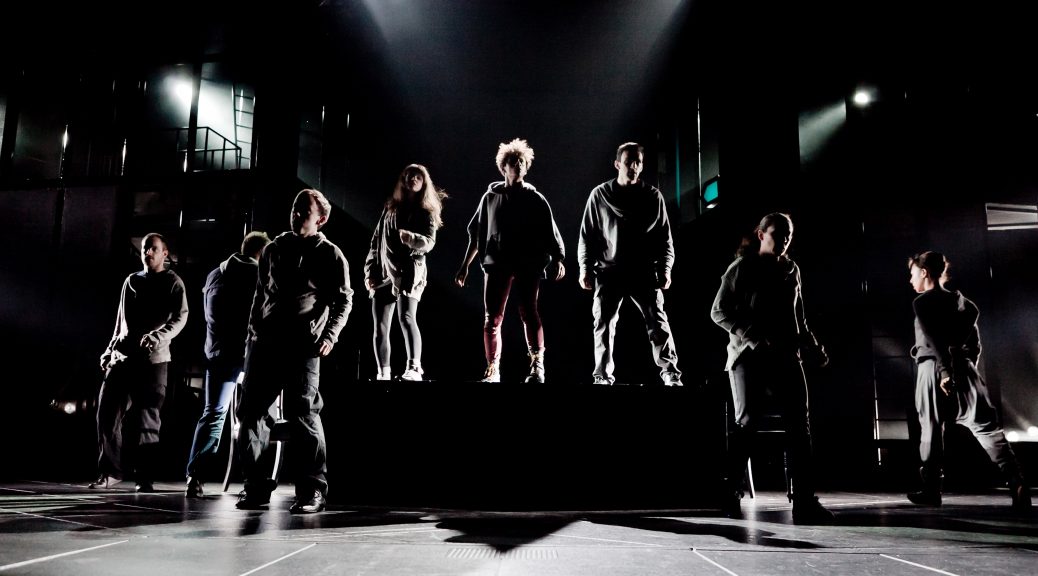
After the success of last year’s Earthquakes in London, Mike Bartlett’s return to the National Theatre with his new play, 13, has something of triumph about it. Promotion to the grand Olivier Theatre would be a dream for most playwrights, but Bartlett seems undaunted and bravely presents us with a fear-fuelled nightmare that’s ambitious, big and bold.

It’s one nightmare, to be specific, spookily shared by 13 different people. This clever device shows a disparate section of society, from a cleaning lady to the Prime Minister (Geraldine James on excellent form), all living in anxious times and searching for something to believe in.

It would be impossible to mistake Barlett’s version of the future as the very nearly now – social networking, riots on the streets, economic catastrophe and the threat of war – it’s all highly topical, with enough iPads on stage to make Steve Jobs smile down on us. As if this weren’t enough, Bartlett introduces religion as a fulcrum to his play. A central messianic character, John, performed with gnomic intensity by Trystan Gravelle, raises yet more questions and heightens the dramatic stakes.

Thea Sharrock’s direction and Tom Scutt’s design match Bartlett’s vision. With the Olivier’s revolve used to great effect, this is a precise production, technically impressive and rewardingly theatrical. The dreams the cast share, full of “monsters and explosions”, are complemented by spectacular lighting design from Mark Henderson.

After detailing a depressing catalogue of ills that beset our world in fantastically dynamic fashion, the pace changes to present a debate between the PM, the prophetic John and Danny Webb who plays an atheist academic with commanding presence.

It’s possible Bartlett has a young audience in mind for 13 – a crowd fresh for debate and highly engaged. If so, then I applaud him. But, despite Bartlett’s skill, the ideas behind 13 don’t match the novelty of their execution. It isn’t that the issues aren’t important or interesting, rather that they have been debated so many times before. What is impressive is that Bartlett presents them with a degree of impartiality seldom seen. And that is a very grown-up thing indeed.

Until 8 January 2012

www.nationaltheatre.org.uk

Photo by Marc Brenner

Written 28 October 2011 for The London Magazine

“Blithe Spirit” at the Apollo Theatre

With her strong reputation for revivals, Thea Sharrock is a safe pair of hands to direct Noël Coward’s wartime comedy Blithe Spirit. The production, fresh from Bath, fits into the West End perfectly with a slick all-star cast and general air of quality.

With the Terrance Rattigan revival currently in full swing, reminding us about craftsmanship in playwriting, Blithe Spirit serves to show Coward’s talent in constructing a play. This maybe frivolous stuff but it’s impeccably plotted, and Sharrock’s zippy pace is perfect for bringing out Coward’s bravura dialogue.

The scenario, a wife coming back to haunt her husband and his new relationship after a botched séance, is a comic device that’s brilliant in its simplicity. As an actor himself, Coward provides roles to die for (in this case, literally) and the cast of this production grabs the opportunity with both hands.

Robert Bathurst plays Charles Condomine. A typically vain Coward hero, he is appealing despite his ego and immature behind his sophistication. Bathurst plays the role superbly but issue has to be taken over the fit of his smoking jacket – no matter how tormented by the paranormal a Coward hero may be, he should never be dishabille.

Charles’ wives are superbly cast. Hermione Norris plays the glacial Ruth as the “staccato Sergeant Major” and her acidic delivery is perfect. Ruthie Henshall adds a mischievous grace appropriate to the role of Elvira and is a joy to watch.

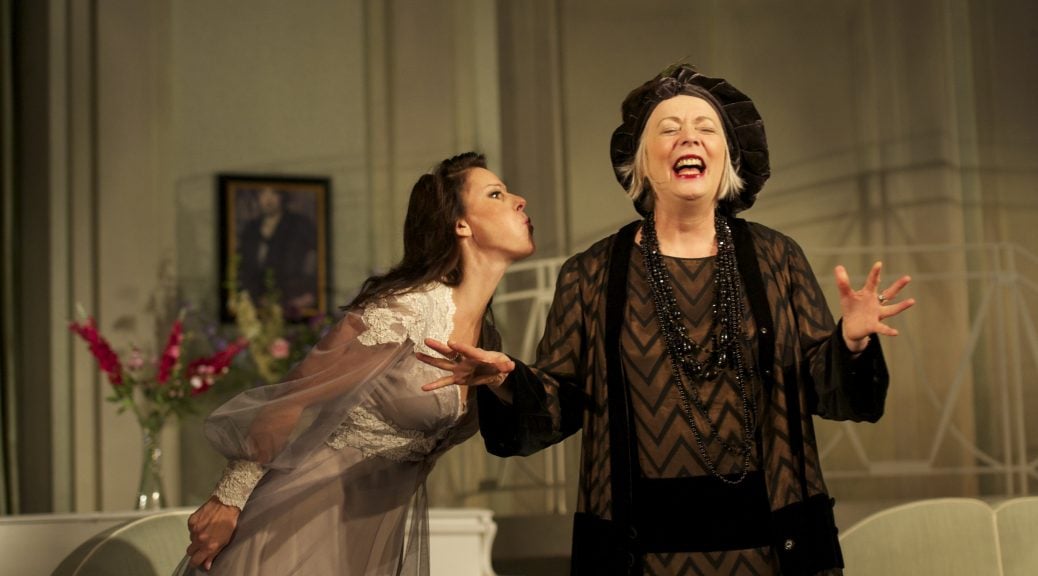
Best of all, a much anticipated performance by Alison Steadman finally lays to rest the ghost of Margaret Rutherford in the role of Madam Arcati. Steadman’s Arcati deals with astral bigamy in hilarious down-to-earth fashion. Concerned about the effect of cucumber sandwiches on her trance, she has an eye to innuendo that a constant quest for “subdued moaning” probably induces. Not that she would find any at the Apollo Theatre during Blithe Sprit – just good old-fashioned laughter.

Booking until the 18 June 2011

www.nimaxtheatres.com

Photo by Nobby Clark

Written 11 March 2011

“After the Dance” at the National Theatre

The National Theatre’s contribution to the Terence Rattigan centenary celebrations is one of his least known plays, After the Dance. This provides a provocative insight into the Bright Young Things – that post-WWI, Bohemian generation – and in particular what happens to them in later life. Set in 1938, the play’s serious-minded youngsters observe their elders with disdain. This new generation thinks the party should have ended long ago and, with a new war looming, it becomes clear that any dance now is likely to be a macabre one.

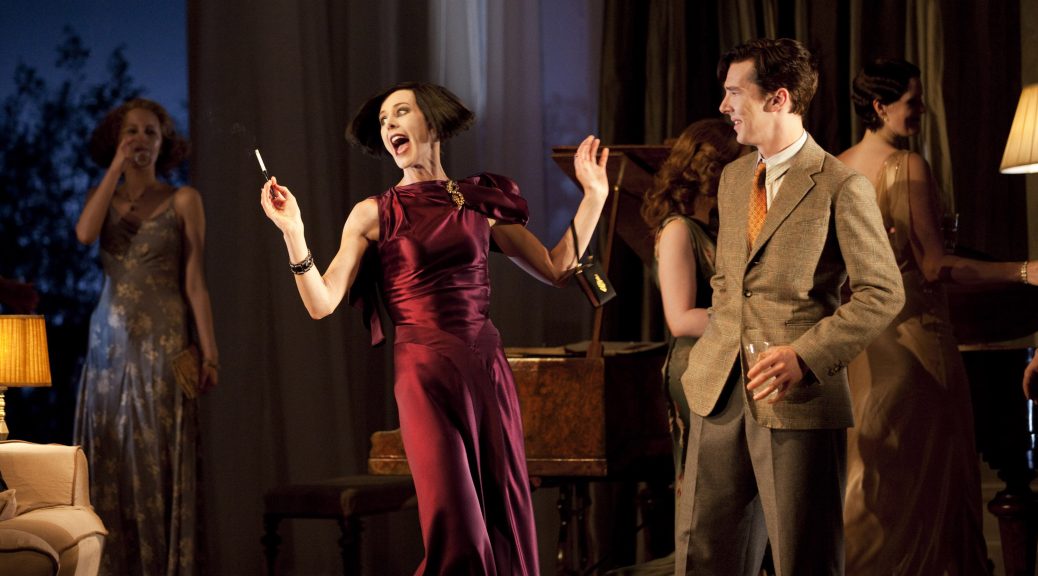
The Scott-Fowlers are a wealthy and glamorous couple, still on the party scene and seemingly enjoying themselves. Reaching for the gin with improbable frequency, even more impossibly they retain their wit. They may not be young but they are still bright and a great source of comedy. Benedict Cumberbatch and Nancy Carroll portray this sophistication perfectly – they positively sparkle.

The Scott-Fowlers are joined by their ‘court jester’ John Reid, played by National Theatre stalwart Adrian Scarborough, who (as usual) manages to steal any scene he is in. We also get to meet their friends, including a cameo from Pandora Colin that is worth the price of a ticket alone. Her character’s vague distaste of her Bloomsbury days now that times have moved on is not only hilarious but reveals the dichotomy this group lives with – obsessed with the past, they are also slaves to fashion.

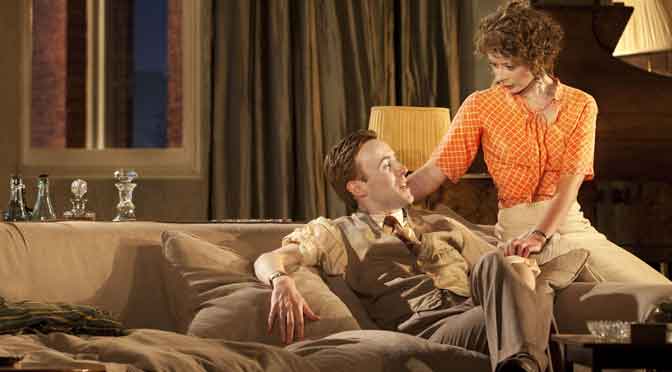
John Heffernan and Faye Castelow

Aloof to it all, David Scott-Fowler’s cousin and young secretary, Peter, is played superbly by the always impressive John Heffernan. While intrigued with the glamorous life he isn’t ashamed of being the “bore” his elders live in fear of being described as. His fiancée Helen also sees that the pretence of being continually interesting is exhausting, but is in love with the older David and young enough to try to change him. Faye Castelow gives this pursuit an almost sinister edge and shows how Helen fails to recognise the depth of character she lectures about is actually already present. Given the chance to show their characters’ deeper side, Cumberbatch and Carroll excel once again.

There is no doubt that this is a revival to cherish. Rattigan’s masterfully crafted script is directed with characteristic clarity by Thea Sharrock. The production values are as high as we might expect from the National Theatre, with a stylish set from Hildegard Bechtler and breathtaking costumes. Any reference to contemporary events and the economic boom of recent history are (perhaps thankfully) avoided. Entertaining and interesting, impeccably performed and produced, this is the perfect period piece.

Until 11 August 2010

www.nationaltheatre.org.uk

Photo by Johan Persson

Written 9 June 2010 for The London Magazine