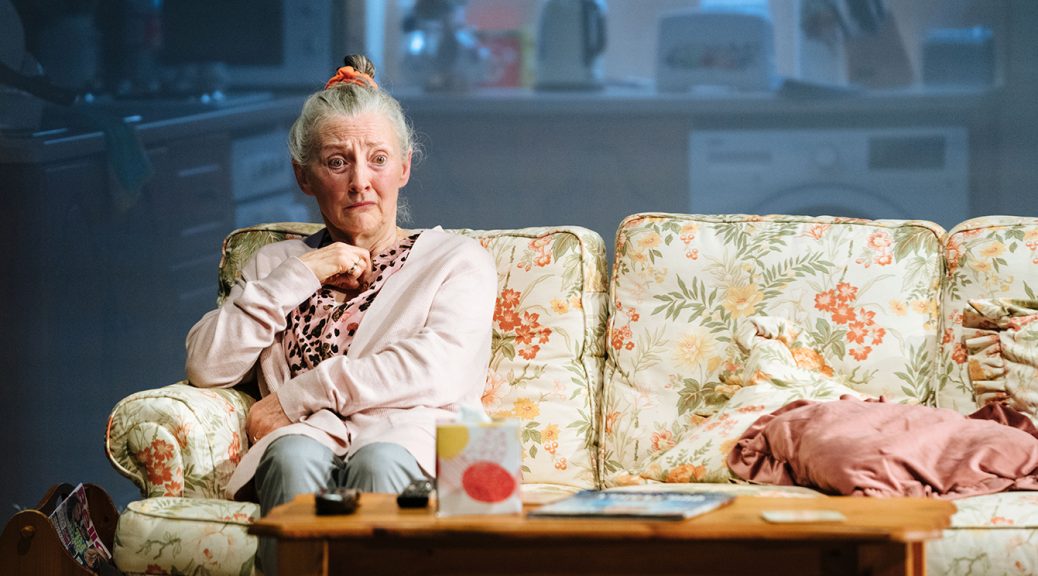
“Dixon and Daughters” at the National Theatre

Theatre doesn’t get harder hitting than this. Director Róisín McBrinn and playwright Deborah Bruce have worked with the show’s co-producer Clean Break, a women’s theatre company that focuses on the criminal justice system. As a story of how that system impacts on traumatised lives, Dixon and Daughters is intense, provocative and powerful.

The insights gained from in-depth research have led to a script with unquestionable authenticity – which doesn’t make Dixon and Daughters easy to watch. No fewer than six women, five from the same family, show the complexity of abuse. What has happened to them isn’t easy to think about, let alone watch. Bruce charts how past events have shaped lives and endanger futures.

Exploring reactions to abuse proves profound. First, there is denial – we meet Mary, the mother of the family, on her return from prison, incarcerated for perverting the course of justice in a case against her husband. Bríd Brennan’s performance in the role is flawless, with plenty of twisted logic and perverse outrage convincingly depicted. When Mary confronts the truth, Brennan gives a raw performance that is painful to see.

Mary’s daughters Julie and Bernie (further excellent performances from Andrea Lowe and Liz White, respectively) share some of this wish for silence, but their trauma is clearer to see. Julie has become an alcoholic in another abusive relationship. Bernie focuses on her daughter Ella (Yazmin Kayani), who has her own story to tell about the pervasiveness of male power.
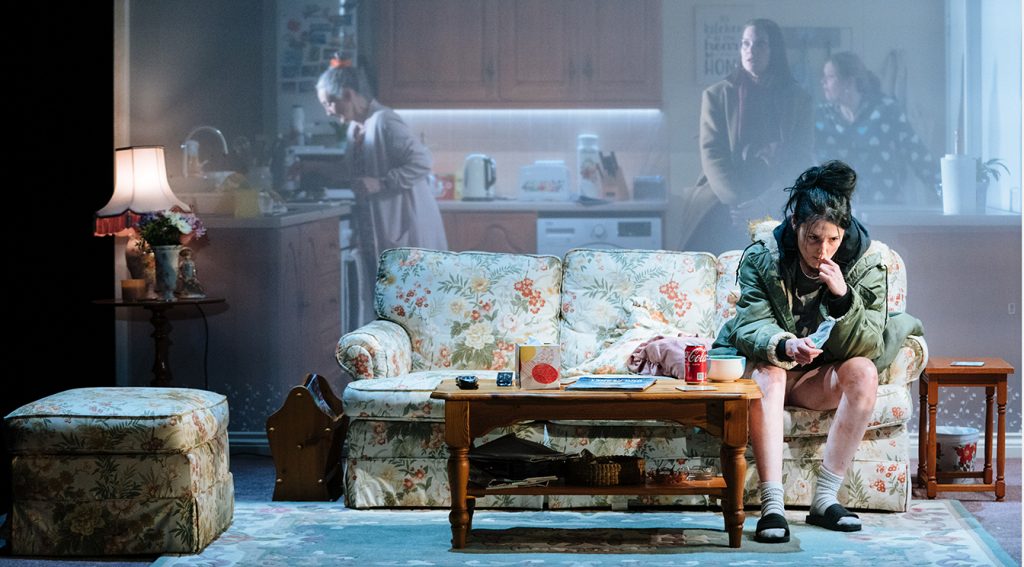
Posy-Sterling-and-behind-Bríd-Brennan-Liz-White-and-Andrea-Lowe-in-Dixon-and-Daughters-at-the-National-Theatre-credit-Helen-Murray
Posy Sterling with Bríd Brennan, Liz White and Andrea Lowe in the background

Ella is joined by a woman called Leigh, who Mary met in prison. This extremely damaged character is vividly portrayed by Posy Sterling – she is frightening and heart-rending. And (of course) Leigh is a victim of abuse herself. In this substitute daughter for Mary, Bruce balances frustration and compassion, which serves as an example of how complex the relationships in her play are.

“Make peace or make trouble”

Mary, Julie, and Bernie juggle with the decision to “make peace or make trouble”, with fear leading to damaging decisions. It’s easy to judge, but the drama gives us a chance to stop and question. It is Mary’s stepdaughter, Briana, who has proved the father’s nemesis – her actions led to the court case that imprisoned Mary. Briana’s self-care, mantras and all, make the character jar – at first. But with the aid of Alison Fitzjohn’s charismatic performance, she becomes an inspirational figure who helps herself and others.

There is a danger that each character in the play represents a response to issues, but this potential flaw is avoided through surprising humour and the strong performances. A motif of the house itself being a witness to events fails to convince or make the most of Kat Heath’s ambitious set – the idea feels tacked on. And it must be admitted that, dramatically, there are alarms but no surprises in Dixon and Daughters – the play is depressingly predictable. Nonetheless, by broadening her concern to misogyny Bruce highlights the systemic and cruel nature of male power with incredible authority.

Until 10 June 2023

www.nationaltheatre.org

Photos by Helen Murray

“Sweeney Todd – the Victorian melodrama” at Wilton’s Music Hall

Opera della Luna are keen to stress that their new show is not a production of the Stephen Sondheim musical. This demon barber of Fleet Street is based on the original 1847 play, also known as The String of Pearls, and is described as a Victorian melodrama. Given that both the period and the genre are sometimes referred to derogatively, the show could be a tough sell. But the production is funny and well executed and the project interesting.

The script, originally by George Dibdin Pitt, is more than a little silly but it is also exciting – a mix of morality play and thriller. As adaptor and editor, as well as director, Jeff Clarke tackles all his tasks with great skill. And the jobs conflict a little as the action is so crammed it is ludicrous; the coincidences are incredible, never mind adding supernatural touches and a servant pivotal to the plot who never actually appears.

It’s clear treating the show as a comedy is a good idea – and it is well done. If I can’t help wondering what a version of the show that tries to revolt, shock and thrill might be like, the strategy of going for laughs is sound.

The cast know they can’t declaim loudly enough or roll their eyes too often and give admirably energetic performances. Doubling roles is overused for comic effect but adds charm. Matt Kellett and Madeline Robinson embrace their roles as romantic leads. Nick Dwyer has a harder job in the title role and while boos and hisses are encouraged, there were a few too many for my taste. As well as having a fine voice Dwyer makes Todd a smart villain – not mad but motivated by money – and interesting as a result. Stealing the show is another baddie, Paul Featherstone’s Reverend Lupin, who is truly revolting – making your skin crawl while getting a laugh makes for an exceptional performance!

A passionate suspicion of the clergy isn’t the only surprise here – there are also remarkably fearless women, admittedly smaller parts, with Todd’s accomplice Mrs Lovett and a maid both made the most of by Lynsey Docherty. The characters are flat but the cast flesh them out: take the “half-murdered, half-smothered, muffin maker” (what a part) made a satisfying figure with a strong performance from Matthew Siveter.

Despite all this praise, the drama is in danger of dragging at times. The venue itself goes a long way to help the show – the charms of Graces Alley are often a production’s secret weapon – it really is the perfect venue for Sweeney Todd. But it is the music that really makes the night. Appropriate given Opera della Luna’s strengths, the score uses compositions by Michael William Balfe, Julius Benedict and Henry Bishop – all eminent Victorians but now less well known. Skilfully orchestrated by James Widden, the music adds atmosphere, aids the action and comedy, and sounds beautiful. Not Sondheim…but a rarer treat that has appeal.

Until 29 April 2023

www.operaellaluna.org

Photos by Andy Paradise

“Worth” at the Arcola Theatre

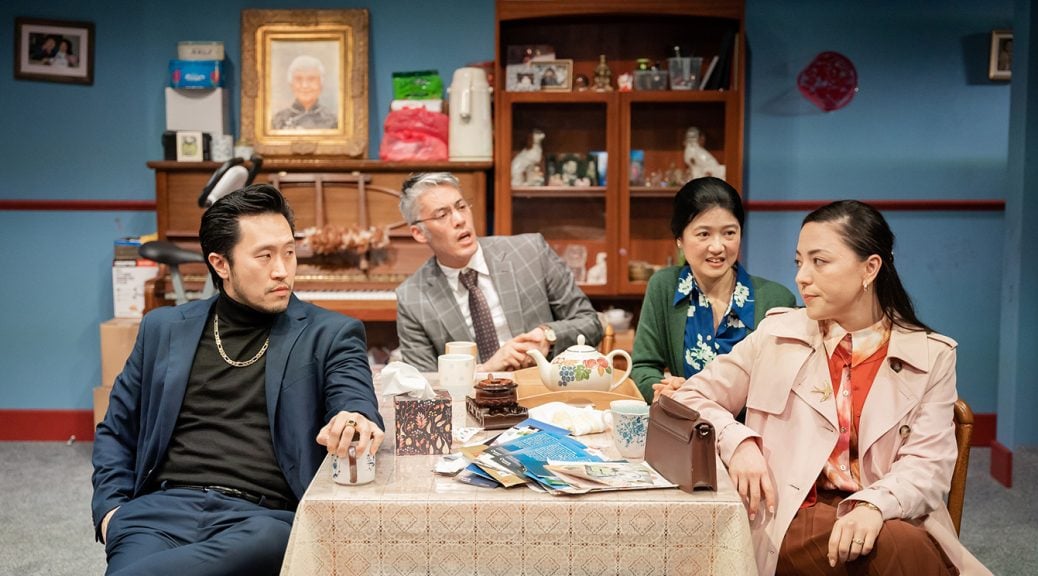
Joanne Lau’s dark comedy is set before the funeral of the mother of four estranged siblings. The unexpected news that the quartet’s inheritance has disappeared starts a frantic search for cash hidden around the home. As family secrets are uncovered, along with currency, the play becomes bleak.

Lau’s idea is tidy, and she sets up the scenario well. But tackling a cycle of abuse, from the mother to her children and then grandchild, ends up rushed. Adding the topic of immigration proves another challenge, and Lau’s considerations end up thin.

Tackling all this with humour is an admirable move but adds further complications. Lau isn’t shy about pushing the play into tastelessness – which is brave. And there’s a strict assessment of the siblings’ competition over how much each suffered. But although the play has laughs, the humour is predictable. Mentions of one character’s offstage wife, or bedwetting, or how the children were beaten with electric cables, all come to play a part. Similarly, the escalation with how crazy everyone starts to become can be seen a long way off. It all ends up very grim. Director Mingyu Lin keeps the action tight so that events are pacey, but the piece needs more surprises.

The script’s strengths come with its closely observed characters, which lead to neat performances. The siblings are distinct and show the effects of their childhood in different ways. Arthur Lee makes a convincing psychopath as Jacob. Sara Chia-Jewell has a tougher job as the highly strung youngest child, May. Having moved to America and found religion, much of the competition over misery rests on her shoulders. Stephen Hoo does well in the play’s most harrowing scene as the insecure yet successful Ted, while the always-apologising Penny makes a great role for Jennifer Lim, who has a firm grasp of the play’s comedy and a strong stage presence.

Leo-Buckley-as-Anthony-in-Worth-at-the-Arcola-credit-Ikin-Yum
Leo Buckley

There’s also an interesting role for Leo Buckley, who plays Penny’s child, Anthony, with skill. Lau writes this young part especially well – taking care to moderate how petulant he is and making him a foil for his elders while still being a rounded role. The characters are written well and make Worth entertaining, but what Lau does with them just isn’t enough.

Until 29 April 2023

www.arcolatheatre.com

Photos by Ikin Yum

“Sap” at the Soho Theatre

This fringe hit is a remarkably accomplished play from Rafaella Marcus. As a debut, it’s tempting to be inspired by its botanical references and write that there’s potential for growth. But, in truth, Sap is a show in full bloom that easily deserves five-star status.

Beginning with strong comedy that endears its central character, Daphne, to an audience, a gripping plot and intelligent script places mythology in the modern world to examine attitudes towards bisexuality and the effects of sexual violence.

The observational jokes that start the show are strong, with work life and Daphne’s sexuality creating complicity with the audience. Direct addresses prove to be one of the many highlights of Jessica Lazar’s superb direction. There is an undertone of what’s to come – Daphne is sensitive and stressed, a frank overthinker who shares too much – conveyed brilliantly in Jessica Clark’s stunning performance in the role.

It’s always impressive when a playwright changes the mood of their work, but let’s not forget that it’s hard. Marcus moves the tone of Sap with a skill that seems effortless. The plot twist in the play made the whole audience groan on the night I saw it – a fantastic moment of theatre. And what comes after the unusual twist is deeply disturbing, as well as original.

Clark is joined by Rebecca Banatvala, who plays several other characters and provides sterling support. Banatvala is especially good as the play’s male antagonist – a lawyer “spat out” of a cloistered quadrangle (what a phrase! You just know him, don’t you?). The script is marvellous, full of vivid imagery and ideas without being overpowering, and not a word could be pruned. Poetry and myth are used sparingly and to great effect.

The physical reaction to Daphne’s anxiety and a series of attacks that she suffers recalls the metamorphosis of her namesake – she feels bark enclosing her body, trapping but also protecting her. It’s a brilliant idea that is enhanced by Lazar’s use of movement. Just as impressive, the conceit isn’t overused – the idea builds powerfully and culminates in a scene that is another theatrical highlight, however harrowing.

The problem of depicting violence towards women is handled with innovation and intelligent. There is a strong sense that Daphne’s insecurities, as well as the biphobia she is subjected too, have created a woman who feels unworthy of the love offered to her. In fact, despite her faults, we can see that she is a “glorious” character – her girlfriend is right when she calls her this, and glorious is a word that can be applied to whole show.

Until 22 April 2023

www.sohotheatre.com

Photo by David Monteith-Hodge

“Guys and Dolls” at the Bridge Theatre

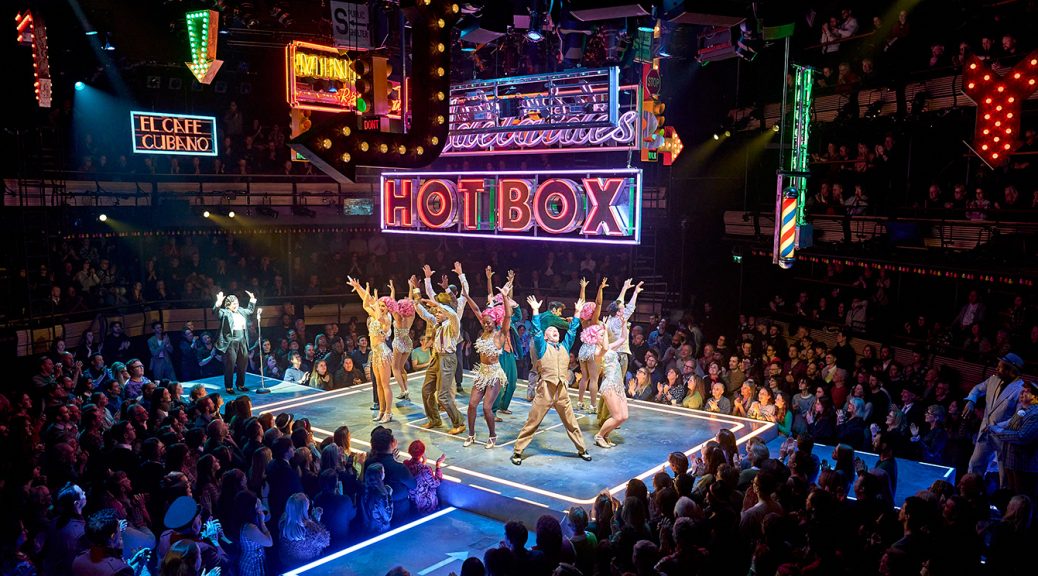
Nicholas Hytner brings immersive theatre to a musical in this superb revival of Frank Loesser’s classic Broadway ‘fable’. The Bridge has seen its audience in the thick of the action before (for productions of Julius Caesar and A Midsummer Night’s Dream), but a song and dance show is different and Hytner’s approach makes this lives-and-loves story about 1930s gamblers extra special.

If you choose a ticket in the pit, you are standing – and moved around a lot as stages rise and fall and props are brought in from all directions. Characters searching for a craps game push past you and a soul-saving Salvation Army mission parts the crowd. A group of ushers dressed as New York cops handles the audience and deserves a special mention. The atmosphere is fantastic. Get in early and don’t leave during the interval.

Apart from tiny fringe venues, you couldn’t be closer to it all… which is not to say it is for everyone. Although choreographers Arlene Phillips and James Cousins do a brilliant job, considering the space available, and the cast makes every effort, you might miss a big dance number in the show.

Standing is enormous fun, but also distracting, as you have to move during the songs. And this is singing you really don’t want to miss. Because the big thrill with the production isn’t this immersive approach so much as how fantastic it all sounds and how funny it all is.

Andrew Richardson and Celinde Schoenmaker make a swoon-worthy couple as Sky Masterson and Sarah Brown. The production doesn’t hold back with romance, embracing a period feel that would be pointless to ignore (it really is terribly old fashioned!).

Daniel-Mays-and-Andrew-Richardson-photo-by-Manuel-Harlan
Daniel Mays and Andrew Richardson

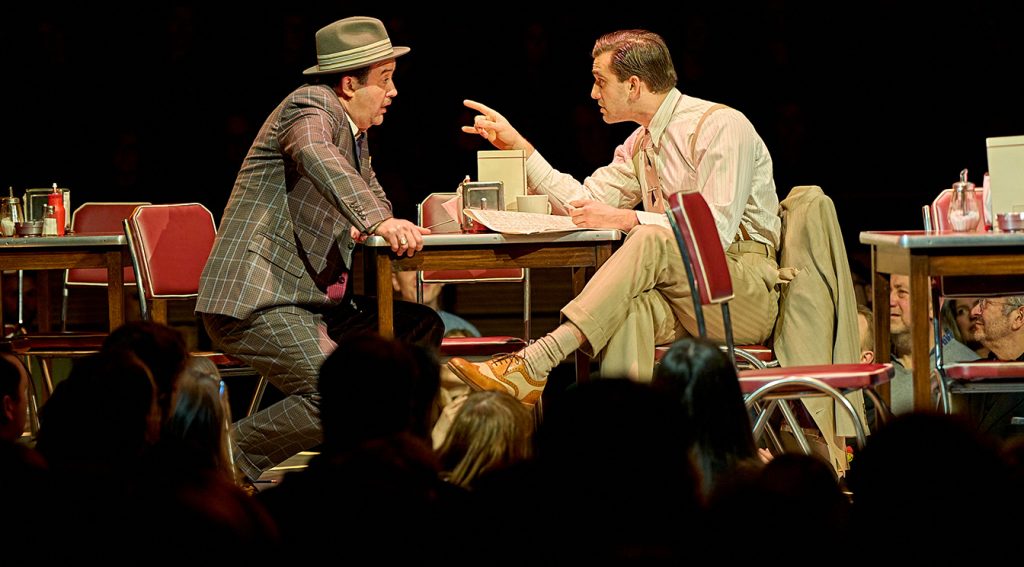
Daniel Mays seems born to play Nathan Detroit, making the most out of every gag. The jokes in Jo Swerling and Abe Burrows’ book hold up very well indeed. But, just as impressive, I’ll admit I had a tear in my eye when Mays sang Sue Me.

Celinde-Schoenmaker-and-Marisha-Wallace-photo-by-Manuel-Harlan
Celinde Schoenmaker and Marisha Wallace

As for Detroit’s long-suffering fiancée, Marisha Wallace’s performance cannot be praised enough. Her Adelaide’s Lament is hilarious, and she convinces as the star of the Hot Box Club with a stunning rendition of Take Back Your Mink.

The show’s lovers are sweet. But there are strong supporting performances that open up the performance and reveal how fresh Hytner’s approach is. Cedric Neal’s Nicely-Nicely Johnson’s crowd pleasing Sit Down, You’re Rockin’ the Boat is as excellent as ever. But note how many of his scenes are accompanied by the excellent Mark Oxtoby as Benny Southstreet – the characters have a strong relationship. And the friendship between Adelaide and Sarah is also a highlight. Both performers are good stage drunks and Marry The Man Today is turned into a highlight.

Bringing out the strengths of the book is a smart idea. Hytner takes every opportunity to flesh out the characters and, with such a stunning cast, the result is spectacular. Getting up close and personal is great, but seeing this show – full stop – is the important thing.

Until 24 February 2024

www.bridgetheatre.co.uk

Photos by Manuel Harlan

“Betty Blue Eyes” at the Union Theatre

There’s a big heart and a lot that’s smart behind this 2011 musical from George Stiles and Anthony Drewe. The story, based on Alan Bennett’s A Private Function, is full of quirky humour and quaint touches. But the strength of this revival comes from director Sasha Regan allowing space for quiet; Regan makes room for simple pleasures and tender moments.

The story has deliberately silly touches – it’s about a chiropodist and his wife stealing a pig destined to be slaughtered to celebrate a royal marriage…so lots of scope there. Add a mother-in-law, flatulence, and Spam and it’s no wonder there are so many laughs. It all leads to some strong and very funny lyrics. And there’s fun choreography from Kasper Cornish that includes sausages.

Although a period piece the show isn’t trapped in its 1947 setting. The date provides humour, and Reuben Speed’s costume design is good, but concerns about the state of the nation are perennial. Poking fun at patriotism gives the piece some meat.

The score doesn’t quite match the standard of the words but the music is entertaining and well structured. Characterisation is another strength that Regan emphasises. Betty Blue Eyes has a collection of strong parts that the cast work hard with: both Jonny Weston and George Dawes stand out with more than one role. And the show’s villain (a government meat inspector) proves a gift for David Pendlebury.

The leads roles of Joyce and Gilbert Chilvers are ambitious tasks for Amelia Atherton and Sam Kipling who should be proud of their performances. The Chilvers’ marriage is the production’s focus as the couple battle against their own sense of inferiority in the face of class prejudice and rationing. Atherton has strong comedy skills in her matriarchal role and lands a lot of laughs while making sure the Joyce’s snobbery doesn’t alienate an audience.

Joyce has a lesson to learn about the kind of man her husband really is – a topic that is treated tenderly – since Gilbert is an unusual hero. Pushing the character past simply being endearing is the challenge and, with a strong voice and a tear in his eye, Kipling succeeds. This gentle man stands in contrast to brash entitlement and suggests a different view of masculinity and British identity. Big claims and questions might not be what you expect from a show about a roast dinner…and that surprise makes the show crackle.

Until 22 April 2023

www.uniontheatre.biz

Photo by Michaela Walshe

“A Streetcar Named Desire” at the Phoenix Theatre

The Almeida Theatre’s hit transfer of the Tennessee Williams classic boasts three Olivier Awards. And it could easily have earned another for director Rebecca Frecknall.

As with a previous production of a lesser-known Williams work, Summer and Smoke, Frecknall’s inventive, disciplined approach has startling results. The freshness and vigour are especially noticeable with a famous piece – this Streetcar is fast, loud, and shocking.

Speed first: the delivery here is astonishingly swift, not just the action but the lines. Blanche, played by Patsy Ferran, is especially skilled. The character’s long speeches are delivered as if they belong in a thriller. The production would feel rushed if everything weren’t so clear.

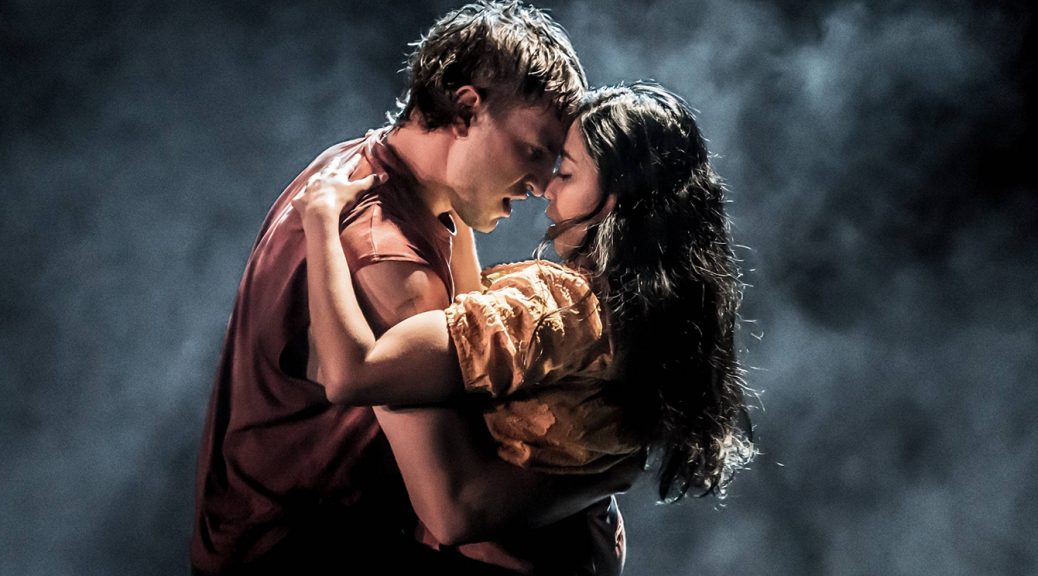
As for loud, there’s the musical accompaniment from Angus MacRae, written mostly for percussion and sure to give you a few jumps. The sound design (Peter Rice) is excellent – nothing is lost, despite a lot of cymbals. And there’s another source of volume – Paul Mescal – the actor who won one of those Olivier Awards.

Mescal’s Stanley shouts every line. It’s a tremendously physical performance with lots of running around. It is possible to feel sorry for Stanley (I’ve seen it in other productions), so you might find this portrayal less subtle than usual. Accusations about the man being an animal are emphasised and the character is very much the villain. When he hits and bullies, he enjoys it.

The violence against women in the play is Frecknall’s target. Stanley isn’t the only animal we see as he is joined by the other male performers who act like a pack. There is even the suggestion that Blanche is raped by this gang.

The trauma of Blanche’s marriage is highlighted from the start, creating immediate sympathy. But this production takes a harsh look at our heroine as well. Blanche doesn’t fool Frecknall, or Ferran, as the character’s wish to create a sense of magic is harshly exposed. You can be enchanted by, or suspicious, of Blanche, but here excuses and plans are blatant. Take the line “I want magic!” – Blanche screams it like a banshee.

To top all this, there’s an excellent Stella and Eunice (the upstairs landlord) who both enforce Frecknall’s focus on women in the play. Anjana Vasan has another well-deserved Olivier award for Stella – her passion for Stanley balanced by a concern for Blanche. And Janet Etuk makes her relatively small role of Eunice stand out. In solidarity with Blanche, the women form a trio in a way I haven’t noticed before. The insight, from an interpretation of the text that has conviction and vision, justifies that third award – for best revival.

Until 6 May 2023

www.almeida.co.uk

Photo by Marc Brenner

“Debate: Baldwin vs Buckley” at Stone Nest

‘The American Dream is at the expense of the American Negro’ was the motion debated at the Cambridge Union in 1965. The event is famous partly because of its speakers, James Baldwin and William F Buckley, and was a precursor to the latter’s famous television confrontation with Gore Vidal (the event is mentioned, and Baldwin appears, in James Graham’s play The Best of Enemies). Reenacted in this adaption by director Christopher McElroen, the piece fits neatly into the genre of verbatim theatre.

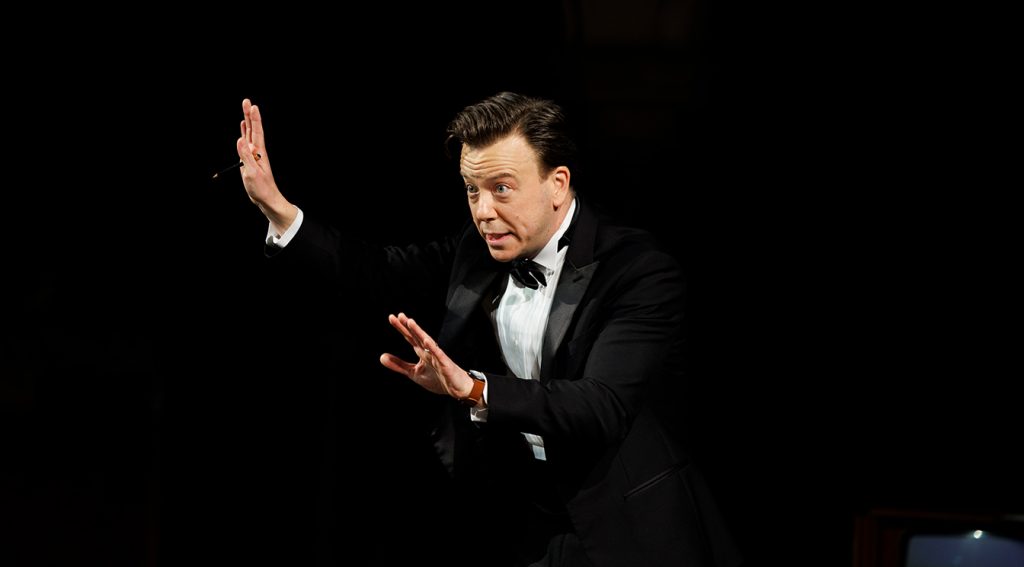
The structure of the debate serves the show well – there’s plenty of drama in the format, after all. It’s a smart move to have Baldwin and Buckley joined by the undergraduates who also spoke at the debate – they set the scene and build tension. That the younger men’s speeches are poorer proves interesting – for them the public speaking is an exercise that lacks the conviction and the intelligence that is to come. Strong performances from Tom Kiteley and Christopher Wareham reflect youthful nerves and bravado well.

Debate-credit-Ellie-Kurttz

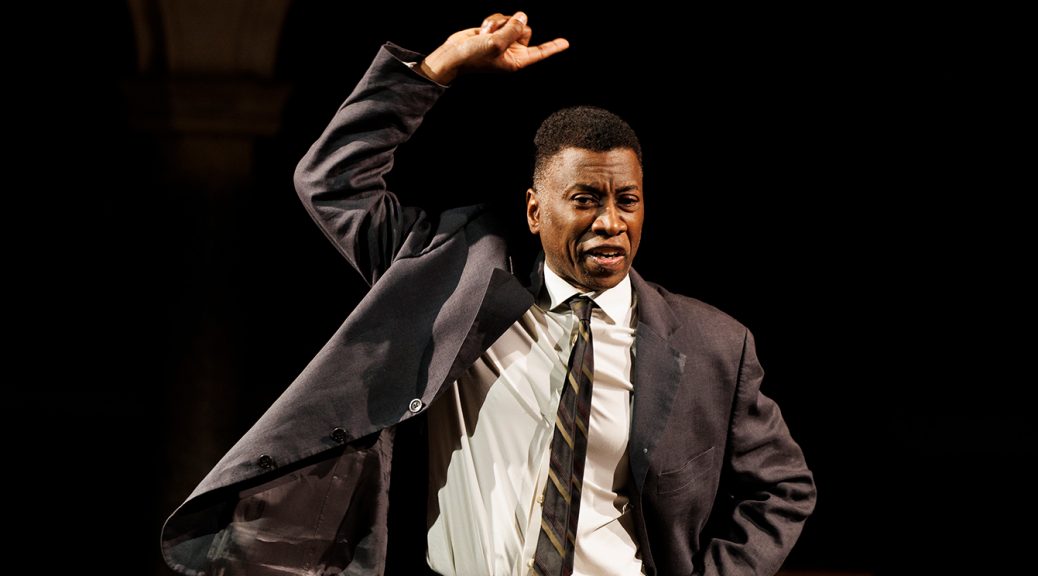
Baldwin and Buckley, performed by Teagle F Bougere and Eric T Miller, respectively, are the star attractions and their speeches are justifiably famous. Bougere brings Baldwin’s passion to the stage, it’s difficult to take your eyes off him even before he speaks as you record his reactions to what he hears. Miller shows the wily Buckley at his ‘best’ with a mix of faux self-deprecation and a performance of objectivity that impress as well as chills. Both bring their roles to life using their skills as actors rather than impersonators.

It is the skill in implanting the debate into our reality that makes the show great theatre. After all, you can watch the debate on YouTube so why go to the show? McElroen has a TV set on stage, with a voiceover introducing the event and its speakers. It is smart reminder that we should question the distance that watching the show as an archival recording from 1965 creates between us and the arguments. Because what we hear – live – is shockingly relevant. 

The way Buckley alienates and then demonises Baldwin may be more subtly polite than we are used to nowadays but could be a playbook for polarising politicians. As Baldwin recounts the impact the colour of his skin has had on his life, current concerns with systemic racism come into focus. Baldwin speaks of how our very reality is shaped by racism. A performance like this allows us to question how much that reality has changed.

Until 15 April 2023

www.stonenest.org

Photos by EllieKurttz

“Black Superhero” at the Royal Court Theatre

Danny Lee Wynter’s debut play brims with wit, contemporary preoccupations and important issues. Like a lot of theatre lately, Black Superhero is concerned with representation. And the play offers valuable insight into racism and the pressure of hyper-masculinity on black men. But despite excellent performances and strong staging from director Daniel Evans, with the help of his designer Joanna Scotcher, the piece is over-stretched and confusing.

Discussions about race and gay life come via three friends: David, Raheem, and King.  The trio are actors who, as actors do, talk about casting and in particular casting straight actors in gay roles. Oh, and they talk about King’s open marriage. The ideas are well observed and the chat funny – if it sounds a bit like a Twitter feed, that shows skill on Wynter’s part. But it is only David’s sister, Kweku, who really appeals; as a voice of no-nonsense that Rochenda Sandall delivers brilliantly, she is a great character who almost steals the show.

King is a successful actor, in a superhero franchise, and Dyllón Burnside takes the part with suitable charisma. King’s liberation (or maybe his midlife crisis if you prefer Kweku’s view) results in an affair with David. The latter’s fragility is revealed in Wynter’s sensitive performance of the part. But this central role is too slight – take David’s ambitions, he is cast as Horatio but wants to be Hamlet. David needs to be given more time. Maybe as a writer, Wynter has been overgenerous to his fellow performers? There is too little tension – we can see trouble ahead for David too easily. The subjects of absent fathers, abuse and trauma, make the piece emotionally powerful but are not developed in depth.

“What kind of queer are you?”

Changes of focus prove distracting. There’s a great scene with King interrogated about his sexuality at a press junket – extremely topical and very well done. Burnside is excellent at showing a frosty charm and frustration. And there’s another subplot about a producer (a strong role that Ako Mitchell is superb in) accused in “me too” style. While both tangents connect to Wynter’s larger themes, neither is explored sufficiently.

Nor is the central conceit effectively handled. The idea that we can learn a lot about ourselves and society from who our heroes are, is a premise with potential. The idea is employed in scenes of fantasy, as David imagines the films coming to life, that are theatrical highlights. But the idea is left hanging. Working out who the superhero here is – Danny, King or maybe his sister – could be engaging but ends up a puzzle.

Until 29 April 2023

www.royalcourttheatre.com

Photo by Ajamu X

“Sleepova” at the Bush Theatre

Matilda Feyiṣayọ Ibini structures her new play to great effect. At first, the scenario is simple, slight even, with four friends celebrating a 16th birthday. As a sweet coming-of-age story with great humour, and fantastic energy from Jade Lewis’ impeccable direction, there are smiles all round.

Ibini tackles common problems that come with writing about young people well. Rey, Elle, Shan and Funmi are smart and very funny, but not so much beyond their years. They have some silly ideas – one source of fun – but their wit is a delight. Ibini’s writing is detailed and specific – addressing age, race and location – but always has an eye on universal experiences that come from first loves and leaving school.

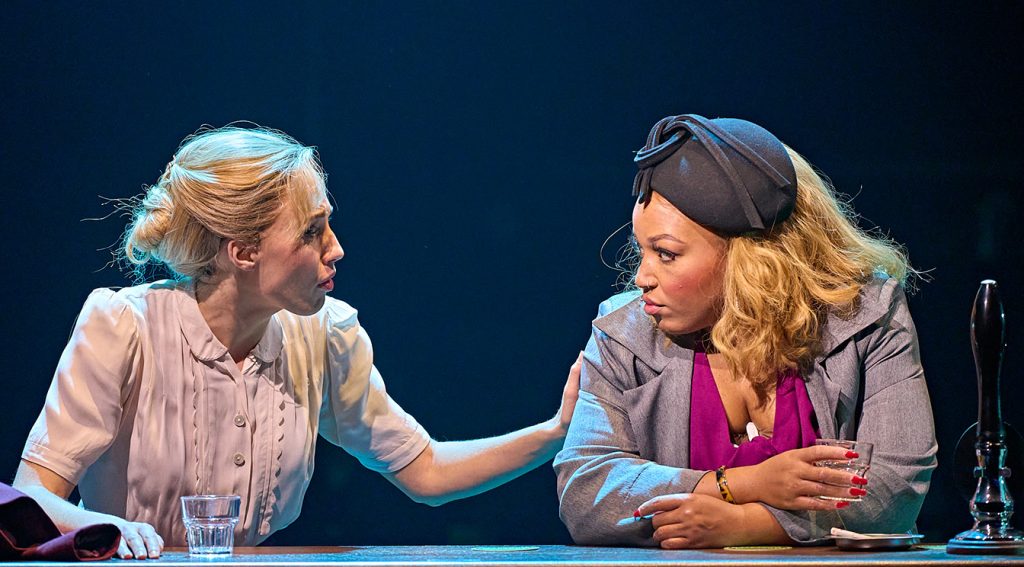
The cast responds to the strong script superbly. Amber Grappy, Shayde Sinclair, Aliyah Odoffin and Bukky Bakray bring an ease to the scenes that make the girls’ ages and friendships convincing. They are a joy to watch. The characters are distinct and complex. While you fear a sharp tongue, with cutting lines delivered perfectly by Bakray, or note Grappy’s cleverly suggested nonchalance, it is clear these girls care deeply about each other. Grappy and Sinclair make their roles charming but both Rey and Elle have a selfish side that makes them believable. The quartet’s touching friendship, mixing banter with sincerity, comes to the fore when things get tough for all of them.

Ibini prepares us for the play to become darker… but I admit I was having so much fun I missed it. After the interval, Elle’s parents’ protectiveness becomes abusive when she is sent to a gay conversation camp. Meanwhile Rey’s affair with an older woman has its own problems. Shan suffers from sickle cell disease and has a near-death experience. And Funmi’s father dies. There is heartbreak in Sleepova – every character has a scene that moves, a defining moment in their maturity, an instant when a young life is being shaped.

By getting to know the girls, the audience is invested in them and cares about the problems they face. Sleepova is gripping as a result. Maybe the four grow up a little too quickly? Or maybe they mature too evenly? But big problems are faced and the development of each is heartwarming. Remarkably, humour is retained throughout – the performers are fantastic comedians – even in the darkest moments. The sense that, through their friendship, all will be well might be an idealistic touch. But Sleepova’s optimism makes it a play to fall in love with.

Until 8 April 2023

www.bushtheatre.co.uk

Photo by Helen Murray