Tag Archives: Jolyon Coy

“Bird Grove” at the Hampstead Theatre

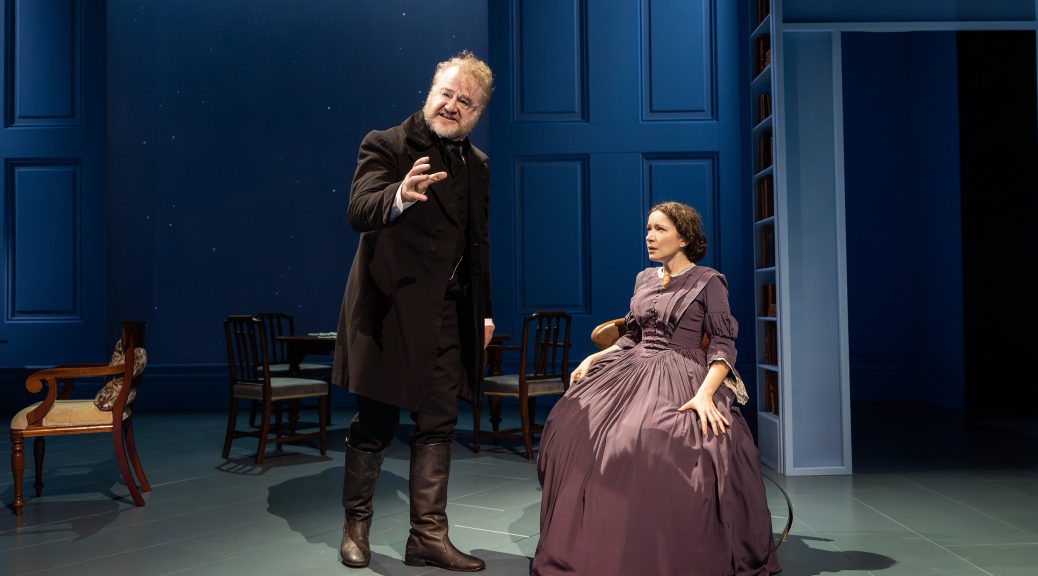
Alexi Kaye Campbell’s new play, about the life of Mary Ann Evans before she ‘became’ George Eliot, is admirable in many ways. Focusing on a father and daughter relationship, neatly balancing humour and emotion, it’s a biography that makes a case for its subject’s relevance without straining too hard.

There’s an interesting decision not to give the audience any background, to assume we all know a lot about Eliot. Lazy, maybe? But it frees the script of clunky exposition. And you could easily enjoy Bird Grove without the history. Some might have a bigger problem with how static it all is, although director Anna Ledwich makes an effort to inject energy and the production looks great. Might it be useful to provide more context as to how rebellious Eliot was? How conservative her milieu? A few cheap gags about Coventry seems unfair. But the piece does well to give an impression of the period, avoiding parody despite the verbosity of the characters.

Because what is said is interesting. The arguments between father and daughter are intelligent and Eliot’s views on life and religion investigated. It’s neat to give the best line to her friend: “Love is not a feeling but an intelligence”. I could have done with the interval at that stage to have a good think.

While Eliot’s frequent anger is justified, and always smart, there is a danger we see all debate from her perspective. Yes, it’s hard not to – but the result is that other characters feel flat. It works for the comic relief of Evans’ suitor, a nice role for Jonnie Broadbent. But her brother (Jolyon Coy) and her “purposeful” friends, played by Tom Espiner and Rebecca Scroggs, fail to convince. The always excellent Sarah Woodward is criminally underused as Evans’ former tutor.

Thankfully, there are great parts for the leads. The focus on Eliot’s father is almost strong enough to make him work as a stand-alone figure, and the character’s success is secured by the performance of Owen Teale. But, of course, the show belongs to Eliot, and Elizabeth Dulau is terrific in the role. Making some of these lines sound like natural conversation is an achievement itself. That the ideas are conveyed so clearly and with emotion is even better.

Kaye Campbell’s affection for his subject shines through and is contagious. Like Eliot, he gets a lot of ideas into his fiction, and that is exciting. That the ideas aren’t any kind of revelation might seem a churlish complaint. And pointing out that, for all the writing’s sophistication, it is strong performances that secure the piece’s success, may appear meanspirited. But Bird Grove is smart enough to give us a hero without hagiography – a tricky task accomplished stylishly.

Until 21 March 2026

www.hampsteadtheatre.com

Photo by Johan Persson
“Little Eyolf” at the Almeida Theatre

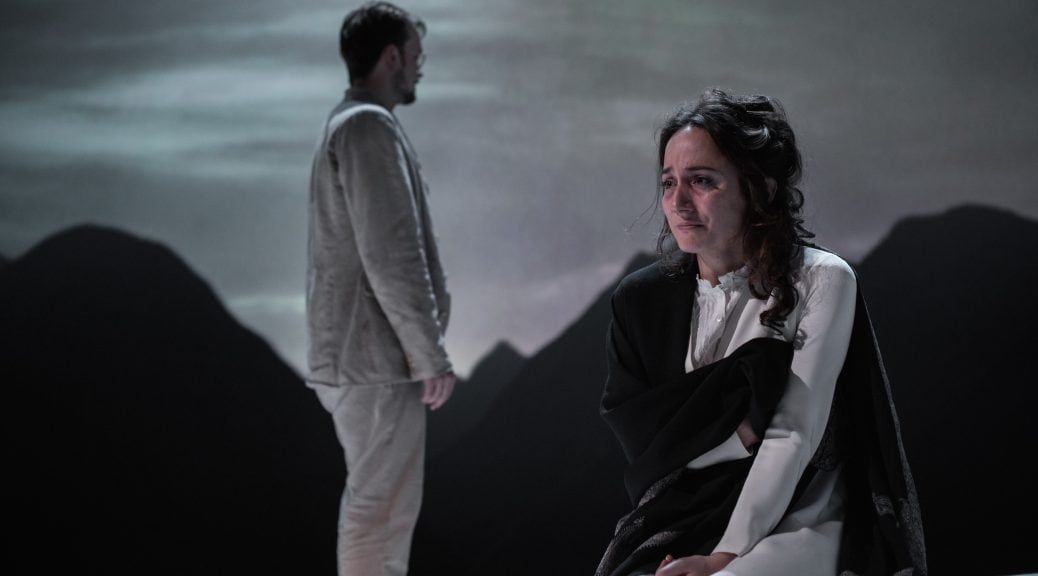
A marriage not so much on the rocks as already wrecked is the focus of Ibsen’s 1894 play. Alfred and Rita are an odd couple of obsessive personalities struggling to share their lives and loves. Along with a ‘sister’, Asta, who creepily shares a pet name with their son, this is a peculiar, unstable love triangle that’s intense from the start. When their only child dies, pressure mounts and the play doubles as an examination of grief.

This is Richard Eyre’s third time adapting and directing Ibsen at the Almeida. Living up to the reputation of his Hedda Gabler and Ghosts, the production is made all the more remarkable by Tim Hatley’s stunning set – never has mid-century modern felt so claustrophobic – and some strong performances. Jolyon Coy and Lydia Leonard take the leads. Coy gives a nimble performance, on the surface a repressed academic, cold and plotting for his wife’s money, yet toying with the idea he might be our hero. Leonard is the sexiest Ibsen heroine you’re likely to see. Embodying a sensuality that has a serious point, she displays a moving, almost scary raw emotion. Eve Ponsonby’s Asta has the trickiest job – doting on the family while the tension surrounding her own desires builds magnificently.

The honesty between this trio is unrelenting and shocking. Home truths that would destroy any family are shouted out – it’s difficult to hear a mother say she wishes her son hadn’t been born. The observation that the parents are “vile and cruel” feels like an understatement. And Ibsen’s view of the human condition –reinforced by a book Alfred is writing on the “law of change” – is pretty grim. When hope enters the play, it feels natural and welcome. This hope may be only a glimmer, an exhausted sigh after all the crying, but it arrives just in time to secure the show’s status as a triumph.

Until 9 January 2016

www.almeida.co.uk

Photo by Hugo Glendinning

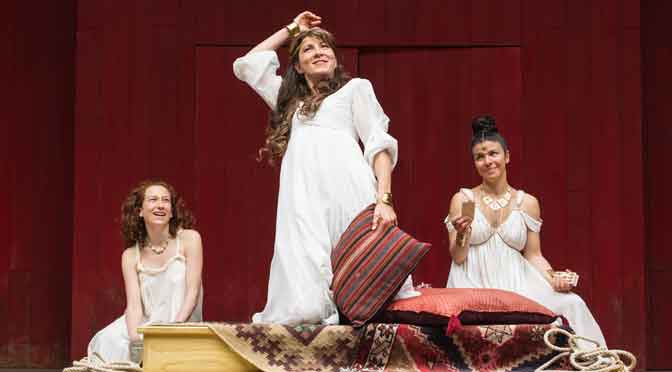
“Antony and Cleopatra” at Shakespeare’s Globe

Eve Best has made a triumphant return to Shakespeare’s Globe. Following her fine directorial debut in 2013, she now takes the lead in Antony and Cleopatra. This accessible production, directed by Jonathan Munby, tells Shakespeare’s tale of love and war with the utmost clarity.

A pirate queen, full of fight, with a wicked sense of humour, Best’s Cleopatra displays the character’s fabled “infinite variety” and knows how to play the crowd in all moods. She is joined by Clive Wood, who makes the perfect “old ruffian” Antony, giving a studied performance that’s crafted to fill you with unease – he’s both too much the politician and too passionate to trust, degenerating into little more than a bully.

The air of luxury Munby establishes makes for a slow start, and the production has moments that might be speedier. Much time, for example, is given to Phil Daniels’ Enobarbus, though it has to be admitted he gives a remarkably subtle performance. The battle scenes are handled efficiently, though, and transitions between scenes, with characters overlapping each other, create some intriguing resonances.

There’s some great use of music and the humour in the text is sustained throughout. Several smaller roles are given their due, creating a world that feels populous and convincing. Jolyon Coy stands out as the “boy Caesar” and Sirine Saba works hard as Cleopatra’s attendant. The finale is testament to how captivating Best’s performance becomes, particularly in her poignant appeals to the women in the audience.

All this for a production dogged by troubles. Christopher Saul is a last-minute substitute who bravely performed with the text last night. Wood has been ill, missing several preview shows, while Best sports a bandaged ankle. But I couldn’t see their performances marred in the slightest. Let’s be thankful for the old adage that the show must go on. This is an evening full of affirmation for the theatre generally and this cast in particular, with a show that, like its star, is “a wonderful piece of work”.

Until 24 August 2014

www.shakespearesglobe.com

Photo by Manuel Harlan

Written 30 May 2014 for The London Magazine

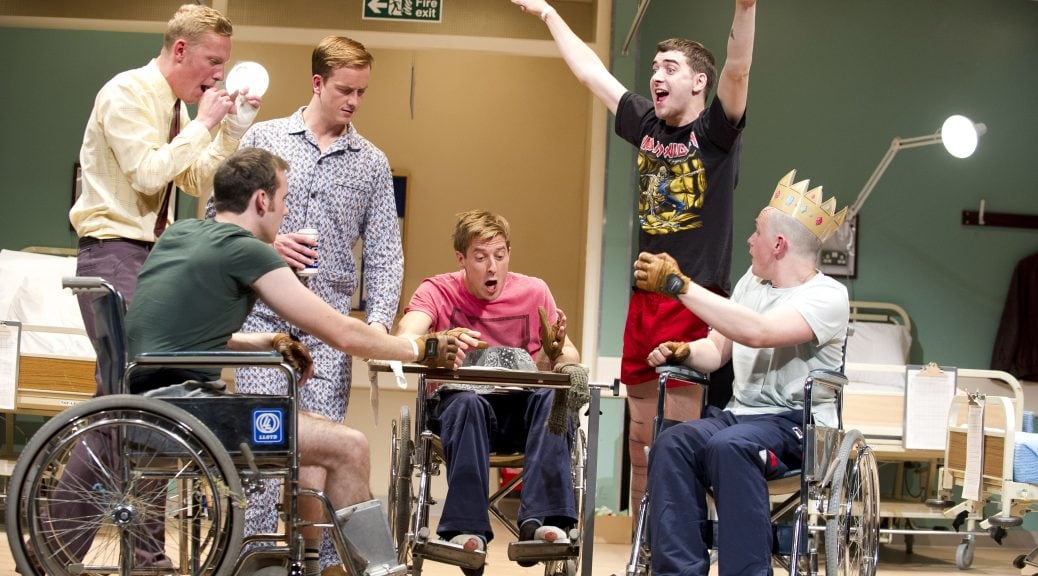
“Our Boys” at the Duchess Theatre

Jonathan Lewis’s Our Boys is nearly 20 years old – but it’s aging very well indeed. Set in a military hospital, and based on the author’s own experiences as a Potential Officer, it’s a rites-of-passage drama about young soldiers recovering from serious trauma. Our Boys is a well-crafted and traditional affair of simple, effective story telling.

A performer himself, Lewis has created the kind of roles that actors love since each character develops almost on cue. We know that these young men will bare their souls, but with each revelation the play gains in power. Lewis never slips into patronising his creations, while director David Grindley has marshalled his impressive cast into a believable cohort.

Lewis Reeves has to be singled out. As the most physically injured solider, his painful route to recovery is deeply moving and wonderfully performed. Jolyon Coy plays P.O. Menzies who shares the ward with the men he may one day command, with sensitive conviction. Laurence Fox gives a tremendous performance as Joe, a natural leader who delivers the most dramatic, genuinely shocking scene with steely skill.

The earthy humour of the piece may wear thin, but Lewis uses it to bond the play and it’s delivered well enough. Our Boys isn’t free of cliché but, after all, our insecurities are pretty universal and seeing them in these young men under pressure has tremendous power. The disastrous drinking game they play shows the best and the worst of characters we have learnt to care for: they really have become Our Boys, a fact that shows the strength of the play and the performances.

Until 15 December 2012

Photo by Geraint Lewis

Written 4 October 2012 for The London Magazine