Tag Archives: Tom Espiner

“Bird Grove” at the Hampstead Theatre

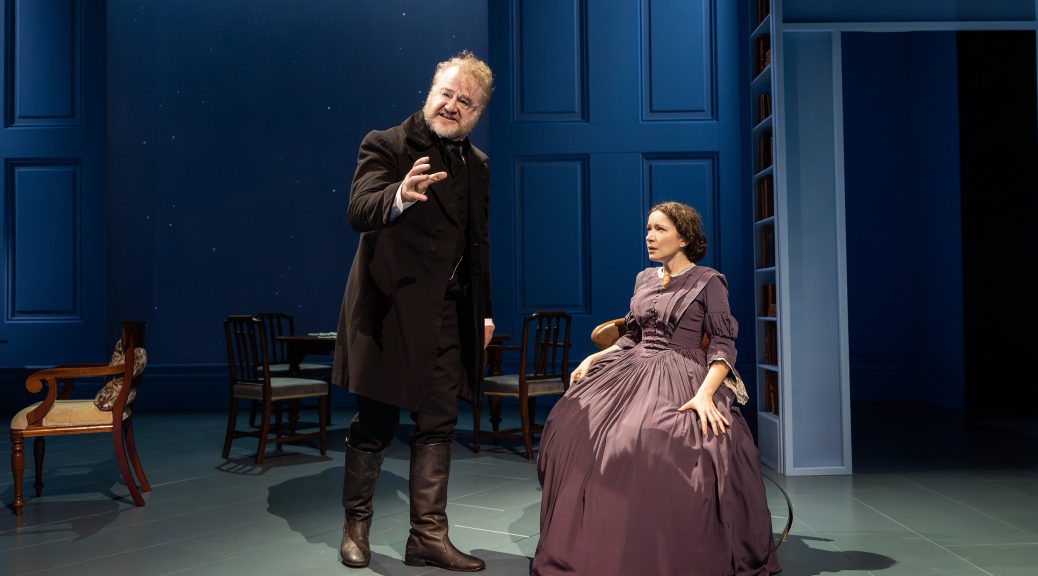
Alexi Kaye Campbell’s new play, about the life of Mary Ann Evans before she ‘became’ George Eliot, is admirable in many ways. Focusing on a father and daughter relationship, neatly balancing humour and emotion, it’s a biography that makes a case for its subject’s relevance without straining too hard.

There’s an interesting decision not to give the audience any background, to assume we all know a lot about Eliot. Lazy, maybe? But it frees the script of clunky exposition. And you could easily enjoy Bird Grove without the history. Some might have a bigger problem with how static it all is, although director Anna Ledwich makes an effort to inject energy and the production looks great. Might it be useful to provide more context as to how rebellious Eliot was? How conservative her milieu? A few cheap gags about Coventry seems unfair. But the piece does well to give an impression of the period, avoiding parody despite the verbosity of the characters.

Because what is said is interesting. The arguments between father and daughter are intelligent and Eliot’s views on life and religion investigated. It’s neat to give the best line to her friend: “Love is not a feeling but an intelligence”. I could have done with the interval at that stage to have a good think.

While Eliot’s frequent anger is justified, and always smart, there is a danger we see all debate from her perspective. Yes, it’s hard not to – but the result is that other characters feel flat. It works for the comic relief of Evans’ suitor, a nice role for Jonnie Broadbent. But her brother (Jolyon Coy) and her “purposeful” friends, played by Tom Espiner and Rebecca Scroggs, fail to convince. The always excellent Sarah Woodward is criminally underused as Evans’ former tutor.

Thankfully, there are great parts for the leads. The focus on Eliot’s father is almost strong enough to make him work as a stand-alone figure, and the character’s success is secured by the performance of Owen Teale. But, of course, the show belongs to Eliot, and Elizabeth Dulau is terrific in the role. Making some of these lines sound like natural conversation is an achievement itself. That the ideas are conveyed so clearly and with emotion is even better.

Kaye Campbell’s affection for his subject shines through and is contagious. Like Eliot, he gets a lot of ideas into his fiction, and that is exciting. That the ideas aren’t any kind of revelation might seem a churlish complaint. And pointing out that, for all the writing’s sophistication, it is strong performances that secure the piece’s success, may appear meanspirited. But Bird Grove is smart enough to give us a hero without hagiography – a tricky task accomplished stylishly.

Until 21 March 2026

www.hampsteadtheatre.com

Photo by Johan Persson

“Boys on the Verge of Tears” at the Soho Theatre

For lovers of new writing, the Verity Bargate award is a big deal. Selected from 1500 entries by prestigious judges, this year’s winner from Sam Grabiner is fantastic piece full of ambition and a sense of adventure.

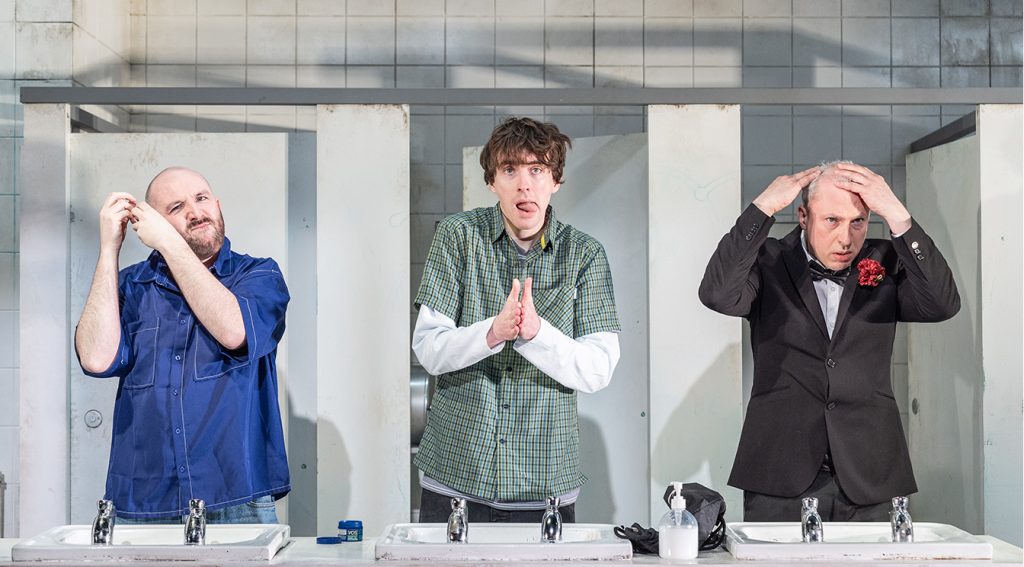
Set entirely in a gents toilet (Ashley Martin-Davis’s set could win another award) the piece is made up of “movements” – pun surely intended – that show the ages of men: from childhood, as teens at school, out on the town, and through to old age.

The conceit is even more audacious than it sounds. Themes and ideas recur and reflect on one another. A dad waiting for his boy finds a parallel to a sick man being helped by his new stepson. Scenarios are in flow, pretty much untethered by specific date or place.

There are 39 characters, most of them substantial, and only five performers so the number of roles they take is incredible. There are stumbles, but impressively few. Discrepancies in age or contrasts with scenes we’ve just watched are used to great effect. 

It’s interesting to pick out favourite roles from such a great selection.

Boys-on-the-Verge-of-Tears-photo-Marc-Brenner

Tom Espiner is stunning in the penultimate scene as a dying man, giving a hugely sensitive performance. Matthew Beard is great as leery teen, Jack, who despite being pretty disgusting is oddly endearing. Maanuv Thiara and David Carlyle have a smashing scene as characters who name themselves Maureen Lipman and Vanessa Feltz, delivering brilliant lines worthy of stand-up comedy. Finally, Calvin Demba might well steal the show as a young man who has been attacked: his concussion is convincing and the character’s fate dramatic.

In truth, all the performers balance humour and a sense of concern brilliantly.

The dialogue is a huge achievement, with different ages, classes, and various degrees of intoxication, all written assuredly. Grabiner gets considerable tension out of variety and director James Macdonald draws this out with skill. Be it offensive jokes or violence, even the shocking lack of hand washing, there’s a tension between sympathy and anxiety time and time again.

There are effortful moments. There are self-conscious tries to shock, obvious attempts to be experimental, and scenes that shout a message. But note: the piece succeeds in shocking, the experiments are interesting (two cleaners working in silence proves strangely fascinating), and Grabiner’s ideas about the body and our relationships to it are worth hearing.

While many of the circumstances or issues raised could be ticked off a list, Boys on the Verge of Tears is full of unpredictable moments. There are touches of whimsy, the surreal, and even horror. It seems Grabiner could write for any genre. And let’s not forget costume supervisor Zoe Thomas-Webb, who is kept very busy. All the scenes are strong and if some might not be missed, that’s interesting too, making me think of Alice Birch’s [Blank], with 100 scenes that can be selected for each production. It’s easy to see a bright future for both play and writer. This one is a five-star winner.

Until 18 May 2024

www.sohotheatre.com

Photos by Marc Brenner

“Berberian Sound Studio” at the Donmar Warehouse

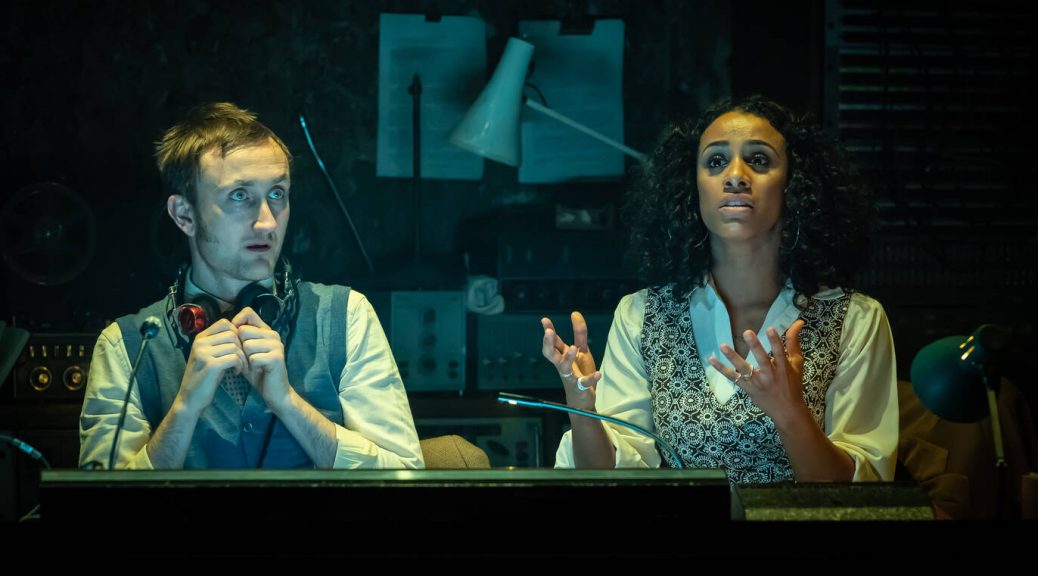
This must be the show of a lifetime for composers and sound designers Ben and Max Ringham. It follows a fictional sound engineer – the oddly named Gilderoy – who is working on an Italian horror film, and a claim might be made that sound is the subject matter for this whole show. Let’s be ringing, crystal clear that the Ringhams do a great job throughout. It is their night… but perhaps theirs alone.

A too thin plot fails to hold attention even at just over 90 minutes. As Gilderoy works behind the scenes to find a particularly horrible noise, and as his backstory is clumsily developed, there’s little tension and no surprises. Tom Brooke makes for a charismatic lead, doing well to restrain the hammy humour in the piece, but the character’s timid English manners are too caricatured, and contrasting his inhibitions with his continental colleagues becomes painful. As for the continually promised horror that’s played with, you’d have to be very timid to jump even once. While Gilderoy is searching for what frightens us most, his biggest fear is literally written above him in lights – no wonder the quest ends up dragging.

Weightier themes painfully forced into the play are the real terror here: Art and Ethics, screamed out loud. We get two sides of the debate, first from a voiceover actress offended by torture scenes. Eugenia Caruso does well and manages to craft a credible character here, but her points are pretty obvious. Then the auteur director himself comes in with a seductive defence. Credit to Luke Pasqualino, who has a good stab at making the part memorable, but the appearance is too brief and, by the time he arrives, it’s already obvious that the film being worked on is too awful to bother about.

Director Tom Scutt tries hard to raise the stakes. This show is clearly a pet project for him and writer Joel Horwood, who have brought Peter Strickland’s screenplay to the stage. As well as bells and whistles, Lee Curran’s lighting design includes complete blackouts (rarer than you’d think in the theatre). And there’s an effort at comedy with two assistants, both called Massimo (chortle), played by Tom Espiner and Hemi Yeroham, whose creation of the sound effects before our eyes proves a diversion. But restricting action to the booths that make up Scutt’s and Anna Yates’ design makes the show static, as surprisingly little of the stage is used. And placing the actresses’ booth in one corner of the stage is a big mistake – if you do bother to see the show, don’t sit stage right. Time and again it’s too clear that a film would be (and was) more effective. There’s a growing frustration that anyone bothered to stage the piece at all. Let’s hope that the Ringhams, at least, had fun.

Until 30 March 2019

www.donmarwarehouse.com

Photo by Marc Brenner