“Sleepova” at the Bush Theatre

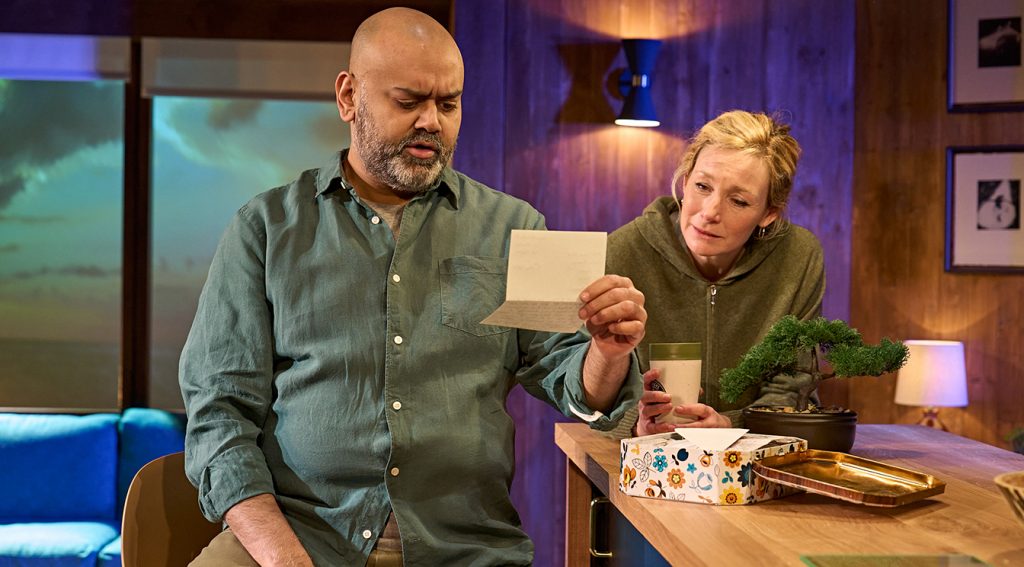
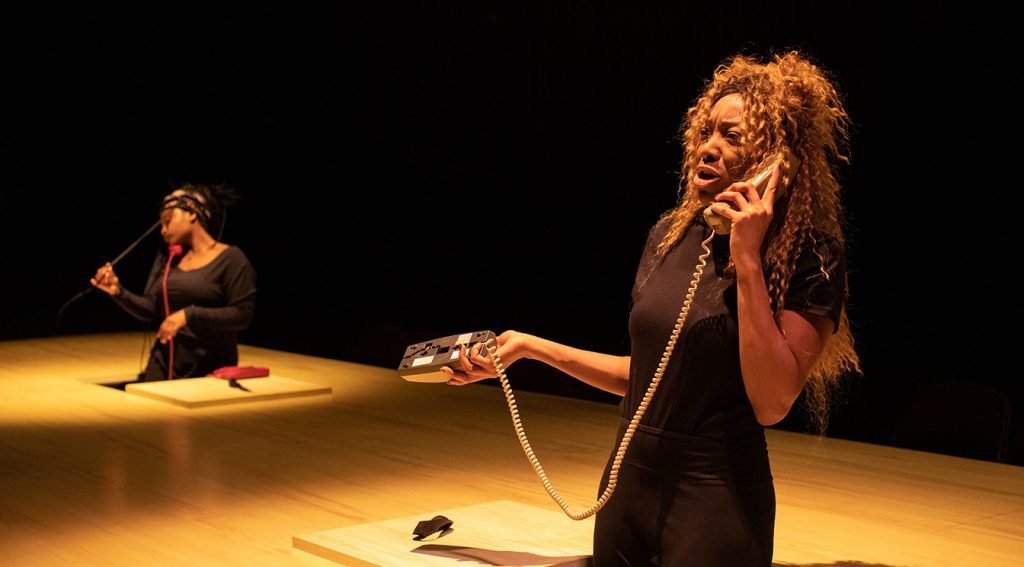
Matilda Feyiṣayọ Ibini structures her new play to great effect. At first, the scenario is simple, slight even, with four friends celebrating a 16th birthday. As a sweet coming-of-age story with great humour, and fantastic energy from Jade Lewis’ impeccable direction, there are smiles all round.

Ibini tackles common problems that come with writing about young people well. Rey, Elle, Shan and Funmi are smart and very funny, but not so much beyond their years. They have some silly ideas – one source of fun – but their wit is a delight. Ibini’s writing is detailed and specific – addressing age, race and location – but always has an eye on universal experiences that come from first loves and leaving school.

The cast responds to the strong script superbly. Amber Grappy, Shayde Sinclair, Aliyah Odoffin and Bukky Bakray bring an ease to the scenes that make the girls’ ages and friendships convincing. They are a joy to watch. The characters are distinct and complex. While you fear a sharp tongue, with cutting lines delivered perfectly by Bakray, or note Grappy’s cleverly suggested nonchalance, it is clear these girls care deeply about each other. Grappy and Sinclair make their roles charming but both Rey and Elle have a selfish side that makes them believable. The quartet’s touching friendship, mixing banter with sincerity, comes to the fore when things get tough for all of them.

Ibini prepares us for the play to become darker… but I admit I was having so much fun I missed it. After the interval, Elle’s parents’ protectiveness becomes abusive when she is sent to a gay conversation camp. Meanwhile Rey’s affair with an older woman has its own problems. Shan suffers from sickle cell disease and has a near-death experience. And Funmi’s father dies. There is heartbreak in Sleepova – every character has a scene that moves, a defining moment in their maturity, an instant when a young life is being shaped.

By getting to know the girls, the audience is invested in them and cares about the problems they face. Sleepova is gripping as a result. Maybe the four grow up a little too quickly? Or maybe they mature too evenly? But big problems are faced and the development of each is heartwarming. Remarkably, humour is retained throughout – the performers are fantastic comedians – even in the darkest moments. The sense that, through their friendship, all will be well might be an idealistic touch. But Sleepova’s optimism makes it a play to fall in love with.

Until 8 April 2023

www.bushtheatre.co.uk

Photo by Helen Murray

“Macbeth” at the Southwark Playhouse

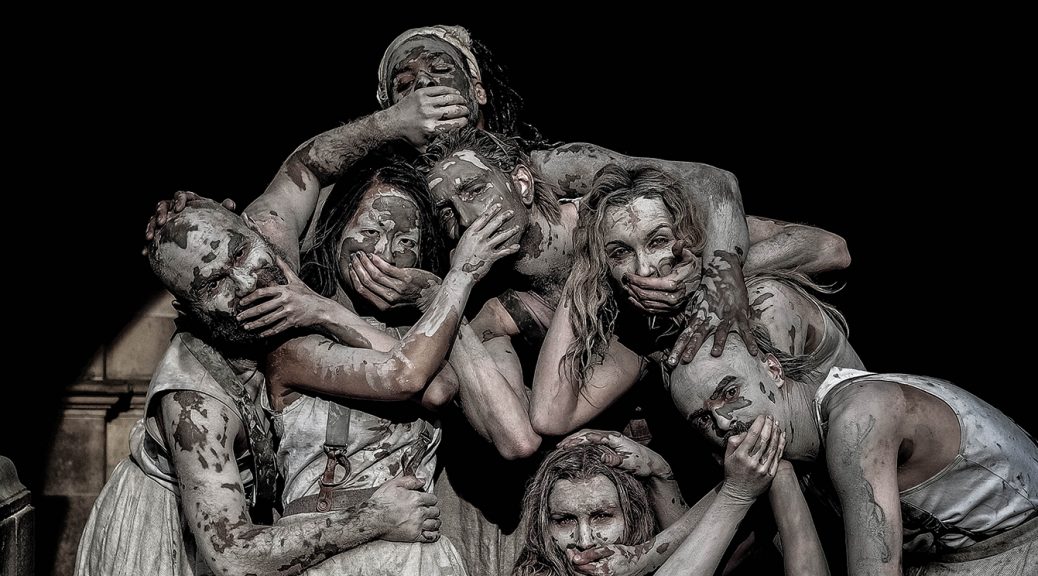
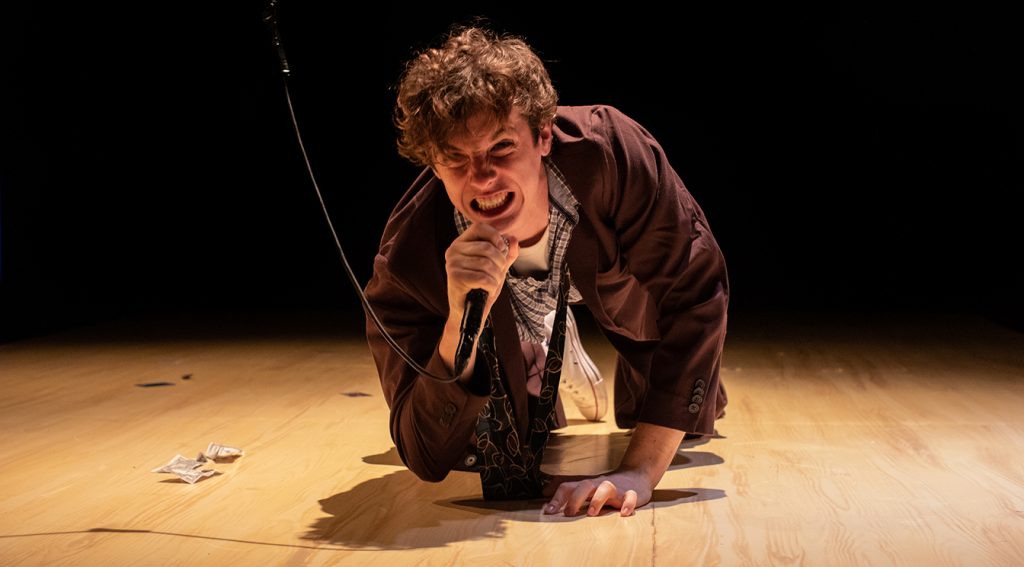
Flabbergast Theatre’s production of Shakespeare’s tragedy is a brave failure. The show is full of arresting imagery and committed performances – it is bold from start to finish. But a central conceit is hard to pin down and uncomfortably constraining… Macbeth in a madhouse seems close to describing what’s going on. That the idea turns out less interesting than it sounds is a shame, given the tremendous effort of all involved.

Linking Macbeth to insanity isn’t a bad idea. Fits are mentioned, there are famous hallucinations, and the banqueting scene is ripe for such an interpretation. Can the witches be mad? Of course, they’ve been everything else in various productions. And the suggestion that Banquo’s murderer is schizophrenic is a good touch. But the whole idea does, forgive me, straitjacket the play. It’s scary and unpredictable (an achievement of sorts) but it is hard to take the drama seriously as connections between the characters are severed. While the ensemble work together well, the characters seem isolated in individual trauma.

Henry Maynard’s direction is aided by work with movement from Matej Majeka which is often interesting.  The whole ensemble impress, not least with some of their backbends. Everyone is on stage a lot and never loses focus. The musical arrangements from Adam Clifford make great use of percussion and the ensemble are a good choir. The small amount of puppetry that features is worth noting. But every aspect of the show is exaggerated and that turns into a serious flaw.

There are technical problems too. The production fails to consider the venue’s thrust stage so that two thirds of the audience are ignored too often. Above all, hearing what anyone is saying is very difficult. Taking the lead role, Maynard tries hard but it is really only Kyll Thomas-Cole’s Malcolm we get to hear properly. There’s no way you’d know what was going on without a thorough knowledge of the play and while the company can be proud of its energy, that makes the effort here wasted.

Until 8 April 2023

www.southwarkplayhouse.co.uk

Photo by Picturegrafix

“That’s Ace” at the Vault Festival

A night in a nightclub is the very simple scenario for Jonny Brace’s play. We follow the adventures of Ace as she waits for a school friend, Sasha, who she might be in love with; as an asexual, Ace is not sure. The play’s exploration of her dilemma is sensitive, smart, and above all funny.

Ace is blunt, she has a logical mind, so I don’t think she’d be offended by pointing out that the play is all about her. Although there are conversations with others, the perspective is Ace’s alone and the play all about the character. The limitations are obvious… but what a character! Brace has written a role to adore and, importantly, laugh with rather than at.

From small observations, like the way vodka and coke is like coke but not as nice and more expensive, to her frank questions about why people are so obsessed with sex, it is hard not to fall in love with Ace. Maybe I’m biased… I’ve also wondered why people like nightclubs. But as well as being quirky, Brace writes about the sense of touch very well – as the text’s aim is to open discussion and understanding of asexuality, this is an important addition.

Much of the character’s power comes from an excellent performance from Tiffany Marina Pearmund, who has the show’s kooky yet also down-to-earth comedy down to perfection. You feel for Ace, young love never runs smooth. But the lack of drama here is a brave, smart move (Ace is too sensible to get too worked up) that shows a distinctive voice behind the show. Brace’s direction is snappy and strict with his own writing. That’s Ace has a justified confidence; it shows us something different and it shows it well.

Until 17 March 2023

www.vaultfesival.com

“Marjorie Prime” at the Menier Chocolate Factory

Given that it deals with dementia, grief and artificial intelligence it’s not a surprise that Jordan Harrison’s play is fairly hard work. But given that there’s little so little action in the piece, Marjorie Prime packs a remarkable punch. Tightly written, fraught conversations lead to a chilling conclusion, which I suspect was the inspiration for the whole show.

Although the 2014 play has already been a hit – and a film – plot spoilers are especially tricky as so much of the piece’s power come from its twists and structure. It doesn’t seem too naughty to say the show opens with Marjorie and her ‘Prime’ – a robot that looks like her husband 50 years ago and is learning to be like him to aid her memory. Creeped out yet?

Harrison is light on the science behind AI, and some might like more explanation – or even more exploration of problems that, surely, come with the very idea. The technology is accepted (which is probably an accurate prediction) and doesn’t follow a cliché of becoming evil. Richard Fleeshman seems underused in the robotic role, but his calm performance is entirely appropriate. Likewise, Dominic Dromgoole’s cool direction appreciates the play’s tone. Understatement is fine… this is all scary enough in its own right.

Tony-Jayawardena-and-Nacy-Carroll-credit-Manuel-Harlan
Tony Jayawardena and Nacy Carroll

How AI impacts on Marjorie, her daughter, Tess, and son-in-law, Jon, leads to troubled characters and excellent performances. Taking the title role, Anne Reid gives a brilliant portrayal of someone suffering from dementia, which is all the more moving through flashes of humour. The complicated relationship between Marjorie and her daughter results in a passionate performance from Nancy Carroll that almost steals the show. Tony Jayawardena gives a further fine portrayal as Jon, who ends up haunted by the past, too. Let’s not say how.

The characters are, oddly, unsympathetic, despite what they are going through – it’s a surprising move, skilfully done, but adds to the piece’s cold tone. Problems with memories and how personal identity is formed might be a little predictable given the scenario; the script almost wants to move on from the themes. The result is that the play relies on its intriguing conclusion. And here is a plot spoiler – Harrison’s unexpected idea about what happens to AI when we are no longer around makes for a brilliant scene. I’m just not sure much else about the play is that memorable.

Until 6 May 2023

www.menierchocolatefactory.com

Photos by Manuel Harlan

“Farm Hall” at the Jermyn Street Theatre

Playwright Katherine Moar has chosen a fascinating piece of history for an impressive debut. Farm Hall was the real-life location for a group of German physicists held by the Allies at the end of World War II. Great names with Nobel prizes galore were, politely, imprisoned in the country and their recorded conversations make for interesting theatre.

Carefully written and performed and expertly directed, Farm Hall is a traditional affair – there’s no avoiding that it’s a collection of (clever) talking heads. But Moar has done her research and her quest for nuance proves an invaluable asset. There’s also a reminder of Covid lockdown as these brilliant men are so bored! Bickering against a background of having been enemies in Germany, they are far from united in defeat.

Including the group’s amateur dramatics and sing-songs is a smart touch. But what really impresses is how director Stephen Unwin allows the structure of the scenes to flourish. After a surprisingly light start, personal dramas are balanced by abstract questions, and flipping between the two provides dynamism. Moral dilemmas don’t come bigger than those these men faced. Yet the play’s best bits emerge from individual circumstances.

Bringing to the stage six big characters leads to understandable shortcuts from Moar, but the performances smooth over any clunky exposition. I did wonder if the “impenetrable” Werner Heisenberg might be the star of the script? The theoretical physicist has appealed to dramatists before and Alan Cox’s performance in the role is certainly commanding.

Archie-Backhouse-in-Farm-Hall-at-the-Jermyn-Street-Theatre-credit-Alex-Brenner
Archie Backhouse

The question of Heisenberg’s role in Germany’s failure to make an atom bomb looms over the play – it isn’t given enough time to become a focus. But the piece benefits as a whole. Heisenberg’s students, Erich Bagge and Carl Friedrich von Weizsäcker, prove powerful figures. The latter is an odd dandy, made intriguing by Daniel Boyd’s layered performance. Archie Backhouse’s Bagge brings the most overt emotion to the play – excellent work.

There’s a further trio to enjoy. Kurt Diebner is a less apologetic Nazi and full-on oddball that Julius D’Silva manages to make us warm too – how’s that for an achievement? His opponent, Max von Laue, is given great dignity by David Yelland, while Forbes Masson’s placatory Otto Hahn gives a similarly detailed performance. Placing the biggest weight of guilt on this seemingly sweet man is a highlight.

Moar deserves credit for opening up so many themes. Of course, the men discuss their war, but general ideas about cooperation and competition are neatly pulled out alongside plenty of politics. Farm Hall is sure to prompt after-show discussions. And who doesn’t like that? But stripping back the men behind the science is the key to making the play engaging. And it’s the sextet of performers who guarantee the show’s success.

Until 8 April 2022

www.jermynstreettheatre.co.uk

Photo by Alex Brenner

“Fanboy” at the Vault Festival

Writer and performer Joe Sellman-Leava’s strong monologue shares a lot of characteristics with its titular protagonist – the show is full of enthusiasm and insight. Yet Fanboy’s biggest strength is how surprising it is. 

Sellman-Leava has a lot to say and using the Star Wars films and The Muppet Christmas Carol makes the delivery of ideas novel. Spoilers are strictly prohibited – fanboys hate them – so let’s just say the show takes in a lot of contemporary events and big issues. And that Fanboy looks at the topic of childhood in a thought-provoking way.

It should be OK to comment on the theatricality of the show. Sellman-Leava gives a suitably endearing, intimate, performance. The direction from Yaz Al-Shaater is tight, at times a little rushed, while Al-Shaater’s video and sound design are impressive. The romance in the show might need more detail to have the desired impact. But the story of a mate who becomes toxic is exceptionally well handled – shared memories are cherished for too long as this school friend starts to become a fan of more sinister people.

It’s possible Sellman-Leava takes a little too much knowledge for granted from his audience. Even if never having seen Star Wars amazes you, a lot of knowledge of the whole franchise is needed to enjoy some of the jokes. But the sense of outrage and admiration common to fan communities is well known and well depicted. Sellman-Leava harnesses passion expertly to tell his engaging story.

While there’s a lot of fun in Fanboy, Sellman-Leava is aware it’s how people feel about these movies (and books and video games) that count. The place held in memories and the dangers of nostalgia create a powerful drama. 

Until 12 March 2023

www.vaultfestival.com

“After the Act” at the New Diorama Theatre

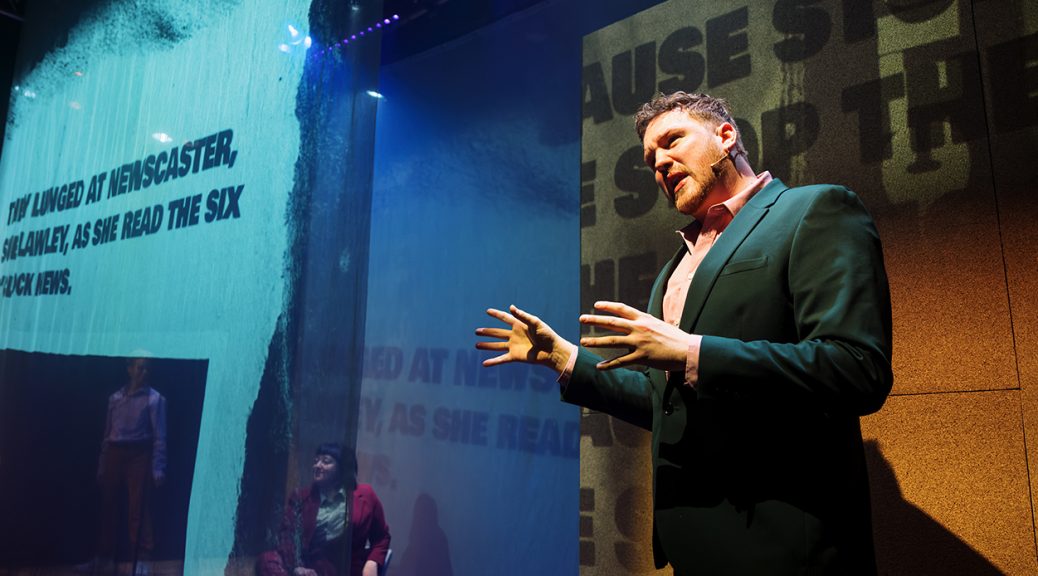
We know a musical can be about anything… but the legislation introduced in 1988 to prohibit the promotion of homosexuality in schools? And while verbatim musicals are nothing new, using speeches from parliament and interviews in songs is tough. Thankfully, Breach Theatre, which brings this slightly mad idea to life superbly, knows that crazy can work. After the Act is energetic and emotive. The big surprise comes from making the topic so upbeat and empowering.

There is a lot covered. Key moments in LGBT history are recounted: remember those angry lesbians on the six o’clock news, or angry lesbians abseiling in the House of Lords? Hurrah for angry lesbians! And writers Ellice Stevens and Billy Barrett know it’s smart to present an argument, so supporters of Section 28 are given plenty of time. Their own words condemn them (there’s a lot of offensive language on stage) but, with the exception of Margaret Thatcher’s conference speech, the tone is cool. Offended parents even get the smartest song.

For me, it’s the personal testimony from activists or people who were at school at the time that are best. And extremely powerful. Stevens and Barrett, the latter also directing, structure the material well, with a rhythm of outrage and then the effects of the legislation. Political rhetoric and nasty newspaper headlines contrast with lived experience. And there’s an intelligent approach to the different ages in the audience – the show educates younger members while hitting home for anyone who remembers the time.

Zachary Willis
Ellice Stevens, Tika-Mu’tamir, EM Williams, Zachary Willis

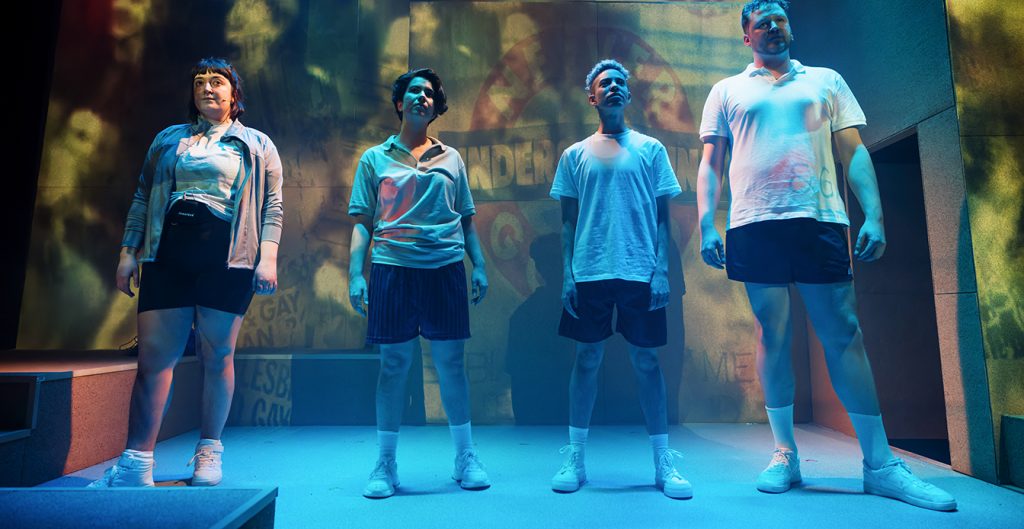
Excellent performances aid this ambitious project. Praise again for Barrett’s clarity in staging, important as the four cast members have to struggle with a lot of tongue’twisting lines and occasionally fussy choreography from Sung Im Her. The performers revel in the variety of roles. The highlights for Tika Mu’tamir and EM Williams come when they play protestors, bringing great sincerity to surprisingly understated performances. Stevens and Zachary Willis take on some of the most contrasting roles. The latter moves from outraged father to bullied schoolboy brilliantly, with forceful commitment and strong humour, too. The quartet is hugely enjoyable.

The show’s score is by Frew. Nobody is going to go away humming the numbers here as the ‘lyrics’ make the songs sometimes tricky to follow. And it is all a little too obviously hard to sing. Combining the songs with speech might be smoother. The score earns respect, though: the music is intelligent, works theatrically and sets the period very well. After all, this is a show about a piece of history… isn’t it?

You’d think the company would have enough to do, setting out and singing about historic homophobia, with the background of the AIDS crisis. The research is fantastic, and the quality and breadth of interviews for the show mean it serves as an important document. But its title is more than alliteration. After the Act looks at the legacy of Section 28, bringing us up to date to address the question of trans rights in schools. The show becomes campaigning in its own right. It’s an appropriate concluding note that important lessons are worth learning.

Until 1 April 2023

www.newdiorama.com

Photos by Alex Brenner

“Spur” at the Vault Festival

There is a particular excitement about seeing a play on the fringe that has the potential to expand. Spur is already a five-star show. But it is also constrained by its hour-long duration and by the venue. This is the kind of theatre that, for me, is what the marvellous Vault Festival is all about. Spur is great, and it also has room to grow.

Matt Neubauer’s script is strong – a poetic and imaginative exploration of love and catharsis. And it’s novel. Spur is framed around the re-enactment of a Western, just the kind you’d comfortably watch on a Saturday afternoon. The film was a favourite of a deceased father, and the actress ‘starring’ in the movie breaks character to tell us about her family relationships.

There are stories, too, from her ‘co-stars’ – that I can’t think of a better word indicates how involving the connection between memories and the ‘film’ we see performed are, and how well the cast and creatives play with the link between the two. Two other cast members also play more than cowboys, they have their own tales of loss and grief as well.

As for these extra stories – note how much deception there is. Each is unsettling, there’s plenty going in the background and there’s a sense of humour to disappointments that proves alluring.

The only caveat is that the script is too compacted. While the play thrives on ambiguity, it is frustrating to see how easily it could be unpacked. The show is crying out for another scene from both George Fletcher and Benjamin Victor. I’d bet a silver dollar they’re already written.

A deal of the piece’s success is down to the actors. It’s hard to fault the performances from Fletcher, Victor or Maddy Strauss, who plays the lead protagonist Sadie. Strauss gives my favourite performance of the festival so far, investing the show with great emotional power. And she really could star in a Western!

Bringing the piece close to a tearjerker, the projected film that Sadie watches/performs is interspersed with a home movie. Alberto Lais’ video work is touching, the traverse staging is handled well by director James Nash and the lighting design by Ben Kulvichit is superb. But the technical difficulties of working in a tunnel (oh, those trains) are painfully easy to appreciate. All aspects of the production could be improved with ease.

It’s tricky to write about what a play could be rather than what is on stage – and any observation doesn’t detract from what has been achieved here. But it would be good to see Spur again with a little more polish in a better space. It could have a bright future.

Until 9 March 2023

www.vaultfestival.com

“Time” at the Vault Festival

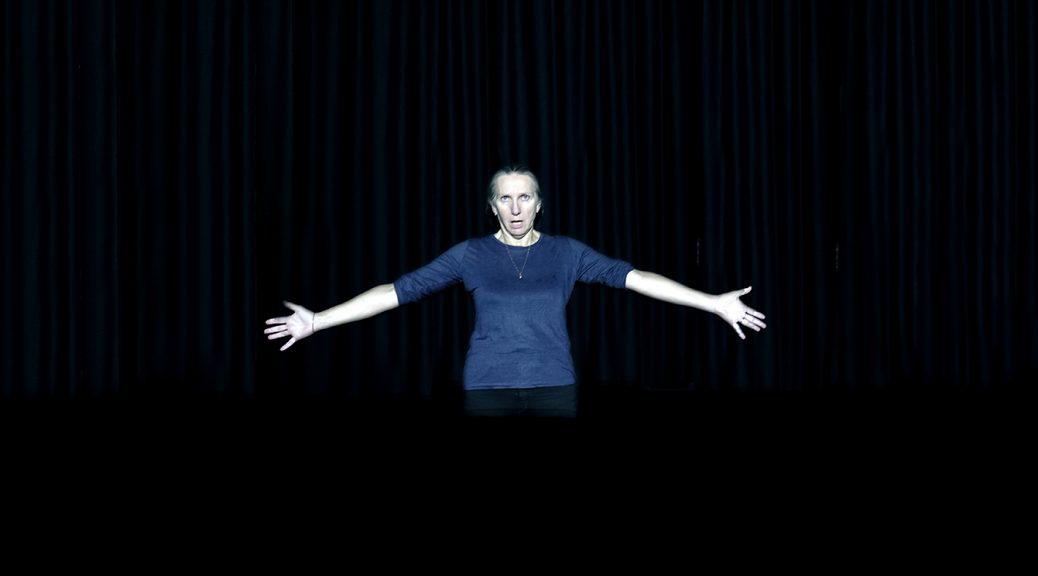
Playwright and performer Gaynor O’Flynn’s show has a meditative quality, with spiritual aims, that makes for novel and thought-provoking theatre.

The fascinating character in Time is “a woman of a certain age” that O’Flynn makes intriguing as well as relatable. Looking back on the past with grim frankness, she stalks old friends online. These contemporaries, described as “bigger, better, brighter” women, are heard from via video projections.

Could’ve, should’ve, would’ve


It turns out these other women – wealthy through careers in law, TV, music, tech, art – are all jealous. They remember our protagonist’s freedom, a flowing approach to life that contrasts with the fixed paths they have travelled. The spooky projections seem to have it all, to have achieved what they set out to do, but suffer from imposter syndrome and dream about what might have been.

When it comes to the role of time in all of this, perhaps not surprisingly given the complexity of the subject, the show doesn’t quite convince. It’s hard not to make such ruminating seem solipsistic and the characters can come across as somewhat spoilt. A concluding acceptance of past and present seems woolly – in stark contrast to how focused both writing, structure and performance are.

The video monologues might be a little too neat and, despite being admirably concise, there might be too many of them. But the friends’ admiration of our central figure – who many admit they didn’t know well – raises a lot of questions. How accurate are any of these narrators? The script has a musicality that is strangely hypnotic, the detail is impressive, and the show questions ideas of “success” very… successfully, which all makes it 60 minutes of time well spent.

Until 12 March 2023

www.vaultfestival.com

“Bootycandy” at the Gate Theatre

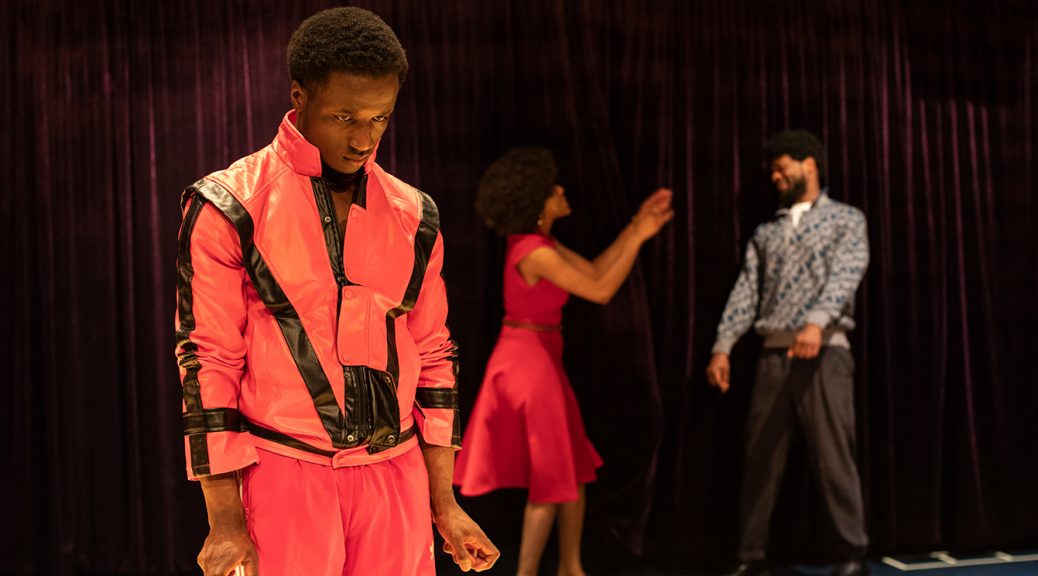
Robert O’Hara’s semi-autobiographical play is original and adventurous. To say Bootycandy is the story of a gay African American boy growing up in the 1980s belies how many surprises the show has. This is theatre that takes huge risks, crediting its audience with intelligence, and confident in its meta-theatricality.

Veering wildly from scene to scene, concessions to a conventional story come with the character of Sutter and his family. Sutter’s growth is literal – he first appears as a small boy and becomes an increasingly central, and powerful, figure. Taking the role, Prince Kundai impresses throughout.

Nonetheless, presented as a collection of sketches – or maybe memories – there is the danger of the piece being disjointed and confusing. Credit to director Tristan Fynn-Aiduenu, who ensures a coherent atmosphere. And, thankfully, every strangely isolated scene is superb – give each a star and the rating for this show would be off the scale.

DK-Fashola-in-Bootycandy-credit-Ali-Wright
DK Fashola

A scene of women talking on the phone is a highlight for Bimpé Pacheco and DK Fashola, Luke Wilson’s drag queen pastor is superb and a monologue for Roly Botha truly extraordinary. These are tremendous performances, each aided by Malik Nashad Sharpe’s superb work as director of movement. Dance is integral to Bootycandy: the physicality – at every moment – is enthralling.

Roly-Botha-in-Bootycandy-Production-credit-Ali-Wright
Roly Botha

A queer ‘lens’ here is flipped as O’Hara examines his community and Sutter’s interactions with a heterosexual world. The play’s most vivid characters are women (a mother and grandmother). And there is a fixation with straight men that gets very dark indeed.

The scenes are funny, sexy, and scary – sometimes all three at the same time. And none of this is as it first seems. It’s possible what we are watching is a collection of ‘works in progress’ by playwrights at a conference. So, is Bootycandy being constructed before our eyes? Even the cast starts to question what on earth is going on!

There isn’t one key to the undoubtable success of this show – why would there be when we are presented with so many ideas and perspectives? But Fynn-Aiduenu creates an impression of spontaneity that works to great effect, generating a tremendous energy that powers the show and ensures Bootycandy hits a sweet spot.

Until 11 March 2023

www.gatetheatre.co.uk

Photos by Ali Wright