Category Archives: Uncategorised

“Cowbois” at the Royal Court Theatre

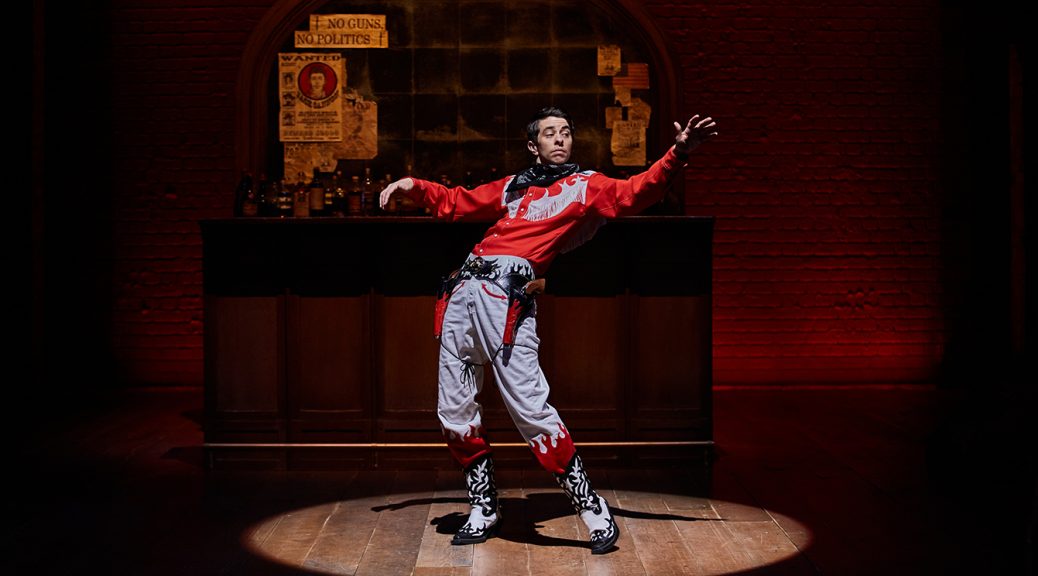
Into a no-name town, sometime when the West was wild, walks a wanted man. He’s doubly in demand because all the guys who used to live there have gone missing. The twist is that he’s transgender. Cue the show’s sell, that Cowbois is “a rollicking queer Western like nothing you’ve seen before”. They aren’t joking. Charlie Josephine’s show, which they co-direct with Sean Holmes, is tough to describe. 

I guess, in a way, we have seen Westerns like this before – Josephine is playing with cliches. It’s a sensible genre to adopt if you want to explore masculine identity. The story itself is solid, the characters well written, and the twists great. Oh, and the show is a romance, with fantasy thrown in, powered by two superb central performances from Sophie Melville, as saloon owner Lillian, and Vinnie Heaven as the bandit on the run, Jack.

All the tropes make the show funny, and the cast play up to them brilliantly. Melville and Heaven have a great handle on the humour and are aided by energetic performances from, in particular, Emma Pallant and Lucy McCormick. Paul Hunter has a great turn as a drunk sheriff on another journey of self-discovery. It’s affirming and inclusive (of course), even jolly – but none of this goes far enough to pin down what’s going on.

The energy does dip. Maybe it’s a deliberate irony that when the men come home, the play sags; there’s tension but we care less about the new arrivals and the comedy takes a while to get back up to speed. There are too many stories to do justice to. Sensitive performances from Lee Braithwaite and Bridgette Amofah seem wasted – maybe that’s just an indication of how interesting all the characters are? But the show does get a little messy.

Music goes a long way to hold everything together – Jim Fortune’s work, and the onstage band, are superb. Heaven has a voice that is… well, they are aptly named. Indeed, Cowbois’ biggest failing is that we don’t get more songs. But what really solidifies the show is the excellent movement work, credited to Jennifer Jackson. Highlighting how performative gender is and adding touches of fantasy through choreography, the way everyone moves is worth paying attention to. A marked majority of the show is played to the audience – Josephine and Holmes highlight how aware of they are of us. The result is compelling. Maybe, magnetic is the word I’m searching for?

Cowbois gets crazy. Even before the finale, featuring a slapstick shootout (great fun), there are party scenes that mix violence and euphoria in a startling fashion. “If in doubt dance” might sum up the approach. And, by the way, a show-stopping cameo from LJ Parkinson, as a bounty hunter hoping to catch Jack, is jaw-dropping. Josephine has created a unique, uncanny world that pushes towards something new. Theatre often provides a space to invent and imagine – to play, in a way – but to take a show to this extreme is audacious. What’s the right word for Cowbois? I’ve got it. Fearless.

Until 10 February 2024

www.royalcourttheatre.com

Photos by Henry T © RSC

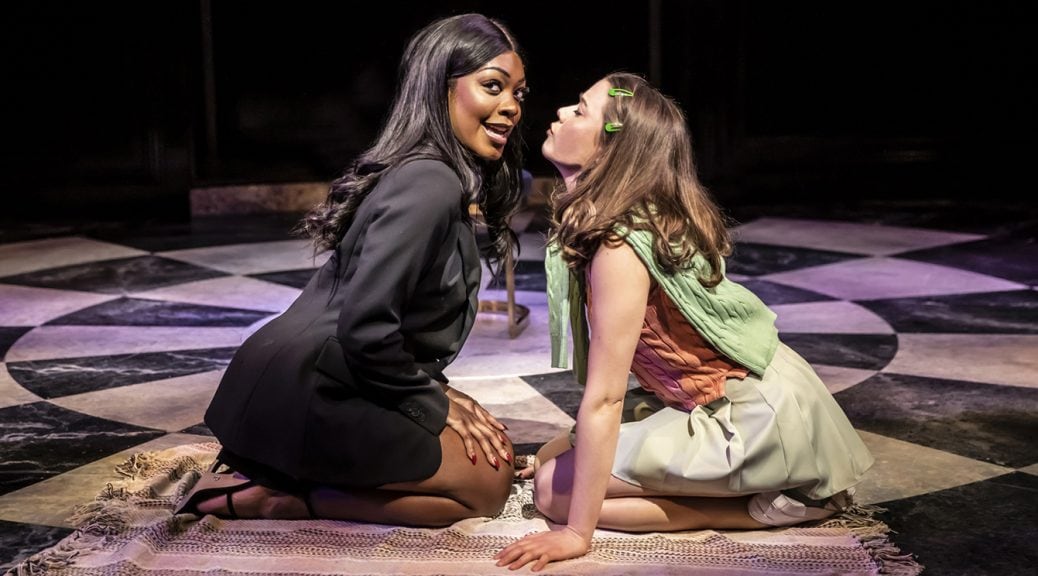
“Cruel Intentions” at The Other Palace

The market for this new musical is clear enough – it’s an adaptation of a popular film from the 90s with pop songs from the same era that should secure an audience. You might like the movie and the hits. But Jordan Ross, Lindsey Rosin, and Roger Kumble’s efforts at bringing both to the stage are messy and unsatisfying. The combination of story and song isn’t inspired and the whole show comes across dated.

At least the story is OK, after all, it’s based on Pierre Choderlos de Laclos’ Dangerous Liaisons. The action is moved to a wealthy school. Emotions and motives are simplified but the book is clear and replacing French aristocrats with wealthy American teenagers is an interesting idea. If it suffers from the characters all being the same age, and focusing on sex rather than power, the change provides insight.

The show is well performed. The leads, now wicked stepsiblings, have strong voices and are convincingly sexy. Daniel Bravo has the required charisma as Sebastian Valmont and sounds great. Rhianne-Louise McCaulsky, who takes the part of the villainous Kathryn Merteuil, is phenomenal. She has a voice that can make anything sound good (a talent she employs frequently here). Their victims can also sing but their roles are less successful; the parts for Abbie Budden and Rose Galbraith are either saintly or stupid and neither is particularly interesting. At least director Jonathan O’Boyle keeps everything clear and swift.

Problems arise with the songs. It’s not just a matter of taste or the issue of forcing songs into a musical that were never intended to be there (this can be done well, look at &Juliet). The trouble is that the mix seems random. Styles often jar…but pointlessly so. With a couple of exceptions, songs are thrown into the action with little thought. Even if you enjoy the performances, it’s hard to get past questioning – why this number? Compounding the problem, the orchestration is, mostly, unimaginative.

Yet it isn’t the music that really dates the show. Dangerous Liaisons should shock. Credit where it is due, these characters really are awful (and foul mouthed). The action isn’t coy. But any challenge or drama is dampened by injecting humour. Mixing Choderlos de Laclos with pop songs is, undoubtedly, camp. But camp should be clever. There’s a complicity with laughing along here that is thoughtless. Maybe it goes back to changing everyone’s age? Again, it isn’t a question of the talent on stage: Josh Barnett and Jess Buckby both have nice cameos that show their comic skills. It just seems odd to laugh at teens exploiting one another. In case that is a judgement based on taste, if you do want a comedy, the jokes still need to be better. Random profanities and unimaginative innuendo shouldn’t cut it nowadays. Ultimately, we know what’s going on here isn’t funny – as the end proves – so the show concludes on a downer and the jokes feel pointlessly tasteless.

Until 14 April 2024

www.theotherpalace.co.uk

Photo by Pamela Raith

“Kim’s Convenience” at the Park Theatre

It’s a little odd to see a play, with clear potential, that has already gone on to bigger things – it feels like the wrong way around! It’s easy to see why Ins Choi’s script has been developed as a TV show; the scenario is fruitful and the comedy excellent. If it isn’t quite as strong a show on stage, the evening is fun and the play highly entertaining.

The scenario is key: our titular hero is from Korea, his shop is in Canada and his children have been raised there – cue cultural and linguistic differences that mean the jokes can run and run. There aren’t a lot of surprises, but everything is handled neatly, and Esther Jun’s direction is, also, tidy. Quality is assured by interesting characters, sensitive issues, and strong performances.

Both Mr Kim and his estranged son, Jung, are strong characters. The elder endears but is also a little scary, he doesn’t mind being unreasonable. Understandably, Choi gives an assured performance of his own writing and is a pleasure to watch. Jung has been in trouble with the law and is now struggling as a new father. The role engenders the piece’s quieter moments and is performed with commendable calm by Brian Law. Is a reconciliation between the two possible? Of course. But it’s still sweet.

Mr Kim’s daughter, Janet, doesn’t fare as well with a disappointing, underwritten, role. But, there’s still a strong performance from Jennifer Kim. And Janet has a nice love story that provides a good part for Miles Mitchell (who also impresses as various shoppers at the store). Janet is very much the foil for her dad’s jokes – they are good jokes – but the character is sometimes only there to get them off the ground. The problem is even bigger for Mrs Kim (a role Namju Go seems wasted in) who gets to do very little indeed.

The action moves along nicely, the jokes arrive at a satisfying pace. The play is short (90 mins without an interval) but perfectly formed. From the Canadians in the crowd, it seems designer Mona Camille (and, presumably, prop supervisor Shupin Liu) deserves special praise for sourcing so many goodies for the shelves. The shop itself looks good. What’s on offer is worth buying. Even if, when it comes to the play itself, there isn’t that much in store.

Until 10 February 2024

www.parktheatre.co.uk

“Don’t Destroy Me” at the Arcola Theatre

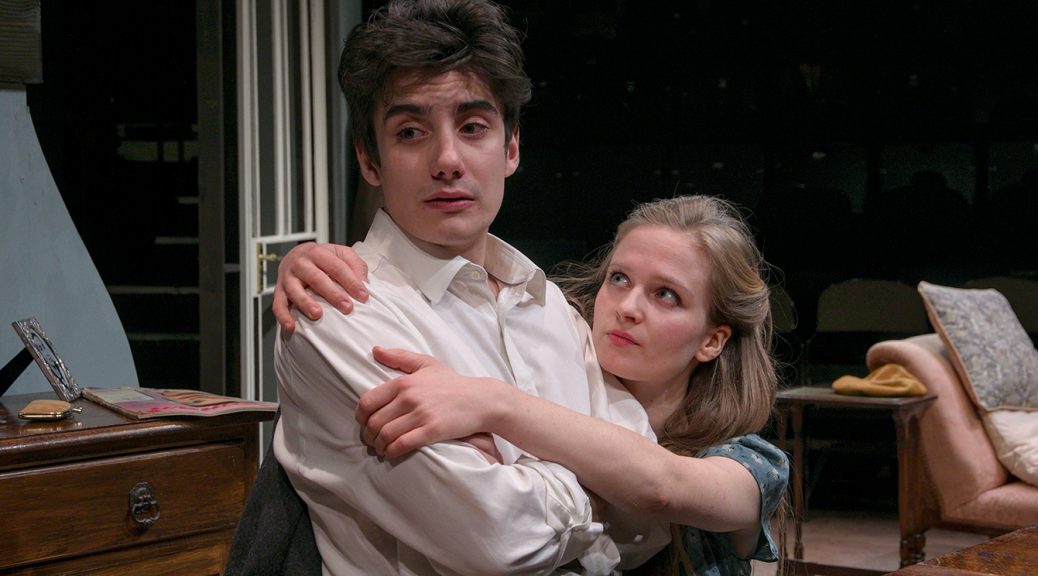
A quality production adds interest to this play by Michael Hastings, despite its flaws. Written in 1956, Don’t Destroy Me is a family drama and coming-of-age story that reveals a society undergoing change. There’s plenty going on but, unfortunately, what really ends up fascinating is the young playwright’s struggles with his script.

While it is worthwhile to see kitchen-sink concerns via a working-class Jewish family the perspective isn’t elaborated on very much. And while there are interesting characters – that are well performed – it isn’t clear whose story this really is. The script lacks focus, and even strong direction from Tricia Thorns cannot add this.

There is no doubt you’ll enjoy the performance from Paul Rider as the patriarch with problems, Leo. Symbolic of his generation, he is “busted up by war”. But neither his story of immigration, his loss of faith, nor his self-medication with alcohol, are explored enough. Leo is in a loveless marriage with Shani, whose affair with her neighbour George (made superbly sinister by Timothy O’Hara) is an oddly open secret. Rider gives an emotive performance but it’s hard to feel for Leo. I wonder if Hastings disliked his creation?

Into this unhappy family arrives Leo’s son, Sammy, who has been living with his aunt. Is this our hero? The role marks a professional debut for Eddie Boyce who can be proud of their performance. But the character puzzles. We know teenagers can be tempestuous. But Sammy’s rebellion arrives too swiftly. And his loss of religion, seemingly at the moment a Rabbi he requested to meet arrives, is baffling. A lot rests on Sammy’s shoulders, and Boyce does well. But the writing isn’t strong enough. Maybe, here, Hastings was too close to his character?

Sammy isn’t the only odd one in the house. Upstairs are a mother and daughter through whom Hastings highlights mental health. Again, there’s strong work from the cast. Nell Williams plays the young Suki and makes her endearing. Alix Dunmore takes the part of her mother and works hard, carefully dropping the character’s posh voice when under stress. But the serious problems both have are handled frostily. There’s even the suggestion they’re faking. Articulacy battles with how serious these delusions are. Then Suki inexplicably transforms into a voice of wisdom for Sammy, which left me scratching my head. Both women are exaggerated so that they appear eccentric rather than troubled. Their lyrical dialogue is so laboured they become tiresome.

Considering what’s going on in this boarding house, Don’t Destroy Me should devastate any residual nostalgia for 1950s. The work might well have been shocking when it was written. But how much credit should Hastings get for that, now? The play fits neatly into a history of post-war theatre and is interesting for a social historian but is dramatically unwieldly and unrewarding. I’m grateful to have seen it, and everyone involved has done a good job. But I can’t recommend it to others.

Until 3 February 2024

www.arcolatheatre.com

Photo by Phil Gammon

“The Good John Proctor” at the Jermyn Street Theatre

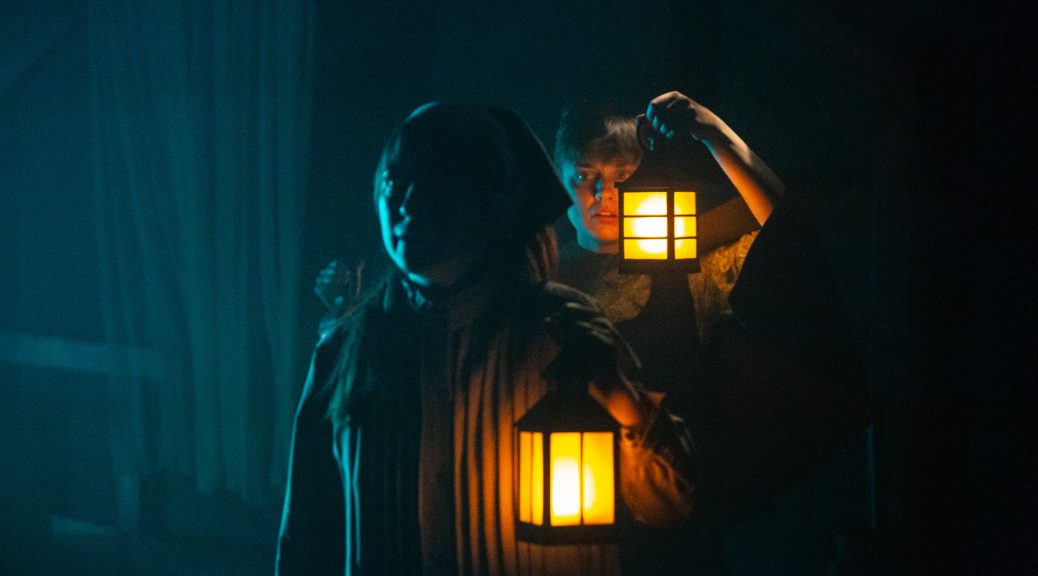
Part of the Footprints Festival, curated to showcase new talent, Talene Monahon’s play is inspired by Arthur Miller’s The Crucible. With events set before the Salem witch trials, it is a prequel, of sorts, but might be best thought of as a dialogue with Miller’s classic. And a clever conversation it is too. I’m not sure The Good John Proctor stands on its own – you do need to know about its context. But it comes close and deserves praise.

There are only four characters here – Abigail, Betty, Mary and Mercy. They are performed by Anna Fordham, Sabrina Wu, Lydia Larson, and Amber Sylvia Edwards respectively. Each performer succeeds in making the roles their own. Being younger (then, in a final epilogue scene, older) they are not quite Miller’s creations. The key move on Monahon’s part is to focus on the girls’ youth.

The action unfolds before the characters come to be used by the wider community for profit or vengeance. Monahon benefits from her focus. We see ideas about sin and the supernatural impacting these young lives. And how anxieties about growing up, physically and emotionally, take their toll. There is more – to increasingly powerful effect- as it becomes clear how the girls suffer under the men in charge of them. There are whippings and servitude to consider. The titular hero of Miller’s work becomes a sinister figure. It all gives rise to an atmospheric production, complete with spooks and whoops, thanks to director Anna Ryder’s strict handling of the swift, sharp scenes and some bold design from Laura Howard and Bella Kear.

There’s an interesting decision about language. Rather than getting bogged down in seventeenth century America, there are touches of the modern high school behind how the girls speak. Hearing “what’s up kids” jars – but it is effective. The technique might be more consistent (maybe more extreme?). But the only problem is that it takes a while to appreciate that it works.

Using speech outside the historical period is important when considering another part of Monahon’s project – examining the girls’ reputation in history, including the legacy of Miller’s play. An intriguing address from Mary, who describes herself as an “ancient child”, with the house lights raised, needs elaboration but is thrilling. Far from being in awe of its source, Monahon has challenges for Miller’s play. Part of this conversation is an interrogation – one that is delivered smartly and with dramatic effect.

Until 27 January 2024

www.jermynstreettheatre.co.uk

Photos by Jack Sain

“Exhibitionists” at the King’s Head Theatre

A new year and a new theatre! The new home for this stellar fringe venue, pretty much behind the pub it takes its name from, is a great start to 2024. And it is commendable that the inaugural production is a new play, written by Shaun McKenna and Andrew Van Sickle. The piece can be generously described as safe – a romantic comedy (of sorts) with an eye on the LGBTQ audience that the King’s Head Theatre admirably serves.

The aim is light entertainment, the inspiration (we’re told) screwball comedies from the 1930s and 40s. There are touches of Alan Ayckbourn too, but the play might best be thought of as an openly gay version of Noel Coward’s Private Lives. These are solid sources and the idea of updating them isn’t bad. Maybe it shouldn’t surprise that the play doesn’t live up to them… it’s a big ask after all.

Ex-lovers, Conor and Robbie, who meet again at an art exhibition, had long experimented with an open relationship. They run off together, leaving their new, younger, boyfriends Mal and Rayyan bereft, before a predictable and improbable ending. The problem isn’t that we can guess what happens next – it’s that the dialogue doesn’t sparkle. There’s little wit and the jokes are lacking.

It’s interesting that the younger characters are better written. Or maybe they are just more interesting? At least, it’s a neat point that they behave less like children than the older men. But it’s a shame some less savoury points from McKenna and Van Sickle’s old-fashioned inspiration have been retained – Conor and Robbie’s attitude to waiting staff and the domestic violence in the play do not sit well with trying to make people laugh nowadays. To be fair, there are some attempts at satire that are topical. An unhappy role for a Norwegian hotelier (performed valiantly by Øystein Lode) and new age therapy (using a spoon!) should be easy targets. And Instagram of course. But there isn’t enough originality here and the jokes continue to be poor.

While the play itself leaves a lot of be desired, praise is deserved when it comes to the production. The five cast members all have a tough job but each manage to make their lines light, even when the jokes don’t land. Ashley D Gayle and Robert Rees convince as a couple who have known each other a long time, even if it is hard to care about their characters. Rolando Montecalvo and Jake Mitchell-Jones both have a clear idea of what the piece is trying to do, even if the material limits them. Credit to director Bronagh Lagan who keeps the action tight, touches of farce are handled particularly well, and ensures the show at least has the energy that the script lacks.

Until 10 February 2024

www.kingsheadtheatre.com

Photo by Geraint Lewis