
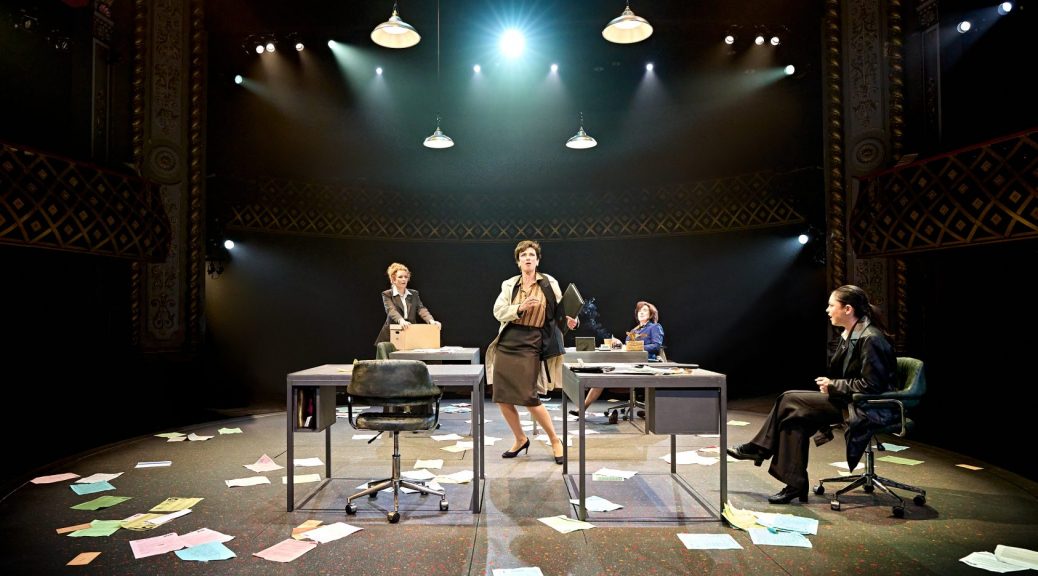
This revival of David Mamet’s play will probably be remembered for its all-female casting. It’s a first – prominently advertised – and the twist is oddly appropriate to writing so obsessively focused on masculinity. The story of real estate salesmen, ruthless and desperate in equal measure, is made stranger, uncanny even, by director Patrick Marber and his performers. Yet, unlike the very best revivals, this production adds surprisingly little to an appreciation of the piece.
To be clear, the cast is excellent. There’s Dorothea Myer-Bennett as office manager John, revelling in the bureaucratic power over the leads that help sales. Frustrated Dave and insecure George, played by Niky Wardley and Nancy Crane, are both in danger of losing their jobs because they cannot close sales. And Shelly ‘The Machine’ Levine, one of Mamet’s most powerful creations, inspires one of Indira Varma’s finest performances. Shelley is paired with former protégé Roma, played by Rosa Salazar, whose strong portrayal helps establish a bond with Levine that is one of the few humane relationships in the show.
The cast revel in roles they surely never imagined they would get the chance to play. They embrace the absence of anything appealing about the characters – that is Mamet’s point. Marber doesn’t shy away from the ugliness of the business, and Salazar is particularly strong at showing it (the deal with a gullible client, played by Mercedes Bahleda with great reserve, is particularly uncomfortable). Yes, you can recognise the salespeople; Varma even allows you to feel sorry for Levine, and Crane creates sympathy, too. But with so much greed on display, no matter how accurate Mamet’s analysis, Glengarry Glen Ross is not an easy watch.
Being uncomfortable is part of the intention, of course. These salesfolk aren’t super successful and you can pity them. They are exploited, too, by the offstage owners Mitch and Murray, who Mamet makes so vivid. If the argument is laboured, it doesn’t feel dated. The play’s observations on capitalism and morality, made by many, are as valid as ever. But for all the skill, the production has a problem. The casting won’t convert anyone to the play. Of course, it doesn’t have to, as the show stands strong. But this is an unpleasant piece you’ll either love or hate – nothing has changed on that front.
Until 18 July 2026
Photo by Manuel Harlan