
Tag Archives: Richard Lynson

“Safe Haven” at the Arcola Theatre

Documentary dramas are a challenging genre and this valiant effort from Chris Bowers cannot be considered a full success. Let’s start with what works. Bowers provides a history of the invasion of Kuwait, Saddam Hussein’s persecution of the Kurdish people and the international intervention to aid them. As well as being an important subject, the events are described in detail and from several perspectives. All good. 

The credentials behind the show are impressive. Bowers is a former diplomat and Consul General in Iraqi Kurdistan. And he used the memoir of one of his characters alongside his considerable knowledge. It is a lot to condense and, to the script’s credit, a sense of individual voices is preserved. The action is clear – a big achievement – aided by the capable direction of Mark Giesser, who makes the most of designer Jida Akil’s split stage. 

It is when we get to the drama that we encounter problems. There’s so much exposition that the dialogue is clunky and characterisation suffers. The frightfully posh chap from the British Foreign Office, beautifully spoken by Richard Lynson, ends up looking stupid. And that can’t be fair. Surely he would appreciate the problems of dispatching aid by air (I’m not sure even the audience needs it explained)? It’s the same for the American General (again, great accent work from Stephen Cavanagh) who you can almost hear thinking. The play’s heroine, Catherine, suffers too and that’s a real shame for Beth Burrows, who has a great go at expressing how awful events were. Trouble is that the disappointment with everyone around her comes across like reading a poor prep school report. When she gets to lay down the law, she does so like an Eton Dame. Maybe that’s accurate and a good way to deal with these fellows, but it doesn’t work on stage. And when it comes to a scene explaining the play’s title it’s just too much like the characters are doing a crossword. 

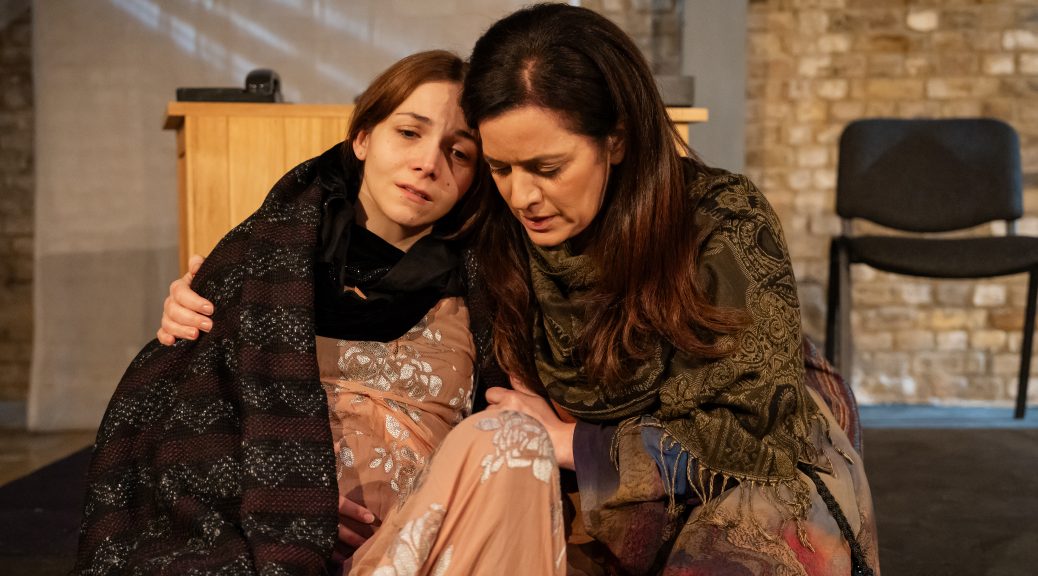
Thankfully, the Kurds in the piece are more engaging. They have a more emotive story, of course, but it is handled sensitively and without sensationalism. Eugenie Bouda and Lisa Zahra make an inspiring pair as they cross the mountains searching for safety. Similarly, a second heroic figure, Dlawer, who campaigned for his people while a doctor in London and then searched for his sister back in Iraq, is thoroughly admirable. The performance from Mazlum Gül (who also impresses with a second role as UN Ambassador Al-Tikriti) is a highlight. There’s a strong blend of reserve, determination and passion in the character that reflects the piece’s strengths. Safe Haven is admirably even-handed and well-intentioned, but it doesn’t quite work as drama.

Until 7 February 2026

www.arcolatheatre.com 

Photo by Ikin Yum 

“The Devil May Care” at the Southwark Playhouse

Mark Giesser’s adaptation of George Bernard Shaw’s 1897 play, The Devil’s Disciple, is interesting, if flawed. The action is moved from Revolutionary America to the Philippine-American War which started at the turn of the 20th century. It’s a period of history I confess is new to me but parallels with the British Empire and American interventionism, which I’d guess Shaw would like, are thought-provoking.

There are moments when Giesser’s treatment is brash. Scenes that show politicians campaigning share a tub-thumping quality the writing is trying to criticise. And a satire on the American press abroad is too shouty to be funny. But Giesser’s own direction makes the action clear. And the cast members get to show their strengths taking on an awful lot of extra roles. Richard Lynson, who performs as a vicar and General MacArthur, deserves highlighting, brilliantly switching characters and bringing out intriguing parallels.

The idea of changing the setting doesn’t detract from Shaw. So, how much you enjoy the show will depend on how you feel about the original. The piece is a family drama, a romance, and a moral conundrum all mashed up. Plenty to enjoy or too much of a mix seem equally valid responses. And it all arrives at speed, with many of the characters’ reactions rushed and plenty of the paradoxes Shaw liked to underscore on offer.

The Conroe family who the action revolves around are a (too) strange bunch, pretty much all unlikeable. The mother and one son, who is in the military, seem happy following a plan from the black sheep of the family, Richard, to take the place of the vicar and be executed for helping local rebels. The fact that motives are vague is partly the point. The dark humour around the situation builds – the scene of Richard’s kangaroo trial is good – but the production isn’t quite witty enough overall.

Giesser has the sensible idea of emphasising the strong female roles so that Jill Greenacre, as a formidable matriarch, has some good lines. And a biracial step-niece is a role managed very well by Izyan Hay, who makes the most of her character’s brief backstory. There are problems for Beth Burrows as the vicar’s wife, though. Making her a lawyer who cannot practice because she’s a woman is a complication too far (bear in mind she is English yet dealing with American martial law).

Burrows is also the show’s love interest – a further tricky call. It’s a little odd, or maybe Shavian, that the struggling marriage is more interesting than the new romance we see. Burrows gets more sense of emotional conflict into one short scene with her husband than anyone else manages in the whole play. Her character’s potential affair is with Richard and may – or may not – be a motive for his self-sacrifice. It’s really only with Richard, who gives the original play its title, that the show comes together. The self-proclaimed Satanist, an arms dealer and general ne’er-do- well, makes a great role for Callum Woodhouse, who brings neat touches of understatement to the part: he is funny, charming but also biting and cynical. Woodhouse carries the show. Shaw’s philosophising villain is fascinating but, regrettably, not quite enough to save the night.

Until 1 February 2025

www.southwarkplayhouse.co.uk