Tag Archives: Rajiv Pattani

“Darkling” at the Bush Theatre

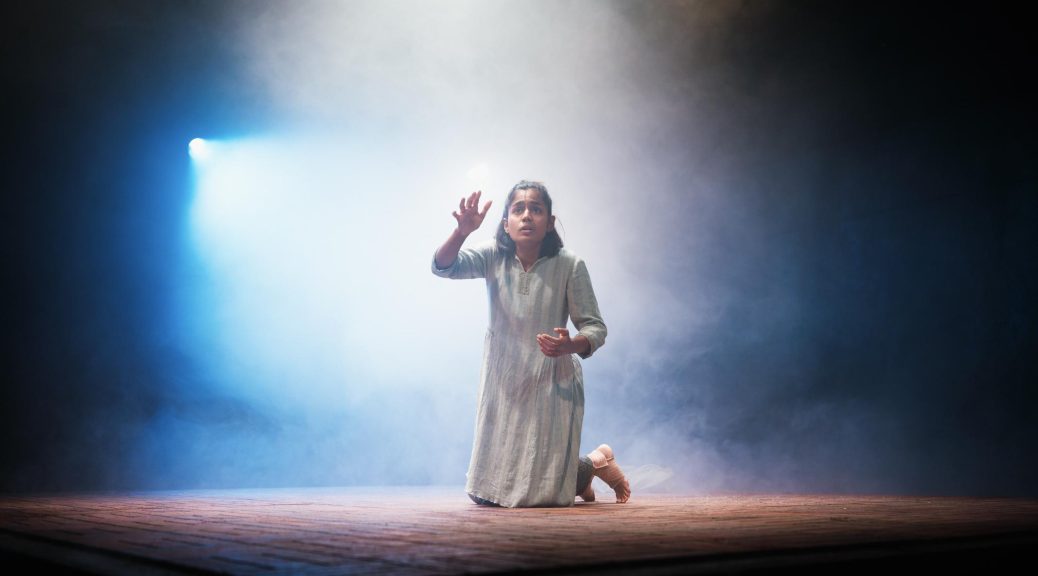
Titas Halder’s play tells the story of the Bhopal chemical disaster through the experience of one nameless character. Giving this woman, from one of India’s lowest castes, a potent voice and focusing on her in such detail is stirring. At first, the poetry used to describe her difficult life includes moments of childhood joy and chances for a better future. The vivid descriptions are strong on colour and the sense of touch.

This is a huge role for one performer, not least as 90 minutes is a very long monologue. Taking on the challenge, Linnea Berthelsen secures respect but, unfortunately, there are moments when she does not do the script justice. The delivery is sometimes rushed, repetitious and, perhaps, nervous. Performing as a wide-eyed child, the naivety comes close to grating. And some of the script, especially at the end of a thought, is hard to hear, which is frustrating.

Berthelsen gets a lot of help. Matthew Xia’s direction is unflinching, embracing the brutal realities of the piece. The minimal set and lighting design, from Simon Kenny and Rajiv Pattani, are strangely beautiful, and the use of dry ice is particularly effective. Berthelsen also improves as her character grows up. Scenes of the disaster are done well, while her life afterwards – difficult to comprehend let alone perform – is depicted with a passion and skill the actor should be proud of.

The aftermath of the chemical spill gets relatively little time, but is uncomfortably intense. After a miscarriage, there is also a stillborn baby. The question arises: is that the depth of the cruelty here? It isn’t just what happens to this woman or her fears for the future we are asked to face. It is the destruction of hope. It’s a bold move for a playwright. And while it risks being simply bleak, Darkling carries that danger proudly.

Until 24 October 2026

www.bushtheatre.co.uk

Photo by Alex Brenner

"Hunger" at the Arcola Theatre

This adaptation of Knut Hamsun’s 1890 novel has clever moves and clear decisions. As we follow its starving character, a student and writer who struggles as a “loser and misfit” in a big city, the direction from Fay Lomas has smart touches. The staging is inventive, the design by Anna Kezia Williams and Rajiv Pattani well used, while tight choreography creates considerable momentum. Pain is effectively portrayed, and highlighting the mental health problems that arise from malnutrition proves enlightening. A case that this tale of a down-and-out could occur any time and any place is obviously the point. Lomas works to show just that – and it’s a job well done.

There’s no doubt the piece serves as a brilliant showcase for a talented quartet of performers. Archie Backhouse, Katie Eldred and Jessica Tomlinson act as the population of a whole town; they cannot fail to impress as you lose count of the ages and accents depicted. They even manage to make a few named characters vivid, despite the brevity of the roles. With the unnamed lead, Hunger makes an exciting vehicle for Kwami Odoom who brings a great presence to the stage and intelligent responses to his task. It’s a thrill for the audience too – there’s a sense of seeing a big talent for the first time and the hope we’ll be able to boast about it one day!

Kwami Odoom in Hunger at the Arcola Theatre photographed by Alex Brenner
Kwami Odoom

Much of the production’s clarity comes from Amanda Lomas’s adaptation. For a plotless novel that explores psychology through a first-person narrative, her decisions seem sensible, if conservative. Unlike Hamsun, Lomas provides a hero for us to focus on – the play’s lead is far more sympathetic than in the book. The most distressing and controversial scenes are passed over: the character chews on orange peel rather than a bone and his relations with women are made less problematic. We’re given more background, a sense of his age and a more carefully chartered descent into poverty that work well dramatically and serve a broadly political purpose.

Lomas has created a more even experience than that of reading the book. She has an eye on an audience rather than an existential axe to grind. Hamsun was obsessed with pride and religion – both have a small part here as they don’t fit with the programme. And it has to be admitted that there’s a disappointing lack of intensity for a novel famed for just that quality. The character’s ego and his rants against God end up a little lost. Thankfully, it’s possible to argue that the production’s aims are served by toning both down. We’re presented with a story about poverty made universal and powerful by theatre makers with a strong sense of purpose.

Until 21 December 2019

www.arcolatheatre.com

Photos by Alex Brenner