Tag Archives: Mason Alexander Park

“Oh, Mary!” at the Trafalgar Theatre

Revising history has never been as much fun as this ridiculous reimagining from Cole Escola featuring Mary Todd Lincoln in the days before her husband’s assassination. The huge Broadway hit is a hoot – who knew the president’s wife used to be a showgirl? The former cabaret star is now a frustrated first lady and, to distract her Abe hires an actor to give her drama lessons. A romance starts, but Mary loses her lover. And her mind. Actually, that went long ago.

Mary is a monster, albeit an appealingly vivid one. Her flaws make her sympathetic and the lack of self-pity is refreshing but, make no mistake, she is every vice combined. This is a tremendous role that exercises every comedic skill. For this London premiere, Mason Alexander Park makes the most of Mary, refusing to hold back and getting to show off their voice in the startling – hilarious – finale.

While Escola has written a great star vehicle, smaller roles, such as Mary’s chaperone or her husband’s assistant, allow Kate O’Donnell and Oliver Stockley to also shine. The always excellent Giles Terera plays Lincoln and, while the play just calls him ‘Mary’s Husband’, he gets time in the spotlight. Terera scores a lot of laughs at Lincoln’s guilt about being gay – it really is a giggle. Finally, to avoid spoilers, let’s just say there’s a lot going on with that acting tutor. Dino Fetscher is perfectly cast and does a great job.

A lot of the jokes come from the historical figures swearing or having sex – the play is very rude. There are also plenty of gags about alcoholism and depression… and how ignorant Mary is. It’s all rather childish and stupid, so lots of it probably shouldn’t be funny. And I cannot understand why referring to a portrait of George Washington as her mother works so well. It really is a laugh a minute. 

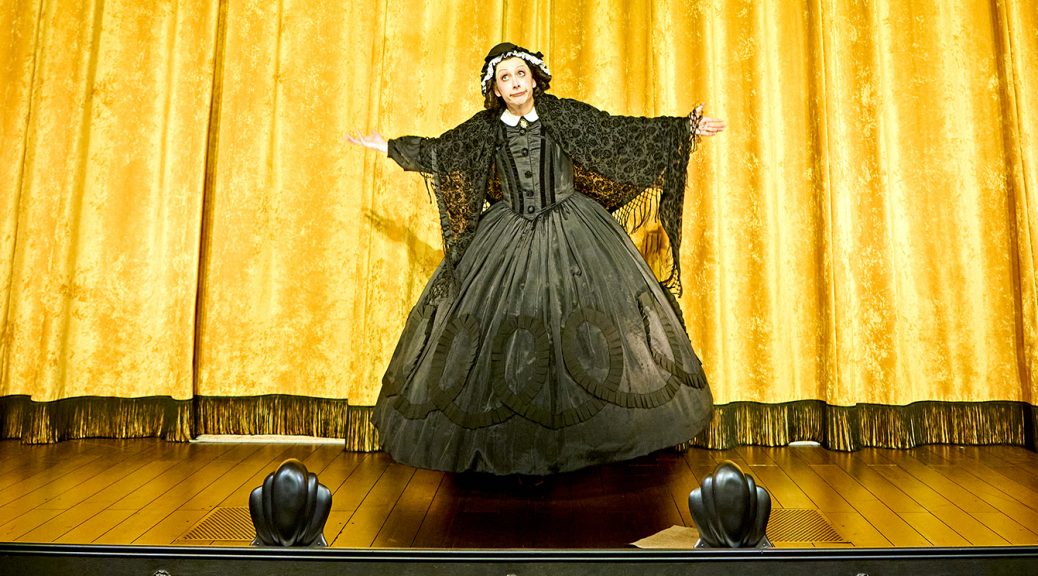
The brilliantly exaggerated movements in director Sam Pinkleton’s production are part of the superb physical comedy. The lighting design from Cha See and costumes from Holly Pierson excel at aiding the humour. Mary’s hoop skirt deserves its own round of applause. 

The theatre itself is a big joke, too. And there’s a challenge here. Leaning into ‘low’ comedy and cabaret, it could be tempting to dismiss the play, especially with its sketch-like structure. But the short scenes end with plenty of punchlines that surprise and have an emotional edge. The action builds nicely to the night of Lincoln’s death – in a theatre, of course. And if you’ve never wondered who shot who, then perhaps you should?

Until 25 April 2025

www.ohmaryplay.co.uk

Photo by Manuel Harlan

“The Tempest” at the Theatre Royal Drury Lane

Director Jamie Lloyd delivers every time. The big draw for his new production of Shakespeare’s late play is the West End debut of Sigourney Weaver as Prospero and, since she never leaves the stage, we get a lot of her. You came for a star? You get a star…

Weaver’s is not the clearest delivery I’ve heard, but it is good. She is a focused presence, often stationary, drawing in energy as her character’s magic controls what’s going on. We never doubt this Prospero’s power – which diminishes tension a little – but Weaver is truly magnetic.

No doubt it’s a thrill to see such famous faces on stage (Lloyd’s career proves as much). But the production has more to offer. There’s a reason actors of Weaver’s status want to work with him: the production is bold, controlled, and has big ideas.

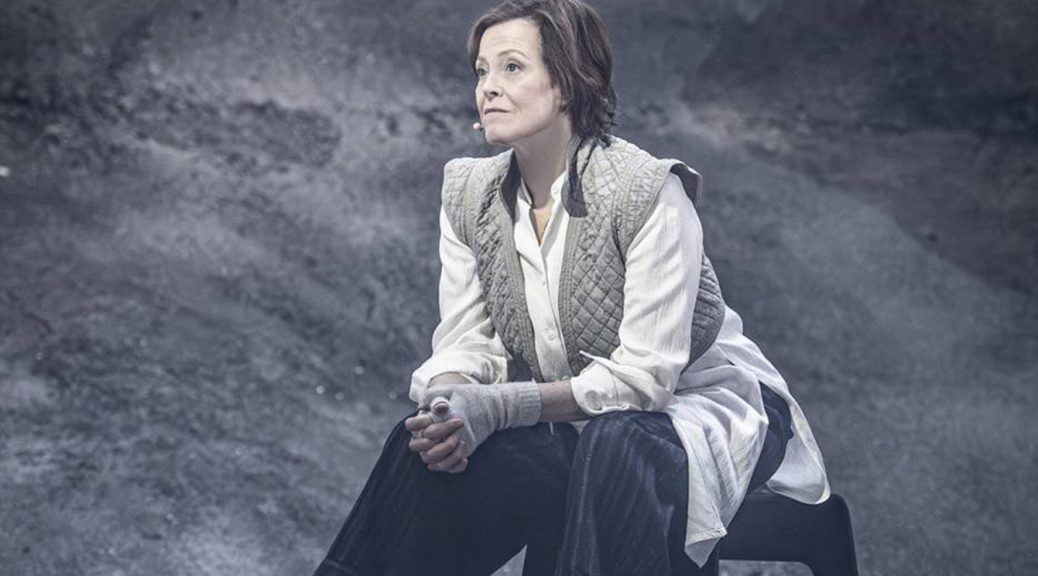
Let’s take the bombastic first; Soutra Gilmour’s set is stunning. Shakespeare hasn’t been staged at the Theatre Royal Drury Lane in a long time and the space, so perfect for big musicals, is huge. Maybe with a nod to Weaver’s movies (although it is described as “barren”) the isle’s setting looks like a moonscape. Gilmour works marvels with huge curtains of gauze. For added drama there’s Jon Clark’s ambitious lighting design including some tricky total blackouts.

The island is, famously, “full of noises”. Sound designers Ben and Max Ringham must have been rubbing their hands at the job. Their work is loud. Too often the amplification is to the detriment of the poetry, but the effects are good and help with the plot. The Ringham’s are also co-composers to a score from Michael ‘Mikey J’ Asante, available to buy soon I’d bet.

For all the epic feel, the production is emphatically not cinematic. Lloyd knows theatre shouldn’t compete with film – it has something else to offer (that’s his point when he uses live recordings). There are good old fashioned theatrical techniques here, including a lot of aerial work for… Ariel!

To further balance the grand touches, this is also a cerebral version of The Tempest. Weaver reflects the thought process behind the grief, revenge, and forgiveness that is going on. And Lloyd points out that much of this is happening in people’s heads. It is the mental anguish Prospero’s illusions creates that are continually emphasised (notably, the joyous wedding masque is downplayed). There’s a focus on choreography, with characters coming forward into a spotlight or circling one another in their confusion. It all looks great. And, often it makes the play easy to follow. But there is a sense that characters are puppets for Prospero… or maybe for Lloyd.

Much of the cast suffer from the stylised staging. The play’s villains merge into one, despite the efforts of Tim Steed and Oliver Ryan. Young lovers (Mara Huf and James Phoon) fade into the background. Like romance, there’s little room for humour so Jason Barnett’s Stephano and Mathew Horne’s Trinculo (always difficult roles) are also lost. Jude Akuwudike and Selina Cadell, as Alonso and Gonzalo, fare better and make their roles unusually interesting.

Mason Alexander Parks in The Tempest
Mason Alexander Park

It’s the characters that are other-worldly that excel. An unrecognizable Forbes Masson takes the part of Caliban; the physicality of his performance is commendable. Mason Alexander Park’s Ariel is particularly impressive, benefitting from the music in the show and its special effects. Affection for Prospero is balanced well with the desire for freedom, giving the character a melancholy touch. And there’s an element of theatricality to this Ariel that is fascinating; they seem to enjoy tricks played and fear induced. Park is the only challenge to Weaver’s dominance and does so well that they may be the real star of the show.

Until 1 February 2025

www.thejamielloydcompany.com

Photos by Marc Brenner