
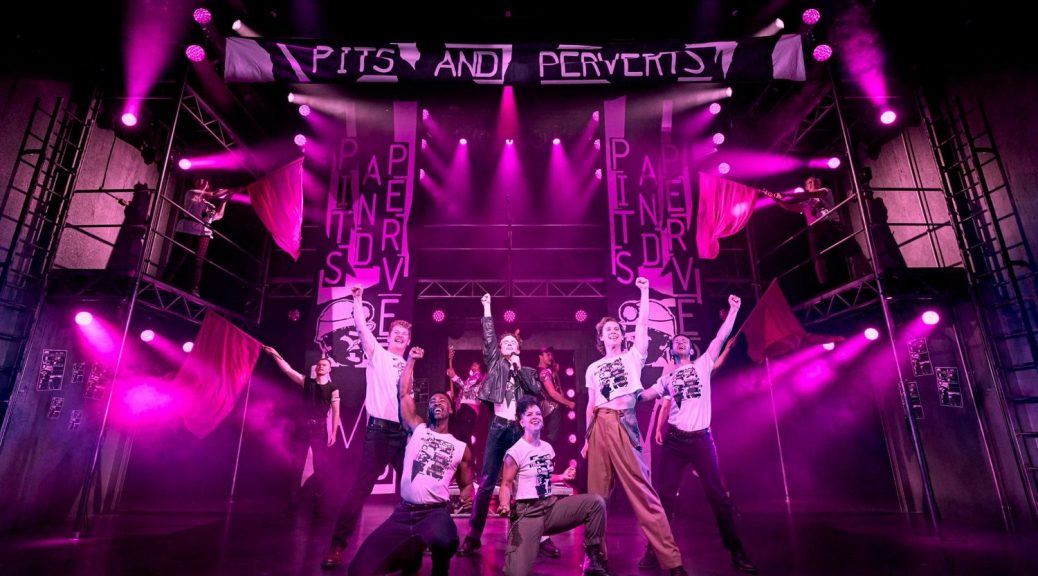
Director Matthew Warchus’ project to turn his 2014 film into a musical makes sense. The true story of the Lesbians and Gays Support the Miners group, which raised funds during the 1984 miners’ strike, has protests and parades, strong characters and political changes. Even better, bringing Pride to the stage adds something special: the music and lyrics by Christopher Nightingale and Stephen Beresford highlight passion and the potential for change in a way only musicals can. After all, shows about revolutions can work remarkably well.
There’s no doubt Warchus gets it. His handling of the action is superb: clear, energetic and capable of delivering both laughter and tears. His staging balances the nostalgia that threatens to overwhelm Beresford’s book, reminding us that these were not easy times for either the LGBT community or the miners on strike. There is less success with the sentimentality that can also be laid at Beresford’s door. Some moments are simply too sickly sweet and pass by too quickly to earn their emotional weight. Overall, Pride is far from perfect, but its characters power it through to deliver impressive results.
The show is slow to get started. The exposition that introduces the period, while necessary, is sure to depress anyone of a certain age and plods along terribly. The piece also drags towards the end, becoming hagiographic in its treatment of its lead, the inspiring activist Mark Ashton. Despite the nuance Beresford tries to introduce, Jhon Lumsden struggles to convey the character’s charisma. There is also a moment when Pride focuses on personal identity to the exclusion of broader politics. It’s nice that the character of Bromley, whose coming-out story provides an effective subplot, gets a strong song, and Lewis Cornay is excellent in the role, but this shift in focus feels uncomfortable and anachronistic.
Other characters fare better. Matthew Durkan has a fine time as the group’s administrator, Mike, giving a strong and effective performance. Courtney Stapleton stands out as Steph, getting a lot of laughs out of her lines. Ensuring plenty of attention is given to the mining community is a smart move and leads to excellent performances from Matthew Woodyatt and, particularly, Sarah Pugh as Siân James. Her vocals are superb and her solo number is one of the show’s strongest moments. Samuel Barnett also has a great time as Jonathan, a role that showcases his considerable talents. Jonathan’s flamboyance has a clear political purpose – he gets the first truly memorable musical number (although the wait for it is too long), and Barnett’s performance is fantastic.
The lyrics have a humour that could be encouraged; the jokes are the best moments. There’s a pleasing variety to the score, helped by the subject matter, and while ‘Bread and Roses’ is always going to steal the show, the arrangement demonstrates real skill. It’s a shame that the biggest numbers rely so heavily on their performers, as the songs themselves are not quite memorable enough. Lizzie Gee’s choreography disappoints, while Bunny Christie’s set may be too simple. Many audiences will want more from a musical, and it’s easy to spot where a few banners could have been added. At least we get flags.
Warchus brings an energy to the show that is contagious. Pleasing the crowd is an aim, but so is doing justice to the source material. Reaching a wide audience without compromise is tough and occasionally results in clunky storytelling and a few cheap jokes. But the real-life material remains compelling and, although the score never quite makes the show as inspiring as it aspires to be, there is enough humour and passion here for all involved to have a lot to be proud of.
Until 12 September 2026
Photo by Manuel Harlan