Tag Archives: DJ Walde

“The Maids” at the Donmar Warehouse

As any of the characters in his new production might say, director Kip Williams is having a moment… and I’m here for it. Following a thrilling go at Oscar Wilde (and aren’t we all excited about Dracula next year?), this is his new version of Jean Genet’s 1947 play. There are problems – maybe concessions would be a fairer description – but The Maids is stylish, intense and intelligent.

That moment Williams is having is very now. Achingly so. The play is frequently changed (Jamie Lloyd’s version also “updated” the action), but here the Madame from Genet’s play could have walked in off the streets outside the venue. She is transformed into a social media fashionista influencer. Her titular staff are still poor sisters and they still want her life, but it’s a life online that they crave. So, a lot of Genet’s interest in power, particularly class, takes a different direction and is, perhaps, even lost. The religious overtones in the “rituals” the maids perform struggle for potency.
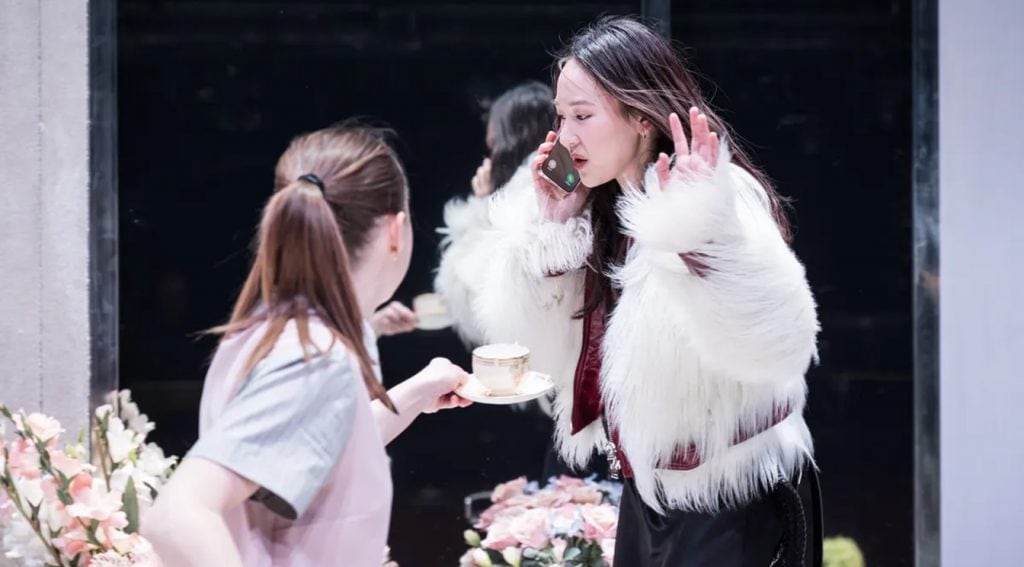
Yerin Ha as Madame in The Maids at the Donmar Warehouse
Yerin Ha as Madame

Instead, Williams goes for satire. And, of course, he has plenty to aim at with his new Madame and her followers. This is a strong performance from Yerin Ha as a spoilt rich kid who is breathtakingly solipsistic and easy to hate. It is to Ha’s credit that we sense the pressure her character is under (even if we think it is silly). There’s a similar doubt about the sisters. How serious or dangerous are they? Their bond to Madame is hard to explain and a plot to murder her (Genet’s initial inspiration) almost disappears. 

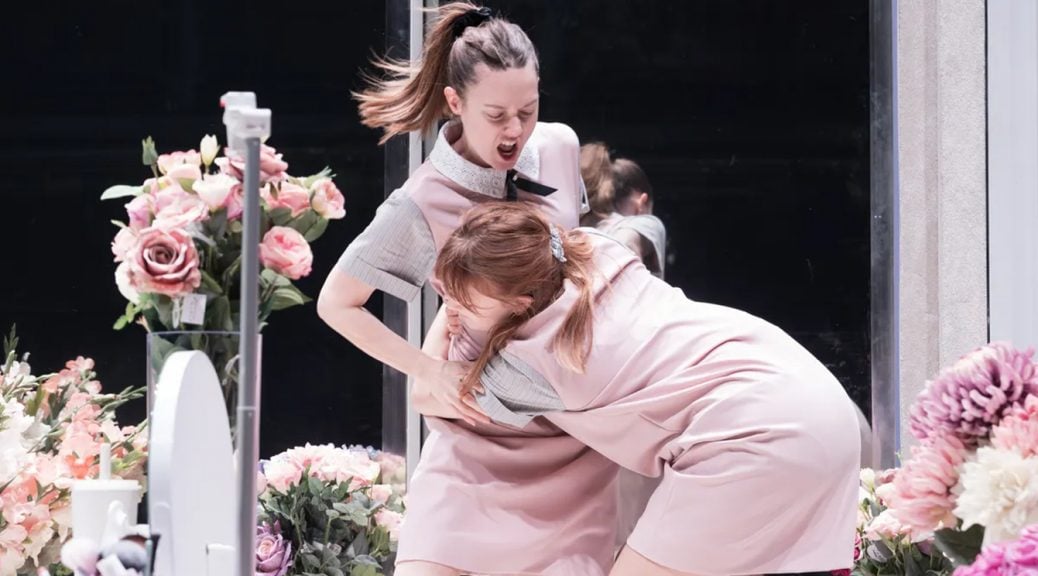
Williams focuses his efforts on the language that Phia Saban and Lydia Wilson, who take the titular roles, handle marvellously. Mixing Genet’s flowery, morbid, somewhat suffocating vocabulary with a lot of swearing and contemporary slang is a bravura achievement. The script creates a vivid alternate reality that’s far more intoxicating than anything online. It is here where we see how crazed the sisters are, trapped in their imaginations as much as their employment.

This is a script I really wanted to read. And it is frequently funny. The humour throughout is great (Saban is particularly strong) and, if tension is lacking, despite excellent music from DJ Walde, it is still compulsive viewing. Williams’ direction is sure. Despite the one-room setting, the play is never static. There’s a lot of looking at phones and filters, but projecting these on to the mirrored doors of Madame’s wardrobe is a brilliant move from set designer Rosanna Vize. Darker moments are lost, and it seems fair to question this decision. But it is surely a knowing sacrifice in a play that is executed superbly.

Until 29 November 2025

www.donmarwarehouse.com

Photos by Marc Brenner

“Bacchae” at the National Theatre

After taking up the toughest role in theatre this spring, Indhu Rubasinghams first show as artistic director of the National Theatre is a production under pressure. There’s a lot of thought behind it – choosing a Greek tragedy is a smart nod to the National’s past and perfect for the Olivier Theatre. Presenting a version – a “new play” – is important, too. There’s much to praise but it’s a shame that, although there are triumphant moments, Bacchae is not a triumph.

From the start, the show looks great, with fantastic puppetry representing a wounded horse. The set and costume design from Robert Jones aid Rubasingham’s clear direction and make the most of the venue. Oliver Fenwick’s lighting is ambitious and, more than once, breathtaking. The fight scenes are great. The music and sound design (DJ Walde and Ben and Max Ringham, respectively) distinctive and atmospheric. Rubasingham is clearly loving her new playground and uses it expertly – who doesn’t love a revolve?

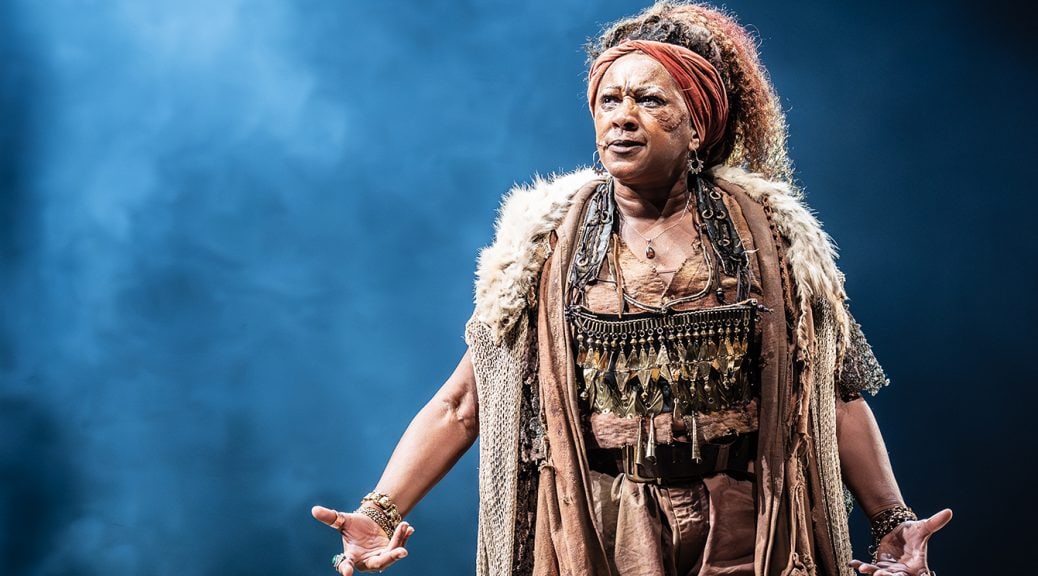
Bacchae is also well acted. There are strong performances from James McArdle and Sharon Small as the doomed Theban royals, showing the script’s savagery and humour. The star of the show is Clare Perkins, who plays Vida, Dionysos’ adopted mother, with ferocious energy and violence while also showing the affection the character has for the man she raised. Perkins is ably supporting by the titular troop who, despite their number, work hard to bring out distinct characters. As the half-God himself, Ukweli Roach brings a lot of bling but runs into problems from the script.

As a first play for Nima Taleghani – and the first time a debut play has been performed at the Olivier – the text impresses but is full of snags. The very different kind of Greek chorus is a strong concept, but the execution is clumsy. Other ideas engage… but don’t quite make sense. Take the play’s exploration of freedom: Dionysian liberty comes at a price, which the Greeks knew, and the play can’t ignore, but Taleghani can’t quite bring himself to warn us about it. His Dionysos is too much of a hero, which dilutes a sense of danger. And there’s the status of the god and his followers – described as immigrants, refugees and terrorists. All very topical, but Dionysos isn’t powerless, or poor… and he comes from Thebes.

As for the Taleghani’s language, that’s a success, although using colloquialism and even rap isn’t particularly new. The play is funny – a nice surprise – yet, oddly, the humour doesn’t work when characters try to make jokes. There’s too much profanity in the sense that it becomes repetitive (“bro” and “fam” are also overused). As Dionysos is the god of theatre, reflections on storytelling are suitably smart, culminating in a finale from Vida that it’s hard not to hear as a statement for the beginning of Rubasingham’s tenure. It’s a strong moment, full of passion and commitment. But how provoking it can be is a problem. It shows one reason why Rubasingham’s job is so hard. Challenging the status quo from the most prestigious stage in the country falls flat. When you’re on it – you are the establishment. 

Until 1 November 2025

www.nationaltheatre.org.uk

Photo by Marc Brenner