Tag Archives: Barney Wilkinson

Martin Guerre at the Old Vic Theatre

Billed as an exclusive first look at a new version of the musical by Alain Boublil and Claude-Michel Schönberg, it is easy to see what director Matthew Warchus is aiming for here – and that is usually a good start. His audience is challenged by originality, bold staging, (very French) realism and a serious piece of musical theatre.

The story is simple and familiar: a wastrel steals the identity of a dead friend in the hope of securing a better life. The setting – 16th-century rural France – proves troublesome, with religion, superstition and an obsession with land and wives competing for attention. Possibly, Warchus’s emphasis on just how strange it all is, alongside his focus on patriarchy, is a mistake. At times, there’s an air of The Wicker Man.

For good or ill, a lot sounds familiar. Fans of Les Misérables – and who isn’t one? – will prick up their ears at a few numbers. But Boublil and Schönberg are trying to be adventurous, and the result is interesting. The folk-inspired score, with new lyrics by Annabel Mutale Reed and Paul Hodge, has a martial edge and wants to provoke. The cast have evidently been instructed to deliver power and emotion. They can certainly do that. Liv Andrusier and Shane O’Riordan are good as the leads, while the ensemble is suitably mobbish (pitchforks help).

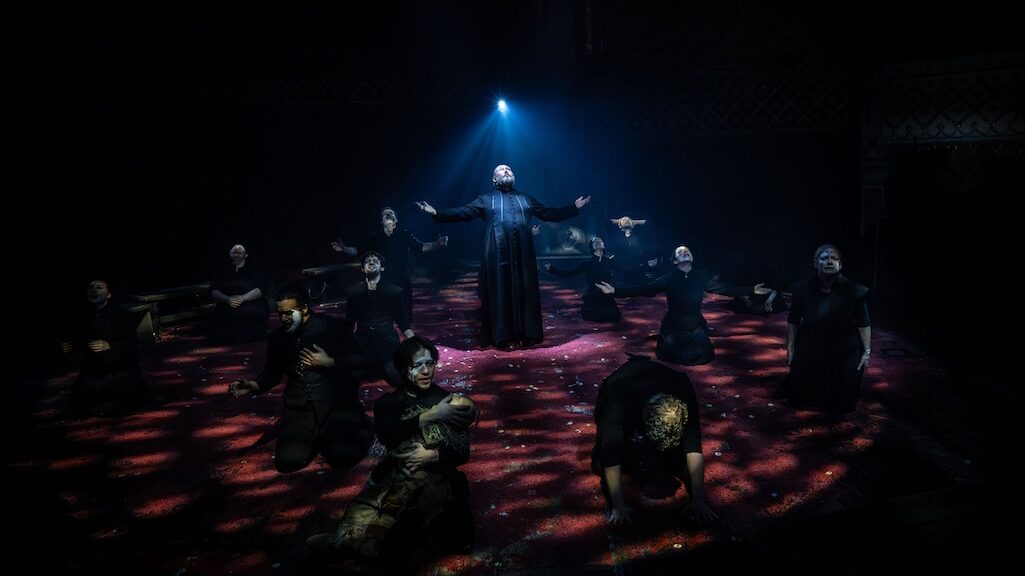
The show is at its best when it comes to staging. A musical in the round is tricky, but when it works, it can be hugely impressive. Warchus’s use of the space is exemplary. The lighting (credited to Hugh Vanstone, Luca Panetta and Toby Ison) is superb, Lizzi Gee’s choreography is strong, and the restraint of Rob Howell’s design is appropriate. I vaguely remember a revolving stage in the original production (and Ian Glenn falling off it). Achieving similar dynamism, drama and energy with seeming simplicity shows great skill.

Martin Guerre still doesn’t work, though. The emoting becomes grating, the menace fails to convince and the lack of humour makes it hard work. Perhaps the biggest problem is the characters. It’s hard to be interested in the OG Martin, while those in charge of the village are flat. Then there’s the thoroughly unconvincing baddie Guillaume. Barney Wilkinson’s performance yields diminishing returns the more violent the character becomes. Finally, there’s Benoit, the village idiot, surely one of the worst roles in musical theatre. No offence to Colin Ryan, who plays him, but the refrain – and accompanying scary puppet – is irritating and pointless.

This isn’t the first time major changes have been made to Martin Guerre. Warchus deserves admiration for his ambition, and there are some genuinely exciting moments. But I’d be surprised if this version changes many minds about the show, or becomes the big hit everyone once expected. It’s a shame, isn’t it?

Until 31 October 2026

www.oldvictheatre.com

Photo by Helen Maybanks

“Cable Street” at the Marylebone Theatre 

Tim Gilvin and Alex Kanefsky’s musical is marked by its ambition. The show, telling the story of the 1936 protest against a fascist march in London’s East End, is big in scope and full of ideas. This comes at a price, and there are snags despite this being the third iteration to be staged. But using the history – indeed, expanding on it to provoke serious thought – and a strong score make this a grand, impressive affair.  

Three strong leads are the focus. Isaac Gryn plays a local Jewish youth, Lizzy-Rose Esin-Kelly an Irish girl and Barney Wilkinson a young man new to London from the north of England. They all cover a lot of ground, sound great with difficult songs and illustrate, effectively, the complexity of the community the action is set in. The really smart move is to include a wannabe fascist among the trio. Giving time to his concerns – his radicalisation, you might say – is a brave move that benefits the show hugely. 

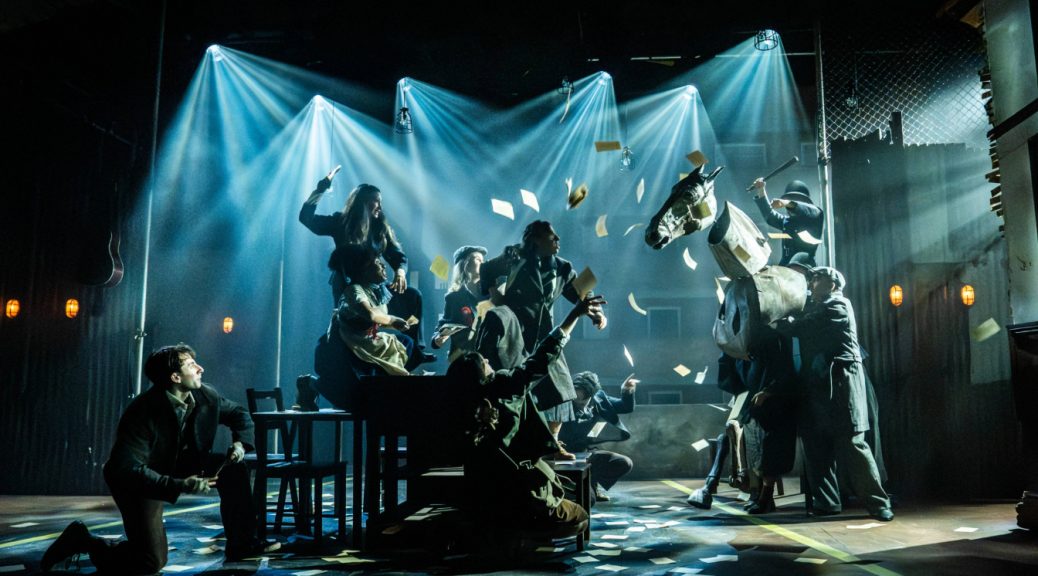
The stories are opened out by a hard-working cast. We get perspectives from each of the younger characters’ families (parents get strong songs) and there are some neat combinations of roles. The cast does a lot of doubling up and, despite its efforts and super-speedy costume changes, this is not always successful. It’s greedy of me, I know, but the production could really do with a couple more bodies. Director Adam Lenson’s work is commendable (he knows the power of a cascading leaflet from his work on Ordinary Days!), but the constant changes left me, if not the cast, a bit breathless. 

Kanefsky’s slightly baggy book is full of great ideas. A framing device of an East End walking tour is good but overused. Similarly, having one of our central characters as a part-time poet has mixed results. And I wonder if it might have been stronger to avoid a romantic subplot altogether? Songs flesh out the story better, and one about newspapers is a highlight (not least for Ethan Pascal Peters and Romona Lewis-Malley as The Daily Mail and The Times). But credit where it’s due: Kanefsky gives us even more after the interval. We don’t just get that famous battle (Lenson does very well here) and its aftermath, but rent strikes in the area are also included. Highlighting another topic that continues to be relevant is a powerful move.  

Most importantly, Gilvin’s music and lyrics are a huge achievement. The score uses all kinds of styles and the words are intelligent and demand attention. There are some wild moments to enjoy: the inclusion of rap and the ‘¡No pasarán!’ slogan from the Spanish Civil War are both excellent, though imagining the BUF as a boy band is hampered by its execution. But the show relies on a collection of solid songs that tap into a current mood of unrest while acknowledging the history of protest. Convinced about the power of musicals, the whole team carries the crowd with it. Cable Street is guaranteed to give you goosebumps. 

Until 28 February 2026 

www.marylebonetheatre.com/productions/cable-street 

Photo by Johan Persson