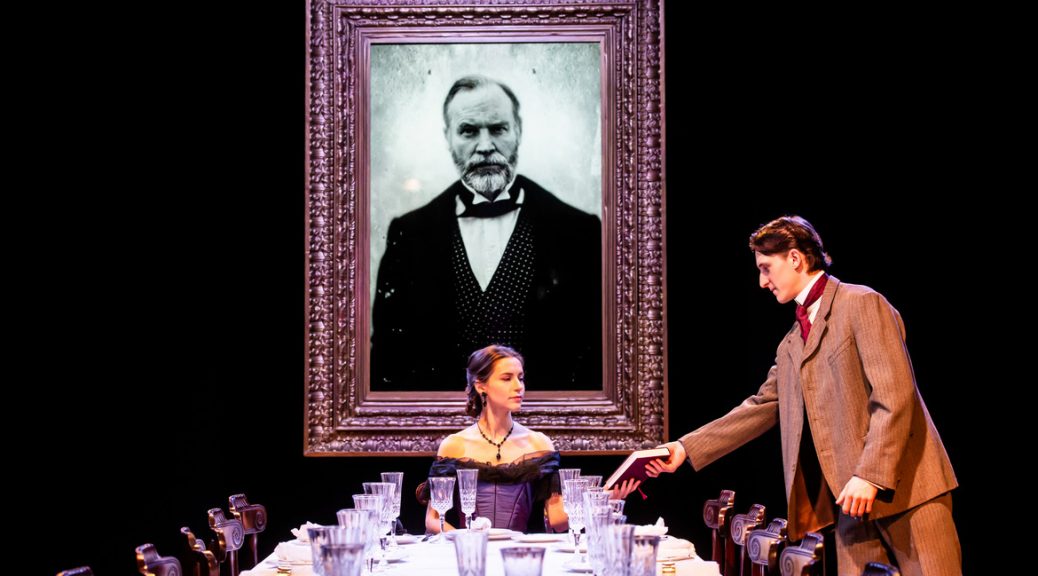
This sophisticated historical drama by Thomas Klingenstein examines Kate Chase, daughter of a presidential wannabe hoping to depose Lincoln during the American Civil War. The history is fascinating and the view of politics as “the art of ‘it depends’” insightful. The show balances romance and political ambitions well, showing how they connect without too much judgement. You might want more or less of the love stories, but the script, and direction from Christopher McElroen, are both admirably controlled.
The Chases, father and daughter, are great roles for Darrell Brockis and Wallis Currie-Wood. Both performers generate sympathy for characters who aren’t particularly likeable, taking the audience on a detailed and enjoyable emotional journey. It is easy to view Kate as “regal but cold”, yet Currie-Wood shows a lot of repressed emotion and gives the character’s self-sacrifice a certain dignity. Brockis has a good line in gravitas, too. I spent a lot of the play admiring this Secretary to the Treasury, persuaded by his humour and humility. But he is also ruthless figure. How much Kate becomes an “indispensable nag” to her father for his own sake, to progress his career, becomes an increasingly open question. And how much she is allowed to make this sacrifice adds further debate. Father and daughter have a lot to work out – if Klingenstein veers a little close to a therapy session at times, their relationship is always layered, intriguing and well performed.
Supporting roles are slightly less successful. Christy Meyer and Haydn Hoskins both do well as Mrs Eastman and General McClellan. But they are too obviously foils for the main characters and don’t convince as romantic interests for father and daughter. That’s partly deliberate – neither couple gets together. Kate’s heart is taken not by the General (an old flame) or her off-stage fiancé, but by Lincoln’s secretary John Hay, admirably performed by Tom Victor. Hay is a poet, and the love of literature he shares with Kate is the sweet basis of their relationship (Klingenstein gets a lot of mileage out of Whitman and Dickens – discussions of Great Expectations are a nice touch until they become laboured.) The wish for a happy ending works well, though, and is touching and thought provoking.
Although the piece is a static affair, the staging is strong. A video screen is made good use of, and McElroen does a great job injecting tension into staging a dinner party. The event is part of Kate’s strategy for her father’s campaign and leads to a fine theatrical moment – a great surprise – when tension explodes. A piece so wordy and cerebral isn’t to all tastes but Our American Queen is a quality affair: an interesting take on Great Men in history providing a valuable perspective with a clear intelligence. Does Kate get her happy ending? Well, it’s a truism that political careers always end in failure. But Klingenstein and Currie-Wood did raise my hopes, and that’s an achievement.
Until 7 February 2026
www.sbf.org.uk
Photo by Lidia Crisafulli